


Let’s get something straight right out of the gate. In my 12 years managing supply chains, rapid tooling, and high-volume production at RAPMAF, I’ve seen thousands of RFQs (Requests for Quote) cross my desk.
Some are from seasoned Procurement Managers at Fortune 500 companies who hand over a perfectly packaged ZIP file with 3D STEP models, fully toleranced 2D PDFs, and a clear Bill of Materials (BOM). I can get those guys an accurate, rock-solid quote in 24 hours.
But then there is the other side of the inbox.
We get a massive influx of inquiries from individuals, DIY garage inventors, and early-stage hardware startups. They attach a JPEG of a hand-drawn sketch on a piece of graphing paper, or maybe a screenshot of a basic shape, and ask: “How much to make 1,000 of these?”
I say this with zero disrespect, but I need to give you the brutal American business reality: We cannot quote a napkin sketch. No legitimate industrial manufacturer can.
If you are a hobbyist just looking to tinker in your garage, this guide probably isn’t for you. But, if you are a serious founder, a purchasing manager stepping into a new role, or a hardware startup aiming to transition from a great idea to a massive commercial rollout, grab a cup of coffee and read this carefully.
I am going to walk you through exactly what you need to prepare before you engage a manufacturing partner, why we demand 3D CAD, how to handle your prototyping phases (10 to 50 units), and how to set yourself up for our true specialty: rapid tooling and injection molding at MOQs (Minimum Order Quantities) of 100 to 100,000+ units.
Let’s get your supply chain dialed in.
Phase 1: The “Napkin Sketch” Reality Check (Why We Need 3D CAD)
The biggest bottleneck in the manufacturing quoting process is a misunderstanding of how modern factory floors actually work.
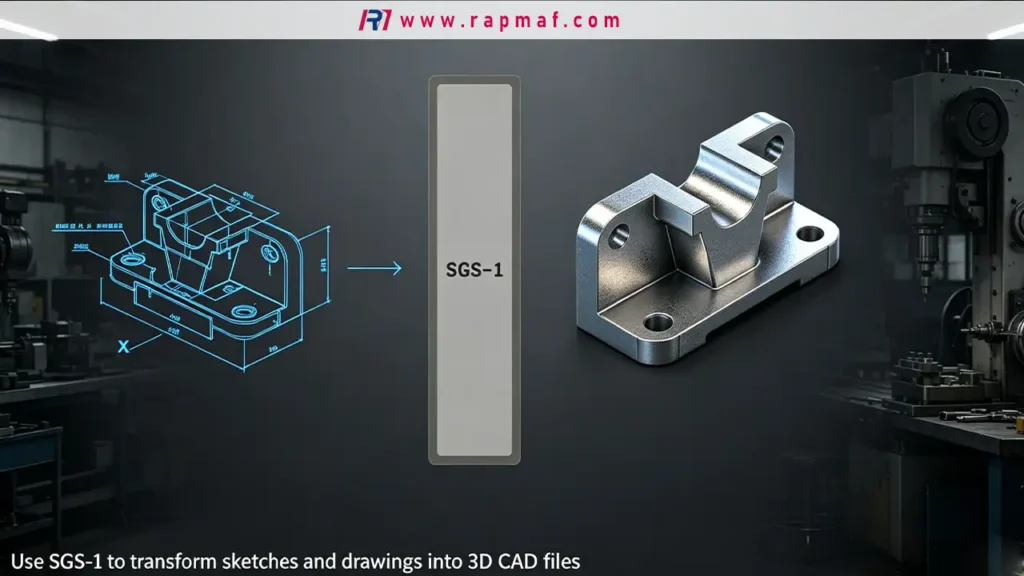
When you send a hand-drawn picture, you are asking a manufacturer to act as your product design engineer, industrial designer, and legal liability shield all at once. If we guess the dimensions of your drawing, machine a part, and it doesn’t fit into your assembly, who pays for the scrapped metal? (Hint: It’s going to be a nasty legal fight).
Modern CNC machines and injection mold tooling centers do not read English, and they certainly don’t read hand-drawn PDFs. They run on G-Code, which is generated by CAM (Computer-Aided Manufacturing) software. That software requires a mathematically closed 3D solid model.
Step 1: Digitize Your Idea
Before you ask any factory in the world for a quote, you must convert your idea into the industry-standard language: 3D CAD (Computer-Aided Design).
If you do not have an in-house mechanical engineer, you need to outsource this step.
- Hire a Freelancer or Firm: Go to platforms like Upwork or Fiverr, or hire an American industrial design firm. Pay a professional mechanical engineer to take your sketch and build a fully parametric 3D model in software like SolidWorks, Autodesk Inventor, or Fusion 360.
- The Golden File Format: When the designer is done, do not let them just send you an
.STLfile (that is only good for cheap 3D printing). You need to demand a.STEPor.STPfile. This is the universal, vendor-neutral CAD format that every industrial machine shop on earth uses to quote and manufacture parts. - The 2D Blueprint: Alongside the 3D model, have them generate a standard 2D engineering drawing (in PDF format). Why? Because a 3D model tells the machine the shape, but the 2D PDF tells the human engineer the tolerances (e.g., this hole must be exactly 5.00mm, ±0.01mm) and surface finish requirements (e.g., anodize matte black).
If you bring RAPMAF a .STEP file and a 2D PDF, we take you seriously immediately. You bypass the “tire-kicker” pile and go straight to the priority quoting desk.
Phase 2: Market Research & The Prototyping Grind (Quantities 1 to 50)
One of the most catastrophic financial mistakes I see bootstrapped startups make is trying to jump straight from a CAD file into a $15,000 steel injection mold for 10,000 units.
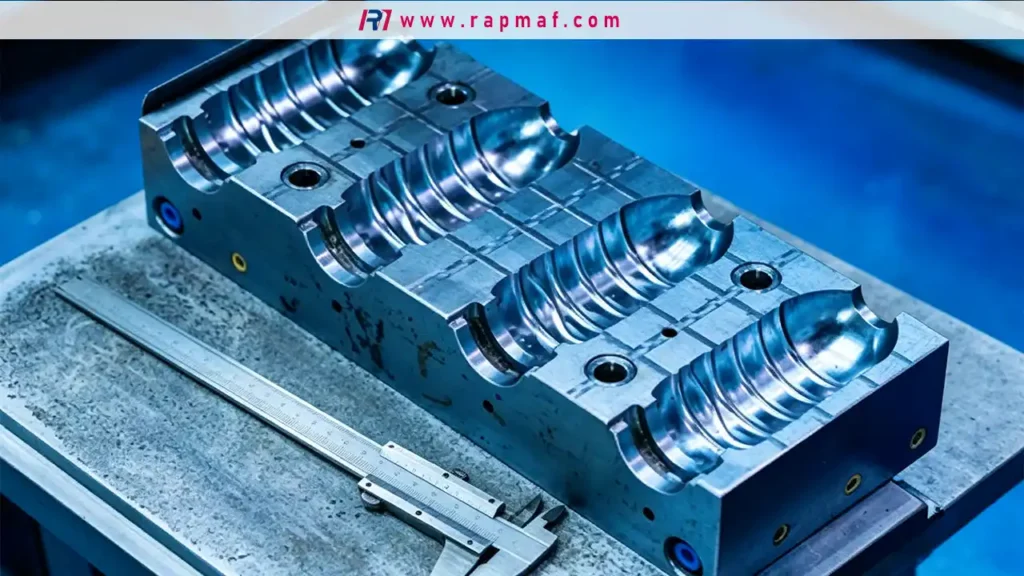
As an engineer, let me save you from bankruptcy: Your first design is going to be wrong. The plastic will be too thin, the clips won’t snap together, or the end consumer just flat-out won’t like it.
Before you come to us for rapid tooling, you must do your homework. You need to validate your market and validate your engineering.
The Low-Volume Hustle
For your initial run (say, 1 to 50 units), you should not be looking at injection molding. You should be utilizing Rapid Prototyping technologies like SLA/FDM 3D printing or low-volume CNC machining.
- The Goal: Put physical, working models into the hands of beta testers, investors, or focus groups. Drop them on the floor. See where they break.
- The Pivot: Take that feedback, go back to your CAD designer, update the
.STEPfile, and lock in the final, proven design.
We can absolutely handle these low-volume CNC or 3D printing prototype runs for you at RAPMAF to help you lock in your geometry. But understand that unit costs at this stage are high because there are no economies of scale. You are paying for engineering time, not just machine time.
Once your market research is done, your beta testers are happy, and you are ready to actually launch a commercial product, you graduate to Phase 3. That is where we really shine.
The Hardware Development & Quoting Matrix
To help you visualize where you are in the pipeline, I’ve put together the standard American hardware development matrix. Find your current stage below to see exactly what you need to be doing.
| Development Stage | What You Currently Have | What You Must Acquire Next | Ideal Manufacturing Method | Target Quantity | Eptahub’s Role |
|---|---|---|---|---|---|
| 1. The Idea | Napkin sketch, cardboard mockup, or basic JPEG. | Hire an ME to create a 3D .STEP file and 2D PDF drawing. | None (Design Phase Only) | 0 | We wait. Come back when CAD is done. |
| 2. Prototyping & Alpha Testing | Initial 3D CAD files. Unproven geometry. | Physical parts to test fit, form, and function. | 3D Printing (SLA/SLS) or basic CNC Machining. | 1 to 10 | We can CNC/Print these to help you test the design. |
| 3. Market Validation (Beta) | Updated CAD. Need parts for investor pitches or focus groups. | End-user feedback. Pre-orders. Market data. | High-quality CNC Machining, Urethane Casting. | 10 to 50 | We produce high-fidelity prototypes to help you sell the vision. |
| 4. The Big Leagues (Scaling) | Locked CAD, 2D PDFs, proven market demand, capital ready. | Rapid Tooling / Injection Molding. | Steel/Aluminum Injection Molds, Die Casting. | 100 to 100,000+ | This is our sweet spot. We build the mold and scale your business. |
Phase 3: Rapid Tooling & Mass Production
At RAPMAF, our core mission is helping you bridge that gap. Once you have locked in your CAD designs and validated your market (as discussed in Phase 2), you are ready for high-volume manufacturing. This brings us to the most critical pivot point in your supply chain strategy: Tooling.
The Economics of the 100+ MOQ
We frequently get asked, “Why is your Minimum Order Quantity (MOQ) for injection molding set at 100 units? Why can’t you just mold 10 pieces for me?”
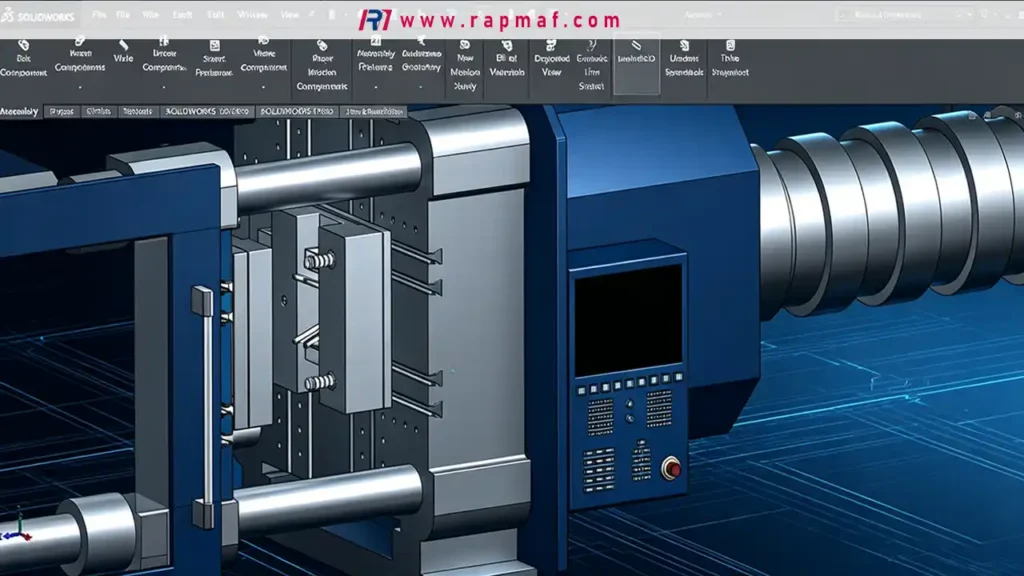
The answer is pure economics. Injection molding requires us to literally carve a negative cavity of your part into a massive block of metal (the mold, or “tool”).
- If we machine a mold for 3,000 USD and you only order 10 parts, you are effectively paying a 300 USD tooling premium on every single plastic part. That is terrible business. You would be better off CNC machining them.
- However, if you order 100 parts, that tooling cost amortizes down to $30 per part.
- If you scale to 10,000 parts, the tooling cost drops to $0.30 per part, and the raw material piece price drops to pennies.
Our sweet spot at RAPMAF is Rapid Tooling. Instead of forcing you to buy a $40,000 hardened steel Class 101 mold designed to shoot 2 million parts (which takes 10 weeks to build), we utilize high-grade Aluminum (like Alumold or 7075-T6) or soft P20 steel.
We can cut a rapid mold in as little as 10 to 15 days. It is incredibly cost-effective, easily survives runs of 100 to 50,000 units, and allows you to hit the market, generate revenue, and prove your business model before you commit massive CapEx (Capital Expenditure) to a multi-cavity production tool.
How to Get Quoted in 24 Hours?
If you want to move the needle and get a professional, comprehensive quote from my engineering team, you need to hand us a complete package. Stop trickling information over 15 different emails.
When you hit the “Request a Quote” button on our site, upload a single ZIP file containing the following four items.
- The 3D
.STEPFiles: One file for every unique part in your assembly. Please make sure the files are exported at a 1:1 scale in millimeters or inches (and tell us which one you used). - The 2D
.PDFDrawings: This is your legal contract with us. It must include GD&T (Geometric Dimensioning and Tolerancing). Call out the critical dimensions, the required surface finish (e.g., SPI-B1 matte, or VDI 24), and any threaded inserts. - The BOM (Bill of Materials): An Excel sheet listing every part, the material, and the color.
- Pro Tip: Don’t just write “Plastic.” There are 80,000 types of plastic. Write “Sabic Lexan 940 Polycarbonate, Black, UV-Stabilized.” If you aren’t sure, tell us the application (e.g., “It sits outside in the Texas sun and takes heavy impacts”), and our engineers will spec the right resin for you.
- EAU & Batch Sizes: Tell us your Estimated Annual Usage (EAU) and your target batch size for this specific order. Quoting a 500-piece batch is a radically different manufacturing strategy than quoting a 50,000-piece continuous run.
Give us those four things, and we will hand you a detailed quote outlining your exact NRE (Non-Recurring Engineering/Tooling) costs, unit prices, and lead times.
Case Study: The Austin Smart-Lock Startup
Let’s look at a real-world scenario we handled for a smart-home hardware startup based out of Austin, Texas.
The Scenario: The founders designed an IoT-enabled deadbolt lock. They had great marketing and $250,000 in seed funding. They bypassed the prototyping phase entirely and sent a local machine shop a flawed CAD file, demanding a 500-unit run fully CNC machined out of solid Delrin plastic to hit a launch deadline.

The Disaster: CNC machining 500 complex plastic housings is incredibly slow and expensive.Worse,becausetheyhadn′tvalidatedthedesignwithbetatesters,asnap−fitcliponthebatterydoorwas0.5mmtoothick.Thepartsarrived,thebatterieswouldn′tfit,andtheentire85perhousing.Worse,becausetheyhadn′tvalidatedthedesignwithbetatesters,asnap−fitcliponthebatterydoorwas0.5mmtoothick.Thepartsarrived,thebatterieswouldn′tfit,andtheentire42,500 batch was scrapped. Their burn rate spiked, and they nearly went under.
The RAPMAF Fix: The lead investor stepped in and pulled us into the project. We forced them to take a step back.
- We 3D printed 5 iterations (SLA) in three days until the battery door clicked perfectly.
- Once the CAD was locked, we didn’t CNC 500 units. We built a single-cavity Aluminum Rapid Tool for $3,500.
- We shot their first batch of 500 units using injection-molded ABS/PC blend. The unit cost plummeted from 85.00downto85.00downto3.20.
They launched successfully, secured their Series A funding, and we are currently running their 25,000-unit mass production orders using a multi-cavity steel tool.
Don’t skip steps. Test your design. Buy rapid tooling. Scale profitably.
Engineer’s FAQ: Purchasing and Procurement Pain Points
I spend half my day on the phone with American procurement teams. Here are the hard truths to the questions you are probably asking right now.
Q1: Why is the tooling cost separated from the piece price on my quote?
Standard American accounting practices require us to separate NRE (Non-Recurring Engineering/Tooling) from COGS (Cost of Goods Sold). The mold is a one-time upfront capital expense. Once it’s paid for, you only pay for the raw plastic and machine time (the piece price) on future orders.
Q2: If I pay for the injection mold, who actually owns it?
You do. This is a massive red flag with sketchy overseas suppliers who hold your molds hostage. At RAPMAF, our policy aligns with US business standards: if you pay for the tool, it is your proprietary property. We store it and maintain it for free in our facility for your production runs, but you own the physical steel.
Q3: Can I just send you an .STL file from my 3D printer for injection molding?
No. An STL file is a “dumb” mesh made of thousands of little triangles. We cannot program CNC toolpaths off triangles. We must have a mathematically solid .STEP or .IGES file to cut the steel mold. If you only have an STL, you must hire a CAD engineer to reverse-engineer it into a solid body model first.
Q4: Do you sign NDAs (Non-Disclosure Agreements)?
Absolutely. We understand that IP (Intellectual Property) is the lifeblood of American startups. Send us your standard corporate mutual NDA, our legal team will sign it, and your CAD files will remain strictly siloed and confidential on our secure servers.