



Look around you. Pick up the pen on your desk, the cap from a water bottle, the remote control for your TV, or a Lego brick from the floor. You are holding a product of injection molding. This single manufacturing process is the invisible engine behind nearly every mass-produced plastic item in our modern world. It is the reason we can have complex, durable, and identical plastic parts for pennies apiece.
But what exactly is it?
At its core, injection molding is a manufacturing process for producing parts by injecting molten material into a mold. The concept sounds simple, but the execution is a high-tech symphony of pressure, temperature, and speed.
Imagine a supercharged, industrial-grade hot glue gun combined with a highly complex, precision-machined Jell-O mold.
- The “glue gun” (the injection unit) melts small plastic pellets into a liquid.
- It then injects this molten plastic at extremely high pressure into the closed “Jell-O mold” (the mold tool).
- The mold is cooled, causing the plastic to solidify into the desired shape.
- The mold opens, and the finished part is pushed out.
This cycle, which can take anywhere from a few seconds to a couple of minutes, is repeated hundreds, thousands, or millions of times, creating a stream of perfectly identical parts. This guide will take you from this simple analogy to a deep, expert-level understanding of the entire process, its machinery, and its critical role in manufacturing.
What is Injection Molding? A Formal Definition
Formally, injection molding is a manufacturing process where a thermoplastic or thermosetting polymer, in the form of granular pellets, is heated to a molten state and forced under high pressure into a closed mold cavity. Once inside the mold, the material cools and solidifies (for thermoplastics) or cures (for thermosets) into the shape of the cavity. The mold then opens, and the finished part is ejected.
Let’s break down the three pillars that make this process work:
- The Machine: The injection molding machine itself.
- The Mold (or Tool): The custom-made heart of the operation that defines the part’s shape.
- The Material: The raw plastic pellets that will become the final product.
Understanding these three components is the key to understanding the entire process.
The Three Pillars of Injection Molding
Pillar 1: The Injection Molding Machine
An injection molding machine is a complex piece of heavy equipment with two primary sections: the Injection Unit and the Clamping Unit.
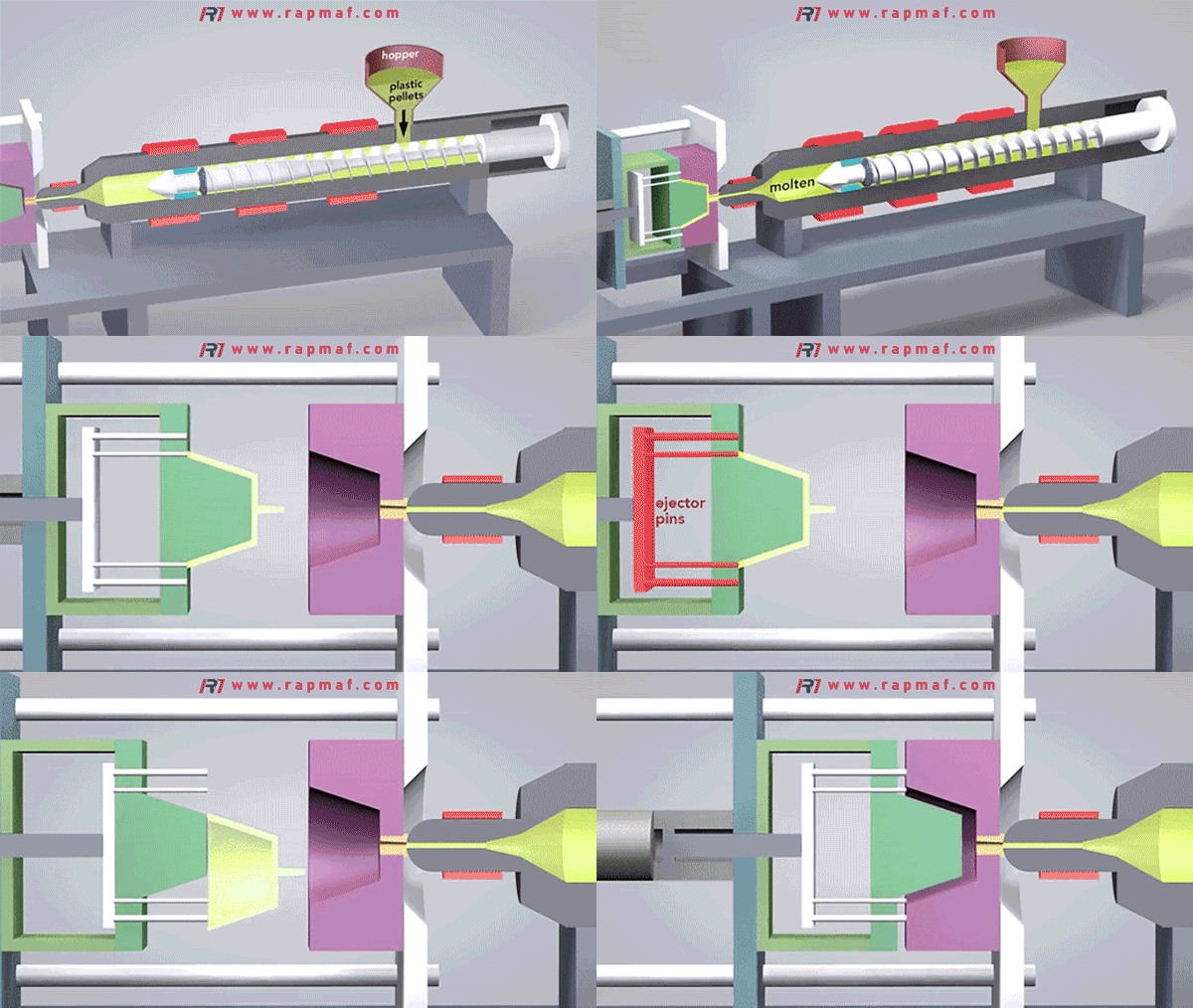
- The Injection Unit is responsible for melting and injecting the plastic. Think of it as the “hot glue gun.” It consists of a hopper to feed the plastic pellets, a heated barrel, and a large reciprocating screw. This screw is a marvel of engineering; it not only transports the pellets forward but also heats, melts, and mixes them into a homogenous liquid plastic before acting like a plunger to force it into the mold.
- The Clamping Unit is responsible for holding the mold shut against the immense pressure of the injected plastic. Think of it as a powerful, hydraulic or electric vise. This unit holds the two halves of the mold, closes them with extreme force (measured in “clamping tons”), and opens them to eject the part. Without this immense clamping force, the high-pressure molten plastic would simply push the mold halves apart and ooze out the sides.

Pillar 2: The Mold (The Tool)
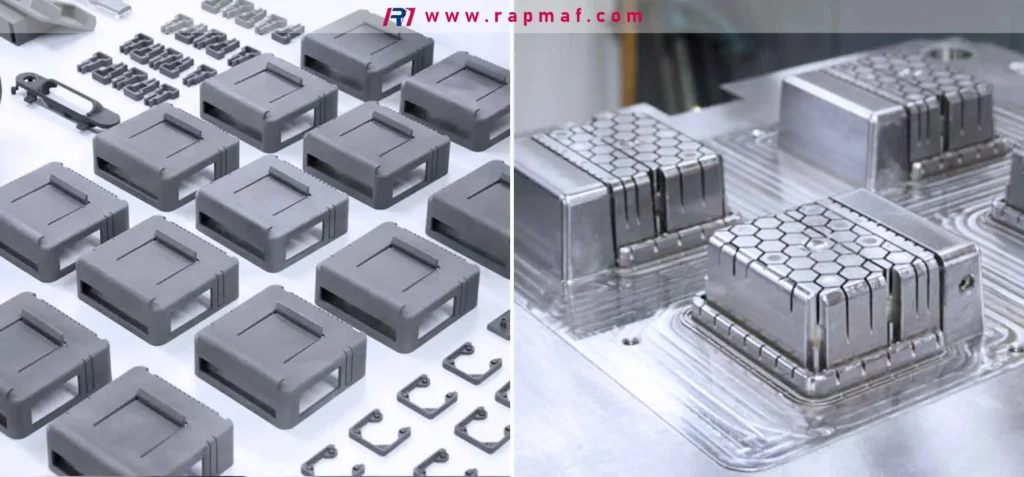
If the machine is the engine, the mold is the DNA. It is a highly-engineered, custom-machined block of steel or aluminum that contains the negative space—the cavity—of the part you want to create. Molds are the most expensive and time-consuming part of the injection molding equation, often costing tens of thousands to hundreds of thousands of dollars.
A typical mold consists of two halves:
- The “A” Side (Cavity Side): This half usually mounts to the stationary side of the clamping unit and often forms the “exterior” or cosmetic surface of the part.
- The “B” Side (Core Side): This half mounts to the moving side and contains the core elements that form the internal features of the part. It also houses the ejector system—a series of pins that push the finished part out of the mold once it has cooled.
The mold also contains intricate channels for cooling liquid (usually water) to flow through, which is critical for controlling the temperature and solidifying the plastic in a timely manner.
Pillar 3: The Material (The Plastic Resin)
Injection molding works with a vast library of polymers, primarily thermoplastics. Thermoplastics are polymers that can be melted and solidified multiple times without significant degradation, like freezing and melting an ice cube. This is what allows them to be fed into the machine as solid pellets, melted into a liquid, and then cooled back into a solid part.
Common thermoplastics include:
- Polypropylene (PP): Inexpensive, flexible. Used for food containers, car bumpers, and living hinges.
- Acrylonitrile Butadiene Styrene (ABS): Strong, impact-resistant, with a good surface finish. The material used for Lego bricks and computer keyboard keys.
- Polycarbonate (PC): Extremely tough and transparent. Used for safety glasses, water bottles, and automotive headlights.
- Nylon (PA): Strong, with excellent wear resistance. Used for gears, bearings, and zip ties.
While less common, the process can also be adapted for thermosets, which undergo an irreversible chemical change (curing) when heated, and for other materials like metals and ceramics in a process called Metal Injection Molding (MIM).
Why Injection Molding Dominates Manufacturing
The reason this process is so ubiquitous comes down to three unparalleled advantages when it comes to mass production:
- Incredible Speed & High Volume: The cycle times are extremely short, often measured in seconds. This allows a single mold to produce millions of identical parts per year, making it the most efficient way to manufacture at scale.
- Unmatched Precision & Complexity: Injection molding can produce parts with incredibly intricate details and tight tolerances. Complex features like ribs, bosses for screws, and living hinges can be incorporated directly into the mold, eliminating the need for secondary assembly operations.
- Extremely Low Per-Part Cost: While the initial investment in the mold is very high, the cost per part becomes minuscule once production begins. The high speed, automated nature of the process, and low cost of raw materials mean that each individual part can cost mere pennies or even fractions of a penny to produce.
Now that we understand the “what” and the “why,” it’s time to explore the “how.” In the next part, we will walk through the entire injection molding cycle step-by-step, dissect the anatomy of the machine in greater detail, and present a real-world case study from RM on how a custom plastic enclosure is brought from concept to reality.
The Injection Molding Cycle: A Four-Step Breakdown
Every injection molding cycle, whether it’s producing a simple bottle cap or a complex automotive dashboard component, follows the same four fundamental stages. The entire sequence is managed by the machine’s controller, which orchestrates every movement and parameter with millisecond precision.
Step 1: Clamping (Mold Closing)
Before a single drop of plastic can be injected, the two halves of the mold tool must be securely closed and held together. The moving platen of the clamping unit pushes the “B” side of the mold forward until it meets the stationary “A” side. A powerful hydraulic or all-electric mechanism then applies an immense amount of force, locking the two halves together.
This force, known as clamping tonnage, is one of the primary specifications of an injection molding machine. It can range from under 5 tons for small desktop machines to over 5,000 tons for massive machines that mold car bumpers or large storage bins.
Why is this force so critical? During the injection phase, the molten plastic is forced into the mold cavity at pressures that can exceed 20,000 PSI (pounds per square inch). Without sufficient clamping force to counteract this, the plastic would simply force the mold halves apart, creating a messy and unusable part with excess material seeping out—a defect known as flash. The rule of thumb is that you need 2 to 8 tons of clamp force for every square inch of the part’s projected area.
Step 2: Injection (Filling & Packing)
With the mold securely clamped shut, the injection process begins. The reciprocating screw inside the heated barrel, which has already been melting and accumulating a “shot” of homogenous molten plastic at its front, now acts like a high-pressure plunger.
The screw rapidly pushes forward, forcing the molten plastic out of the barrel, through the nozzle, and into the mold. The plastic travels through a channel in the mold called a sprue, then through a network of smaller channels called runners, and finally enters the actual part cavity through a small, precise opening called a gate.
This phase is actually a two-part process:
- Filling: The initial high-speed injection that fills about 95-99% of the mold cavity. This is done as quickly as possible without degrading the material or trapping air.
- Packing (or Holding): As the plastic inside the mold begins to cool, it also begins to shrink. To compensate for this shrinkage and ensure the part is fully dense and detailed, a sustained “holding pressure” is applied after the initial fill. This packs more material into the cavity and is crucial for achieving good surface finish and dimensional accuracy, preventing defects like sink marks (small depressions in the surface).
Step 3: Cooling (Dwelling)
Once the cavity is filled and packed, the cooling phase begins. This is arguably the most critical stage for both part quality and profitability. The mold is maintained at a specific temperature by coolant (usually water) flowing through channels machined into its steel walls. This coolant draws heat out of the molten plastic, causing it to solidify into the shape of the cavity.
The cooling time is determined by several factors, including the type of plastic, the thickness of the part’s walls (the thicker the wall, the longer the cooling time), and the desired cycle time. In many high-volume production runs, the cooling time can account for more than 50% of the total cycle time. Therefore, optimizing cooling is a primary focus for engineers looking to reduce costs.
If the part is ejected before it has cooled sufficiently, it can warp or distort. If the cooling is uneven, it can introduce internal stresses that lead to premature failure.
Step 4: Ejection (Part Removal)
After the part has cooled to a solid state, the clamping unit opens, separating the two mold halves. As the moving platen retracts, the finished part, along with the now-solid sprue and runners, stays on the “B” side (the core side) of the mold.
At this point, the machine’s ejector system is activated. A series of steel pins and sleeves, hidden behind the core, push forward and press against the part, cleanly pushing it out of the cavity. The part (and its attached runner system) then falls into a collection bin or is removed by a robotic arm.
The machine is now ready to begin the next cycle, starting again with Step 1. This entire four-step process repeats seamlessly, producing a finished part every few seconds.
A Deeper Look at the Machine’s Anatomy
To truly appreciate the process, it’s helpful to understand the key components of the machine that make it all possible.
| Component | Location | Primary Function |
|---|---|---|
| Hopper | Top of the Injection Unit | A large funnel that holds the raw plastic pellets and feeds them into the barrel via gravity. |
| Barrel | Injection Unit | A thick-walled steel cylinder containing the screw. It is wrapped with heater bands to melt the plastic. |
| Reciprocating Screw | Inside the Barrel | The heart of the injection unit. Rotates to convey, melt, and mix plastic, then moves forward to inject it. |
| Nozzle | Tip of the Barrel | The exit point for the molten plastic. It forms a seal with the mold’s sprue bushing during injection. |
| Platens (Fixed & Moving) | Clamping Unit | The large steel plates to which the two halves of the mold are mounted. |
| Tie Bars | Clamping Unit | Four large, solid steel rods that connect the ends of the clamping unit and guide the moving platen. They resist the stretching force generated during clamping. |
| Ejector System | Inside the Moving Platen | The hydraulic or mechanical system that actuates the ejector pins to push the finished part out of the mold. |
| Controller | The Machine’s “Brain” | The computer interface that allows an operator to set and monitor all process parameters (temperature, pressure, speed, time). |
Real-World Case Study: The RM Custom Electronics Enclosure
A client approached RM with a new handheld IoT diagnostic tool. They needed a custom plastic enclosure that was durable, ergonomic, and aesthetically pleasing, with precise internal features to mount a circuit board and battery.
- The Challenge: The enclosure required tight tolerances, internal screw bosses for assembly, snap-fit features for the two halves to connect, and a small, transparent window for an indicator LED. The client needed 50,000 units within a three-month window.
- Our Process: Injection molding was the only viable option for this volume and complexity.
- Material Selection: We chose ABS for the main body due to its excellent impact strength, high-quality surface finish, and ease of molding. For the small LED window, which needed to be welded into the main body, we chose a clear, weldable grade of Polycarbonate (PC).
- Mold Design & DFM: Our engineers worked with the client’s design, applying critical Design for Manufacturability (DFM) principles. We added a 1.5-degree draft angle to all vertical walls to ensure the part would release easily from the mold. We added fillets to sharp internal corners to reduce stress concentration. We also optimized the wall thickness to be a uniform 2.5 mm, preventing sink marks and ensuring consistent cooling.
- Tooling & Production: We designed and built two molds: a two-cavity mold for the ABS body halves and a four-cavity mold for the tiny PC windows. Using a 150-ton injection molding machine, we dialed in the process parameters. The final cycle time for the main body was 28 seconds, with 16 seconds dedicated purely to cooling.
- The Result: We successfully produced and delivered the 50,000 enclosures on time and on budget. The parts were dimensionally accurate, cosmetically flawless, and robust enough to pass the client’s drop-testing requirements. This case perfectly illustrates how injection molding transforms a digital design into thousands of identical physical products with unparalleled efficiency.
We have now seen how the machine works and how the process unfolds. But the quality of the final part is determined long before the plastic ever enters the mold. It’s determined on the designer’s screen.

In the final part of our guide, we will explore the critical principles of Design for Manufacturability (DFM), discuss the common defects that can occur in injection molded parts and how to prevent them, and provide a final verdict on when to choose this powerful manufacturing process.
The Golden Rules of Design for Manufacturability (DFM)
Design for Manufacturability is an engineering practice focused on designing products in a way that makes them easy and efficient to manufacture. In the context of injection molding, DFM is not just a best practice; it is the absolute key to controlling costs and ensuring quality. Every decision made here—from the thickness of a wall to the radius of a corner—has a direct impact on mold complexity, cycle time, material usage, and the likelihood of defects.
Mastering these rules is how you transform a great idea into a great product.
Rule #1: Maintain Uniform Wall Thickness
This is the single most important rule in plastic part design. The goal is to design a part where the walls are as consistent in thickness as possible throughout.
- The Problem: Molten plastic cools and shrinks as it solidifies. If one section of a part is significantly thicker than another, the thick section will cool much slower. This differential cooling creates internal stresses that cause the part to warp or twist out of shape. Furthermore, the thicker section will continue to shrink after the thinner sections have solidified, pulling material inward and causing a depression on the surface known as a sink mark.
- The Solution: Strive for uniformity. If a part requires extra strength or stiffness, do not simply make the wall thicker in that area. Instead, use reinforcing features like ribs (which we’ll cover next). This keeps the overall wall thickness consistent while adding structural integrity.
- Best Practices: Most common thermoplastics have a recommended wall thickness range (e.g., for ABS, it’s typically 1.2 mm to 3.5 mm). Staying within this range and keeping it uniform is the first step to a defect-free part.
Rule #2: Incorporate Draft Angles
A draft angle is a slight taper applied to all vertical faces of a part that are parallel to the direction the mold opens and closes.
- The Problem: As the plastic part cools, it shrinks and grips tightly onto the core half of the mold. If the walls are perfectly vertical (90 degrees to the parting line), the friction during ejection is immense. This can cause the part’s surface to be scratched, deformed, or “dragged.” In severe cases, the part can get stuck in the mold, forcing the ejector pins to apply so much pressure that they punch through or damage the part.
- The Solution: By adding a small angle, typically between 1 and 2 degrees, the surface of the part is no longer parallel to the mold opening direction. As soon as the ejector pins begin to push, the part immediately separates from the mold wall, breaking the friction and allowing for a clean, smooth release.
- Best Practices: A minimum of 1 degree of draft is a standard recommendation. If the part has a textured surface (like a matte or grained finish), more draft is required (3 to 5 degrees) because the texture creates thousands of tiny undercuts that can resist ejection.
Rule #3: Add Radii and Fillets to Corners
Never design a plastic part with sharp internal or external corners. Every corner should have a smooth, rounded radius.
- The Problem: Sharp internal corners are significant stress concentrators. When a part is subjected to an external force (like being dropped), all the stress flows to that sharp corner, making it the most likely point of failure—it acts like the perforated edge of a piece of paper, inviting a tear. Additionally, molten plastic has difficulty flowing into and filling sharp corners, which can lead to incomplete parts or trapped air.
- The Solution: Add generous radii (fillets) to all corners. This allows the stress to be distributed over a wider area, dramatically increasing the part’s strength and durability. It also promotes smooth, uninterrupted flow of the plastic during injection.
- Best Practices: A good rule of thumb is to make the inside radius at least 0.5 times the nominal wall thickness. The outside radius should then be the inside radius plus the wall thickness to maintain consistency.
Rule #4: Design Smart Ribs and Bosses
Ribs are thin, wall-like features used to add strength and stiffness to a part without increasing its overall wall thickness. Bosses are cylindrical features used to accommodate screws, threaded inserts, or locating pins for assembly.
- The Problem: If designed improperly, these features can violate Rule #1 and create thick sections that cause sink marks and warping. A solid, thick boss is a guaranteed source of cosmetic defects. A rib that is too thick will cause a visible sink mark on the opposite side of the part.
- The Solution: Design these features intelligently.
- For Ribs: The thickness of a rib at its base should be no more than 60% of the wall thickness it’s attached to. They should also have draft angles and radii at their base.
- For Bosses: Bosses should be cored out (hollow) and connected to the main wall with ribs or gussets, rather than being solid cylinders of plastic. This maintains a more uniform wall thickness throughout the feature.
Recognizing and Preventing Common Molding Defects
When DFM principles are ignored or process parameters are incorrect, a host of predictable defects can appear. Understanding these defects is key to troubleshooting and creating a robust manufacturing process.
| Defect | Description | Common Causes | Prevention Strategy |
|---|---|---|---|
| Sink Marks | Small depressions or craters on the surface of the part. | Non-uniform wall thickness; ribs or bosses that are too thick; insufficient holding pressure or time. | DFM: Follow Rule #1 & #4. Process: Increase holding pressure/time. |
| Warping | The part distorts or twists from its intended shape after ejection. | Differential cooling rates caused by non-uniform walls; part ejected too hot; incorrect cooling channel design in the mold. | DFM: Design with uniform walls. Process: Increase cooling time; optimize mold temperature. |
| Flash | A thin layer of excess plastic that seeps out of the mold cavity at the parting line or ejector pin locations. | Insufficient clamp tonnage; mold halves not sealing properly; injection pressure is too high. | Process: Increase clamp tonnage; maintain the mold tool; reduce injection pressure. |
| Short Shot | The part is incomplete because the molten plastic did not fully fill the mold cavity. | Insufficient injection pressure or speed; material is too cold (viscous); gates are too small or blocked. | Process: Increase injection pressure/speed/temperature. DFM: Design larger gates. |
| Weld Lines | A visible line or notch where two or more fronts of molten plastic met as they filled the cavity. This can be a weak point. | Plastic flowing around a core or hole and meeting on the other side. | DFM: Strategically position gates to move weld lines to non-critical, non-visible areas. |
The Final Verdict: When Is Injection Molding the Right Choice?
Injection molding is an immensely powerful technology, but it is not the right solution for every project. The decision to invest in injection molding hinges on a simple trade-off: high upfront costs versus extremely low per-part costs.
Injection Molding is the ideal choice when:
- You need high production volumes. The breakeven point is typically in the range of 5,000 to 10,000+ units. Below this, the cost of the mold is difficult to justify.
- Your part design is stable and finalized. Changes to a hardened steel mold are extremely expensive and time-consuming.
- You require high precision and repeatability. The process produces thousands of parts with virtually no deviation from one to the next.
- Your part has a complex geometry. Injection molding excels at creating intricate features like snap-fits, ribs, and bosses that would be impossible with other methods.
- You need a specific material property. The selection of moldable thermoplastics is vast, offering a wide range of mechanical, thermal, and chemical properties.
You should consider other processes (like 3D printing or CNC machining) when:
- You only need a few prototypes.
- Your design is still evolving.
- Your production volume is very low (under 1,000 parts).
- Your part is very large and simple (thermoforming might be cheaper).
Conclusion: From Pellets to Products
We have journeyed from a simple question—”What is injection molding?”—to a deep understanding of its place at the heart of modern manufacturing. We have seen how a symphony of heat, pressure, and precision mechanics transforms humble plastic pellets into the complex, functional, and ubiquitous products that shape our world.
More importantly, we’ve learned that the true art of injection molding lies not just in the machine, but in the thoughtful design of the part itself. By embracing the principles of Design for Manufacturability, engineers and designers can unlock the full potential of this process, turning a concept into a cost-effective, high-quality reality, millions of times over. From a single Lego brick to a life-saving medical device, injection molding is the silent, powerful engine of mass production.
External References & Further Reading:
- Malloy, R. A. (2010). Plastic Part Design for Injection Molding: An Introduction. Hanser Publications. (A foundational textbook in the field, providing in-depth engineering principles for DFM in plastics).
Disclaimer
The information on this page is for informational purposes only. RM makes no representations or warranties, express or implied, as to the accuracy or completeness of this information. For any third-party services procured through the RM network, it is the buyer’s responsibility to specify and confirm performance parameters, tolerances, materials, and workmanship during the quotation process. For more detailed information, please do not hesitate to contact us.
RM: Your Precision Manufacturing Partner
RM is an industry leader in custom manufacturing solutions. With over 20 years of profound experience, we have become the trusted partner for more than 5,000 clients worldwide. We specialize in a comprehensive range of manufacturing services—including high-precision CNC machining, sheet metal fabrication, 3D printing, injection molding, and metal stamping—to provide you with a true one-stop-shop experience.
Our world-class facility is equipped with over 100 state-of-the-art 5-axis machining centers and operates in strict compliance with the ISO 9001:2015 quality management system. We are dedicated to providing solutions that blend speed, efficiency, and exceptional quality to customers in over 150 countries. From rapid prototyping to large-scale production, we promise delivery in as fast as 24 hours, helping you gain a competitive edge in the market. Choosing RM means selecting an efficient, reliable, and professional manufacturing ally.
Explore our capabilities today by visiting our website: www.rapmaf.com







2 Responses