



his guide is written from my personal perspective as a professional engineer and a partner at RM (Rapid Manufacturing). Knurling is one of those fascinating, fundamental machining processes that most people have felt but few can name. It’s a texture that instantly communicates functionality and quality—a silent, tactile language that tells your hands, “This is meant to be gripped,” or “This is a precision instrument.”
On our shop floor, we use knurling for a huge range of applications, from rugged tool handles to delicate adjustment knobs on scientific equipment. The purpose isn’t always the same, but it’s always deliberate.
For anyone in a hurry, here is the direct answer:
| Primary Purpose | Simple Explanation |
|---|---|
| Functional Grip | To create a textured, non-slip surface that makes an object easier to hold and turn, especially by hand. This is the most common reason. |
| Aesthetic Appeal | To give a part a precise, industrial, and high-quality look. The clean, geometric pattern is often used on knobs and decorative components. |
| Repair & Press Fitting | To slightly increase the diameter of a shaft or pin, creating a tight interference fit when pressed into a hole. The raised points bite into the surrounding material. |
But to truly appreciate the genius of this simple process, you have to understand the mechanics behind it and the different “flavors” it comes in. The story of knurling is a story of cold-formed metal, strategic design, and the subtle art of making things that not only work well but feel right.
So, how do we create this unique texture? In the next section, I’ll take you through the two primary methods of knurling—cutting vs. forming—and break down the different patterns you can create, from the classic diamond to the elegant straight line.
The Two Schools of Knurling: Cutting vs. Forming
In the first part, we established that knurling serves two masters: the human hand seeking grip and the mechanical assembly seeking a secure fit. But how we create that textured surface is a fundamental choice that dictates the final look, feel, and performance of the part. On our shop floor at RM, this choice boils down to a head-to-head matchup between two competing philosophies: displacing metal with immense pressure (Forming) versus surgically removing it with sharp edges (Cutting).
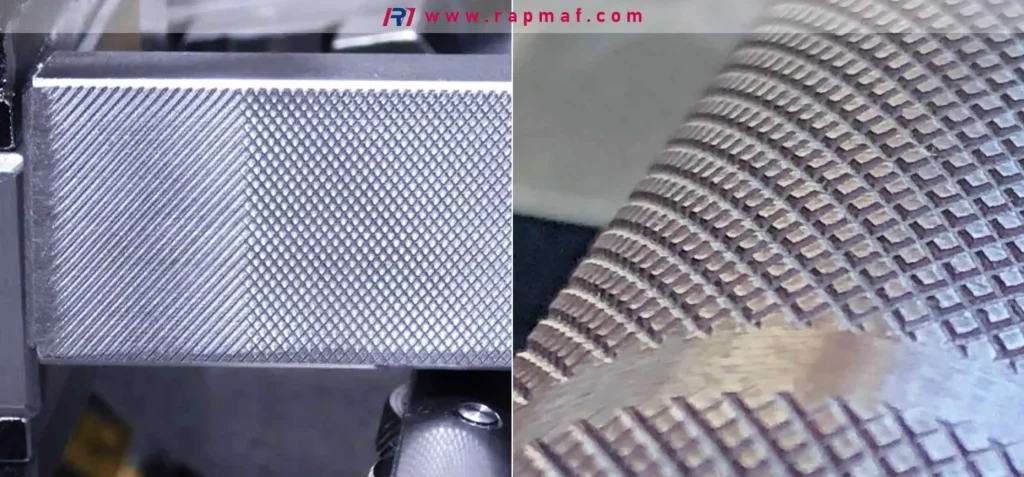
This isn’t just a technical preference; it’s a strategic decision. Choosing the right method is the difference between a high-volume, cost-effective part and a pristine, aesthetically perfect component. It’s the difference between a process that strengthens the material and one that treats it with a delicate touch. Let’s put them in the ring.
The Philosophy of Forming (Displacement)
Imagine trying to create a pattern in a block of clay. You wouldn’t scrape bits of clay away; you’d press a textured object into it, forcing the clay to move and take the new shape. This is the essence of form knurling.
Form knurling, also known as pressure knurling, uses one or more incredibly hard, patterned wheels that are forced against the rotating workpiece. The pressure is immense—so high that it exceeds the material’s compressive yield strength. The metal doesn’t get cut; it flows. Material is pushed down to form the troughs of the knurl and simultaneously pushed up to form the peaks. It is a process of pure plastic deformation.
The Advantages of Forming:
- Speed: It is exceptionally fast. Once the tool is engaged, the pattern can often be formed in just a few revolutions of the workpiece. For high-volume production, this speed translates directly into cost savings.
- Strength: The process of displacing metal under high pressure is a form of cold working. This work-hardens the surface of the material, making the knurled section slightly stronger and more wear-resistant than the parent material.
- No Material Loss: Since no chips are created, there’s no wasted material and no swarf to clean up or manage. This is a clean, efficient process.
- Slight Diameter Increase: Because material is pushed up to form the peaks, the final major diameter of a form-knurled section is always larger than the starting diameter. This is a huge advantage when you’re designing a part for a press-fit. You can machine a shaft to a precise slip-fit diameter and then use the knurl to increase its size just enough to create a strong, permanent interference fit.
The Disadvantages of Forming:
- High Radial Pressure: The forces involved are significant. This puts a lot of stress on the workpiece, the tool, and the lathe itself. It’s not suitable for thin-walled tubing or long, unsupported shafts, as the pressure can easily cause the part to bend or distort.
- Less Sharp Finish: Because the metal is flowing, the resulting peaks are never perfectly sharp. They are slightly rounded, which can be less aesthetically pleasing for high-end consumer products.
- Diameter Sensitivity: The quality of the knurl is highly dependent on the starting diameter of the workpiece. If the diameter isn’t a near-perfect multiple of the tool’s pitch, the pattern won’t track properly on subsequent revolutions, leading to a messy, “double-tracked” appearance.
My Experience at RM: The High-Volume Press-Fit Pin
A few years ago, we landed a major contract with an automotive supplier to produce hundreds of thousands of small, hardened steel dowel pins. These pins needed to be pressed into an aluminum housing to act as alignment features. The client’s print specified a knurl on one end to ensure the pin would never back out under vibration.
For a job of this scale, speed was everything. Cutting was not an option—it would have been far too slow. We immediately opted for a forming process using a straddle-type knurling tool with two wheels. The key challenge was dialing in the process. The client’s print specified a final outside diameter after knurling. Our task was to calculate the precise starting diameter of the pin so that after the forming process displaced the metal, the peaks of the knurl landed exactly on that target dimension, within a tolerance of just a few thousandths of an inch. It took a few trial runs, but once we locked in that “magic” starting diameter, our CNC lathes were churning out perfectly formed, work-hardened pins every few seconds. It was a beautiful example of using forming’s primary advantage—its ability to both create a feature and control a dimension in a single, rapid step.
The Art of Cutting (Removal)
Now, imagine creating that same pattern in a block of wood. You wouldn’t press into it; you’d use a chisel or a file to carve away material, leaving behind the desired texture. This is the philosophy of cut knurling.
Cut knurling uses sharp, angled wheels that act like tiny milling cutters. As the workpiece rotates, these wheels are fed into the material, and they physically shear off small chips of metal to generate the pattern’s grooves. It is a true machining process, defined by material removal.
The Advantages of Cutting:
- Superior Finish & Precision: The resulting pattern is incredibly sharp, clean, and well-defined. Because the tool is cutting, the peaks are crisp and the troughs are clean. For any application where aesthetics are paramount—like the control knob on a high-end stereo or a precision measuring tool—cutting is the only way to go.
- Low Radial Pressure: The cutting action requires significantly less pressure than forming. This makes it the ideal choice for thin-walled parts, hollow tubes, or long, slender shafts that would buckle under the stress of a forming tool.
- Less Diameter Sensitivity: While starting with the correct diameter is still good practice, cut knurling is far more forgiving than forming. The tool is cutting its own path, so it’s less likely to “double track” on a non-ideal diameter.
- Works on a Wider Range of Materials: Some materials, particularly certain plastics or very hard metals, don’t flow well and can flake or crumble under the pressure of forming. Cutting is often the only way to get a clean knurl on these challenging materials.
The Disadvantages of Cutting:
- Slower Process: Cutting takes more time. The tool needs to be fed across the workpiece more slowly, and often multiple passes are required to achieve the full depth of the knurl.
- Produces Swarf: Like any machining operation, it creates chips. These chips need to be managed with coolant to prevent them from getting caught in the tool and marring the surface finish.
- Tool Wear: The sharp edges of the cutting wheels will eventually dull and need to be replaced, adding to the tooling cost over the life of a project.
- Maintains Diameter: The major diameter of the workpiece does not increase. This means you can’t use it to easily create press-fits in the same way you can with a forming tool.
My Experience at RM: The Aerospace Latch Handle
We once had a project for an aerospace client that required a small, intricate latch handle to be machined from a piece of 7075 aluminum tubing. The handle needed a very fine, precise diamond knurl to ensure a secure grip for the flight crew, even when wearing gloves.
This part presented a classic engineering challenge. The handle was made of tubing, so the walls were thin. Any attempt to use a form knurl would have instantly crushed it. Furthermore, the aesthetic standards for aerospace components are incredibly high; the knurl had to be perfect.
Our solution was a CNC lathe equipped with a high-quality cut knurling tool. We programmed a slow feed rate and used a high-pressure coolant flush to continuously clear the tiny aluminum chips from the cutting wheels. The process was slow, taking almost a minute per part just for the knurl, but the result was flawless. Each diamond peak was perfectly sharp, the pattern was geometrically pristine, and the thin-walled tube was completely undistorted. It was a case where the higher cycle time and tooling cost were easily justified by the absolute need for precision and a low-stress process.
The Engineer’s Verdict: A Head-to-Head Comparison
So, how do you choose? On our team at RM, we use a simple decision matrix based on the part’s function and requirements.
| Decision Factor | Choose FORMING When… | Choose CUTTING When… |
|---|---|---|
| Primary Goal | You need speed, strength, or a press-fit. | You need a perfect aesthetic or are working on a delicate part. |
| Part Geometry | The part is solid, thick-walled, and well-supported. | The part is thin-walled, hollow, or a long, slender shaft. |
| Material | You’re using standard steels, aluminum, or brass that flow well. | You’re using tough alloys, some plastics, or very hard materials. |
| Production Volume | You’re in high-volume production where cycle time is critical. | You’re in low-volume, high-mix, or prototype production. |
| Final Diameter | You need to increase the diameter for an interference fit. | You need to maintain the original major diameter of the part. |
| Aesthetics | The knurl is purely functional and a “good enough” finish is acceptable. | The knurl is a key visual element and must be sharp and pristine. |
The Language of Knurling: Patterns, Pitch, and Standards
Once you’ve chosen your method, you need to define the texture itself. This is the “language” of knurling, described by a specific set of patterns and measurements. Getting this language right is just as important as the manufacturing process, as it dictates the final feel and function of the part.
Decoding the Patterns: Straight, Diamond, and Beyond
While there are many specialty patterns, the vast majority of knurling falls into a few key categories.
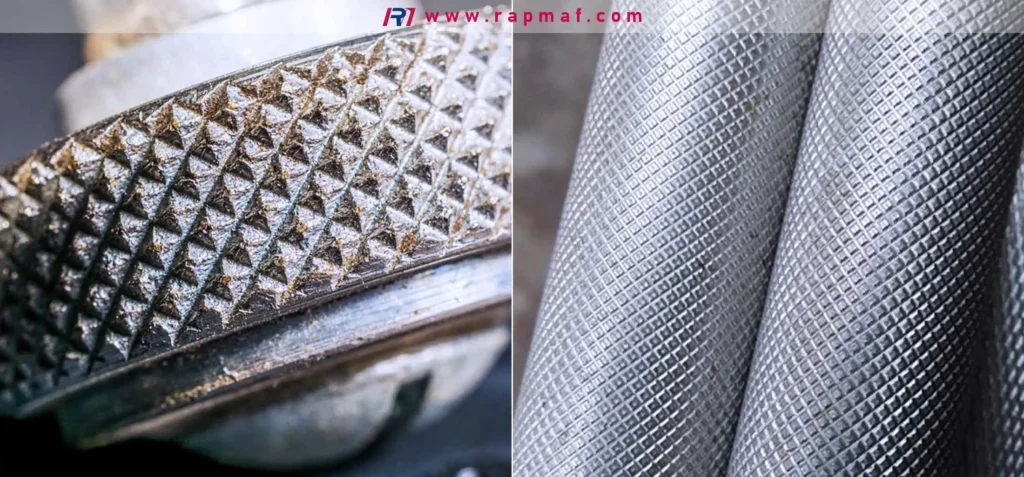
- Straight Knurl: This is the simplest pattern, consisting of a series of straight, parallel grooves running along the axis of the part. It provides excellent grip against rotational forces (like twisting a knob) but offers little resistance to axial force (pulling). We often use straight knurls for press-fit applications where we want to prevent a pin from spinning in its hole but don’t want to create the “screw-in” resistance that a diamond pattern can cause during assembly.
- Diamond Knurl: This is the iconic, classic pattern. It’s created by two helical wheels, one right-handed and one left-handed, which combine to form the familiar diamond shape. This pattern provides excellent omnidirectional grip, resisting both rotational and axial slipping. It’s the standard for hand tools, dumbbells, and any handle where a secure grip is the top priority.
- Angular/Helical Knurl: This is the pattern created by a single knurling wheel. It looks like a series of spiral grooves. While sometimes used on its own for aesthetic reasons, its primary function is as one-half of a diamond knurl.
The Importance of Pitch: Defining the Texture
The “pitch” of a knurl refers to the density of the pattern. A coarse pitch has teeth that are far apart, creating an aggressive, rough texture. A fine pitch has teeth that are close together, creating a delicate, file-like texture. This is specified in two ways:
- TPI (Teeth Per Inch): In the imperial system, pitch is defined by the number of teeth per inch on the knurling tool. Common values might range from a coarse 16 TPI to a very fine 64 TPI.
- Metric Pitch: In the metric system, pitch is simply the distance in millimeters between two adjacent teeth (e.g., 0.5mm, 0.8mm, 1.2mm).
Choosing the right pitch is a critical design decision. For a heavy-duty wrench that will be used in a greasy environment, a coarse pitch (like 20 TPI or 1.2mm) is ideal because it provides an aggressive grip that won’t get clogged easily. For the focus ring on a camera lens or the adjustment knob on a micrometer, a very fine pitch (like 50 TPI or 0.5mm) is necessary to provide a subtle, secure grip that allows for precise, delicate adjustments.
The Hidden Formula: Why Starting Diameter is Everything
This is one of the most important and frequently overlooked secrets to good knurling, especially form knurling. For the pattern to be perfect, the circumference of the workpiece must be an even integer multiple of the circular pitch of the knurl.
Let me translate that from engineering-speak. Imagine you’re wrapping a patterned ribbon around a cylinder. If the length of the ribbon doesn’t perfectly match the circumference, the pattern won’t line up when you get back to the start. The same thing happens with a knurling tool. On the first revolution, it creates a pattern. On the second revolution, the teeth of the tool must land perfectly back in the grooves they just created. If they don’t, you get a hideous, overlapping mess.
To ensure this happens, the starting blank diameter must be carefully calculated. The formula is a bit complex, but the principle is simple: there is a “magic” diameter for every combination of tool and pitch.
A Painful Lesson from the RM Shop Floor:
I will never forget an early job we did for a medical device company. They designed a beautiful stainless steel thumb screw with a fine diamond knurl. The engineer who designed it simply specified the knurl on a section with a nominal diameter of 10.0mm. Our machinist set up the job, ran the first part, and it looked awful. The knurl was fuzzy and indistinct, a classic case of double-tracking.
The operator was frustrated, thinking his setup was wrong. But I suspected the issue was on the print. We pulled out the tooling catalog and ran the calculation. For the fine-pitch knurling tool we were using, the ideal diameter wasn’t 10.0mm; it was 9.92mm.
We machined the next blank down to that “magic” 9.92mm diameter and ran the knurl again. It was perfect. The diamonds were sharp, the tracking was flawless. It was a powerful lesson that we now teach every new engineer and machinist at RM: the knurl doesn’t just go on the part; the part must be designed for the knurl. We sent a note back to the client’s engineering team with our recommendation. They were so impressed with the analysis and the final quality that they made the change on their official drawing and have been a loyal client ever since.
We now understand the what (the patterns and purposes) and the how (cutting vs. forming). But all the theory in the world doesn’t make a good part. In the final section, we’ll move from the engineering print to the lathe itself. We’ll cover the practical side of knurling: feeds, speeds, proper lubrication, and how to diagnose and fix the common problems that turn a precision pattern into a mangled mess.
Mastering the Craft: Feeds, Speeds, and Shop Floor Wisdom
In the first two parts of this guide, we’ve explored the theory. We’ve defined the purpose of knurling, debated the merits of cutting versus forming, and decoded the language of patterns and pitch. But as any machinist will tell you, the real magic happens at the machine. The most meticulously designed part and the most expensive tool are useless without the hands-on knowledge to make them work in harmony. This is the craft of knurling—a delicate dance of speed, pressure, and lubrication that separates a pristine, functional texture from a pile of expensive scrap.
On my shop floor at RM, this is where our most experienced machinists truly shine. It’s where the numbers on a setup sheet give way to the look, sound, and feel of the process. In this final section, I’m going to share the practical, hard-won wisdom that we apply every day to turn engineering theory into physical reality.
The Machinist’s Triangle: Feeds, Speeds, and Lubrication
Success in knurling, like many machining operations, depends on balancing three critical variables: the rotational speed of the workpiece, the feed rate of the tool, and the application of the right lubricant. Getting this triangle right is the key to a clean pattern and long tool life.
Setting the Right Speed (SFM to RPM)
The first question is always, “How fast should I spin the part?” The answer, frustratingly, is “slower than you think.” Knurling is not a high-speed operation. The goal is to give the metal time to flow (in forming) or to be cleanly sheared (in cutting). Excessive speed is the number one cause of poor finishes, flaked patterns, and premature tool wear.
In professional machining, we don’t think in terms of RPM (Revolutions Per Minute) directly. We start with SFM (Surface Feet per Minute), which is the speed at which the material is moving past the cutting tool, regardless of the part’s diameter. For knurling, the recommended SFM is typically low, often in the range of 50 to 150 SFM. Soft materials like aluminum can be run at the higher end of that range, while tough materials like stainless steel demand the lower end.
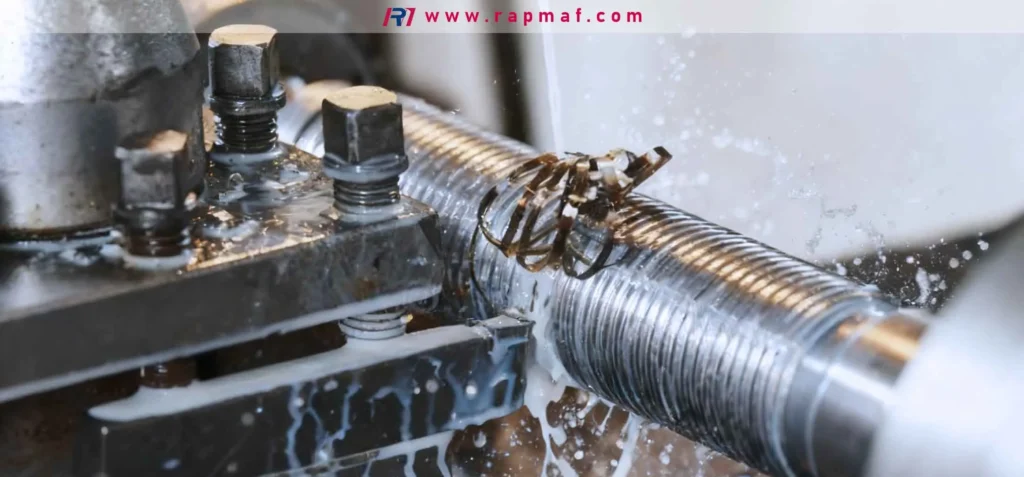
Let’s translate that into practical RPM. The formula is:
RPM = (SFM * 12) / (π * Diameter)
Imagine we’re knurling a 1-inch diameter aluminum shaft. We might choose a starting SFM of 120.
RPM = (120 * 12) / (3.14159 * 1.0) = 1440 / 3.14159 ≈ 458 RPM
Now, imagine we’re knurling a 0.5-inch diameter stainless steel pin. We’d choose a much lower SFM, say 60.
RPM = (60 * 12) / (3.14159 * 0.5) = 720 / 1.5708 ≈ 458 RPM
Notice something interesting? The RPM ended up being the same! This is why thinking in SFM is so powerful; it automatically accounts for the diameter to ensure the tool is interacting with the material at the optimal surface speed.
A Shop Floor Rule of Thumb: If you don’t have a chart handy, a good starting point for most knurling on a manual lathe is to set the speed to about one-quarter of what you would use for a normal turning operation on the same material. Start slow, observe the results, and only increase the speed if the pattern is forming cleanly.
Dialing in the Feed Rate (IPR)
The feed rate is the speed at which the tool travels along the length of the part. This is typically measured in IPR (Inches Per Revolution). Like speed, the feed rate for knurling is also slow and deliberate.
- For Forming: A typical feed rate is between 0.005″ and 0.015″ IPR. You need to give the material enough time to plastically deform. Rushing the feed will result in a shallow, incomplete pattern.
- For Cutting: The feed rate is often a bit faster, perhaps in the 0.008″ to 0.020″ IPR range. However, the feed must be slow enough to allow the cutting teeth to do their job without chipping or creating a rough finish.
The sound of the process is your best guide. A good knurling operation has a steady, “grinding” sound. A high-pitched squeal is a sign of excessive speed or insufficient feed. A chattering or banging sound means something is loose or your feed rate is far too aggressive.
The Non-Negotiable Role of Lubrication
Knurling generates a tremendous amount of friction and heat, especially form knurling. Without proper lubrication, you will destroy your tool and your part in a matter of seconds. The lubricant serves two purposes: it reduces friction, allowing the tool wheels to turn freely, and it carries away heat, preventing the material from galling or welding itself to the tool.
My Go-To Lubricants at RM:
- For General Purpose Steel & Aluminum: A high-quality, sulfurized cutting oil is our workhorse. It provides excellent lubricity and cooling. Flood coolant on a CNC machine works well, but for manual operations, a steady stream from an oil can directly into the tool-workpiece interface is essential.
- For Stainless Steel & Tough Alloys: This is where you bring out the heavy hitters. We use a thick, high-pressure cutting oil or a wax-based tapping fluid. These lubricants are designed to cling to the surface under extreme pressure and provide a boundary layer that prevents metal-to-metal contact. Never, ever try to knurl stainless steel dry.
Troubleshooting: A Machinist’s Diagnostic Guide
Even with the perfect setup, things can go wrong. Over the years, I’ve seen every possible failure mode. Here is the diagnostic checklist we use at RM when a knurl comes out looking less than perfect.
| Problem | Symptoms | Likely Causes & Solutions |
|---|---|---|
| Double Tracking | The pattern is fuzzy, indistinct, or looks like two patterns laid on top of each other. | 1. Incorrect Blank Diameter (Most Common): The part’s circumference is not an even multiple of the knurl pitch. Recalculate and machine the blank to the correct “magic” diameter. 2. Worn Tool: The teeth on the knurling wheels are dull and are slipping instead of tracking. Replace the wheels. 3. Loose Setup: The tool or the workpiece is not held rigidly. Check the tailstock pressure and tighten the tool post. |
| Flaking or Chipping | Small flakes of metal are breaking off, leaving a rough, ugly surface. | 1. Material is Too Hard/Brittle: The material may have been heat-treated or is a non-ductile alloy. Anneal the part first, or switch to a cut knurling tool. 2. Excessive Pressure/Feed: You are forcing the tool too aggressively. Reduce the feed rate and make multiple passes. 3. Dull Tool: A worn forming tool can cause flaking instead of flowing. Replace the wheels. |
| Shallow or Incomplete Pattern | The knurl is not formed to its full depth. | 1. Insufficient Dwell/Pressure: You didn’t push the tool in far enough or didn’t let it “dwell” for a few revolutions at full depth. 2. Part is Too Hard: The material is resisting deformation. You may need more pressure or a slower speed. 3. Incorrect Tool for the Job: Trying to form a deep, coarse knurl on a tough material may require a more robust tool. |
| Tapered Knurl | The knurl is deeper on one end than the other. | 1. Misalignment: The knurling tool is not perfectly perpendicular to the workpiece axis. Use a square to check the tool alignment. 2. Workpiece is Pushing Off: The part is deflecting away from the tool due to excessive pressure, especially on long, slender parts. Use a steady rest for support. |
The Final Verdict: When Knurling is the Right Answer
We’ve journeyed from the simple purpose of grip to the complex science of metallurgy and the practical craft of machining. So, when should an engineer or designer choose to add a knurl to their part?
Knurling is the right answer when you need to create a deliberate, controlled interface between a machine and its environment. That environment might be the hand of a human operator, requiring a predictable and comfortable grip. Or it might be another mechanical component, requiring a permanent, high-strength interference fit.
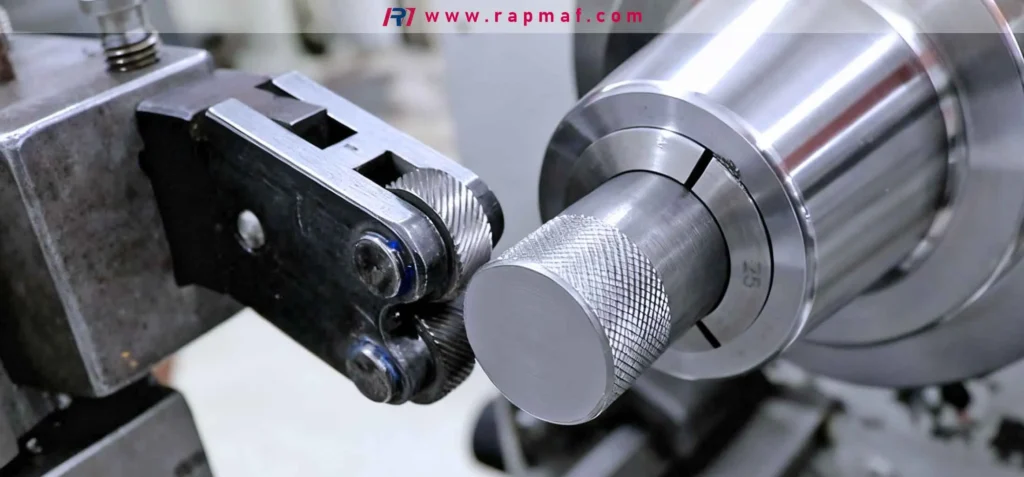
It’s a process that seems brutish on the surface—deforming metal with immense force—but it is, in fact, a process of incredible nuance. It’s a testament to the idea that in engineering, the texture of a surface can be just as important as the dimension of a diameter.
From the simple, satisfying grip on a well-made hand tool to the hidden, mission-critical press-fit inside a jet engine, knurling is a fundamental and enduring part of our manufacturing language. It’s a process that reminds us that even in our high-tech world, the way things feel and the way they hold together still matters. It’s a craft that my team and I are proud to have mastered, and one that will continue to shape the world, one textured surface at a time.
Frequently Asked Questions (FAQs)
What’s the main disadvantage of knurling?
The main disadvantage, particularly with form knurling, is the high radial stress it puts on the workpiece and the machine. It’s not suitable for delicate or thin-walled parts. For cut knurling, the primary disadvantage is that it’s a slower, less productive process compared to forming.
Can you knurl any material?
Not easily. Knurling works best on ductile materials that can be formed or cut cleanly, such as most steels, aluminum alloys, brass, and some plastics like Delrin or Nylon. Very hard, brittle materials (like hardened tool steel or ceramics) and very soft, gummy materials can be extremely difficult to knurl effectively.
How do you measure a knurl to see if it’s in spec?
Measuring a knurl is tricky. You can’t use standard calipers on the jagged surface. For functional checks, we often use “go/no-go” ring gauges for press-fit applications. For aesthetic checks, it’s often a visual comparison against a pre-approved “golden sample” under magnification. The most precise method involves an optical comparator, which projects a magnified silhouette of the part onto a screen for measurement.
Why is my knurling tool producing a spiral or screw-like pattern instead of a straight one?
This is almost always a result of misalignment. If a straight knurling tool is not set perfectly on center and perfectly perpendicular to the axis of the part, it will tend to track sideways, creating a slight helix. Re-centering and squaring the tool is the solution.
References and Further Reading
- Machinery’s Handbook – “Knurls and Knurling”: The definitive engineering reference book, providing detailed charts, formulas, and standards for knurling specifications, including blank diameter calculations.
- Zeus Precision – “Knurling Tool Guide”: A practical guide from a tooling manufacturer that explains the different types of knurling tools and provides operational advice.
- Practical Machinist – “Knurling Troubleshooting Forum”: An online community of professional machinists discussing real-world problems and solutions, including extensive threads on troubleshooting difficult knurling jobs.






