



When you hear the word “stainless,” your mind likely jumps to a kitchen appliance, a piece of high-end cookware, or the gleaming trim on a modern building. While “stainless” is an adjective meaning “free from stains,” in the world of engineering, materials science, and everyday products, it is almost exclusively used as shorthand for one of the most important materials of the modern era: stainless steel.
But what does that actually mean? What makes a piece of steel “stainless” when a normal steel nail left out in the rain will rust into a flaky orange mess in a matter of days?
The difference isn’t a coating, a paint, or a temporary treatment. The “stainless” property is baked into the very chemistry of the metal itself. It is the result of a precise and ingenious metallurgical recipe that creates a material with a built-in, self-healing suit of armor. In this guide, we will deconstruct this remarkable material, moving from its fundamental definition to its many variations and applications.
The Problem: Why “Normal” Steel Rusts
To understand why stainless steel is so special, you must first understand the inherent weakness of its most common ancestor: carbon steel.
All steel is fundamentally an alloy—a metal made by combining two or more metallic elements. In its most basic form, steel is an alloy of iron (Fe) and a small amount of carbon (C). The carbon gives the iron strength and hardness, transforming it from a relatively soft metal into the backbone of construction and industry.
However, this combination has a fatal flaw: iron is chemically unstable in its pure form. It desperately wants to react with oxygen in the environment to return to its more stable state, iron oxide. We call this process oxidation, or more commonly, rusting.
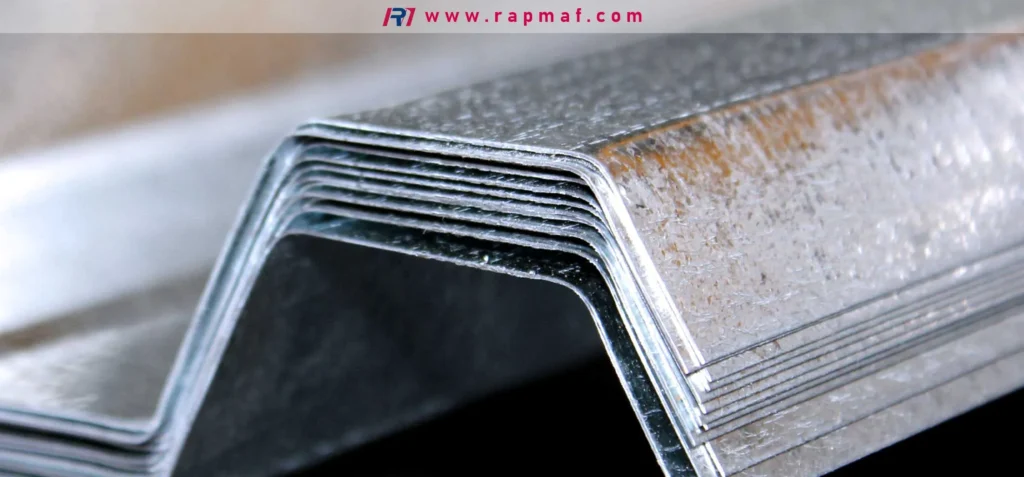
The process requires three things:
- Iron (the steel itself)
- Oxygen (from the air)
- Water (from humidity, rain, or moisture)
When these three meet, the iron atoms on the surface give up their electrons, combine with oxygen, and form a reddish-brown, flaky compound called hydrated iron(III) oxide (Fe₂O₃·nH₂O)—rust. This rust layer is porous and weak. It flakes off, exposing fresh iron underneath, which then rusts in turn. This cycle continues until the entire piece of steel is consumed.
The “Stainless” Solution: The Magic of Chromium
In the early 20th century, metallurgists searching for a solution to this billion-dollar problem discovered a key ingredient that could change everything: Chromium (Cr).
By adding a significant amount of chromium to the steel alloy, they created a material with a remarkable defense mechanism. This is the core of what “stainless” means.
At its most basic definition, stainless steel is a family of iron-based alloys that contains a minimum of 10.5% chromium by weight.
This specific percentage is the magic number. At this concentration, the chromium provides a phenomenal level of corrosion resistance through a process called passivation.
Understanding the Passive Layer: An Invisible Shield
Here’s how it works: The chromium in the alloy is far more reactive with oxygen than the iron is. When the surface of stainless steel is exposed to air, the chromium atoms instantly react with oxygen to form an incredibly thin, tough, and transparent layer of chromium oxide (Cr₂O₃).
This layer, known as the passive film or passive layer, is the secret to stainless steel’s power.
- It’s Impermeable: The layer is chemically stable and non-porous, forming a complete barrier that seals the iron in the steel from the oxygen and water in the environment.
- It’s Self-Healing: This is its most incredible property. If the stainless steel surface is scratched, cut, or damaged, the newly exposed chromium atoms instantly react with oxygen again, regenerating the passive layer in microseconds. As long as there is oxygen present, the “armor” repairs itself.
This is fundamentally different from a coating like galvanizing (a layer of zinc on steel) or chrome plating. In those cases, a deep enough scratch can breach the protective layer and expose the vulnerable steel underneath. With stainless steel, the protection is an integral part of the material and can heal itself.
Beyond Chromium: The Other Key Ingredients
While the 10.5% chromium threshold is the official definition, most of the stainless steels you encounter are far more complex. Metallurgists add other elements to the alloy to fine-tune its properties for specific applications, creating a vast and versatile family of materials.
Two of the most important additions are:
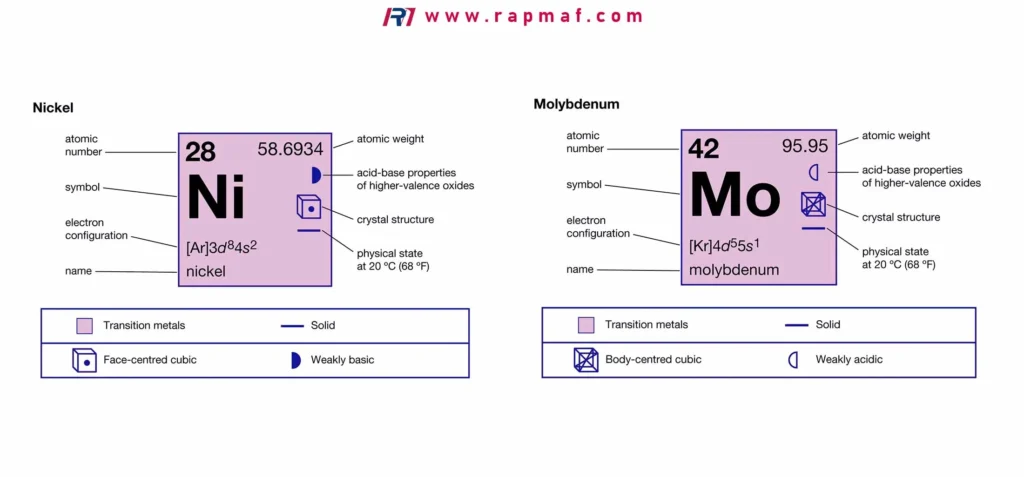
- Nickel (Ni): Nickel is the second most common alloying element after chromium. It is added primarily to stabilize the internal crystal structure of the steel, making it more ductile (easier to form and shape without breaking) and tougher, especially at very low temperatures. It is the key ingredient in the most common class of stainless steels, the “300 series” (like the 304 grade used in kitchen sinks).
- Molybdenum (Mo): Molybdenum is added to significantly enhance the steel’s resistance to a specific and insidious type of corrosion caused by chlorides. Chlorides (found in saltwater, de-icing salts, and even some cleaning chemicals) can attack and break down the passive layer. Molybdenum strengthens this layer, making the steel suitable for marine applications, chemical processing plants, and coastal architecture. The famous “316” grade is essentially 304 stainless steel with molybdenum added.
Now that we understand the basic science of what makes steel “stainless,” we can see that it’s not a single material, but a broad category defined by its chemical composition. In the next part, we will explore the major families of stainless steel—Austenitic, Ferritic, and Martensitic—and see how these different recipes create materials with vastly different properties and uses.
The Three Main Families of Stainless Steel
While there are hundreds of individual stainless steel grades, nearly all of them fall into one of three primary families:
- Austenitic
- Ferritic
- Martensitic
Understanding the core differences between these three groups is the key to understanding why one stainless steel is used for a kitchen sink, another for a car’s exhaust pipe, and a third for a surgeon’s scalpel.
Family 1: Austenitic Stainless Steel (The Workhorse)
When most people picture stainless steel, they are thinking of an austenitic grade. This is by far the most widely used family, accounting for over 70% of all stainless steel production.
Key Characteristics
- Excellent Corrosion Resistance: This is the gold standard for corrosion resistance in the stainless world.
- Non-Magnetic: A simple test for most austenitic grades is to see if a magnet sticks to it. It won’t.
- Excellent Formability: Austenitic steels are highly ductile, meaning they can be easily bent, stretched, stamped, and formed into complex shapes (like a deep kitchen sink) without cracking.
- Cannot be Hardened by Heat Treatment: You cannot make an austenitic steel harder by heating and quenching it like you can with carbon steel. It can only be hardened by “work hardening”—the process of physically bending or working the metal.
The Science Inside (Microstructure)
The unique properties of austenitic stainless steel come from its atomic structure. The addition of nickel (typically 8% or more) changes the crystal lattice into a form called austenite, or a Face-Centered Cubic (FCC) structure. This structure is stable over a wide range of temperatures, is very tough, and is not magnetic.
Common Grades and Applications
The austenitic family is known as the 300 Series of stainless steels.
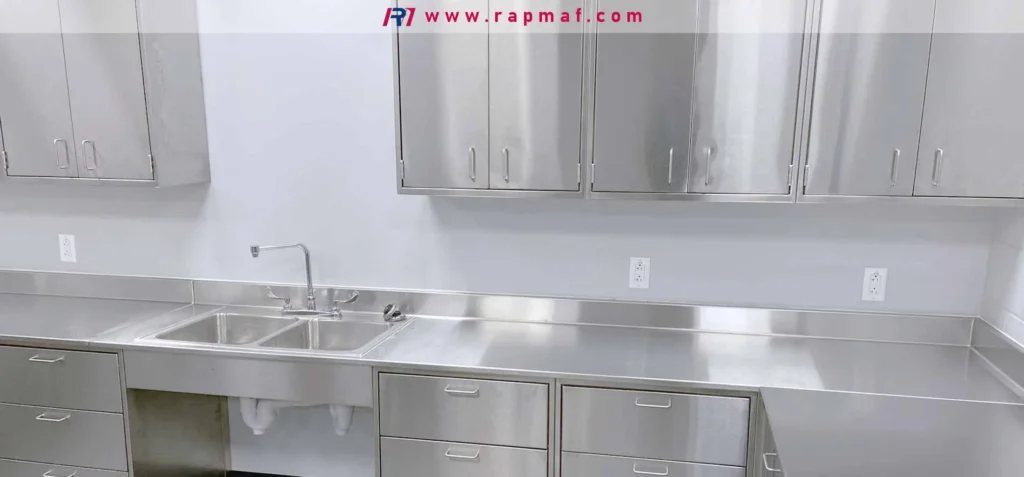
- Grade 304: The most common stainless steel in the world, often called “18/8” because it is made of approximately 18% chromium and 8% nickel. It’s the material used for kitchen sinks, cookware, food processing equipment, and architectural trim.
- Grade 316: The second most common grade. It is essentially 304 with molybdenum added. This gives it superior resistance to chlorides, making it the standard choice for marine hardware, chemical tanks, and medical implants.
Family 2: Ferritic Stainless Steel (The Magnetic Choice)
The ferritic family is the second most common type. They are often used in applications where cost is a major driver and the extreme formability of austenitic grades isn’t required.
Key Characteristics
- Good Corrosion Resistance: They resist corrosion well, especially in milder environments, but are generally not as robust as austenitic grades.
- Magnetic: Ferritic stainless steels are magnetic, just like carbon steel. Many “stainless steel” refrigerators use ferritic grades so that magnets will stick to the door.
- Lower Cost: The key advantage of ferritic grades is the absence of expensive nickel in their alloy composition, making them significantly cheaper than the 300 series.
- Cannot be Hardened by Heat Treatment: Like austenitic grades, they cannot be hardened through heat.
The Science Inside (Microstructure)
Ferritic steels have a ferrite microstructure, or a Body-Centered Cubic (BCC) structure. This is the same crystal structure found in pure iron and basic carbon steel. They contain chromium but have very little or no nickel, which is why they are magnetic and less expensive.
Common Grades and Applications
The ferritic family is primarily part of the 400 Series of stainless steels.
- Grade 430: A very popular, low-cost grade used for automotive trim, exhaust systems, appliance panels (dishwashers, refrigerators), and other decorative applications where it won’t be exposed to highly corrosive environments.
Family 3: Martensitic Stainless Steel (The Hardened Edge)
The martensitic family is the least common of the main three, but it is indispensable for applications where high strength and wear resistance are paramount.
Key Characteristics
- High Strength and Hardness: This is their defining feature. They are the only family of stainless steel that can be significantly hardened by heat treatment.
- Magnetic: Martensitic grades are magnetic.
- Moderate Corrosion Resistance: The focus on hardness comes at a price. Their corrosion resistance is lower than that of the austenitic and ferritic families.
- Can be Hardened by Heat Treatment: They can be heated to a high temperature and then rapidly cooled (“quenched”) to create an incredibly hard and strong material capable of holding a sharp edge.

The Science Inside (Microstructure)
Martensitic steels have a higher carbon content than ferritic grades. The heat treatment process traps carbon atoms within the crystal lattice, creating a highly strained, needle-like structure called martensite. This structure is what gives the material its exceptional hardness.
Common Grades and Applications
Martensitic grades are also part of the 400 Series.
- Grade 410: A general-purpose martensitic steel used for bolts, turbine blades, and parts needing a combination of strength and moderate corrosion resistance.
- Grade 420: With higher carbon content, this is the “razor blade” steel. It is used for cutlery, knives, surgical instruments, and plastic injection molds where hardness and wear resistance are the most important properties.
Comparison Chart: Austenitic vs. Ferritic vs. Martensitic
To summarize the key differences, here is a direct comparison of the three main families:
| Property | Austenitic Stainless Steel | Ferritic Stainless Steel | Martensitic Stainless Steel |
|---|---|---|---|
| Corrosion Resistance | Excellent | Good | Moderate |
| Magnetic? | No | Yes | Yes |
| Can be Hardened? | No (Only by work hardening) | No | Yes (By heat treatment) |
| Ductility/Formability | Excellent | Good | Poor |
| Cost | High (due to nickel) | Low | Medium |
| Common Grades | 304, 316 | 430 | 410, 420 |
| Primary Use Case | All-purpose, food-grade, marine | Automotive, appliances, decorative | Knives, tools, high-wear parts |
Real-World Case Study: Choosing the Right Stainless at RM
The importance of these families is not just academic; it drives critical engineering decisions every day. At RM (Rapid Manufacturing), we recently worked on a project for a client in the food processing industry who needed a new automated vegetable dicing machine. The machine required two key custom components:
- A large, seamless mixing hopper where washed vegetables would be held.
- A set of high-speed, razor-sharp dicing blades.
The Challenge: Both parts needed to be “stainless steel” for hygiene reasons, but their functional requirements were complete opposites. The hopper needed to be corrosion-proof and easy to clean, formed into a complex shape with no seams where bacteria could hide. The blades needed to be incredibly hard to hold a sharp edge after thousands of hours of dicing tough vegetables.
The Analysis & Solution:
- For the Hopper: We immediately specified Grade 304 Austenitic Stainless Steel. Its excellent formability allowed us to spin-form it into the complex hopper shape without welding, eliminating seams. Its superior corrosion resistance ensured it would stand up to acidic vegetable juices and harsh cleaning chemicals without rusting or pitting. A martensitic steel would have been too brittle to form, and a ferritic steel wouldn’t have offered enough corrosion resistance for this demanding food-grade application.
- For the Dicing Blades: Using 304 for the blades would have been a disaster. It’s too soft and cannot be heat-treated to hold an edge; the blades would be dull after just a few minutes of use. Instead, we selected Grade 420 Martensitic Stainless Steel. We machined the blades in their softer, annealed state and then sent them for a precise heat treatment process (quenching and tempering) to achieve a high hardness rating (typically 52-55 HRC). This gave them the wear resistance needed to stay sharp for thousands of operating cycles.
This case study perfectly illustrates that the term “stainless” is just the beginning of the conversation. Choosing the right family of stainless steel is essential for the success of any project.
Now that we’ve covered the three main families, what about newer, hybrid materials? And how do you go from a grade number like “304” to specifying the exact look you want, from a mirror polish to a brushed finish? In the final part, we will explore the specialized Duplex family of stainless steels and demystify the system of grades and surface finishes.
The Fourth Family: Duplex Stainless Steel (The Hybrid)
Duplex stainless steels are a modern and increasingly popular class of material. As their name suggests, they have a mixed, two-phase microstructure containing both austenite and ferrite in roughly equal proportions.
This hybrid structure is achieved by carefully controlling the chemical composition, balancing elements that promote ferrite (like chromium) with elements that promote austenite (like nickel). The result is a material that isn’t just a compromise but often outperforms its parent families in specific ways.
Key Characteristics
- Exceptional Strength: Duplex steels are typically twice as strong as common austenitic grades like 304. This allows engineers to design components with thinner walls, saving weight and cost.
- Excellent Corrosion Resistance: They have outstanding resistance to corrosion, particularly to chloride stress corrosion cracking (SCC), a weakness of many austenitic steels.
- Good Weldability: They can be welded successfully, though the procedures are more demanding than for austenitic grades to ensure the correct microstructure is maintained in the weld zone.
Applications
The combination of high strength and excellent resistance to chloride-induced corrosion makes Duplex stainless steel the ideal material for harsh environments. You will find it used extensively in:
- Oil and Gas Industry: For pipelines, risers, and processing equipment exposed to corrosive seawater and sour gas.
- Chemical Processing: In tanks and vessels that handle aggressive chemicals.
- Desalination Plants: Where equipment is in constant contact with highly concentrated salt brines.
- Architecture and Infrastructure: For bridges and structures in marine environments where both strength and corrosion resistance are critical.
Beyond the Family: Understanding Grades and Finishes
Now that we understand the four major families, we can tackle the final piece of the puzzle: how to specify the exact stainless steel you need. This involves two key identifiers: the Grade and the Surface Finish.
The Grade: A Specific Recipe
The grade number (e.g., 304, 430, 316) is a specific recipe within a family, defined by standards organizations like AISI (American Iron and Steel Institute) and ASTM International. The number tells a metallurgist the precise chemical composition of the alloy. For example:
- 304 tells you it’s an austenitic grade with roughly 18% chromium and 8% nickel.
- 316 tells you it’s also austenitic, but with the addition of molybdenum for enhanced chloride resistance.
- 430 tells you it’s a ferritic grade with ~17% chromium and no significant nickel.
Choosing the right grade is the most important decision, as it dictates the material’s core performance properties like corrosion resistance, strength, and magnetism.
The Surface Finish: The Final Appearance
The surface finish describes the texture and reflectivity of the steel’s surface. It doesn’t change the material’s inherent corrosion resistance (the passive layer is still there), but it can affect cleanability and has a huge impact on the final aesthetic.
Finishes are typically designated by a number. While there are many specialized finishes, these are the most common ones you’ll encounter on sheet and plate products:
| Finish No. | Description | Common Applications |
|---|---|---|
| No. 2B | A smooth, moderately reflective cold-rolled finish. The most common “mill finish.” | Industrial equipment, chemical tanks, general use. |
| No. 4 | A brushed finish with fine, parallel polishing lines. Non-reflective. | Kitchen appliances, sinks, decorative trim, food equipment. |
| No. 8 | A highly reflective, mirror-like finish produced by extensive polishing. | Architectural panels, decorative surfaces, mirrors. |
So, if an architect specifies “Type 316, No. 4 Finish” for a handrail on a coastal building, they are asking for a very specific product:
- Type 316: To resist the corrosive salt spray in the marine air.
- No. 4 Finish: To provide an attractive, non-reflective brushed look that hides fingerprints well.
Final Verdict: What “Stainless” Really Means
At the beginning of this guide, we asked a simple question: “What do you mean by stainless?” We now have the complete answer.
“Stainless” is not a single material. It is a broad family of iron-based alloys defined by a minimum of 10.5% chromium. This chromium is the magic ingredient, creating a passive, self-healing oxide layer that prevents rust and corrosion.
However, the journey from there is one of immense variety and specificity.
- The Family Matters: Whether it’s Austenitic (non-magnetic, formable), Ferritic (magnetic, low-cost), Martensitic (hardenable, high-strength), or Duplex (high-strength, corrosion-resistant), the internal structure dictates the material’s fundamental behavior.
- The Grade is the Recipe: A number like 304 or 420 is a precise chemical formula that determines the exact performance characteristics.
- The Finish is the Look: The surface finish, from a dull 2B to a mirror-like No. 8, defines the final appearance and texture.
Ultimately, “stainless” means durable, clean, and resistant. But for an engineer, designer, or informed consumer, it means making a precise choice from a vast catalog of high-performance materials to perfectly match the demands of the job at hand.
Frequently Asked Questions (FAQs)
What is the main difference between stainless steel and regular steel?
The single biggest difference is the presence of chromium. Regular carbon steel does not have a significant amount of chromium and will readily rust when exposed to moisture. Stainless steel contains a minimum of 10.5% chromium, which reacts with oxygen to form a thin, invisible, and self-healing “passive layer” on the surface that protects the iron underneath from corroding.
Is all stainless steel non-magnetic?
No, this is a common misconception. Austenitic stainless steels (like the common 304 and 316 grades) are non-magnetic. However, Ferritic (e.g., 430) and Martensitic (e.g., 420) stainless steels are both magnetic. So, if a magnet sticks to your “stainless steel” appliance, it’s likely made from a ferritic grade.
Which stainless steel is best for cookware?
The vast majority of high-quality stainless steel cookware is made from Grade 304 Austenitic stainless steel (often marketed as 18/8 or 18/10). Its excellent corrosion resistance prevents it from reacting with acidic foods, its superior formability allows it to be shaped into pots and pans, and it is very durable and easy to clean.
Can stainless steel ever rust?
Yes, under certain harsh conditions, even stainless steel can “rust” or corrode. The protective passive layer can be broken down by specific chemicals, most notably chlorides (found in salt, seawater, and some cleaners). This is why Grade 316, with its added molybdenum for chloride resistance, is used for marine applications instead of Grade 304. Severe scratching or contamination with iron particles (e.g., from using steel wool) can also disrupt the passive layer and lead to localized corrosion.
References
- ASM International. (2018). ASM Handbook, Volume 1: Properties and Selection: Irons, Steels, and High-Performance Alloys. (The definitive, peer-reviewed engineering handbook for metallic alloys).
- Specialty Steel Industry of North America (SSINA). (n.d.). Design Guidelines for the Selection and Use of Stainless Steels. (A primary industry association providing standards and practical guides for stainless steel applications).
Disclaimer
The information on this page is for informational purposes only. RM makes no representations or warranties, express or implied, as to the accuracy or completeness of this information. For any third-party services procured through the RM network, it is the buyer’s responsibility to specify and confirm performance parameters, tolerances, materials, and workmanship during the quotation process. For more detailed information, please do not hesitate to contact us.
RM: Your Precision Manufacturing Partner
RM is an industry leader in custom manufacturing solutions. With over 20 years of profound experience, we have become the trusted partner for more than 5,000 clients worldwide. We specialize in a comprehensive range of manufacturing services—including high-precision CNC machining, sheet metal fabrication, 3D printing, injection molding, and metal stamping—to provide you with a true one-stop-shop experience.
Our world-class facility is equipped with over 100 state-of-the-art 5-axis machining centers and operates in strict compliance with the ISO 9001:2015 quality management system. We are dedicated to providing solutions that blend speed, efficiency, and exceptional quality to customers in over 150 countries. From rapid prototyping to large-scale production, we promise delivery in as fast as 24 hours, helping you gain a competitive edge in the market. Choosing RM means selecting an efficient, reliable, and professional manufacturing ally.
Explore our capabilities today by visiting our website: www.rapmaf.com







6 Responses