

What is Welding in Welding?
On the surface, it’s a strange question. But for anyone who has spent their life around the blue-white glare of a welding arc, it makes perfect sense. It’s asking: What is the essence of this craft? What is the fundamental, unchanging truth that connects a massive shipyard welder to a micro-TIG artist in an aerospace lab?
As an engineer, my job is to define processes with absolute precision. But welding is more than a process; it’s the controlled, instantaneous creation of a new reality. It’s where two separate pieces of metal cease to be “two” and become “one” at a molecular level.
Before we dive into the science and the art, let’s put the direct answer on the table.
| Level of Definition | The Meaning of Welding |
|---|---|
| The Simple Answer | Welding is using intense heat to melt two or more pieces of metal, causing them to fuse together into a single, continuous piece as they cool. |
| The Technical Answer | Welding is a fabrication process that joins materials, usually metals, by causing coalescence. This is often done by melting the workpieces and adding a filler material to form a pool of molten material (the weld pool) that cools to become a strong joint. |
| The Philosophical Answer | Welding is the act of creating a metallurgical bond so complete that the original joint line no longer exists. It is the practical application of alchemy—turning separate components into a monolithic whole. |
To truly understand welding, you have to grasp the three non-negotiable pillars that are present in almost every single welding process. I call it the “Holy Trinity” of welding.
The Holy Trinity of Welding
Every weld, from the crudest farm repair to the cleanest aerospace joint, is a delicate balance of three elements: Heat, Shielding, and (usually) Filler Metal. Master the interplay between these three, and you have mastered the craft.
Heat: The Focused Fury
The first thing everyone associates with welding is the intense heat, but that’s only half the story. The true magic is in the focus of that heat. A bonfire is hot, but it can’t weld. Welding requires a surgically precise application of energy in a tiny, controllable area.
At RM, this isn’t an academic point. When we’re TIG welding a thin-walled aluminum enclosure for an electronics project, the heat has to be perfect. Too little, and the weld won’t fuse (a “cold lap”). A fraction too much, and you’ll blow a hole right through it. The welder is controlling a miniature sun, a plasma arc burning at over 10,000°F (6,000°C), with the finesse of a painter. This focused energy is what allows us to melt a tiny puddle of metal without distorting or destroying the surrounding material.
Shielding: The Invisible Bodyguard
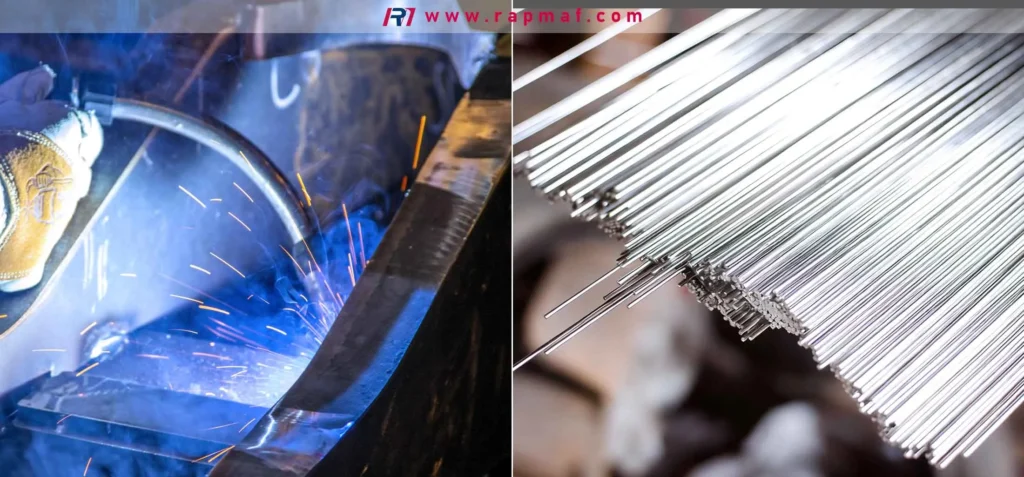
Molten metal is desperate to react with the air around it, especially with oxygen and nitrogen. If you let it, the weld will become brittle, porous, and weak—like a cake made with salt instead of sugar. The job of shielding is to act as an invisible bodyguard, creating a protective bubble around the molten weld pool, shoving the atmospheric gases out of the way until the metal has solidified and is no longer vulnerable.
On our shop floor, you’ll see this bodyguard in two main forms:
- Shielding Gas: In processes like MIG (GMAW) and TIG (GTAW), we use a steady flow of inert gas (like Argon or a CO₂ mix) from a cylinder. It’s clean, precise, and leaves a beautiful weld. This is our choice for high-precision, high-aesthetic work.
- Flux: In processes like Stick (SMAW) or Flux-Cored (FCAW), the consumable electrode is coated or filled with a solid material called flux. When burned, this flux creates a puff of protective gas and a layer of molten slag that floats on top of the weld pool. It’s rugged, works great outdoors in the wind, but it’s messy. We use this for heavy-duty structural work and field repairs.
Filler Metal: The Metallurgical Bridge
While you can weld some thin materials by just melting their edges together (an autogenous weld), most joints require the addition of a “filler metal.” This is typically a wire or a rod that is melted into the joint. Its job is twofold: first, to fill any gap between the two pieces, and second, to act as a metallurgical bridge.
A great example was a recent repair job on a piece of heavy machinery. The base metal was a high-carbon steel, but the crack was in a high-stress area. We didn’t just use a generic mild steel filler. We selected a specific low-hydrogen, high-tensile strength electrode. This filler metal didn’t just join the two pieces; it created a new piece of metal in the middle that was stronger and more crack-resistant than the original. It was a translator, ensuring the two sides could communicate without breaking.
So, heat, shielding, and filler metal are the grammar of welding. But this grammar is used to speak several very different languages. In the next section, I’ll take you on a tour of the four main languages of arc welding, the workhorses of the modern world.
The Four Languages of Arc Welding
Think of these not as “good” or “bad,” but as different tools for different jobs. You wouldn’t use a sledgehammer to hang a picture frame, and you wouldn’t use a tack hammer to break up concrete.
SMAW (Stick Welding): The Rugged Old-Timer
Stick welding, or Shielded Metal Arc Welding (SMAW), is the grizzled veteran of the group. It’s the manual transmission, the cast-iron skillet of the welding world. It’s simple, brutally effective, and requires a true feel for the craft. The “machine” is little more than a powerful transformer, and the electrode is a simple metal rod coated in flux. That single rod provides the filler metal, the shielding gas, and the slag covering all in one brilliant, self-contained package.
On our shop floor, Stick welding is our go-to for field repairs and heavy-duty structural work. Just last month, a support bracket on our exterior steel gantry crane cracked. It was thick, slightly rusty, and a good 30 feet in the air. We couldn’t drag a delicate MIG machine with its bulky gas bottle up there. Instead, our lead fabricator slung a small “inverter” Stick welder over his shoulder, climbed the ladder, and laid down a perfect, deeply penetrating repair weld in the wind. It wasn’t pretty under the slag, but it was immensely strong. That is the essence of Stick: ultimate portability and power, with no need for external gas.
GMAW (MIG Welding): The Production Powerhouse
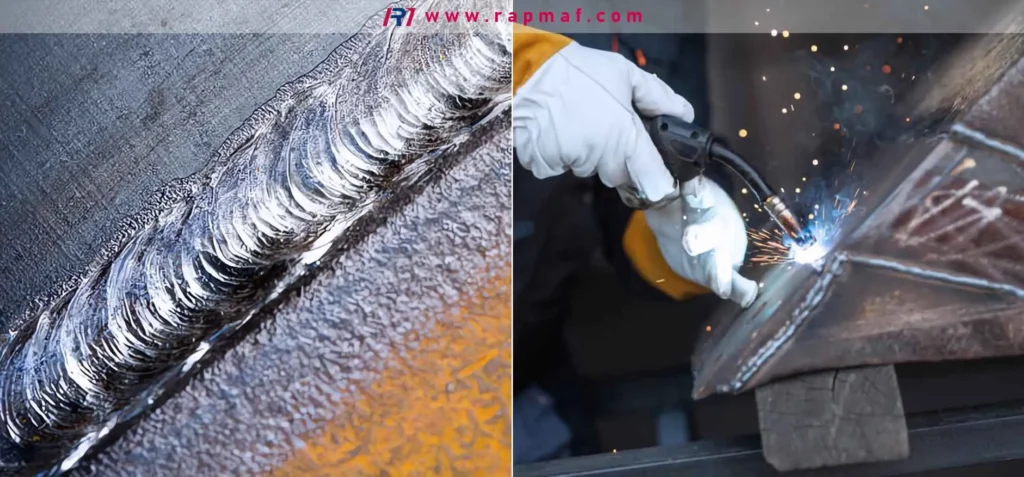
If Stick is a manual transmission, Gas Metal Arc Welding (GMAW), or “MIG,” is the smooth automatic. It’s the “point-and-shoot” camera of welding, which is why it’s so incredibly popular. Instead of a finite rod, you have a continuously fed wire from a spool. You pull the trigger on the “gun,” and three things happen at once: the wire feeds out, it becomes electrically live, and a flow of shielding gas starts. It’s a semi-automatic process that allows a welder to lay down long, consistent welds very, very quickly.
MIG welding is the engine of our production line at RM. When we’re fabricating the steel frames for a custom piece of automation equipment, which might involve hundreds of individual welds, MIG is the only choice. It’s fast, it’s clean (no slag to chip), and a moderately skilled operator can produce beautiful, strong welds all day long. This is the language of speed, efficiency, and consistency.
FCAW (Flux-Cored Arc Welding): The Hybrid Maverick
FCAW is the rebellious child of Stick and MIG. It takes the speed and convenience of MIG’s wire-feed system but replaces the solid wire with a hollow, tubular wire filled with—you guessed it—flux. This gives it a unique, hybrid personality. The self-shielded version (FCAW-S) needs no external gas bottle, making it like a supercharged Stick welder that never needs to stop for a new rod.
We turn to FCAW when we need to weld thick structural sections with deep penetration, fast. It runs hotter and faster than Stick and penetrates better than standard MIG. When we built the heavy steel base for a new CNC machine, we used a gas-shielded Flux-Cored wire. The process laid down an enormous amount of metal quickly, fusing the thick plates together with incredible strength. The downside? It’s messy. It produces a lot of smoke and slag, just like Stick welding, but the upside in pure deposition rate and power is undeniable.
GTAW (TIG Welding): The Surgical Artist
Finally, we have Gas Tungsten Arc Welding (GTAW), or “TIG.” If MIG is a point-and-shoot camera, TIG is a fully manual Hasselblad. It is the most difficult, the slowest, and the most precise welding process there is. The welder holds the TIG “torch” in one hand, which holds a non-consumable tungsten electrode to create a pinpoint-perfect arc. In the other hand, they feed a separate, thin filler rod into the molten puddle. All this while controlling the heat with a foot pedal, like playing a musical instrument.
TIG is the language of perfection. At RM, it’s reserved for our most critical and high-aesthetic jobs. When we fabricate a delicate aluminum enclosure for a sensitive electronics assembly, it has to be TIG welded. When we build a custom stainless steel manifold for a food-grade application, where the weld must be perfectly smooth and crevice-free, it must be TIG welded. TIG welding is slow, methodical, and produces a weld of unparalleled purity and beauty, often described as a “stack of dimes.” It is the ultimate expression of a welder’s skill.
These are the languages we use to build the world. But knowing the grammar and the vocabulary isn’t enough. The most important part of the equation is the person holding the torch.
The Human Element: The Mindset of a Welder
Melting metal is easy. Anyone can strike an arc and make a mess. Welding, however, is a discipline. It’s a conversation between the operator, the machine, and the material. Over the years, I’ve learned that the best welders on my team share a common set of mental traits that are far more important than the brand of machine they use.
Patience and a Steady Hand
Welding is an act of controlled violence. You are unleashing thousands of degrees of heat, yet the application must be done with surgical steadiness. This is most obvious with TIG welding. I’ve watched our top fabricator, a man named Dave, TIG weld a thin-walled aluminum assembly. His breathing is slow and rhythmic. His hands, which can easily lift a 100-pound steel plate, move with the grace of a calligrapher. He isn’t just melting metal; he’s guiding the flow, managing the heat with a foot pedal, and dabbing the filler rod with perfect timing. This isn’t just a physical skill; it’s a state of mind. Rushing a weld leads to defects. Becoming frustrated leads to mistakes. Patience is the foundation of quality.
The Art of Reading the Puddle
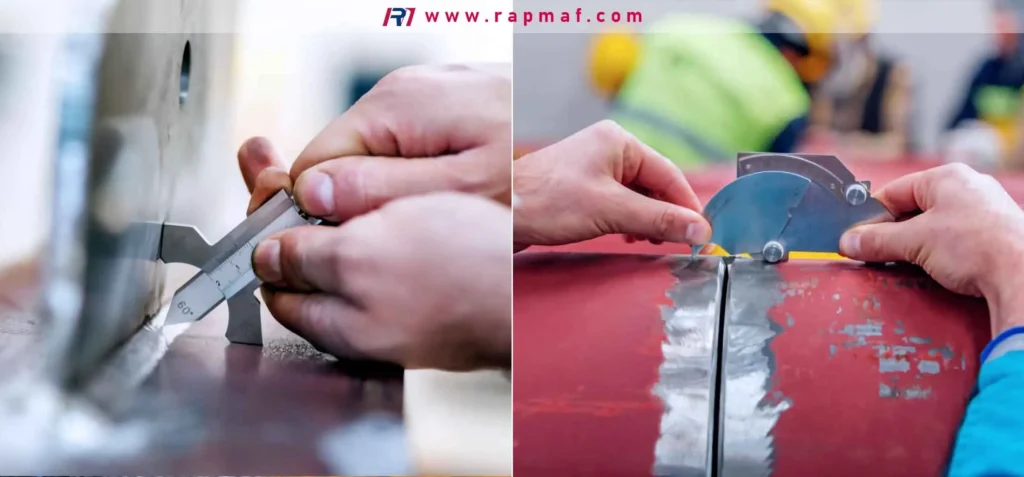
This is the single most important skill that separates the novice from the master. When a welder looks at the arc, they aren’t just seeing a bright light. They are looking at the “weld puddle”—the small, molten pool of metal where the magic happens. To them, that shimmering puddle is a living thing, and it tells a story.
Is it too wide? Too much heat, slow down. Is it narrow and piling up? Not enough heat, or you’re moving too fast. Are little sparks dancing on its surface? That’s contamination. The base metal wasn’t cleaned properly. Is the edge of the puddle “wetting out” and flowing smoothly into the base metal, or is it sitting on top like water on wax? This determines if you have good fusion. A great welder is in a constant feedback loop with the puddle, making micro-adjustments to their speed, angle, and heat input to keep it behaving perfectly.
Problem-Solving Under the Hood
No project ever goes perfectly. At RM, we once had a job fabricating a series of complex stainless steel brackets. The material we received was from a different supplier than usual, and it was behaving strangely under the arc. The welds were coming out with a weird, sugary texture—a clear sign of porosity. An inexperienced operator would have just kept going, producing a pile of scrap.
Our senior welder stopped after the first inch. He immediately recognized the problem wasn’t his technique; it was the shielding gas coverage. He diagnosed that the different alloy composition was reacting poorly with our standard gas mix. After a quick consultation, we switched to a specialized tri-mix gas, and the problem vanished. That ability to diagnose, adapt, and solve problems in real-time is what makes a welder an invaluable artisan, not just a technician.
Safety: The Non-Negotiable Foundation
Because welding is an act of controlled violence, the respect for its dangers is absolute. On my shop floor, safety isn’t just a policy; it’s the culture. The mindset of a great welder includes an almost obsessive commitment to personal protective equipment (PPE). The hazards are what I call the “unholy trinity”: intense light, extreme heat, and toxic fumes.
Here is the absolute bare-minimum checklist I give to every new person who even steps foot in our welding department.
| PPE Item | My Pro Tip & Justification |
|---|---|
| Welding Helmet | Don’t cheap out. Get a good auto-darkening helmet. The UV/IR light from an arc is so intense it will cause “arc flash,” a painful sunburn on your corneas. A good helmet protects you from this and frees up your hands. |
| Welding Jacket | FR Cotton or Leather. A hot spark from MIG or Stick welding can smolder on a normal shirt and burst into flames when you least expect it. A fire-retardant (FR) jacket is your primary defense against severe burns. |
| Welding Gloves | Choose for the Process. Heavy, thick leather gauntlets are essential for high-heat Stick or Flux-Core. For the delicate control of TIG, you need thinner, goatskin gloves that offer dexterity and heat protection. |
| Respirator | This is not optional. Welding fumes, especially from galvanized or stainless steel, contain heavy metals like zinc, chromium, and manganese. A P100 pancake-style respirator that fits under your helmet is essential for long-term health. |
| Steel-Toed Boots | Protect your feet. You are often working with heavy metal components. A dropped piece of steel can easily crush the bones in your foot. Leather also resists sparks better than synthetic shoe materials. |
| Safety Glasses | Wear them under the helmet. Chipping slag, grinding, and wire brushing all throw debris. Your helmet protects you during the weld; your glasses protect you before and after. |
Frequently Asked Questions
After years of talking to people curious about the trade, a few questions always come up.
Why do welders drink milk after welding?
This is a persistent myth. The theory was that the calcium in milk would help counteract the effects of inhaling zinc fumes from galvanized steel, which can cause “metal fume fever.” There is zero scientific evidence for this. The only effective prevention is to not breathe the fumes in the first place by using a proper respirator and working in a well-ventilated area.
Does welding affect sperm?
This is a serious health question. The primary concern is exposure to heavy metals like manganese, chromium, and lead, which are known reproductive toxins. With modern safety standards, including high-quality ventilation and the mandatory use of respirators, the risk can be mitigated to safe levels. However, unprotected exposure absolutely carries risks.
What is the easiest welding to learn?
For most people, MIG (GMAW) is the easiest to learn the basics of. The semi-automatic process lets you focus on your gun angle and travel speed. Stick (SMAW) is more difficult to master, and TIG (GTAW) is by far the most challenging.
What is the highest welding salary?
This varies wildly. A production MIG welder might make a solid hourly wage, but a specialized pipe welder working on a nuclear submarine or a high-purity aerospace TIG welder can earn well into the six figures. The more specialized the skill, the higher the pay.
My Final Verdict: The Soul of the Craft
So, what is welding in welding?
It’s the science of metallurgy and the art of the human hand, working in perfect concert. It’s the quiet confidence of a welder reading a molten puddle and knowing exactly what it needs. It’s the profound, almost magical act of taking two separate, useless pieces of metal and joining them with a bond that is stronger than the metal itself, creating something whole, permanent, and useful.
It is, in the simplest terms, the force that holds our modern world together.
References
- American Welding Society (AWS): The leading authority on welding standards, certifications, and best practices.
- OSHA – Welding, Cutting, and Brazing Safety: The official guidelines from the Occupational Safety and Health Administration covering the mandatory safety protocols for all welding processes.
Disclaimer
The information on this page is for informational purposes only. RM makes no representations or warranties, express or implied, as to the accuracy or completeness of this information. For any third-party services procured through the RM network, it is the buyer’s responsibility to specify and confirm performance parameters, tolerances, materials, and workmanship during the quotation process. For more detailed information, please do not hesitate to contact us.
RM: Your Precision Manufacturing Partner
RM is an industry leader in custom manufacturing solutions. With over 20 years of profound experience, we have become the trusted partner for more than 5,000 clients worldwide. We specialize in a comprehensive range of manufacturing services—including high-precision CNC machining, sheet metal fabrication, 3D printing, injection molding, and metal stamping—to provide you with a true one-stop-shop experience.
Our world-class facility is equipped with over 100 state-of-the-art 5-axis machining centers and operates in strict compliance with the ISO 9001:2015 quality management system. We are dedicated to providing solutions that blend speed, efficiency, and exceptional quality to customers in over 150 countries. From rapid prototyping to large-scale production, we promise delivery in as fast as 24 hours, helping you gain a competitive edge in the market. Choosing RM means selecting an efficient, reliable, and professional manufacturing ally.
Explore our capabilities today by visiting our website: www.rapmaf.com