


In the world of metal fabrication, few questions are more common or more critical than, “Should I use a MIG or TIG welder?” To the newcomer, they both seem to do the same thing: join metal with a flash of light and a steady hand. But to a professional, they are as different as a framing hammer and a surgical scalpel. One is built for speed and efficiency, while the other is the undisputed master of precision and beauty.
The idea that one is universally “better” is a common misconception. The truth is that MIG and TIG are not rivals; they are specialists, each perfectly engineered for a different set of tasks. Choosing the right one is the first step toward a successful project, while choosing the wrong one can lead to frustration, poor results, and wasted material.
This guide will demystify these two essential welding processes. We will break down how each one works, put them in a direct head-to-head comparison, and provide a clear framework to help you decide which tool is the right one for your specific needs, whether you’re building a race car frame, repairing a lawnmower deck, or creating a work of art.
First, A Quick Primer: What is Arc Welding?
Before we dive into the specifics, let’s establish the foundation. Both MIG and TIG are forms of arc welding. This process uses a power supply to create an electric arc between an electrode and the base material. This arc is incredibly hot—often exceeding 6,500°F (3,600°C)—which melts the base metals, allowing them to fuse together as they cool.

To protect this molten metal puddle from atmospheric contaminants like oxygen and nitrogen, which would cause a weak and porous weld, a shielding gas is used to create a protective bubble around the arc. The key differences between MIG and TIG lie in how the electrode, filler metal, and shielding gas are controlled.
The Speed King: What is MIG (Gas Metal Arc Welding)?
MIG (Metal Inert Gas) welding, formally known as Gas Metal Arc Welding (GMAW), is the workhorse of the welding world. If you’ve seen a robot welding a car frame in a factory, you’ve seen MIG welding. Its defining characteristic is its simplicity and speed.
Think of a MIG welder as a high-powered, semi-automatic hot glue gun for metal. The machine continuously feeds a solid wire electrode from a spool, through the welding gun, and into the weld puddle. When you pull the trigger on the gun, three things happen simultaneously:
- The wire electrode feeds out at a pre-set speed.
- The electric arc is initiated between the wire tip and the workpiece.
- The shielding gas (typically a mix of argon and carbon dioxide) flows out of the nozzle to protect the weld.
The wire itself acts as both the electrode to create the arc and the filler material to build up the joint. The operator’s job is to control the speed and angle of the gun, moving along the joint to create the weld. This one-handed operation and semi-automatic process make it incredibly fast and relatively easy to learn.
Key Characteristics of MIG Welding:
- High Speed: The continuous wire feed makes it one of the fastest manual welding processes.
- Ease of Use: It has a much shorter learning curve than TIG, making it a favorite for beginners and hobbyists.
- Good for Production: Ideal for long, repetitive welds on clean steel in a manufacturing environment.
- Less Versatile: While it can weld aluminum and stainless steel with the right setup, it truly excels on mild and carbon steel.
MIG welding is the go-to choice for production manufacturing, automotive repair, and general fabrication where speed and efficiency are the top priorities.
But what if your priority isn’t speed, but absolute, uncompromising control and a flawless finish? For that, we need to introduce the artist’s choice. In the next part, we will explore TIG welding, the process responsible for the strongest and most beautiful welds in the industry, and then put the two processes in a direct head-to-head showdown.
The Artist’s Choice: What is TIG (Gas Tungsten Arc Welding)?
TIG (Tungsten Inert Gas) welding, formally known as Gas Tungsten Arc Welding (GTAW), is the polar opposite of MIG in its approach. If MIG is the framing hammer, TIG is the scalpel. It is a slower, more methodical process that offers the highest degree of control and produces the cleanest, strongest, and most aesthetically pleasing welds possible.
The fundamental difference lies in the electrode. Unlike MIG’s continuously feeding wire, a TIG welder uses a non-consumable tungsten electrode. Tungsten has the highest melting point of any pure metal, allowing it to sustain the intense heat of the arc without melting into the weld pool.
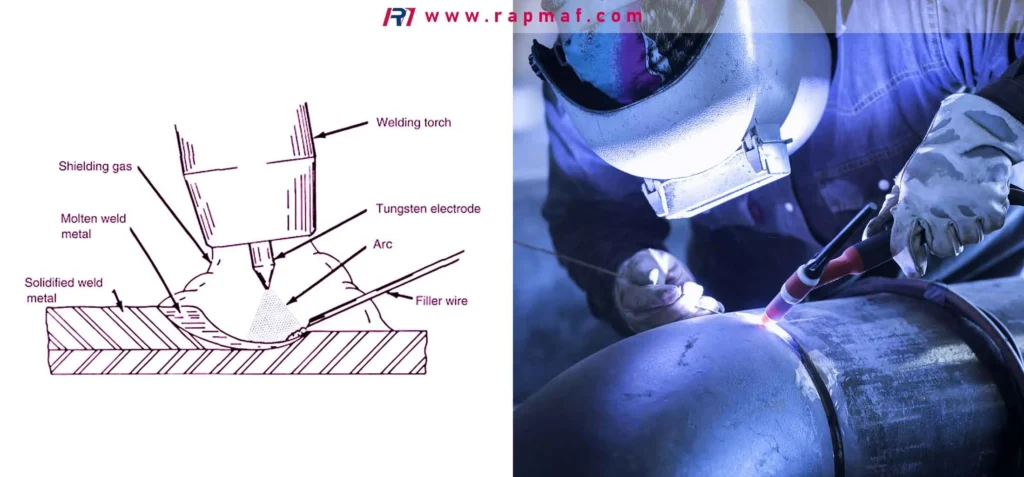
The TIG process requires significant ambidexterity and coordination, making it a true craft:
- The Torch: The operator holds the TIG torch in one hand. The torch houses the pointed tungsten electrode and directs a flow of shielding gas (typically pure argon) to protect the weld.
- The Filler Metal: In the other hand, the operator manually dabs a separate, thin filler rod into the molten weld puddle to add material. This is done with precise timing to build up the joint.
- The Heat Control: The operator controls the amperage (heat) of the arc in real-time using a foot pedal or a fingertip control on the torch. Pressing down increases the heat, while letting up decreases it.
This complete separation of tasks—creating the arc, adding filler metal, and controlling the heat—gives the TIG welder unparalleled control over every aspect of the weld. This is why TIG welding is required for the most demanding applications, from aerospace components and pressure vessels to custom race car frames and intricate metal sculptures.
Key Characteristics of TIG Welding:
- Supreme Quality and Purity: Creates exceptionally clean, strong, and precise welds with no spatter.
- Unmatched Control: Allows for fine-tuning of heat input, which is critical for thin materials.
- Versatility: The premier process for welding a wide range of metals, including stainless steel, aluminum, magnesium, titanium, and copper alloys.
- Steep Learning Curve: TIG welding is widely considered the most difficult welding process to master.
- Slow and Deliberate: It is a much slower and less productive process compared to MIG.
Head-to-Head: MIG vs. TIG Showdown
Now that we understand the fundamentals of each process, let’s put them side-by-side to highlight their core differences.
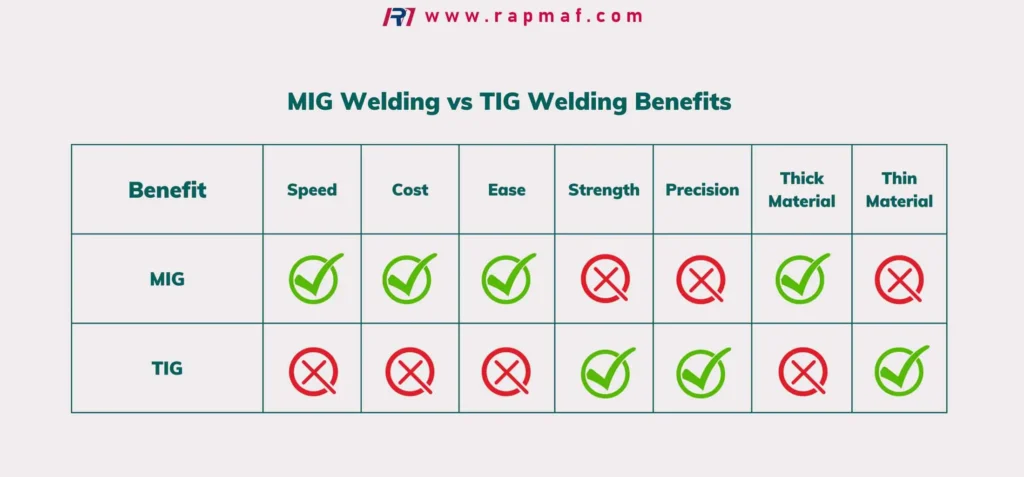
| Feature | MIG Welding (GMAW) | TIG Welding (GTAW) |
|---|---|---|
| Process Name | Metal Inert Gas / Gas Metal Arc Welding | Tungsten Inert Gas / Gas Tungsten Arc Welding |
| Electrode | Consumable wire, continuously fed from a spool | Non-consumable tungsten |
| Filler Metal Application | Automatic; the electrode IS the filler | Manual; a separate filler rod is fed with the other hand |
| Primary Control | Travel speed and gun angle | Amperage (heat), travel speed, and filler metal addition |
| Speed | Fast. Excellent for production and long welds. | Slow. A deliberate and methodical process. |
| Ease of Use/Learning Curve | Easy. Often called the “point and shoot” method. | Difficult. Requires two-handed coordination and practice. |
| Weld Appearance | Functional, often with spatter requiring cleanup. | Aesthetically beautiful, clean “stack of dimes” appearance. |
| Best For | Thicker materials, steel, manufacturing, repairs. | Thin materials, aluminum, stainless steel, visible welds. |
| Material Thickness | Good for >20 gauge (approx. 1mm) up to heavy plate. | Excellent for materials as thin as razor blades up to ~1/4″. |
| Cleanliness Requirement | Requires clean material, but is more forgiving. | Requires meticulously clean material; any contaminant will show. |
| Initial Cost | Generally lower for entry-level machines. | Generally higher, especially for AC/DC capable machines. |
Case Study: Choosing the Right Process for a High-Performance Intake Manifold
The theoretical differences are clear, but how do they play out in a real-world scenario?
The Challenge: A client approached RM to fabricate a custom aluminum intake manifold for a high-performance race engine. The design involved thin-walled tubing (1/16″ or 1.6mm), complex joints where runners met the plenum, and the absolute requirement that every weld be 100% leak-proof under boost pressure. Furthermore, the engine would be on display, so the final appearance was critical.
The MIG Option (The Wrong Tool): Could this part be MIG welded? A highly skilled operator with a specialized “pulse” MIG machine could attempt it. However, the process would be fraught with risk. The high heat input and fast, continuous wire feed of MIG would make it incredibly difficult to avoid warping the thin tubing or, worse, blowing a hole straight through it. Controlling the weld bead in the tight, clustered joints would be a nightmare, and the resulting welds would have significant spatter, requiring extensive grinding and cleanup that could compromise the joint’s integrity. The risk of a pinhole leak would be unacceptably high.
The TIG Solution (The Right Tool): TIG welding was the only professional choice.
- Heat Control: Using a foot pedal, our fabricator could initiate a gentle arc to establish the puddle, add just enough heat to ensure fusion, and then back off instantly to prevent burn-through.
- Precision: Manually dabbing the filler rod allowed for the precise placement of material, creating a strong, reinforced fillet weld right in the root of the joint without excessive buildup.
- Quality: The process produced zero spatter, and the resulting welds were not only perfectly fused and leak-proof but also had the uniform, “stack of dimes” appearance that signals master craftsmanship.
The Outcome: By selecting TIG welding, RM delivered an intake manifold that was both a high-performance engineering component and a work of art. It perfectly illustrates why, for precision work on challenging materials, TIG remains the undisputed champion.
We’ve now broken down the what, how, and why of MIG and TIG welding. But the final, most important question remains: which one is right for your project? In the final part, we will provide a decision-making flowchart and a final verdict to help you choose with confidence.
The Final Verdict: A Decision-Making Framework
Choosing between MIG and TIG is not about which process is universally “better,” but about which tool is perfectly suited for your specific needs. To make the right choice, ask yourself these five critical questions.
1. What is My Skill Level and Willingness to Learn?
- If you are a beginner and need to be productive quickly: Choose MIG. The learning curve is significantly gentler. Within a few hours of practice, a novice can lay down a functional, structurally sound bead. Its point-and-shoot nature builds confidence and is ideal for fabrication, repairs, and general projects.
- If you are a patient craftsperson who enjoys a challenge: Choose TIG. Be prepared for a steep learning curve that requires dedication and practice. Mastering the two-handed coordination of managing the torch, dabbing the filler rod, and modulating the foot pedal takes time. The reward, however, is a level of mastery and a quality of work that is unmatched.
2. What is the Primary Goal: Speed or Perfection?
- If your priority is production speed and efficiency: Choose MIG. For long, continuous welds on projects like vehicle frames, structural supports, or farm equipment, MIG welding is exponentially faster than TIG. The continuous wire feed means less starting and stopping, maximizing your output.
- If your priority is aesthetic perfection and absolute precision: Choose TIG. For any weld that will be visible and judged on its appearance—like custom furniture, motorcycle frames, or marine hardware—TIG is the only choice. It gives you the control to create a perfect, spatter-free “stack of dimes” that requires no grinding or cleanup.
3. What Material (and Thickness) Am I Welding?
This is one of the most critical technical differentiators.
- If you primarily weld carbon steel or thicker stainless steel (> 1/8 inch or 3mm): Choose MIG. MIG welding excels on steel. It’s fast, powerful, and lays down a lot of material quickly, making it ideal for joining thicker sections.
- If you need to weld aluminum, titanium, or very thin materials (< 1/8 inch or 3mm): Choose TIG. TIG’s superior heat control is essential for preventing burn-through on thin-gauge sheet metal. For aluminum, an AC-capable TIG welder is the industry standard, as its alternating current provides the cleaning action necessary to break through the tough aluminum oxide layer.
4. Where Will I Be Welding?
- If you need to weld outdoors or in drafty conditions: Consider MIG (with flux-cored wire). The shielding gas used in both standard MIG and TIG is easily blown away by wind, leading to porous, contaminated welds. However, MIG welders can often run a special “flux-cored” wire (FCAW) that contains its own shielding and requires no external gas, making it far superior for field repairs.
- If you are welding in a controlled shop environment: Either process is suitable. TIG welding, in particular, requires a very clean, draft-free area to ensure the shielding gas provides perfect coverage.
5. What is My Budget?
- If you have a limited budget for your initial investment: MIG is often cheaper to get started with. A quality, entry-level MIG machine for home or light industrial use is generally less expensive than a comparable TIG unit.
- If you are investing in a professional capability, especially for aluminum: Be prepared for a higher cost with TIG. A quality TIG welder with AC/DC capabilities and high-frequency start (necessary for professional aluminum work) represents a more significant financial investment.
Conclusion: The Right Tool for the Job
The debate between MIG and TIG is not a competition with one winner. It’s an acknowledgment that different jobs require different tools.

Choose MIG welding when your priorities are speed, simplicity, and production efficiency, especially on steel. It’s the versatile, powerful workhorse that gets the job done quickly and effectively.
Choose TIG welding when your priorities are precision, quality, and material versatility, especially on thin-gauge metals, aluminum, and stainless steel. It’s the artist’s scalpel, demanding skill but rewarding it with flawless, beautiful results.
For any serious fabricator, the ideal workshop contains both. But by honestly answering the questions above, you can confidently choose the right process to begin your journey and ensure your projects are built for success.
Frequently Asked Questions (FAQs)
Q1: Which weld is stronger, MIG or TIG?
A properly executed weld from either process will be stronger than the base metal itself. Strength is a function of proper penetration, fusion, and the absence of defects. While TIG welding has a reputation for producing higher-purity welds with fewer defects (making it mandatory for aerospace and nuclear applications), a well-dialed-in MIG weld is more than strong enough for nearly any structural or automotive application. The skill of the operator is a far greater factor in determining strength than the process itself.
Q2: Do I need shielding gas for MIG welding?
Yes and no. For standard MIG welding (GMAW), a shielding gas (typically a CO2/Argon mix for steel, or pure Argon for aluminum) is absolutely required to protect the weld from the atmosphere. However, you can use a process called Flux-Cored Arc Welding (FCAW) with most MIG machines. This process uses a special hollow wire filled with a “flux” agent that creates its own protective shield when burned, eliminating the need for an external gas bottle. This is very popular for outdoor and field repairs.
Q3: Is TIG welding really that hard to learn?
TIG welding has the steepest learning curve of the common welding processes because it requires the simultaneous use of both hands and one foot for different, coordinated tasks. It is not an intuitive motion for most people. However, it is not impossible. With dedication, good instruction, and consistent practice (often called “hood time”), anyone can become proficient. The difficulty is often overstated to the point of intimidation; it’s more a matter of patience than impossible skill.
Q4: Can one machine do both MIG and TIG?
Yes, multi-process welders are very popular today. These machines can typically perform MIG, TIG, and Stick welding. However, there are often compromises. The TIG function on many multi-process MIG machines is a “DC-only Lift-Arc” or “Scratch-Start” TIG. This is perfectly suitable for steel and stainless steel but will not be able to weld aluminum, which requires AC capability and a high-frequency start for best results. If your goal is professional aluminum welding, a dedicated AC/DC TIG machine is the superior choice.
References
- American Welding Society (AWS). Welding Handbook, Volume 1: Welding Science and Technology. (The definitive, peer-reviewed source for the science and engineering principles behind all welding processes).
- Lincoln Electric. (2023). GMAW (MIG) vs. GTAW (TIG) Welding. Retrieved from https://www.lincolnelectric.com/en/welding-and-cutting-resource-center/welding-how-tos/mig-vs-tig-welding (An educational resource from a leading manufacturer, providing practical comparisons).
Disclaimer
The information on this page is for informational purposes only. RM makes no representations or warranties, express or implied, as to the accuracy or completeness of this information. For any third-party services procured through the RM network, it is the buyer’s responsibility to specify and confirm performance parameters, tolerances, materials, and workmanship during the quotation process. For more detailed information, please do not hesitate to contact us.
RM: Your Precision Manufacturing Partner
RM is an industry leader in custom manufacturing solutions. With over 20 years of profound experience, we have become the trusted partner for more than 5,000 clients worldwide. We specialize in a comprehensive range of manufacturing services—including high-precision CNC machining, sheet metal fabrication, 3D printing, injection molding, and metal stamping—to provide you with a true one-stop-shop experience.
Our world-class facility is equipped with over 100 state-of-the-art 5-axis machining centers and operates in strict compliance with the ISO 9001:2015 quality management system. We are dedicated to providing solutions that blend speed, efficiency, and exceptional quality to customers in over 150 countries. From rapid prototyping to large-scale production, we promise delivery in as fast as 24 hours, helping you gain a competitive edge in the market. Choosing RM means selecting an efficient, reliable, and professional manufacturing ally.
Explore our capabilities today by visiting our website: www.rapmaf.com