


The word “galvanizing” is a powerful term that appears in two vastly different worlds. A structural engineer might use it to describe the protective coating on a bridge resisting a winter storm, while a historian might use it to describe a leader’s speech that united a crowd. Both are correct.
One meaning is a literal, scientific shield; the other is a metaphorical, emotional spark. Understanding both is key to grasping the word’s true power.
This guide will define both meanings, but our primary focus will be on the engineering definition: the industrial process that protects the steel backbone of our modern world from its greatest enemy—rust. We will explore the science behind it, the step-by-step process, and its critical advantages and disadvantages.
The Two Meanings of Galvanizing
Before we dive into the metallurgy, let’s clearly separate the two definitions that cause so much confusion in search results.
Definition 1: The Engineering Process (Protecting Metal)
In engineering and manufacturing, galvanizing is the process of applying a protective coating of zinc to steel or iron to prevent it from rusting. The zinc layer acts as a sacrificial barrier, corroding first to protect the steel underneath. This is the definition associated with shiny, patterned metal on guardrails, streetlights, and construction materials.

Definition 2: The Metaphorical Meaning (Inspiring Action)
In general language, to galvanize means to shock or excite someone into taking action. It describes a catalyst that spurs a person or a group from a state of inaction to one of sudden activity. For example, “The team’s halftime loss galvanized them into playing a brilliant second half.” This meaning is rooted in the early experiments with electricity by Luigi Galvani, who found he could make a dead frog’s legs twitch by applying an electric current—a “shock” that created action.
For the remainder of this guide, we will focus exclusively on the engineering definition, the one that keeps our infrastructure standing.
The Problem: Why Steel Needs Protection
To understand why galvanizing is so important, we must first understand the enemy: corrosion, or as it’s more commonly known, rust.
Steel is an alloy made primarily of iron. Iron, in its natural state, exists as iron ore—a stable compound of iron and oxygen. The process of making steel involves using massive amounts of energy to remove that oxygen, creating a refined, strong, but fundamentally unstable material.

From the moment it’s made, steel wants to return to its natural, lower-energy state. It does this by recombining with oxygen. This chemical reaction, known as oxidation, is rust. All it requires is the presence of two things:
- Oxygen (from the air)
- An electrolyte (like water or moisture)
Rust is not just a cosmetic issue; it’s a structural failure in slow motion. It’s a slow fire that consumes the steel, reducing its strength, thickness, and integrity until it can no longer support its intended load. Every year, corrosion costs the global economy trillions of dollars in repairs and replacements.
The Solution: How Galvanizing Creates a “Noble Sacrifice”
So, how does a thin layer of zinc stop this relentless process? Galvanizing works through a brilliant scientific principle, providing two distinct levels of protection.
1. Barrier Protection
At its most basic level, the zinc coating simply creates a physical barrier. It seals the steel from contact with the atmosphere, preventing oxygen and moisture from reaching its surface. If the shield is intact, the steel cannot rust. This is similar to how paint works. But what happens when that barrier is scratched? This is where galvanizing’s second, more powerful defense comes into play.
2. Cathodic Protection (The “Sacrificial” Shield)
This is the true genius of galvanizing. When two different metals are in contact in the presence of an electrolyte, they form a “galvanic cell,” which is essentially a tiny battery. One metal becomes the anode (which corrodes) and the other becomes the cathode (which is protected).
On the list of metals ranked by electrochemical potential (the “galvanic series”), zinc is more “anodically active” than steel. This means when the two are connected and moisture is present, the zinc will always corrode first.
Think of the zinc coating as a bodyguard. Even if a deep scratch exposes the bare steel, the zinc surrounding the scratch will form a galvanic cell and corrode sacrificially to protect the exposed steel. The zinc willingly “takes the bullet” to save the steel it’s protecting. This “noble sacrifice” is why galvanized steel is so incredibly effective at preventing rust, even when damaged.
But how is this zinc bodyguard applied? The method used to create this bond is just as important as the science behind it. In the next part, we will perform a deep dive into the most common and robust method: the hot-dip galvanizing process.
The Gold Standard: The Hot-Dip Galvanizing (HDG) Process
When engineers specify a “galvanized” coating for a bridge, a structural beam, or a high-mast light pole, they are almost always referring to Hot-Dip Galvanizing (HDG). It’s a factory-controlled process that involves completely immersing the fabricated steel part in a kettle of molten zinc.
The process is more than just a simple dip; it’s a meticulous series of steps designed to ensure a perfect, unbreakable metallurgical bond.

Stage 1: The Critical Preparation
The success of galvanizing is 99% dependent on surface preparation. The steel must be perfectly clean for the zinc to react with it. Any oil, grease, paint, or rust will create a blind spot where the coating cannot form. This preparation is a three-step cleaning sequence.
1. Degreasing (Caustic Cleaning)
First, the steel is submerged in a hot alkaline solution, or caustic bath. This process, similar to using a powerful soap, removes all organic contaminants—things like grease, cutting oils from the manufacturing process, dirt, and grime.
2. Pickling
Once the organic dirt is gone, the steel moves to a tank of dilute acid, typically hydrochloric acid at room temperature. This is the “pickling” stage. The acid bath attacks and removes all inorganic surface contaminants, specifically mill scale (a hard, flaky layer of iron oxides formed during steel production) and any existing rust. After pickling, the raw steel is completely exposed.
3. Fluxing
The final preparation step involves dipping the steel into a flux solution, usually zinc ammonium chloride. The flux bath serves two critical purposes:
- It removes any last oxides that may have formed on the steel after pickling.
- It applies a protective crystalline layer that prevents any new oxides from forming before the steel enters the galvanizing kettle. It also helps guide the molten zinc to wet the steel surface uniformly.
With the steel now surgically clean and protected, it’s ready for the main event.
Stage 2: Immersion in Molten Zinc
The prepared steel component is fully immersed in a large vat, or “kettle,” containing molten zinc heated to approximately 840°F (450°C).
This is where the magic happens. The immersion triggers a diffusion reaction. The molten zinc doesn’t just sit on the surface like paint; it metallurgically bonds with the iron in the steel. This reaction forms a series of new, distinct layers that are a hybrid of zinc and iron. From the steel outward, these layers are:
- The Gamma Layer: A thin, hard layer with a high iron content (about 25% iron).
- The Delta Layer: A durable layer with about 10% iron content.
- The Zeta Layer: A slightly more flexible layer with about 6% iron content.
- The Eta Layer: The outer layer, which is 100% pure molten zinc.
These intermetallic layers are incredibly hard—often harder than the base steel itself—which is what gives galvanized steel its exceptional resistance to abrasion and impact. The tough, bonded layers are then protected by the softer, pure zinc outer layer, which provides the primary corrosion defense.
Stage 3: Cooling and Inspection
After a few minutes in the kettle—long enough for the reaction to complete—the steel is slowly withdrawn. The excess zinc drips off, and the coating cools. As it cools, the iconic crystalline pattern, known as “spangle,” often forms on the surface.
The final part is inspected for coating thickness, adhesion, and appearance to ensure it meets strict quality standards like those set by ASTM International.
Real-World Application: The RM Coastal Walkway Project
At RM, we were tasked with designing a public walkway for a coastal park. The environment was highly corrosive, with constant salt spray and high humidity. We considered three options:
- Marine-Grade Paint: This would provide initial protection but is susceptible to scratching from foot traffic and maintenance, requiring costly and disruptive repainting every few years.
- 316 Stainless Steel: The ultimate corrosion-resistant material, but the cost for a large structure was far beyond the project’s budget.
- Hot-Dip Galvanizing: This offered the perfect balance. The total cost was significantly less than stainless steel, and its lifetime value was far greater than paint. The sacrificial nature of the zinc coating meant that even if the railing was deeply scratched, it would still be protected from rust.
We chose hot-dip galvanizing for the steel structure. The resulting walkway met the budget and will remain structurally sound and corrosion-free for decades with minimal maintenance, proving the long-term value of the HDG process.
Galvanizing vs. Other Zinc Coating Methods
Hot-dip galvanizing is not the only way to apply zinc to steel. Other methods exist, each with its own trade-offs in thickness, durability, and cost.
| Feature | Hot-Dip Galvanizing (HDG) | Electro-galvanizing (Zinc Plating) | Thermal Spray (Metallizing) |
|---|---|---|---|
| Process | Immersing steel in molten zinc (~450°C). | Using an electric current in a zinc salt bath. | Spraying molten zinc particles onto a prepared surface. |
| Coating Thickness | Very High (typically 45-100+ µm). | Very Low (typically 5-25 µm). | Variable (Can be built up to any desired thickness). |
| Bond Type | Metallurgical Bond (Alloy layers). | Mechanical Bond (Adhesion). | Mechanical Bond (Adhesion). |
| Durability/Hardness | Exceptional. Hard alloy layers resist abrasion. | Low. Thin, soft coating is easily scratched. | Good to Excellent, depending on thickness. |
| Appearance | Can be bright with spangle, matte grey, or variable. | Smooth, bright, and uniform. Often used for aesthetics. | Slightly rough, “orange peel” texture. |
| Typical Use | Structural steel, guardrails, outdoor hardware, fasteners. | Indoor hardware, small fasteners, decorative parts. | Large structures that can’t be dipped, repair work. |
As the table shows, while other methods have their place, hot-dip galvanizing offers an unparalleled combination of thickness, durability, and metallurgical bonding.
But is it always the right choice? And what are its limitations? In the final part, we will explore the key advantages and critical disadvantages of galvanizing to help you decide when it’s the right solution for your project.
The Verdict: Advantages and Disadvantages of Galvanizing
Choosing a protective coating is a balancing act between performance, cost, and aesthetics. Here’s how galvanizing stacks up.
The Overwhelming Advantages
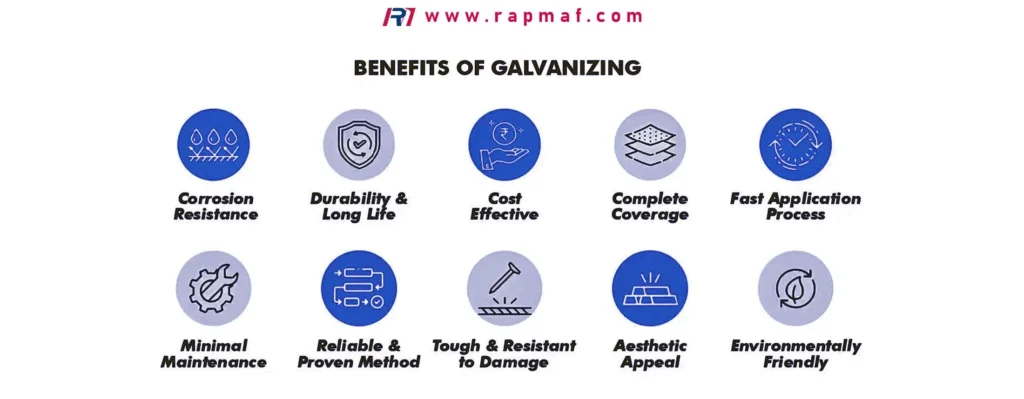
Advantage 1: Unmatched Durability and Lowest Lifetime Cost
This is the single most important reason engineers choose galvanizing. While the upfront cost of hot-dip galvanizing is often higher than applying a high-performance paint system, its lifetime cost is drastically lower.
- Longevity: A properly galvanized coating can last for 50 to 100+ years in most atmospheric environments without any maintenance. In harsh industrial or coastal zones, it can still provide 30-50 years of protection.
- Zero Maintenance: Paint and other barrier coatings require periodic inspection, touch-ups, and complete repainting cycles every 5-15 years. This involves labor, materials, and potential downtime for the asset. Galvanizing eliminates these recurring costs entirely.
- Physical Toughness: The intermetallic alloy layers formed during the galvanizing process are harder than the base steel itself. This gives galvanized steel exceptional resistance to mechanical damage from shipping, handling, installation, and general use—a major weakness of paint.
For public infrastructure projects like bridges, guardrails, and utility poles, the “install it and forget it” nature of galvanizing makes it the most economically sound choice over the life of the project.
Advantage 2: Complete and Reliable Coverage
Paint is applied to a surface; galvanizing becomes part of it. The dipping process ensures total immersion, meaning every part of the steel object is coated—inside and out.
- Internal Protection: Hollow structures, pipes, and complex fabrications are protected on internal surfaces that are impossible to reach with a spray gun or brush.
- Edge and Corner Protection: Coatings like paint tend to pull away and become thinner at sharp corners and edges, which are often the first points of failure. Galvanizing creates a coating that is at least as thick, and often thicker, at these critical points.
- Self-Inspecting: The metallurgical reaction that forms the coating will only occur on a perfectly clean steel surface. Any gaps or flaws in the coating (known as “bare spots”) are immediately obvious during inspection. An area that looks coated is coated. This makes quality control simple and highly reliable.
Advantage 3: Superior Sacrificial Protection
This is the scientific trump card of galvanizing. Unlike a simple barrier coating like paint, zinc is “sacrificial.” As we explained in Part 1, zinc is more electrochemically active than iron (steel).
If a galvanized coating is deeply scratched or damaged to the point where the base steel is exposed, the surrounding zinc coating will corrode first, creating a protective electrochemical “halo” that prevents rust from forming on the steel. A scratch on a painted surface immediately becomes a focal point for rust, which then creeps under the paint film and causes it to fail. A scratch on a galvanized surface is self-healing.
The Critical Disadvantages
Disadvantage 1: Limited to Factory Application and Size Constraints
Hot-dip galvanizing is a factory-based industrial process. This presents two limitations:
- Size: The steel object must be small enough to fit completely into the cleaning tanks and the molten zinc kettle. While galvanizing kettles can be very large (often over 50 feet long), there is always a physical limit. This makes it unsuitable for massive, pre-assembled structures.
- Portability: You cannot “galvanize” something on-site. For existing structures or for repair work, other methods like applying zinc-rich paint or thermal spray (metallizing) must be used.
Disadvantage 2: Aesthetic Inconsistency and Limited Control
While engineers love galvanizing for its performance, architects are often less enthusiastic. The final appearance can be unpredictable.
- Variable Finish: The surface can range from bright and shiny with a visible crystalline “spangle” pattern to a dull, uniform matte grey. This variation depends on the steel chemistry, cooling rate, and other factors. Achieving a perfectly consistent look across multiple parts can be challenging.
- No Color Choice: The finish is metallic. If a specific color is required for branding or design purposes, the galvanized steel must be prepared and painted afterward in a “duplex system,” which adds significant cost. In contrast, paint and powder coating offer a nearly infinite range of colors and finishes (gloss, satin, matte) from the start.
Disadvantage 3: Potential for Warping and Distortion
The high temperature of the molten zinc bath (~840°F / 450°C) is a key part of the process, but it can also be a liability. Immersing a fabricated steel assembly in this heat can relieve internal stresses locked into the steel from rolling, bending, and welding. This stress relief can cause thin, long parts or complex welded assemblies to warp or distort.
Engineers must account for this by adding temporary bracing, using symmetrical designs, and specifying appropriate steel grades. However, for very delicate or thin-gauge items, the risk of distortion may be too high.
The Final Verdict: When to Galvanize
The choice becomes clear when you define your priorities.
- Choose Hot-Dip Galvanizing when: Your primary goal is maximum, long-term corrosion protection with minimal to zero maintenance. It is the ideal choice for structural and industrial applications where durability and low lifetime cost trump aesthetic considerations. Think guardrails, structural beams, utility towers, boat trailers, and heavy-duty outdoor hardware.
- Avoid Hot-Dip Galvanizing when: Precise, uniform aesthetic control is the top priority. It is also unsuitable for parts that are too large to be dipped or for thin, delicate fabrications that are at high risk of heat distortion. In these cases, high-performance paint systems, powder coating, or stainless steel may be better alternatives.
By understanding both the science and the practical trade-offs, you can confidently choose the right protection for your steel, ensuring it stands the test of time.
FAQs about Galvanizing
1. What is the main purpose of galvanizing?
The main purpose is to protect steel or iron from corrosion (rusting). It does this in two ways: by creating a durable physical barrier of zinc that seals the steel from the environment, and by providing “sacrificial” electrochemical protection, where the zinc coating corrodes first to protect any scratches or exposed areas of the steel.
2. How long does a galvanized coating last?
The lifespan depends heavily on the environment. In a mild, rural environment, a hot-dip galvanized coating can last over 100 years. In a more corrosive urban or coastal environment, it can last from 30 to 70 years. This longevity with zero maintenance is its primary advantage over paint.
3. Can you paint over galvanized steel?
Yes, but it requires special preparation. Freshly galvanized steel has a smooth, passive surface that paint does not adhere to well. The surface must first be properly cleaned and often profiled (e.g., through sweep blasting) and then treated with a specialized wash primer or an appropriate direct-to-galv primer before the topcoats are applied. This combined system is called a “duplex coating” and offers the ultimate in protection and aesthetics.
4. What’s the difference between galvanizing and zinc plating (electro-galvanizing)?
The key differences are the process, thickness, and bond. Hot-dip galvanizing involves immersing steel in molten zinc, creating a thick (45-100+ µm) and metallurgically bonded alloy coating. Zinc plating uses an electrical current to deposit a very thin (5-25 µm), mechanically adhered layer of zinc. As a result, hot-dip galvanizing is far more durable and corrosion-resistant, suitable for outdoors, while zinc plating is typically used for indoor hardware and decorative finishes.
References
- American Galvanizers Association (AGA). (The primary industry association providing technical resources, specifications, and case studies on hot-dip galvanizing).
- ASTM International – Standard A123/A123M. (The formal specification for Zinc (Hot-Dip Galvanized) Coatings on Iron and Steel Products, which governs the quality and inspection standards for the process).
Disclaimer
The information on this page is for informational purposes only. RM makes no representations or warranties, express or implied, as to the accuracy or completeness of this information. For any third-party services procured through the RM network, it is the buyer’s responsibility to specify and confirm performance parameters, tolerances, materials, and workmanship during the quotation process. For more detailed information, please do not hesitate to contact us.
RM: Your Precision Manufacturing Partner
RM is an industry leader in custom manufacturing solutions. With over 20 years of profound experience, we have become the trusted partner for more than 5,000 clients worldwide. We specialize in a comprehensive range of manufacturing services—including high-precision CNC machining, sheet metal fabrication, 3D printing, injection molding, and metal stamping—to provide you with a true one-stop-shop experience.
Our world-class facility is equipped with over 100 state-of-the-art 5-axis machining centers and operates in strict compliance with the ISO 9001:2015 quality management system. We are dedicated to providing solutions that blend speed, efficiency, and exceptional quality to customers in over 150 countries. From rapid prototyping to large-scale production, we promise delivery in as fast as 24 hours, helping you gain a competitive edge in the market. Choosing RM means selecting an efficient, reliable, and professional manufacturing ally.
Explore our capabilities today by visiting our website: www.rapmaf.com