


When the majority of people listen to “welding,” they visualize a mask, sparks flying, and liquid steel. They focus on the warmth and the bright light.
Yet when I listen to “welding,” I think about the gas.
Without the appropriate gas, that gorgeous weld puddle comes to be a solidified sponge filled with holes. Welding is not practically melting metal; it is about shielding that thawed metal from the atmosphere. If you attempt to weld without gas (or with the wrong gas), the oxygen and nitrogen in the air will attack your liquified swimming pool instantly.
So, what gas is utilized for welding?
The brief answer: It relies entirely on the process (MIG vs. TIG), the transfer mode (Short Circuit vs. Spray), and the product (Steel vs. Aluminum).
The most usual gases are Argon, CO2 (Carbon Dioxide), Oxygen, and Helium.
As someone that has melted countless extra pounds of cord and changed extra gas cylinders than I care to count, I am mosting likely to damage down precisely what is in those storage tanks. This is not just a listing; this is a deep dive into the physics of the arc, the chemistry of the puddle, and why utilizing the incorrect cylinder will destroy your task.
The Physics: Why Do We Need Gas Anyway?
Before we chat regarding which gas to acquire, we have to comprehend what the gas is in fact doing. It has two work, and they are equally crucial.
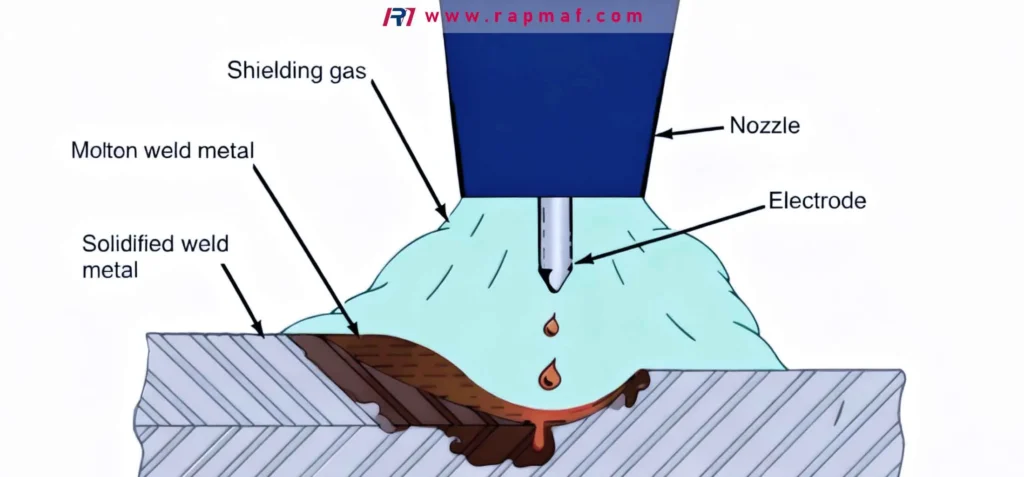
1. Shielding (The Umbrella)
The environment around us is approximately 78% Nitrogen, 21% Oxygen, and 1% Argon/other stuff.
Molten steel dislikes Oxygen. If liquid steel touches Oxygen, it oxidizes quickly. In welding, we call this “porosity.” It looks like Swiss Cheese inside your weld.
Molten steel additionally hates Nitrogen. Nitrogen triggers brittleness.
The welding gas functions as a high-pressure umbrella. It impacts out of the nozzle and pushes the environment away, creating a short-lived bubble of purity where the metal can fuse together without getting polluted.
2. Ionization (The Highway)
This is the component most people neglect. The gas is not just a guard; it is the conductor for the electrical energy.
In order for the electric arc to leap from your torch to the metal, the gas in between need to transform into Plasma. The gas atoms need to lose electrons (ionize) to permit the present to flow.
Different gases ionize at different voltage degrees.
- Argon ionizes easily ( reduced voltage).
- Helium is hard to ionize ( high voltage).
This is why Helium burns hotter– it needs more energy simply to develop the arc.
The “Big 3” Gases: A Deep Dive
We do not just grab any type of container. We choose based upon physics. Here are the main players in the welding globe.
1. Argon (The Lazy Gas)
- Chemical Sign: Ar.
- The Function: It is an Inert Gas. It does not intend to react with anything. It simply sits there and presses the air away.
- Density: It is much heavier than air. This is great because it sinks down over your weld puddle like a hefty covering.
- Ionization Potential: Low. It is easy to start an arc with Argon.
- Best For: TIG welding whatever; MIG welding Aluminum.
Clive’s Shop Rule:
If you are TIG welding, it is Argon. Duration. Don’t attempt to conserve money with CO2; you will certainly burn up your tungsten electrode in 2 secs. The tungsten demands an oxygen-free environment to endure the heat.”
2. CO2 (Carbon Dioxide – The Reactive One)
- Chemical Symbol: CO2.
- The Feature: It is a Semi-Inert (Reactive) Gas. Under the intense heat of the arc, it splits apart into Carbon Monoxide Gas and Oxygen.
- The Effect: Because it releases Oxygen, it makes the weld puddle hotter and assists the weld dig deeper into the steel (infiltration). However, that totally free Oxygen additionally creates Iron Oxide, which is why CO2 welds have brownish glass islands (silica) on top of them.
- Best For: MIG welding simple steel (cheaply) with Short-Circuit transfer.
- The Trade-off: It is the least expensive gas, but it produces a rougher arc and even more spatter (triggering).
3. Helium (The Hot Gas)
- Chemical Sign: He.
- The Feature: Inert, but extremely light. Since it is lighter than air, it floats away instantly. You need two times as much flow rate to get excellent coverage.
- Thermal Conductivity: High. Helium conducts heat extremely well. It makes the arc broader and hotter.
- Best For: Thick Aluminum or automated TIG welding where speed is everything.
MIG Welding Gas: The “Cocktail” Science
This is where novices obtain confused. In MIG (GMAW) welding, we hardly ever make use of pure gas for steel. We utilize blends (Cocktails). We mix an inert gas (Argon) with a reactive gas (CO2 or Oxygen) to get the excellent arc characteristics.
The Standard: C25 (75% Argon/ 25% CO2)
If you have a MIG welder in your garage, this is the container you require. It is the “Goldilocks” gas.
- Why not pure Argon? If you utilize pure Argon on steel, the arc doesn’t want to dig in. It sits on top of the plate. The grain account looks high and slim (undercut).
- Why not pure CO2? It splashes excessive and creates a harsh bead.
- The 75/25 Solution: The Argon supports the arc so it runs efficiently. The 25% CO2 adds just enough oxidation to let the weld puddle “wet out” flat and attack right into the sides of the joint.
When to Utilize It:
- General construction (Tube, angle iron).
- Vehicle bodywork.
- House repair work.
The Tri-Mix (Stainless Steel)
If you attempt to weld Stainless Steel with regular C25 gas, the weld will turn black and corroded. You have destroyed the corrosion resistance of the stainless.
You need a Tri-Mix: Generally 90% Helium + 7.5% Argon + 2.5% CO2.
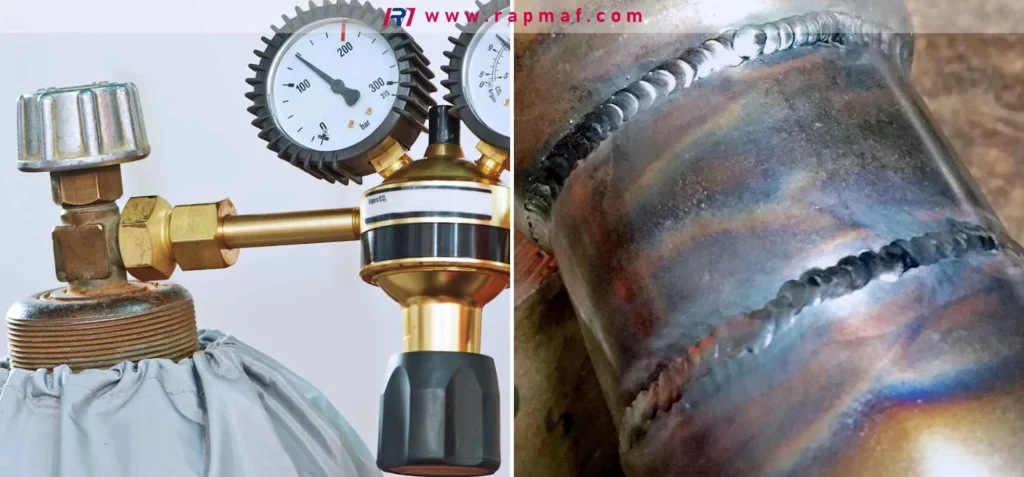
- The Science: Stainless steel has a thick oxide layer. The huge quantity of Helium offers the warmth punch required to break through that layer. The small little bit of CO2 assists stabilize the arc, but it is reduced enough that it doesn’t contaminate the chrome in the stainless.
The Oxygen Mixes (Spray Transfer)
For hefty production (constructing ships or bridges), we utilize Spray Transfer. This is where the cable thaws prior to it strikes the plate, spraying like paint.
For this, you require 98% Argon/ 2% Oxygen.
The Oxygen minimizes the surface stress of the liquified droplet, allowing it to spray efficiently. You can not do Spray Transfer with C25 gas; the CO2 content is expensive.
TIG Welding Gas: The Pursuit of Purity
TIG (GTAW) is the refined art of welding. Unlike MIG, we do not desire any kind of chemical reaction in the arc. We need absolute purity.
The Rule: 100% Pure Argon
It matters not if you are welding Steel, Stainless, or Light weight aluminum. For 99% of TIG jobs, you desire pure Argon.
Clive’s Warning on Purity:
“Gas purity is measured in ‘Nines.’ Standard welding Argon is usually 99.995% pure.
If you are welding Titanium, that is not great enough. Titanium is so sensitive to oxygen that even 0.005% air will make the weld brittle (alpha case). For Titanium, we buy Research study Quality Argon (99.999% pure). It sets you back dual, but a fractured plane part costs a whole lot more.”
When to Add Helium to TIG?
If you are welding a 1-inch thick aluminum engine block, pure Argon may not be warm sufficient. The aluminum draws the warm away faster than the lantern can place it in.
Solution: Utilize a 50/50 or 75/25 Argon/Helium mix.
The Helium increases the arc voltage. It is like changing your lantern from a garden hose pipe to a fire tube. The puddle melts instantly.
Flow Rate: The Silent Killer
Selecting the appropriate gas is just half the battle. You have to set the Flow Rate properly. This is determined in CFH (Cubic Feet per Hour), not PSI.
The Goldilocks Zone (15 – 25 CFH)
For most common nozzles (# 7 or # 8 mug), you desire your regulator established in between 15 and 25 CFH.
Can You Have Too Much Gas?
Yes. This is the # 1 error I see newbies make. They think “Much more gas = Much better protection.”
Wrong.
If you crank the regulator as much as 40 or 50 CFH, the gas appears like a jet engine. It hits the metal so hard that it develops Turbulence.
Think of turning on a kitchen tap full blast into a cup of coffee. It splashes anywhere.
When welding gas is stormy, it pulls outside air into the stream (Venturi effect). So, ironically, utilizing too much gas creates even more porosity than making use of insufficient.
Gas Lenses: The Secret Weapon
If you wish to boost your shielding without transforming gases, purchase a Gas Lens for your TIG torch.
A standard nozzle shoots gas out like a chaotic fire hose.
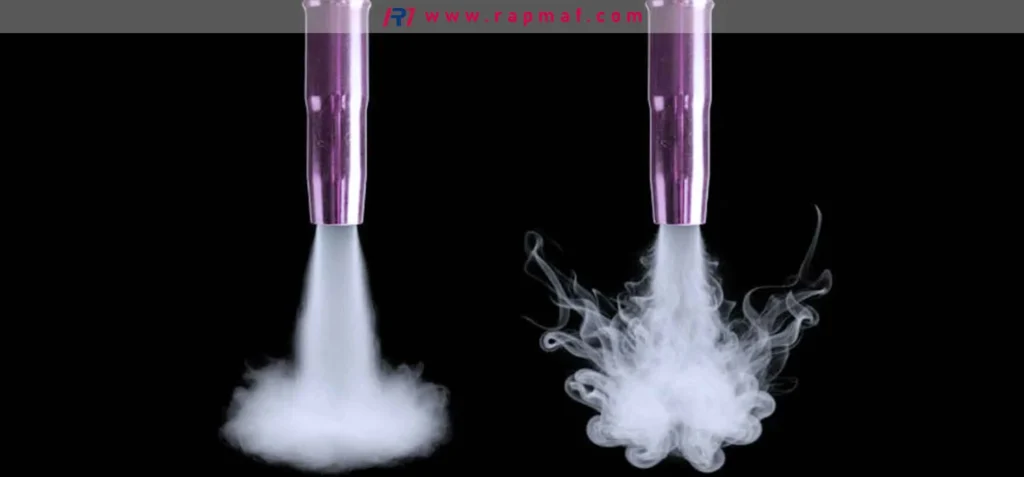
A gas lens has a series of mesh screens inside. It aligns the gas circulation into a perfect laminar column (like water from a showerhead).
Benefits:
- You can stick your tungsten out even more (great for limited corners).
- You get better protection at lower circulation prices ( saves money).
Back Purging: What Happens Behind the Seam?
If you are welding a pipe, you are fretting regarding the outside weld. But what regarding the within?
If you weld Stainless Steel pipe, the warmth passes through to the inside. If the inside contains air, the back of the weld will certainly “sugar.”
Sugaring is huge oxidation. It looks like black cauliflower. If this is a food pipe or an exhaust pipeline, that roughness creates germs development or turbulence.
The Solution: Back Purging.
You must tape off the ends of the pipeline and pump Argon inside. You change the air with Argon. Only then can you bonded.
For large pipelines where filling up the entire point with Argon is also pricey, we make use of Solar Flux. It is a powder mixed with alcohol that you paint on the back of the seam. It turns into a glass guard when warmed.
Oxy-Fuel: The Gas That Burns
Every little thing over was “Shielding Gas” (stopping air from touching the weld).
However what about the gas that in fact produces the fire for reducing or brazing?
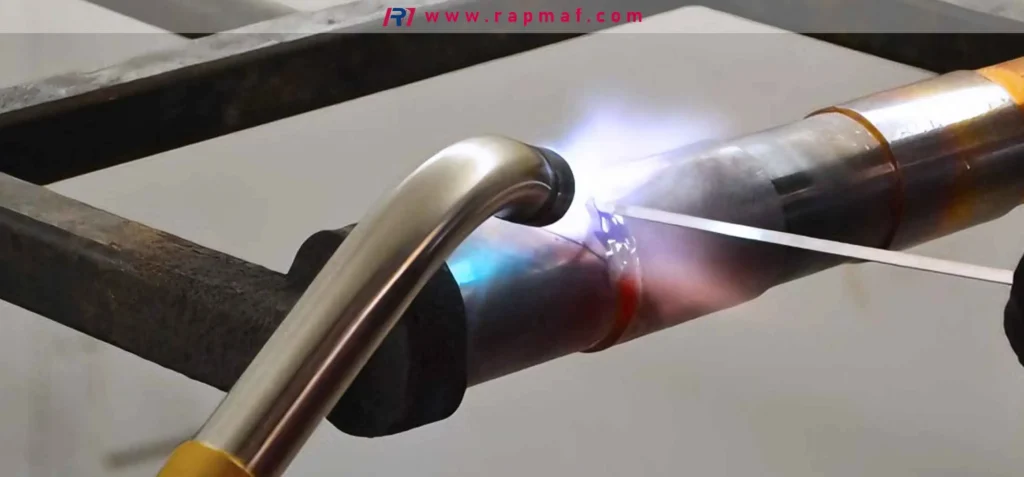
That is Acetylene.
- Chemical Formula: C2H2.
- Why Acetylene? When mixed with pure Oxygen, it burns at 5,700 ° F( 3,150 ° C). It is the only gas fuel hot enough to bonded steel without an electric arc.
- Can I use Propane?
- For Reducing: Yes. Propane works fine for cutting scrap metal. It is cheaper.
- For Welding: No. Propane does not shed hot sufficient, and it creates oxides in the puddle. You can not gas bonded with propane.
Safety Note:
Acetylene is unstable. Never ever run an Acetylene storage tank above 15 PSI. If you discuss 15 PSI, the gas becomes unsteady and can take off automatically inside the hose.
Cost Analysis: Argon vs. CO2
If you are running a service, the price of the gas issues.
- CO2: The least expensive. A refill may set you back $20-$ 30. If visual appeal do not matter (like on a dumpster or a ranch fencing), use CO2.
- C25 (Argon/CO2): The criterion. Costs about $50-$ 70 for a refill. It deserves the additional expense for the reduced spatter (less grinding later on).
- Pure Argon: Similar rate to C25.
- Tri-Mix (Helium blends): The most expensive. Helium is a finite resource. A container of Tri-Mix can set you back $150 – $200. Only use this if you are bonded stainless or aerospace components.
FAQ: Common Myths & Quick Solutions
Here are the solution to the inquiries I see key in Google each day.
Q: Can I utilize Argon for whatever?
A: No.
- For TIG: Yes, it is the universal gas.
- For MIG Steel: No. Pure Argon creates a bizarre, high arc on steel that does not dig in (undercut). You need at least 5% CO2 or Oxygen blended in to support the arc.
- For MIG Aluminum: Yes. You need pure Argon.
Q: Which gas is made use of for welding steel?
A: For MIG welding steel, the market standard is 75% Argon/ 25% CO2.
If you are on a budget plan or welding on a ranch (exterior), you can make use of 100% CO2, however anticipate a great deal of sparks (spatter).
Q: Is welding gas combustible?
A: Shielding gases (Argon, CO2, Helium) are Non-Flammable. In fact, they put out fires.
Fuel gases (Acetylene, Propane, Hydrogen) are Extremely Combustible.
Oxygen itself does not melt, but it is an “accelerant.” If you spray pure Oxygen on a greasy dustcloth, it can spontaneously stir up. Never ever utilize oxygen to blow dust off your clothing.
Q: Can I blend my own gas?
A: No. DO NOT try this.
Gas mixing calls for specific regulatory authorities and mixers. If you try to attach 2 tanks into one hose pipe without the best devices, the stress difference can cause one tank to backfill right into the various other, creating a possible bomb. Buy pre-mixed cylinders from your supplier.
Q: How long does a tank last?
A: It depends on your circulation rate.
Calculation: If you have an 80 cubic foot tank (a common dimension for hobbyists) and you establish your regulator to 20 CFH.
80 divided by 20 = 4 Hours of continuous trigger time.
Because you aren’t welding continuously, this generally lasts a hobbyist a few weekends.
Final Verdict
So, what gas is used for welding?
The response is not “Air.”
If you are MIG welding steel in your garage: Get a container of 75/25 (Argon/CO2).
If you are TIG welding anything: Obtain a container of Pure Argon.
If you are reducing steel with a lantern: Obtain Oxygen and Acetylene.
It is invisible, expensive, and frustrating to re-fill, yet the gas is just as crucial as the steel itself. Without it, you aren’t welding– you are simply making dazzling popcorn.
Deep Dive & Authority Links
For those who intend to dig deeper into the chemistry and safety laws:
- Miller Welds: Shielding Gas Selection Overview
- The bible for selecting the right mix for specific alloys.
- Lincoln Electric: Welding Fume Safety And Security
- Recognize what you are breathing in (specifically Manganese fumes).
- American Welding Culture (AWS): Standard Gas Designations
- The official codes for gas blends used in aerospace and structural codes.