



Quick Answer: What is a Heat Sink?
In engineering and electronics, a heat sink is a passive heat exchanger designed to dissipate unwanted heat from a heat-generating component (like a computer CPU or an LED) into a surrounding fluid medium, usually air or a liquid coolant. It accomplishes this by using a material with high thermal conductivity and a large surface area to accelerate the transfer of thermal energy, preventing the component from overheating and failing.
Before We Begin: A Critical Clarification
The term “heat sink” is used in several different scientific fields, which is why a simple Google search can be confusing. Before we dive deep into the engineered components we design and build at RM, let’s quickly clarify the other meanings you might have encountered:
- In Climate Science: A “heat sink” refers to a natural or artificial reservoir that absorbs and stores thermal energy from the atmosphere. The most significant natural heat sink on our planet is the ocean, which has absorbed over 90% of the excess heat from global warming. Forests and soil also act as heat sinks.
- In Biology: The term is used in the “source-sink” model of physiology. A “sink” is any tissue or organ that consumes or stores sugars or nutrients produced by a “source” (like a photosynthesizing leaf). A growing fruit or root is a biological sink.
For the remainder of this definitive guide, our focus will be exclusively on the engineered heat sink—the physical component that is the unsung hero of the entire electronics industry.
Why Trust RM’s Expertise on Heat Sinks?
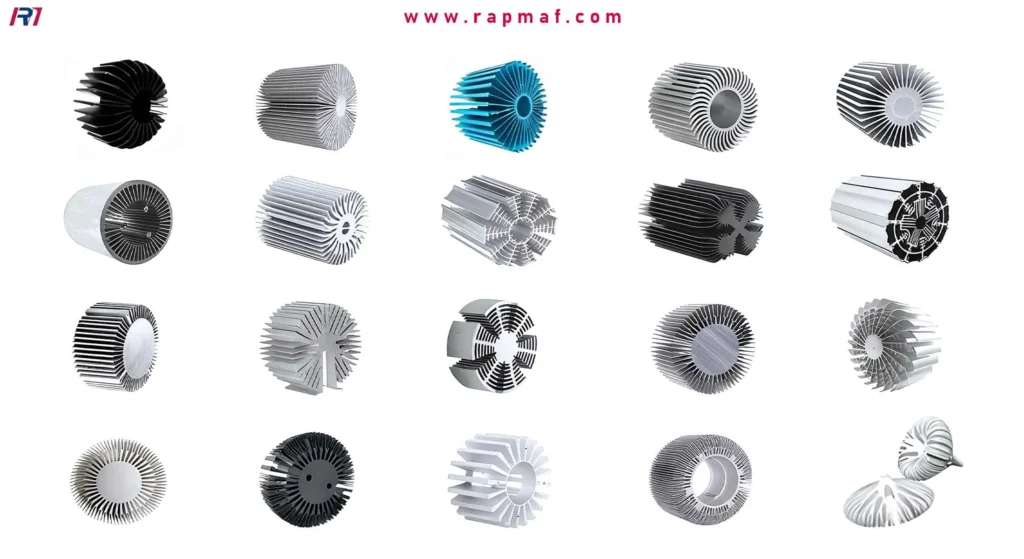
My name is Clive, and I’m a lead engineer at RM (Rapid Manufacturing). Overheating isn’t just a theoretical problem for us; it’s the number one enemy of performance and reliability. We don’t just use off-the-shelf heat sinks; we design, analyze, and manufacture custom thermal management solutions for our clients in the medical, industrial, and high-performance computing sectors. From CNC machining complex fin geometries in solid copper to extruding cost-effective aluminum profiles, we have hands-on experience with the materials, methods, and physics that separate a simple “chunk of metal” from a high-performance thermal solution. This guide is built on that real-world experience.
The Unavoidable Enemy: The Physics of Heat
Every electronic component is imperfect. When electricity flows through a processor, a power transistor, or an LED, a portion of that electrical energy is inevitably converted into waste heat due to electrical resistance. This is governed by the laws of thermodynamics.
If this heat is not removed, the temperature of the component will rise rapidly. This leads to a cascade of problems:
- Reduced Performance: Processors “thermal throttle,” intentionally slowing down to protect themselves.
- Decreased Lifespan: High temperatures accelerate the degradation of semiconductor materials, drastically shortening the component’s life.
- Outright Failure: Excessive heat can cause physical damage, leading to immediate and permanent failure.
The heat sink’s one and only job is to provide a controlled pathway for this waste heat to escape before it can do any damage.
How a Heat Sink Actually Works: The Three Laws of Heat Transfer
A heat sink is not magic. It’s a clever application of three fundamental principles of heat transfer, working in a sequence.
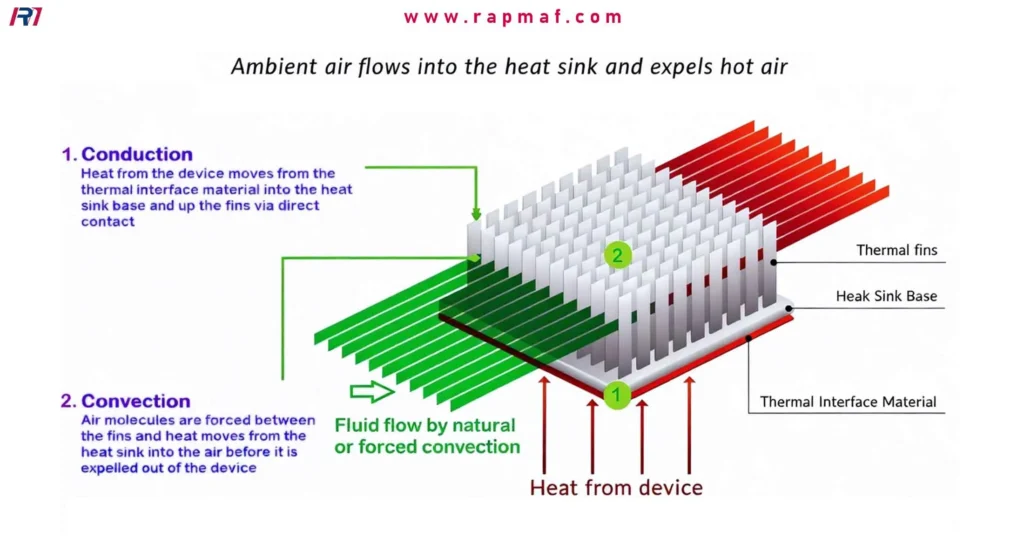
- Step 1: Conduction (The Source to the Sink)
The process starts with conduction. The heat-generating component (e.g., a CPU) is in direct contact with the flat base of the heat sink. Because the heat sink is made of a highly conductive material like aluminum or copper, the thermal energy (the vibration of atoms) transfers directly from the hot component into the cooler base of the sink. Think of it like the handle of a metal spoon getting hot when you leave it in a cup of hot coffee. The heat travels through the solid material. - Step 2: Conduction (Up Through the Fins)
Once the heat is in the base, conduction continues to move it up and out into the heat sink’s most prominent feature: the fins. The entire purpose of the fins is to dramatically increase the surface area of the device. A flat base might only have a surface area of a few square inches, but by adding dozens of thin fins, we can increase that surface area by 10x, 20x, or even 50x. - Step 3: Convection & Radiation (From the Sink to the Air)
Now that the heat is spread out over this massive surface area, the final step is to get it away from the heat sink and into the surrounding air. This happens in two ways:- Convection: This is the primary method. Air molecules that come into contact with the hot fins absorb thermal energy, become less dense, and rise. This movement creates a “convection current” as cooler, denser air moves in to take its place, repeating the cycle. This is the same principle that makes a hot air balloon rise.
- Radiation: All objects with a temperature above absolute zero emit thermal energy in the form of infrared radiation. While less significant than convection in most standard applications, the heat sink also radiates heat away into its surroundings. Anodizing a heat sink black can significantly improve its radiative efficiency.
The Unsung Hero: Thermal Interface Material (TIM)
You might think that simply clamping a flat heat sink onto a flat CPU would be enough for perfect conduction. You’d be wrong. On a microscopic level, even the most beautifully machined surfaces are not perfectly flat. They have tiny peaks and valleys. When you press them together, you create thousands of microscopic air gaps.
Air is a terrible conductor of heat. It’s an insulator. These air gaps act as a massive barrier, preventing heat from efficiently moving from the component to the heat sink.
This is where Thermal Interface Material (TIM) comes in. This is the “heat sink paste,” “thermal grease,” or “thermal pad” you’ve heard of.
- What It Is: TIM is a thermally conductive (but usually electrically insulating) substance that is applied in a very thin layer between the component and the heat sink.
- What It Does: Its purpose is to fill those microscopic air gaps. While the TIM itself isn’t as conductive as pure copper or aluminum, it is thousands of times more conductive than air. By displacing the insulating air, it creates a continuous, uninterrupted path for heat to flow, dramatically improving the efficiency of conduction. Using a heat sink without TIM is like trying to run a marathon with a sprained ankle—you’re crippling its performance from the very start.
The Great Divide: Active vs. Passive Heat Sinks
Not all heat sinks are created equal. The single biggest design choice that dictates a heat sink’s size, performance, and application is whether it is Passive or Active. This choice is all about how we manage the final, crucial step of heat transfer: convection.
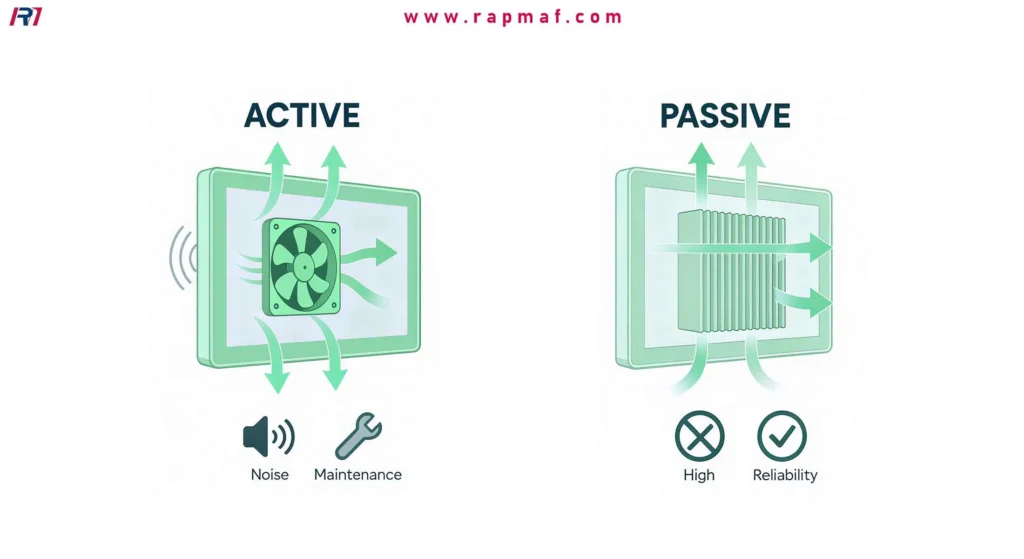
Passive Heat Sinks: The Silent Guardians
A passive heat sink is the purest form of the device. It has no moving parts. It relies entirely on the natural phenomenon of free convection to dissipate heat. As we discussed, the air touching the fins gets hot, becomes less dense, and naturally rises, allowing cooler air to take its place.
- Key Characteristics:
- Silent Operation: With no fan, they produce zero noise, making them ideal for audio equipment, home theater PCs, and office environments.
- Extreme Reliability: The absence of moving parts means there is nothing to wear out, break down, or fail. A solid block of metal has an essentially infinite lifespan.
- No Power Consumption: They don’t require any power to operate.
- Dust Immunity: While they still collect dust, it doesn’t cause a mechanical failure as it would by clogging a fan motor.
- The Inescapable Trade-Off:
Natural convection is a relatively inefficient process. To dissipate a significant amount of heat passively, you need a massive surface area. This means passive heat sinks are often much larger and heavier than active ones designed for the same thermal load. Their performance is entirely limited by the ambient air temperature and natural airflow. - Where You’ll Find Them: They are perfect for low-to-moderate heat loads where silence and reliability are paramount. Think of the back of your Wi-Fi router, the amplifier in your stereo system, or low-power industrial control boards.
Active Heat Sinks: The Power Performers
An active heat sink takes the principle of convection and puts it on steroids. It adds a mechanical component—almost always a fan—to force air across the fins. This is called forced convection.
By actively moving a large volume of cool air over the fins every second, we dramatically accelerate the rate of heat transfer. The difference is not subtle; it’s a game-changer.
- Key Characteristics:
- Massively Superior Performance: An active heat sink can dissipate a huge amount of heat from a very small volume. It can handle high Thermal Design Power (TDP) components with ease.
- Compact Size: For a given TDP, an active cooler will be significantly smaller and lighter than a passive equivalent.
- The Inescapable Trade-Offs:
- Noise: The fan generates noise, which can be a major issue in quiet environments.
- Failure Point: The fan is a mechanical component with bearings that can wear out, a motor that can fail, and blades that can break. If the fan dies, the heat sink’s performance plummets to a level far below even a good passive cooler, which can quickly lead to catastrophic component failure.
- Dust Magnet: The fan actively pulls in dust-laden air, which clogs the fins over time. This acts like a blanket, insulating the fins and drastically reducing performance. Active coolers require regular cleaning to maintain their effectiveness.
- Where You’ll Find Them: They are essential for high-performance applications where a lot of heat must be removed from a small space. The CPU cooler in your desktop PC, the cooling assembly on your graphics card, and server racks are all prime examples of active cooling.
Data Table: Active vs. Passive at a Glance
To make the choice crystal clear, here’s a direct comparison based on our engineering criteria at RM:
| Feature | Passive Heat Sink | Active Heat Sink |
|---|---|---|
| Cooling Principle | Natural Convection | Forced Convection (Fan) |
| TDP Capacity | Low to Moderate (< 35W typical) | Moderate to Very High (> 150W typical) |
| Size / Weight | Very large for its TDP | Compact for its TDP |
| Reliability | Extremely high (no moving parts) | Lower (fan is a mechanical failure point) |
| Noise Level | Silent (0 dBA) | Audible to Loud (20-40 dBA typical) |
| Maintenance | Minimal (occasional dusting) | Required (regular cleaning of fins and fan) |
| Power Requirement | None | Requires power for the fan |
| Typical Use Case | Routers, low-power CPUs, audio amps | Gaming PCs, servers, high-power LEDs |
| Relative Cost | Can be high due to sheer mass of material | Generally lower cost for equivalent performance |
The Heart of the Matter: Heat Sink Materials
The performance of a heat sink is fundamentally tied to the material it’s made from. The single most important property we look at is Thermal Conductivity, measured in watts per meter-Kelvin (W/m·K). In simple terms, this number tells you how quickly and efficiently a material can conduct heat. A higher number is always better.
But as with all engineering, the “best” material isn’t just about one number. It’s a complex trade-off between thermal performance, weight, cost, and manufacturability.
Aluminum (Alloys 6061 & 6063): The Industry Workhorse
If you’ve seen a heat sink, you’ve probably seen an aluminum one.
- Thermal Conductivity: ~180-200 W/m·K.
- Why It Dominates: The reason for aluminum’s ubiquity is simple: it offers the best cost-to-performance ratio on the market. It’s not the best conductor, but it’s very good, and it’s incredibly lightweight, corrosion-resistant, and—most importantly—easy to manufacture. The vast majority of heat sinks are made via aluminum extrusion, a process that allows for complex fin profiles to be created very cheaply at high volumes.
- Best Use Case: It’s the default choice for 90% of thermal management solutions, from your computer’s motherboard chipset to massive industrial power supplies.
Copper (C110): The High-Performance Champion
When raw performance is the only thing that matters, engineers turn to copper.
- Thermal Conductivity: ~400 W/m·K.
- Why It’s Special: With nearly double the thermal conductivity of aluminum, copper can move heat away from a source much, much faster. This is critical when dealing with very small, very hot components (like a modern CPU die). The heat can “soak” into the copper and spread out to the fins more efficiently, preventing a localized hot spot from forming.
- The Downsides: This performance comes at a steep price. Copper is over three times heavier than aluminum, significantly more expensive, and more difficult to machine. It cannot be easily extruded into the complex fin shapes that aluminum can.
- Best Use Case: It’s used where performance is critical and cost/weight are secondary concerns. High-end CPU coolers often use a solid copper base plate to make direct contact with the CPU.
The Best of Both Worlds: Hybrid Copper/Aluminum Designs
This is where smart engineering comes in. The most popular high-performance air coolers today use a hybrid design that leverages the strengths of both metals.
- The Design: They feature a solid copper base that makes direct contact with the heat source. This allows the superior conductivity of copper to rapidly pull the intense, concentrated heat away from the tiny component die.
- The Fins: The heat is then transferred (often via heat pipes, another technology) up into a large stack of aluminum fins. Here, the lower conductivity of aluminum is less of a factor, but its light weight and low cost are huge advantages, allowing for a massive surface area without making the cooler prohibitively heavy or expensive.
Data Table: Material Properties at a Glance
| Material | Thermal Conductivity (W/m·K) | Density (g/cm³) | Relative Cost (Approx.) | Key Advantage |
|---|---|---|---|---|
| Aluminum (6063) | ~200 | 2.7 | 1x | Best all-around cost-performance |
| Copper (C110) | ~400 | 8.9 | 3x – 4x | Highest thermal performance |
| Steel (Carbon) | ~50 | 7.8 | 0.5x | Strength (rarely used for sinks) |
| Silver | ~429 | 10.5 | 100x+ | The best conventional conductor |
A Real-World Case Study: Preventing Failure in a Medical Imaging Cart
At RM, we were approached by a client developing a mobile medical imaging cart. Their problem was a classic thermal challenge.
- The Client’s Problem: The cart’s powerful onboard processing unit was housed in a fully sealed, fanless enclosure to meet strict hospital hygiene standards (no fans to blow dust/pathogens) and noise regulations. During long imaging sessions, the processor would overheat, causing the system to crash—a completely unacceptable failure in a medical environment.
- Our Analysis (Clive’s Perspective): The client’s initial design used a simple, extruded aluminum heat sink inside the sealed box. Our thermal simulations (CFD analysis) immediately showed the problem. The heat was transferring from the processor to the sink, but with no airflow, the sink itself would just get hot and “saturate.” The air inside the box would stagnate, and the system couldn’t shed heat to the outside world fast enough. The solution needed to cool the chip and get the heat out of the box.
- The RM Solution: An Integrated Thermal Chassis
We proposed a completely new approach. Instead of a small heat sink inside the box, we would make a section of the enclosure’s chassis the heat sink itself.- Material & Design: We CNC machined the entire side panel of the enclosure from a single, thick plate of 6061 aluminum. The inside of the panel was machined with a raised pedestal that would make direct contact with the processor (via a thermal pad). The outside of the panel was machined with a series of thick, robust fins.
- How It Worked: Now, the heat path was direct. Heat conducted from the processor, through the solid aluminum chassis, directly to the external fins.
- Passive & Safe: These external fins were exposed to the ambient air of the hospital room, allowing for effective passive cooling through natural convection. The design remained completely fanless, silent, and sealed, meeting all medical requirements.
- Surface Finish: The entire external panel was black anodized to maximize radiative heat transfer, further boosting its passive cooling performance.
- The Result: The new integrated chassis design kept the processor a full 30°C cooler under maximum load, completely eliminating the system crashes. We didn’t just provide a better heat sink; we re-engineered their thermal management strategy from the ground up, ensuring the product was safe, reliable, and met stringent industry regulations.
How Heat Sinks Are Made: From Raw Metal to Finished Cooler
The design and material are critical, but the manufacturing process dictates the heat sink’s final form, complexity, and cost. At RM, we use several methods depending on the project’s specific needs for performance, volume, and budget.
Extrusion: The King of High-Volume Production
This is, by far, the most common and cost-effective method for creating heat sinks.
- The Process: Imagine a giant Play-Doh press. A heated billet of aluminum (usually 6063 alloy) is forced under immense pressure through a steel die. The die has a cross-sectional profile of the desired fin shape. The aluminum flows through the die, emerging as a long, continuous piece with the fins already formed. It’s then cut to the desired length.
- Why It’s Popular:
- Extremely Low Cost at Volume: The tooling (the die) is a one-time cost. Once it’s made, you can produce thousands of feet of the same profile very, very cheaply.
- Good Performance: Extrusion allows for complex, interlocking fin designs that maximize surface area for a given footprint.
- Limitations:
- Material: It’s almost exclusively used for aluminum.
- Design Constraints: All fins must be parallel to the direction of the extrusion. You cannot create pins, cross-cuts, or other complex 3D geometries.
- Aspect Ratio: There’s a limit to how tall and thin you can make the fins relative to the base thickness.
- Best For: The vast majority of heat sinks for motherboards, power supplies, LED lighting, and general electronics.
CNC Machining: For Ultimate Precision and Prototyping
When performance and complexity are paramount, or when you only need a few parts, we turn to CNC machining.
- The Process: We start with a solid block of aluminum or copper. A computer-controlled milling machine then carves away the excess material with high-speed cutting tools to create the final shape, one pass at a time.
- Why It’s Used:
- Total Design Freedom: We can create virtually any geometry imaginable—tapered fins, complex pins, interlocking patterns, integrated mounting features, and ultra-thin fins that are impossible to extrude. This was the process we used for the medical cart case study.
- Superior Performance: Machining allows for higher aspect ratios and sharper corners, which can improve thermal performance over extruded equivalents.
- Prototyping: It’s the perfect method for creating a few prototypes for testing before committing to expensive extrusion tooling.
- Limitations:
- High Cost: It’s a subtractive process that generates waste material (swarf), and the machine time per part is significant, making it much more expensive than extrusion, especially at scale.
- Best For: High-performance prototypes, custom one-off solutions, military/aerospace components, and designs where thermal performance cannot be compromised.
Forging & Stamping: For Specific Applications
Other methods exist for more niche applications.
- Forging (Cold/Hot): A raw piece of metal is stamped and compressed under extreme pressure to form it into the desired shape. This is excellent for creating round, pin-fin heat sinks often used in high-vibration environments, as the forged structure is incredibly strong.
- Stamped Fins: For very low-cost applications, individual fins can be stamped from thin sheets of metal (like steel or aluminum) and then bonded or soldered onto a base. This is common in consumer electronics where cost is the primary driver.
Data Table: Manufacturing Method Comparison
| Method | Tooling Cost | Piece Price (Volume) | Design Complexity | Performance | Typical Material |
|---|---|---|---|---|---|
| Extrusion | Medium | Very Low | Low (Linear) | Good | Aluminum |
| CNC Machining | None | Very High | Very High | Excellent | Aluminum, Copper |
| Forging | High | Low | Medium (Pins) | Very Good | Aluminum, Copper |
| Stamping | Medium | Very Low | Low (Thin Fins) | Fair | Al, Steel, Copper |
Conclusion: The Unsung Hero of Modern Technology
The heat sink is one of the most underappreciated components in the modern world. It is the silent, steadfast guardian that allows our most advanced technology to function. Without its ability to efficiently and reliably move damaging heat away from sensitive components, the processors in our computers, the power supplies in our medical equipment, and the LEDs that light our world would simply burn out in seconds.
Understanding a heat sink is about more than just knowing “it cools things down.” It’s about appreciating a delicate dance between physics and engineering:
- The Laws of Thermodynamics dictate how heat moves through conduction, convection, and radiation.
- Material Science dictates which material can move that heat most effectively for a given budget and weight.
- Manufacturing Processes dictate the final form that unlocks the material’s potential and makes it economically viable.
Whether it’s a massive, silent, passive cooler on an audiophile’s amplifier or a compact, fan-driven, hybrid copper-aluminum beast inside a gaming PC, the principles remain the same. The next time you see those simple metal fins, you’ll know you’re looking at a critical piece of engineering that makes our digital lives possible.
Heat Sink FAQ
Here are the answers to the most common questions our engineers at RM receive about heat sinks.
- Q1: What does a heat sink do?
A heat sink’s primary job is to transfer thermal energy (heat) from a hot component (like a computer processor) to a cooler medium, which is almost always the surrounding air. It does this by using a material with high thermal conductivity to pull heat away and a large surface area (the fins) to dissipate that heat more efficiently. - Q2: What are the two main types of heat sinks?
The two main types are Passive and Active. A passive heat sink has no moving parts and relies on natural airflow (convection) to dissipate heat. An active heat sink adds a fan or other mechanism to force air across its fins, dramatically increasing its cooling capacity. - Q3: What is a heat sink in climate science?
In climate science, a “heat sink” refers to any part of the Earth system that absorbs more heat than it releases. The most significant heat sink on Earth is the ocean, which has absorbed over 90% of the excess heat trapped by greenhouse gases, slowing the rate of atmospheric warming but leading to ocean warming. - Q4: What is a heat sink in biology?
In biology, the term “heat sink” can be used to describe a physiological mechanism or external factor that helps an organism dissipate excess body heat. For example, large, thin ears on a desert animal like a fennec fox act as a biological heat sink, radiating heat away from the body to the cooler air. - Q5: Can you have a heat sink without thermal paste?
Technically yes, but the performance would be terrible. Even two perfectly flat, polished metal surfaces have microscopic air gaps between them when pressed together. Air is a terrible conductor of heat. Thermal paste (or a thermal pad) is a thermally conductive compound that fills these air gaps, ensuring a solid, efficient path for heat to travel from the component to the heat sink. Skipping it can lead to immediate overheating. - Q6: Why are most heat sinks black?
Heat sinks are often anodized black because a dark, matte surface is a more efficient radiator of thermal energy (heat) than a light, shiny one. This process, called increasing emissivity, enhances the heat sink’s ability to cool itself via the third mode of heat transfer: radiation. While convection is the primary cooling method, radiation still plays a helpful role, and black anodizing maximizes it.
References
To ensure the highest level of accuracy and authority, our engineering insights are cross-referenced with established industry standards and academic research.
- “Introduction to Heat Transfer” by Incropera, DeWitt, Bergman, and Lavine: A foundational university-level textbook that provides the core principles of conduction, convection, and radiation that govern all heat sink design.
- “Thermal Management of Electronics: A Review of the State-of-the-Art” from the IEEE Transactions on Components and Packaging Technologies: This academic paper provides a comprehensive overview of advanced thermal management techniques, including the use of heat pipes and advanced materials.
- Aluminum Extrusion Manual by the Aluminum Association: This industry guide details the standards, tolerances, and design considerations for manufacturing components via aluminum extrusion, the most common method for making heat sinks.
Disclaimer
The information on this page is for informational purposes only. RM makes no representations or warranties, express or implied, as to the accuracy or completeness of this information. For any third-party services procured through the RM network, it is the buyer’s responsibility to specify and confirm performance parameters, tolerances, materials, and workmanship during the quotation process. For more detailed information, please do not hesitate to contact us.
RM: Your Precision Manufacturing Partner
RM is an industry leader in custom manufacturing solutions. With over 20 years of profound experience, we have become the trusted partner for more than 5,000 clients worldwide. We specialize in a comprehensive range of manufacturing services—including high-precision CNC machining, sheet metal fabrication, 3D printing, injection molding, and metal stamping—to provide you with a true one-stop-shop experience.
Our world-class facility is equipped with over 100 state-of-the-art 5-axis machining centers and operates in strict compliance with the ISO 9001:2015 quality management system. We are dedicated to providing solutions that blend speed, efficiency, and exceptional quality to customers in over 150 countries. From rapid prototyping to large-scale production, we promise delivery in as fast as 24 hours, helping you gain a competitive edge in the market. Choosing RM means selecting an efficient, reliable, and professional manufacturing ally.
Explore our capabilities today by visiting our website: www.rapmaf.com







7 Responses