



If you’re asking about the difference between MIG welding and “normal” welding, you’ve hit on one of the most common points of confusion in the entire world of metal fabrication. You’ve likely seen someone welding in a movie or on a farm, with sparks flying from the end of a glowing stick. That’s the image most people have, and it’s a great place to start.
Quick Answer: “Normal welding” usually refers to Stick Welding (SMAW), the classic process using a consumable electrode rod. MIG welding (GMAW) is fundamentally different because it is a semi-automatic process that uses a continuously fed wire and a shielding gas. This makes MIG welding significantly faster and much easier for a beginner to learn.
But that simple answer barely scratches the surface. To truly understand the difference, you need to understand what any welding process must accomplish. Choosing the right one is the difference between a project that’s strong, efficient, and beautiful, and one that’s a weak, frustrating mess.
As engineers and fabricators at RM (Rapid Manufacturing), we don’t just weld; we select the optimal joining process based on materials, project goals, and economics. This guide will walk you through the exact same logic we use on our shop floor.
The Welding Trinity: The 3 Things Every Weld Must Have
Before we can compare any two processes, we need to agree on the fundamentals. No matter how fancy the machine, every successful arc weld is a masterful control of three essential elements, which we’ll call the “Welding Trinity”:
- An Intense Heat Source: To join two pieces of metal, you must melt them. Arc welding creates this heat by forming a high-temperature electric arc between an electrode and the workpiece. This arc is a superheated plasma that can be hotter than the surface of the sun, instantly creating a molten pool of metal called the “weld puddle.
- A Filler Material (Usually): In most cases, you need to add extra metal to the joint to fill the gap and create a strong, reinforced bead. This filler material is designed to have properties that are compatible with, or even superior to, the base metals being joined.
- Shielding from the Atmosphere: This is the most critical and often misunderstood part. Molten metal is extremely reactive. If it’s exposed to the oxygen and nitrogen in the air, it will instantly oxidize and become contaminated, resulting in a porous, brittle, and utterly useless weld. Every welding process must have a strategy to “shield” the molten puddle from the atmosphere until it has solidified.

How a process provides the heat, adds the filler, and creates the shield is what defines it.
The Baseline: What is “Normal” Welding? (Stick / SMAW)
When people say “normal” or “arc” welding, they are almost always talking about Shielded Metal Arc Welding (SMAW), more commonly known as Stick Welding. This is the rugged, go-anywhere grandfather of all welding processes.
Here’s how it masterfully handles the Welding Trinity:
- The Stick: The core of the process is the “stick” itself—a consumable metal rod called an electrode. This rod is the filler metal.
- The Flux Coating: The magic is in the crumbly chemical coating on the outside of the stick, called flux. When the electric arc is struck, this flux coating vaporizes.
- Heat: The arc is formed between the tip of the metal rod and the workpiece, creating the heat.
- Filler: As the arc burns, the metal rod melts and is deposited into the weld puddle, becoming the filler material.
- Shielding: The vaporizing flux does two crucial things. First, it releases a cloud of inert gas that pushes the atmosphere away from the weld puddle. Second, it melts into a liquid slag that floats on top of the molten metal, forming a hard, protective crust as the weld cools.
This slag layer is why you see stick welders chipping away at their finished weld with a hammer—they are removing the protective slag to reveal the clean metal bead underneath.
Why Stick Welding Endures
- Simplicity and Portability: The machines are relatively simple and cheap. Because it doesn’t require an external bottle of gas, it’s incredibly portable.
- Versatility: It’s the undisputed king of welding outdoors in windy conditions, as the flux provides robust shielding.
- Forgiveness: It excels at welding on metal that is not perfectly clean, as the flux has cleaning agents that can burn through some rust, mill scale, and paint.
But what if you could get rid of the slag? What if you could weld continuously without stopping to change a stick every 12 inches? What if you could make the process faster and easier to learn?
To answer those questions, engineers developed the process that would come to dominate production manufacturing: MIG welding. In the next part, we will perform a deep dive into how MIG works and put it in a direct head-to-head showdown with Stick welding.
The Production Powerhouse: What is MIG Welding (GMAW)?
Metal Inert Gas (MIG) welding, officially known as Gas Metal Arc Welding (GMAW), is the answer to the question, “How can we make welding faster, cleaner, and easier?” It is the dominant process in most fabrication shops and manufacturing environments for a reason.
If Stick welding is a rugged, manual transmission pickup truck, MIG welding is a smooth, semi-automatic performance sedan. It tackles the Welding Trinity with a more elegant, integrated system.
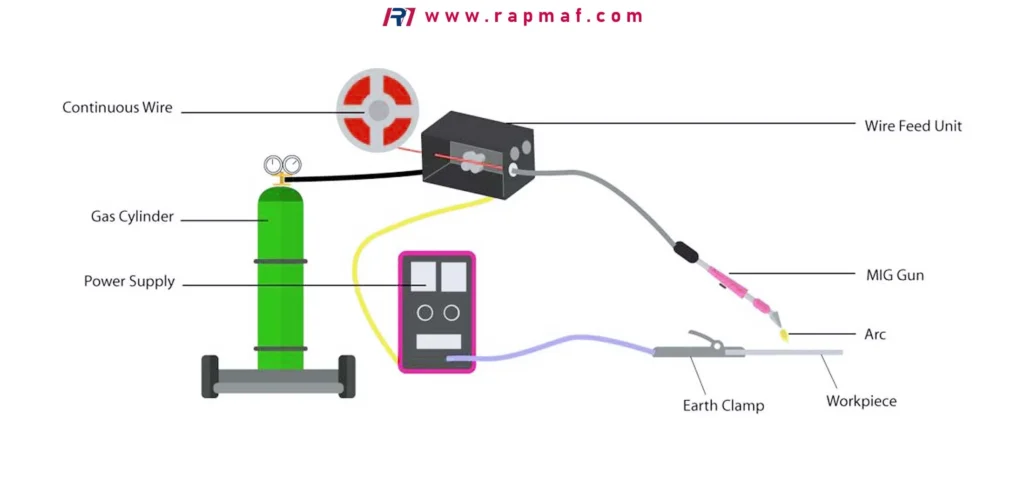
Here’s how the MIG process works:
- The MIG Gun: Instead of a simple stinger holding a stick, the operator holds a “MIG gun.” When the operator pulls the trigger, three things happen simultaneously.
- Continuous Wire Filler: A thin metal wire, fed from a large spool inside the welder, is automatically pushed through the gun. This wire is the filler material. Because it’s a continuous spool that can hold miles of wire, you can weld for a very long time without stopping. This is the “semi-automatic” part.
- Electric Arc Heat: The instant the wire touches the workpiece, an electric arc is formed between the tip of the wire and the metal. This arc melts both the wire and the base metal, creating the weld puddle.
- Shielding Gas: At the same time, a cloud of inert or semi-inert gas (usually a mix of Argon and Carbon Dioxide) flows from a high-pressure cylinder, through the welder, and out of a nozzle surrounding the wire in the MIG gun. This continuous flow of gas completely displaces the atmosphere, perfectly shielding the molten puddle from contamination.
Because the shielding is done by a clean gas, there is no solid flux and therefore no slag to chip off. The finished weld is clean and ready to go, dramatically reducing cleanup time.
MIG vs. Stick: The Head-to-Head Showdown
This is where the real decision-making happens on our shop floor at RM. Choosing between MIG and Stick isn’t about which is “better” in a vacuum; it’s about which is the right tool for the specific job. Let’s break it down by the factors that matter most.
Speed and Efficiency
This isn’t even a contest. MIG welding is dramatically faster than Stick welding. A welder’s efficiency is often measured in “arc-on time”—the percentage of time they are actually welding. With Stick, you have to stop every minute or so to grab a new rod, and then you have to stop again to chip slag and clean the weld. With MIG, you can lay down yards of weld bead just by pulling the trigger. For production environments where time is money, MIG is the undisputed champion.
Ease of Learning
For a beginner, MIG welding is significantly easier to learn than Stick welding. We call MIG the “point-and-shoot” process. Because the machine automatically feeds the wire, the operator only needs to focus on three things: travel speed, gun angle, and the distance from the tip to the metal.
Stick welding is a true craft. The welder must simultaneously manage travel speed, angle, and the arc length, all while the stick is actively burning away and getting shorter. It’s like trying to write your name with a pencil as it’s rapidly shrinking. It takes much more practice to produce consistent, high-quality welds with a Stick welder.
Weld Appearance and Quality
When set up correctly, MIG welding produces cleaner, more uniform, and aesthetically pleasing welds with far less effort. The absence of slag and the smooth, continuous nature of the process result in the classic “stack of dimes” look that fabricators prize.
Stick welds can be just as strong and can also look excellent, but it requires a much higher level of skill. They are also prone to more spatter (small molten balls of metal that stick to the workpiece) and require the aforementioned slag removal.
Equipment Cost and Complexity
Here, Stick welding has an advantage. Stick welders are simpler, more robust, and have a much lower initial purchase price. The machine is essentially a transformer or inverter in a box.
MIG welders are more complex and more expensive. They include a power source, a wire feed mechanism, hoses, and require a separate, heavy cylinder of shielding gas that must be purchased or leased. This also makes the entire setup less portable.
Portability and Outdoor Use
Stick welding is the king of field repairs and outdoor work. The simple machine can be run off a generator, and there’s no gas bottle to haul around. Crucially, the flux shielding is robust enough to withstand a breeze.
MIG welding is a shop-based process. The shielding gas is so light that even a gentle wind will blow it away, leaving the weld puddle exposed to the atmosphere and ruining the weld. It must be done in a controlled, draft-free environment.
Comparison Table: MIG (GMAW) vs. Stick (SMAW)
| Feature | MIG Welding (GMAW) | Stick Welding (SMAW) |
|---|---|---|
| Speed | Very Fast | Slow |
| Ease of Learning | Easy | Difficult |
| Weld Appearance | Excellent, very clean | Good, requires cleanup |
| Cleanup | Minimal (some spatter) | Extensive (slag removal) |
| Portability | Poor (requires gas bottle) | Excellent |
| Outdoor Use | Not Recommended | Excellent |
| Cost (Initial) | High | Low |
| Metal Cleanliness | Must be very clean | Forgiving of rust/paint |
| Primary Use Case | Production, Fabrication, Hobby | Field Repair, Heavy Steel |
Case Study: Choosing the Right Process at RM
The Project: A client needed us to fabricate 200 identical steel frames for an industrial shelving system. The design involved welding dozens of 1/8-inch thick square tubes together. Deadlines were tight, and the final appearance needed to be clean and professional.
The Analysis:
- Stick Welding: We could have used Stick. The welds would be strong enough. However, the time spent changing rods for each of the thousands of small welds would be enormous. Furthermore, the post-weld cleanup of slag from every single joint would add an entire day or more to the project timeline, blowing past the deadline.
- MIG Welding: MIG was the obvious choice. We set up a dedicated welding station with a large spool of wire and a big gas cylinder. Our fabricators could move from joint to joint, simply pointing the gun and pulling the trigger to create fast, consistent, and beautiful welds. The cleanup was minimal—just a quick wipe-down.
The Result: By choosing MIG welding, we completed the entire 200-frame order a full two days ahead of schedule. The welds were highly uniform across the entire batch, meeting the client’s quality standards with ease. For this project, MIG’s speed and efficiency were the critical factors for success.
We’ve now seen how the “easy” production powerhouse of MIG compares to the “normal” ruggedness of Stick welding. But what if your project demands not speed, but absolute, uncompromising precision and beauty? What if you’re working with delicate materials like aluminum or thin stainless steel? For that, we need to introduce the third and final member of the welding trinity: TIG welding.
The Artist’s Tool: What is TIG Welding (GTAW)?
If Stick welding is a rugged manual pickup and MIG is a smooth semi-automatic sedan, then Tungsten Inert Gas (TIG) welding is a surgeon’s scalpel. Officially known as Gas Tungsten Arc Welding (GTAW), this process is synonymous with the highest levels of quality, precision, and aesthetic beauty in the welding world.
TIG welding is a fully manual process that gives the operator maximum control by completely separating the elements of the Welding Trinity. It is significantly more complex and slower than MIG or Stick, but the results are unparalleled.
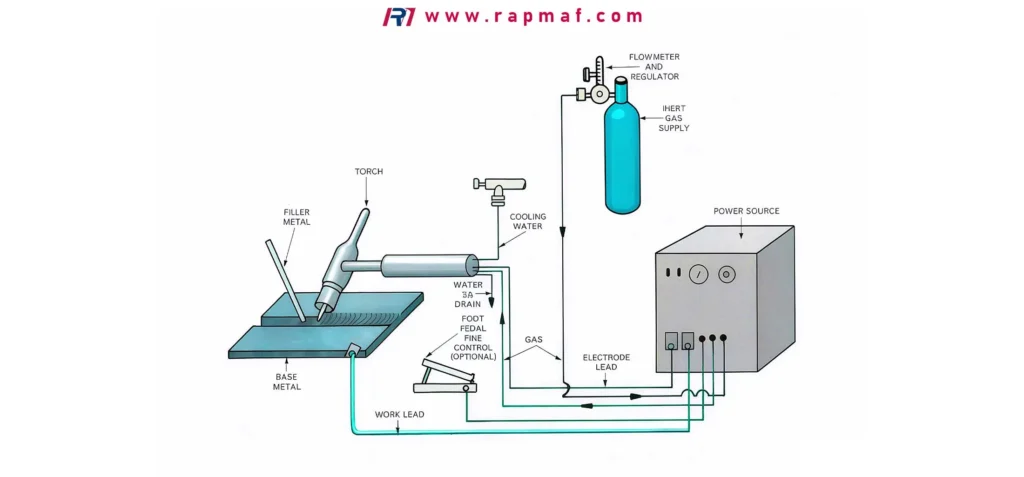
Here’s how the TIG process works:
- The TIG Torch & Tungsten Electrode: The operator holds a TIG torch, which has a small, pointed, non-consumable electrode made of tungsten. Tungsten has an incredibly high melting point (6,192°F / 3,422°C), meaning it can sustain the arc’s heat without melting into the weld puddle.
- Precise Heat Control: The electric arc is established between this tungsten tip and the workpiece. Crucially, the amperage (heat) is not controlled by the machine’s settings alone. It is actively modulated in real-time by the operator using a foot pedal or a fingertip remote on the torch. Pressing down increases the heat, letting up decreases it. This gives the welder surgical control over the weld puddle.
- Manual Filler Rod: Unlike MIG’s automatic wire feed, the filler material in TIG welding is a separate, thin rod held in the operator’s other hand. The welder uses one hand to manage the torch and the heat, and the other hand to manually dip (or “dab”) the filler rod into the molten puddle as needed. This allows for incredibly precise placement and amount of filler material.
- Inert Gas Shielding: Just like MIG, a flow of inert gas (almost always pure Argon for TIG) comes out of a ceramic cup surrounding the tungsten electrode. This gas provides a perfect, oxygen-free environment, resulting in an exceptionally clean and pure weld with zero slag.
This complete separation of tasks—heat control in one hand (or foot), filler addition in the other—is what makes TIG welding so difficult to master, but also what gives it such extraordinary control.
The Final Showdown: MIG vs. Stick vs. TIG
So, with all three major processes on the table, how do you choose? At RM, this decision is made daily. It’s never about which is “best,” but which is the “right tool for the job.”
For Raw Speed and Production: Choose MIG
If you’re manufacturing hundreds of identical parts, fabricating steel structures, or need to lay down a lot of weld quickly and efficiently, MIG is the answer. Its point-and-shoot nature, continuous wire feed, and lack of slag cleanup make it the undisputed king of productivity in a shop setting. It offers a fantastic blend of speed, quality, and relative ease of use.
- Choose MIG for: Production runs, general fabrication, automotive repair, and thicker materials where speed is a priority.
For Outdoor Repairs and Dirty Metal: Choose Stick
If you’re out in the field, repairing a piece of heavy equipment, or working on metal that isn’t perfectly clean, Stick is your reliable workhorse. It’s portable, doesn’t need a fragile gas bottle, and the powerful flux coating can burn through rust, paint, and mill scale that would contaminate a MIG or TIG weld. It’s the most versatile and robust process for challenging conditions.
- Choose Stick for: Field repairs, heavy construction, farm equipment, and welding on thick or dirty steel.
For Unmatched Precision and Beauty: Choose TIG
If you are working on a project where the appearance of the weld is critical, or if you’re joining thin, delicate, or exotic metals, TIG is the only choice. It is the process used for aerospace components, custom automotive headers, food-grade stainless steel, and any application where failure is not an option and the weld must be perfect. It is slow, methodical, and requires immense skill, but the results are flawless.
- Choose TIG for: Thin stainless steel, aluminum, titanium, chromoly, and any project where visual appearance and precision are the most important factors.
Conclusion: From “Normal” to “The Right Tool for the Job”
The initial question—”What is the difference between MIG welding and normal welding?”—comes from a desire to understand the landscape. The journey has shown us that there is no “normal” welding. There is only the right process for the application.

Stick welding (SMAW) is the classic, foundational process. MIG welding (GMAW) is its evolution, engineered for speed and efficiency. TIG welding (GTAW) is its hyper-specialized cousin, engineered for absolute precision.
A good welder can run a bead. A great welder understands the fundamental differences between these three core processes and knows exactly which one to pick to save time, reduce costs, and produce the strongest, most reliable, and most beautiful result possible.
Frequently Asked Questions (FAQ)
What type of welding is best for beginners?
For most hobbyists and beginners, MIG welding (GMAW) is the easiest to learn. The semi-automatic wire feed allows the new welder to focus primarily on gun angle and travel speed, leading to decent-looking welds much faster than with Stick or TIG.
What is the hardest welding to learn?
TIG welding (GTAW) is by far the most difficult welding process to master. It requires excellent hand-eye coordination between two hands and a foot, all working independently to manage the torch, filler rod, and heat. It is often compared to learning to play the drums.
Which welding process is the strongest?
When performed correctly by a skilled operator, all three processes—Stick, MIG, and TIG—can create welds that are as strong or stronger than the base metal itself. The strength of the weld is determined by proper penetration, the correct choice of filler material, and the absence of defects, not by the process itself. However, TIG is often used for the most critical applications (like aerospace) because the process offers the most control over weld purity and quality, minimizing the risk of defects.
Can you MIG weld without gas?
Yes, this is a common variation called Flux-Cored Arc Welding (FCAW). It uses a special hollow wire filled with a flux compound on the inside. When the arc melts the wire, the flux creates its own shielding gas cloud, just like a Stick electrode. This process, often called “gasless MIG,” combines the speed of MIG with the outdoor capabilities of Stick, but it produces slag that must be cleaned off.
References
- American Welding Society (AWS): The leading authority on welding standards, certifications, and educational resources.
- Lincoln Electric – Welding Education: A major manufacturer providing extensive educational materials on the theory and application of different welding processes.
- Miller Welders – Resources: Another top manufacturer offering a vast library of articles, videos, and guides for welders of all skill levels.
Disclaimer
The information on this page is for informational purposes only. RM makes no representations or warranties, express or implied, as to the accuracy or completeness of this information. For any third-party services procured through the RM network, it is the buyer’s responsibility to specify and confirm performance parameters, tolerances, materials, and workmanship during the quotation process. For more detailed information, please do not hesitate to contact us.
RM: Your Precision Manufacturing Partner
RM is an industry leader in custom manufacturing solutions. With over 20 years of profound experience, we have become the trusted partner for more than 5,000 clients worldwide. We specialize in a comprehensive range of manufacturing services—including high-precision CNC machining, sheet metal fabrication, 3D printing, injection molding, and metal stamping—to provide you with a true one-stop-shop experience.
Our world-class facility is equipped with over 100 state-of-the-art 5-axis machining centers and operates in strict compliance with the ISO 9001:2015 quality management system. We are dedicated to providing solutions that blend speed, efficiency, and exceptional quality to customers in over 150 countries. From rapid prototyping to large-scale production, we promise delivery in as fast as 24 hours, helping you gain a competitive edge in the market. Choosing RM means selecting an efficient, reliable, and professional manufacturing ally.
Explore our capabilities today by visiting our website: www.rapmaf.com







2 Responses