



Quick Answer: The Engineering Definition
In engineering and mechanics, a bearing is a machine element that constrains relative motion to only the desired motion, and reduces friction between moving parts. Its sole purpose is to allow a component, like a shaft or a wheel, to rotate or slide smoothly, efficiently, and with minimal wear. It is the critical interface between a moving part and a stationary one.
If you’ve ever wondered how a 3-ton car’s wheels can be spun with a gentle push, how a tiny hard drive platter can spin at 7200 revolutions per minute for a decade, or how a massive wind turbine can pivot silently in the breeze, you’ve been wondering about the magic of bearings.
The word “bearing” has many meanings in the English language—from “bearing gifts” to “getting your bearings.” But in the world of engineering, manufacturing, and everything that moves, a bearing is one of the most fundamental and critical components ever invented. It is the unsung hero that conquered friction, enabling the speed and efficiency of the modern world.
This guide will demystify the bearing. We will start by exploring the fundamental problem it was designed to solve, then dive into the two brilliant strategies it uses to do so.
The Universal Enemy: Understanding Friction
Before you can appreciate a bearing, you must first respect its enemy: friction.
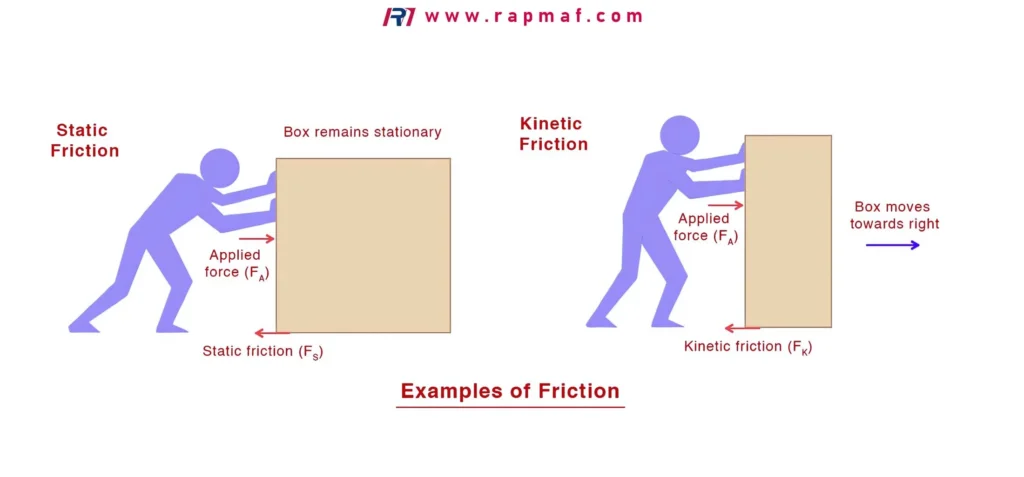
Friction is the force resisting the relative motion between solid surfaces, fluid layers, and material elements sliding against each other. In a machine, unwanted friction is a triple threat:
- It Wastes Energy: Friction converts useful kinetic energy (motion) into thermal energy (heat). A high-friction system requires more power to do the same amount of work, making it inefficient.
- It Causes Wear: As two surfaces rub against each other, microscopic bits of material are torn away. Over time, this abrasion wears down components, altering their dimensions, reducing their precision, and leading to eventual failure.
- It Generates Heat: The energy lost to friction becomes heat. Excessive heat can damage components, degrade lubricants, and cause materials to expand, potentially leading to a machine seizing up completely.
Imagine trying to spin a heavy steel shaft inside a snug steel hole. The direct metal-on-metal contact would create immense sliding friction. You would need a huge amount of force to start it moving (overcoming static friction) and to keep it moving (overcoming kinetic friction). The screeching noise would be the sound of the two surfaces tearing each other apart, and the heat generated would quickly become dangerous.
This is the problem the bearing was born to solve.
The Two Solutions: How Bearings Conquer Friction
A bearing doesn’t eliminate friction, but it brilliantly changes the rules of the game by replacing high-friction sliding contact with a much lower-friction alternative. All bearings, from the simplest to the most complex, achieve this using one of two fundamental strategies.
Strategy 1: Replace Sliding with Rolling
This is the most intuitive and visually recognizable solution. Instead of letting two large surfaces slide against each other, you place a series of smooth, round objects between them.
Think about moving a heavy refrigerator. Dragging it across the floor is incredibly difficult due to high sliding friction. But if you place a few strong pipes underneath it, you can suddenly push it with ease. The pipes roll, and in doing so, they replace the high-resistance sliding friction with much, much lower rolling friction.
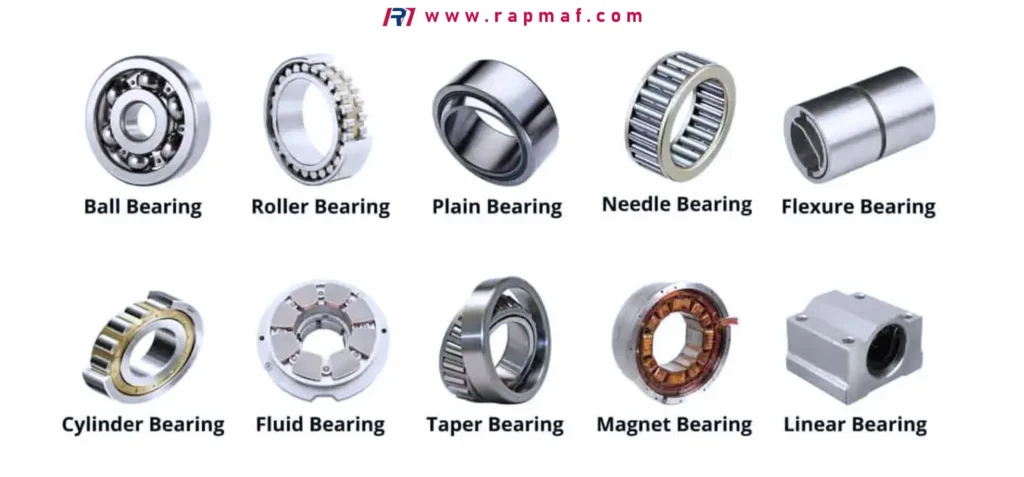
This is the core principle behind an entire family of bearings known as Rolling-Element Bearings. These components use perfectly spherical balls (ball bearings) or cylinders (roller bearings) to separate the moving and stationary parts, allowing them to rotate with astonishingly little effort.
Strategy 2: Separate the Surfaces Entirely
The second strategy is, in some ways, even more elegant: if you don’t want two surfaces to rub, then ensure they never touch at all. This is achieved by introducing a thin, low-friction layer between the moving parts. This family of bearings is broadly known as Plain Bearings.
There are a few ways to accomplish this:
- Material Science: The simplest method is to make the bearing from a material that is naturally “slippery” or designed to wear gracefully without damaging the main shaft. A simple bronze or brass sleeve (a bushing) is a classic example. The soft bronze is a sacrificial surface that is much less abrasive against a hard steel shaft than steel-on-steel would be.
- Fluid Dynamics: A more advanced method is to use a layer of fluid—typically oil—to create a separating film. In a hydrodynamic bearing, the rotation of the shaft itself pulls a wedge of pressurized oil between the surfaces, causing the shaft to literally float on a near-frictionless fluid cushion. This is how the crankshaft in your car’s engine can spin thousands of times a minute without ever touching the engine block.
- Exotic Forces: In extreme applications, other forces can be used. Magnetic bearings use powerful electromagnets to levitate a shaft in mid-air, resulting in zero physical contact and virtually zero friction.
We’ve now established the core problem (friction) and the two ingenious solutions (rolling and separating). These two fundamental concepts give rise to the vast and varied world of bearings. In the next part, we will perform a deep dive into the specific types within each family, from the common deep-groove ball bearing to the high-performance hydrodynamic bearing, and present a real-world case study from RM showing how the right bearing choice is critical to machine performance.
A Tour of the Hardware: The Two Great Families of Bearings
Every bearing you will ever encounter falls into one of two major families, defined by the core strategy they use to manage friction.
Family 1: Rolling-Element Bearings
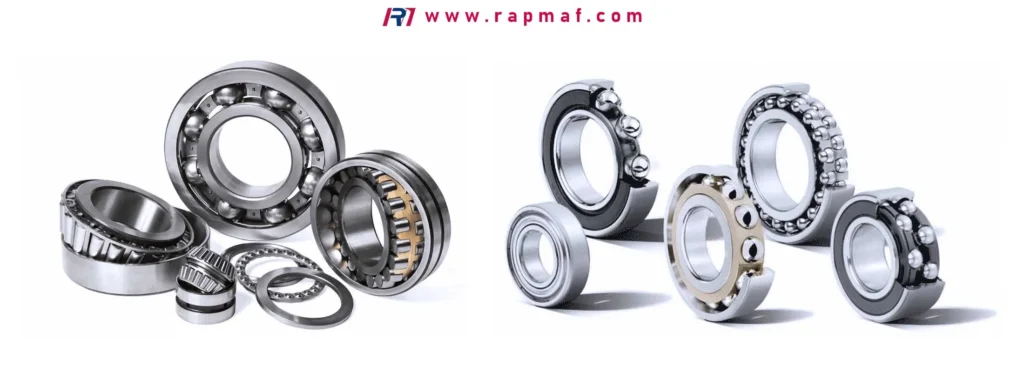
This is the family most people picture when they hear the word “bearing.” They are defined by the use of spherical balls or cylindrical rollers sandwiched between two smooth, hardened rings called “races.” This design transforms high-friction sliding into low-friction rolling, enabling incredible efficiency and speed.
The Anatomy of a Rolling-Element Bearing
While there are many variations, nearly all share four key components:
- Outer Race: The stationary outer ring that fits into a housing. It has a precision-ground track on its inner surface for the rolling elements to travel on.
- Inner Race: The rotating inner ring that fits onto a shaft. It has a matching track on its outer surface.
- Rolling Elements: The “engines” of the bearing. These can be balls or rollers of various shapes (cylindrical, tapered, spherical, needle). They are what allows the two races to move relative to each other with minimal resistance.
- Cage (or Retainer): A separator that holds the rolling elements in place, ensuring they are evenly spaced and preventing them from rubbing against each other, which would create unnecessary friction and wear.

Types of Rolling-Element Bearings
The genius of rolling-element bearings lies in their specialization. By changing the shape of the rolling elements and the races, engineers can optimize a bearing to handle different types and directions of force, known as loads.
- Radial Loads: A force that acts perpendicular to the shaft, like the force of gravity on a car’s axle.
- Axial Loads (or Thrust Loads): A force that acts parallel to the shaft, like the force a propeller exerts on a boat’s drive shaft.
Here are the most important types:
Ball Bearings (Optimized for Speed)
- Deep-Groove Ball Bearing: The most common, versatile, and inexpensive bearing in the world. Its symmetrical “deep groove” race design allows it to handle moderate radial loads and small-to-moderate axial loads in both directions. You’ll find them in everything from electric motors and skateboards to household appliances.
- Angular Contact Ball Bearing: The high-performance specialist. The races are asymmetrically shaped, creating a “contact angle.” This design allows the bearing to handle significant combinations of both radial and axial loads simultaneously. They are essential in high-precision, high-load applications like CNC machine spindles and automotive wheel hubs.
- Thrust Ball Bearing: Designed for one job only: handling purely axial loads. They look like a “sandwich” of two washers with balls in between and cannot handle any significant radial load. You’ll find them in applications like barstools and rotating turntables.
Roller Bearings (Optimized for Strength)
- Cylindrical Roller Bearing: A radial load heavyweight. By replacing balls with cylinders, the contact area with the race changes from a tiny point to a line. This drastically increases the bearing’s radial load capacity. They are used in heavy-duty applications like industrial gearboxes and railway axle boxes.
- Tapered Roller Bearing: The king of combined loads. Using cone-shaped rollers and races, this bearing is designed to handle immense radial and axial loads at the same time. They are the go-to choice for the most demanding applications, from truck wheel hubs to the massive rotating shafts in rock-crushing machinery.
- Spherical Roller Bearing: The problem-solver. This incredibly robust bearing features two rows of barrel-shaped rollers, allowing it to tolerate significant shaft misalignment and heavy shock loads. It’s the bearing you use when conditions are imperfect and forces are extreme, such as in mining equipment and large industrial fans.
Family 2: Plain Bearings
Plain bearings represent the second strategy: separating the surfaces. They have no rolling elements. Instead, they rely on the properties of a material or a fluid film to allow for smooth sliding motion. They are often simpler, quieter, and can handle certain types of loads better than their rolling-element counterparts.
- Bushings: The simplest form of a bearing. A bushing is essentially a sleeve, typically made from a material with a low coefficient of friction like bronze, graphite-impregnated metals, or advanced polymers (e.g., PTFE). They are often used in lower-speed, high-load applications where their simplicity and durability are an advantage, such as in construction equipment pivot points and suspension systems.
- Journal Bearings (Hydrodynamic Bearings): A marvel of fluid mechanics. In this design, the rotating shaft (the “journal”) is separated from the stationary housing by a film of lubricant. As the shaft spins, it pulls a wedge of pressurized oil into the tiny gap, lifting the shaft so it floats without any metal-to-metal contact. This creates an almost frictionless surface capable of handling enormous loads and incredible speeds. They are the lifeblood of internal combustion engines (crankshaft and connecting rod bearings) and large-scale power generation turbines.
- Magnetic Bearings: The ultimate in low-friction technology. These bearings use powerful, computer-controlled electromagnets to levitate a shaft in the air, resulting in zero physical contact. With no contact, there is no friction or wear, allowing for incredible rotational speeds. They are reserved for extreme performance applications like uranium enrichment centrifuges, high-performance turbomachinery, and energy storage flywheels.
Bearing Type Comparison Table
To help summarize, here is a table comparing the general characteristics of the most common bearing types:
| Bearing Type | Primary Load Type | Speed Capability | Friction | Key Advantage | Common Application |
|---|---|---|---|---|---|
| Deep-Groove Ball Bearing | Radial & Moderate Axial | Very High | Very Low | Versatile, cost-effective, widely available | Electric Motors, Power Tools, Pumps |
| Angular Contact Ball Bearing | Combined Radial & High Axial | High | Very Low | High precision under combined loads | CNC Spindles, Wheel Hubs |
| Tapered Roller Bearing | Combined Radial & High Axial | Medium | Low | Extreme load capacity for combined forces | Truck Axles, Gearboxes, Transmissions |
| Spherical Roller Bearing | High Radial & Moderate Axial | Medium | Low | Tolerates misalignment and shock loads | Mining Equipment, Conveyor Systems |
| Journal (Hydrodynamic) | Very High Radial | Very High | Extremely Low | Extreme load/speed, long life, quiet | Engine Crankshafts, Turbines |
| Bushing (Plain Bearing) | High Radial | Low | Moderate | Simple, robust, handles shock well, cheap | Hinges, Pivot Points, Suspension |
Case Study: The Right Bearing for a High-Speed Spindle at RM
At RM (Rapid Manufacturing), we were approached by a client whose custom-built CNC milling machines were experiencing premature spindle failure. The spindles, which hold the cutting tool, were becoming noisy and losing precision after only a few hundred hours of operation, far below the expected service life.
The Problem: The original design used a pair of standard deep-groove ball bearings to support the spindle shaft. On paper, these bearings had a sufficient load rating. However, high-speed milling involves a complex mix of forces. The rotation itself creates a radial load, while the cutting tool pushing into the material creates a significant axial load (thrust). At 20,000 RPM, the standard bearings were being subjected to a constant, high-stakes combination of these forces.
Our Analysis: We disassembled a failed spindle and examined the bearings under a microscope. The wear patterns on the races were a classic sign of excessive axial loading in a bearing not designed for it. The heat generated was degrading the grease, and the tiny amount of “play” or internal clearance in the bearings was allowing the tool to deflect, resulting in poor surface finish on the client’s parts.
The Engineering Solution: The deep-groove bearings were the wrong tool for the job. We re-engineered the spindle cartridge to use a matched pair of high-precision angular contact ball bearings. These bearings are specifically designed to handle a combination of radial and axial loads simultaneously. We installed them in a “back-to-back” configuration, which provides very high moment rigidity, and set a specific preload—a carefully calculated axial force that removes all internal clearance.
The Result: The new spindle assembly ran dramatically cooler and quieter. Our precision testing showed a 70% reduction in runout (the wobble of the tool). The client’s machines could now run faster, produce more accurate parts, and the spindle service life increased to several thousand hours, meeting and exceeding their operational targets.
This case perfectly illustrates that the “strongest” bearing isn’t always the best. The secret to reliability and performance lies in choosing the bearing that is perfectly matched to the specific speed, load, and precision demands of the application.
We have now explored the vast catalog of bearing types and seen a real-world example of why selection is so critical. But how do engineers make these choices? How do they calculate if a bearing will last for 10,000 hours or fail in 10? In the final part, we will explore the key specifications and calculations that govern bearing selection, including load ratings, life calculations, and the critical role of lubrication.
Beyond the Catalog: How Engineers Select the Right Bearing
Choosing a bearing is a systematic process of balancing four competing variables: Speed, Load, Precision, and Life. A bearing that excels in one area often makes a trade-off in another. The engineer’s job is to find the optimal solution for the specific application. They do this using standardized specifications and calculations developed over a century of research and testing.
The Language of Load: Static vs. Dynamic Load Ratings
Every bearing datasheet is dominated by two key numbers that define its strength. Understanding the difference between them is the first step in professional bearing selection.
Static Load Rating (C₀)
The Static Load Rating is a measure of brute force strength. It represents the maximum load a stationary bearing can withstand before the rolling elements create a permanent, microscopic dent in the hardened steel of the races. This damage, known as brinelling, creates a “pothole” that will cause noise and vibration once the bearing starts to rotate.
Think of it like placing a heavy bowling ball on a hardwood floor. A light ball will leave no mark. A heavy enough ball will create a permanent indentation. The Static Load Rating tells you how heavy that ball can be before it damages the “floor” of the race.
This rating is critical for applications that experience:
- High shock loads: Such as the jolt a conveyor system experiences when a heavy box is dropped on it.
- Vibrations when stationary: Like a machine that is vibrating while not in operation.
- Very slow, heavy rotations: Where the bearing is not moving fast enough to build a lubricating film.
Dynamic Load Rating (C)
This is the most important specification for any bearing in continuous motion. The Dynamic Load Rating is a calculated value representing the constant load that a bearing can endure for a defined lifespan—typically one million revolutions—before the first signs of material fatigue appear.
Unlike brinelling, which is a plastic deformation, fatigue is a microscopic cracking and flaking of the steel, a phenomenon known as spalling. It’s the equivalent of bending a paperclip back and forth until it breaks. The Dynamic Load Rating quantifies how much “load” you can apply for a million “bends” before that break is statistically likely to occur. This rating is the cornerstone of the bearing life calculation.
Predicting the Future: The L₁₀ Bearing Life Calculation
Engineers don’t guess how long a bearing will last; they calculate it using a standardized formula. The result is known as the L₁₀ life.
The “L” stands for life, and the “10” signifies that this is a statistical measure. It represents the number of revolutions that 90% of a group of identical bearings will successfully achieve or exceed under a specific load. It is a measure of reliability, acknowledging that in any large batch of components, there will be microscopic variations that lead to a distribution of failure points.
The basic formula is:
L₁₀ = (C / P)ᵖ
Where:
- L₁₀ is the rating life in millions of revolutions.
- C is the Dynamic Load Rating (from the catalog).
- P is the Equivalent Dynamic Bearing Load (the actual combined radial and axial load the bearing will experience in the application).
- p is the life exponent: 3 for ball bearings and 10/3 (approx. 3.33) for roller bearings.
While the formula itself is simple, it reveals a profound and non-obvious truth about bearings: The relationship between load and life is exponential.
Consider a ball bearing (where p=3). If you double the load (P), you don’t cut the life in half. You reduce the life by a factor of 2³, or eight times. If you halve the load, you don’t double the life; you increase it by a factor of eight. This is why even a small reduction in load or a small increase in a bearing’s Dynamic Load Rating can have a massive impact on the operational life and reliability of a machine.
This calculation allows an engineer to take a client’s requirement—”this gearbox needs to operate for 20,000 hours”—and translate it into a specific bearing part number with a calculated L₁₀ life that meets or exceeds that target.
The Unsung Hero: The Critical Role of Lubrication
All the calculations in the world are meaningless if the bearing is not properly lubricated. Lubrication is not an afterthought; it is an integral and critical component of the bearing system.
A lubricant has four primary jobs:
- Reduce Friction: It creates a thin, separating film between the rolling elements and the races, preventing direct metal-to-metal contact.
- Dissipate Heat: It carries heat away from the contact zones, preventing the bearing from overheating, which can alter the steel’s properties and degrade the lubricant itself.
- Prevent Corrosion: It coats the precision-ground steel surfaces, protecting them from moisture and oxidation.
- Flush Contaminants: In a circulating oil system, it can carry away microscopic wear particles before they can cause further damage.
The two main types of lubrication are grease and oil.
- Grease: The most common form of lubrication, used in about 90% of all bearings. Grease is a mixture of a base oil (the lubricant) held in suspension by a thickener (like a sponge). Its main advantage is that it stays in place, is easy to apply, and helps seal the bearing from contaminants. However, it has limited ability to dissipate heat, making it less suitable for very high-speed applications.
- Oil: The choice for high-speed and high-temperature applications. Oil can be supplied as an “oil bath,” where the bearing is partially submerged, or in a circulating system where cool, filtered oil is continuously pumped through the bearing. This provides superior cooling and cleaning but requires a more complex and expensive system with seals and pumps.
The selection of the right lubricant viscosity is just as critical as the selection of the bearing itself, and it is a key part of the overall design process.
Conclusion: The Bearing is More Than a Part—It’s a System
The journey from a simple definition to a deep engineering understanding reveals a powerful truth: a bearing is not just a component; it’s a precision system.
We’ve seen that its core purpose is to conquer friction, a fundamental force of nature. It achieves this through one of two brilliant strategies: replacing sliding with rolling (rolling-element bearings) or completely separating surfaces with a fluid or magnetic film (plain bearings).
We learned that choosing the right bearing is a science of trade-offs, balancing the demands of speed, load, and precision. Engineers make these decisions not by guesswork, but with the data-driven tools of static and dynamic load ratings and the predictive power of the L₁₀ life calculation. Finally, we saw that this entire mechanical system depends on the unsung hero of lubrication to survive and perform.
From the common skateboard wheel to the multi-ton turbine in a power plant, bearings are the invisible enablers of our modern, rotating world. Understanding their principles is a fundamental step in separating amateur tinkering from professional, reliable engineering.
Frequently Asked Questions (FAQ)
What is the most common type of bearing in the world?
The deep-groove ball bearing is by far the most common and versatile type. Its simple, robust design, low cost, and ability to handle both radial and some axial loads make it the default choice for millions of applications, from electric motors to household appliances.
What is the difference between a bearing and a bushing?
A bushing is a specific type of bearing. “Bearing” is the general term for any component that reduces friction between moving parts. A “bushing” is a type of plain bearing—a simple sleeve with no moving parts that provides a low-friction sliding surface. A ball bearing, by contrast, is a type of rolling-element bearing.
Why do bearings fail?
The vast majority of premature bearing failures are not due to the bearing itself reaching its calculated fatigue life. The most common causes are external factors: contamination (dirt or moisture getting inside), poor lubrication (using the wrong type, too little, or too much), improper installation (using a hammer instead of a press), and misalignment or overload (subjecting the bearing to forces it wasn’t designed for).
What does the ABEC rating on a bearing mean?
The ABEC scale, developed by the Annular Bearing Engineers’ Committee, is a rating system for the manufacturing precision and tolerances of ball bearings. It is rated in odd numbers from 1 to 9 (ABEC 1, 3, 5, 7, 9). A higher ABEC number indicates tighter tolerances, less runout, and a higher degree of precision, making the bearing suitable for higher-speed applications. It is a rating of precision, not necessarily of overall quality, material, or load capacity.
Can a bearing be repaired?
For standard rolling-element bearings (like ball or roller bearings), the answer is almost always no. They are precision, hardened components, and once a race or rolling element is damaged, the bearing must be replaced. For very large, high-value plain or journal bearings (like those in a ship’s engine), the surfaces can sometimes be re-machined and polished, but this is a highly specialized process.
References
- SKF Group. (n.d.). Bearing selection process. (An authoritative guide from one of the world’s leading bearing manufacturers, detailing the engineering considerations for choosing a bearing).
- ISO 281:2007. Rolling bearings — Dynamic load ratings and rating life. (The official international standard that defines the methods for calculating the L₁₀ life, forming the basis for all manufacturer catalogs).
- Bhardwaj, R. (2018). Failure of Rolling Element Bearing: A Review. Journal of Engineering Science and Technology, 13(10), 3326-3343. (A peer-reviewed academic paper summarizing the common causes and mechanisms of bearing failure).
Disclaimer
The information on this page is for informational purposes only. RM makes no representations or warranties, express or implied, as to the accuracy or completeness of this information. For any third-party services procured through the RM network, it is the buyer’s responsibility to specify and confirm performance parameters, tolerances, materials, and workmanship during the quotation process. For more detailed information, please do not hesitate to contact us.
RM: Your Precision Manufacturing Partner
RM is an industry leader in custom manufacturing solutions. With over 20 years of profound experience, we have become the trusted partner for more than 5,000 clients worldwide. We specialize in a comprehensive range of manufacturing services—including high-precision CNC machining, sheet metal fabrication, 3D printing, injection molding, and metal stamping—to provide you with a true one-stop-shop experience.
Our world-class facility is equipped with over 100 state-of-the-art 5-axis machining centers and operates in strict compliance with the ISO 9001:2015 quality management system. We are dedicated to providing solutions that blend speed, efficiency, and exceptional quality to customers in over 150 countries. From rapid prototyping to large-scale production, we promise delivery in as fast as 24 hours, helping you gain a competitive edge in the market. Choosing RM means selecting an efficient, reliable, and professional manufacturing ally.
Explore our capabilities today by visiting our website: www.rapmaf.com







7 Responses
Приветствую, кто-то из моей группы в
Facebook поделился этим вебсайтом, и я пришел ознакомиться с ним.
Мне действительно нравится информация.
Я сохраню этот сайт и буду делиться этим с моими подписчиками!
Отличный блог и замечательный стиль и оформление.