


In metalworking, reaming is a finishing operation used to bring an existing hole to a more accurate diameter and better surface finish. You drill (or bore) first, then ream. The reamer removes a thin ring of material from the inside of the hole, producing a more controlled size and a smoother, rounder hole than drilling alone.
Reaming is everywhere in real shops: dowel pin holes in automation fixtures, bushing and bearing seats in machine frames, hinge and pivot holes in equipment, even precision holes in aerospace brackets. It’s a relatively simple step, but it’s also easy to misuse. If the pre-hole, allowance, tooling, and setup are not right, reaming gets a reputation for “never holding size.”

This article walks through the process, tooling, allowances, tolerances, typical problems, and practical case studies so you can specify or run reaming operations more confidently.
What Reaming Is (and What It Isn’t)
Definition in machining
In machining, reaming is:
A hole-finishing operation performed with a multi-flute tool (a reamer) to improve diameter accuracy, surface finish, and roundness/straightness of an existing hole.
Key aspects:
- The hole already exists (drilled, bored, cast, or punched).
- The reamer removes a small amount of material (the reaming allowance).
- The reamer typically follows the existing hole axis, improving its geometry but not completely redefining it.
What reaming is NOT
Reaming is not:
- A substitute for drilling when you need to remove a lot of material.
- A reliable fix for holes that are badly off-location or misaligned.
- A cure-all for large out-of-round or crooked holes.
Because a reamer tends to follow the path of least resistance, it will mostly follow the pre-hole. If location and axis are wrong, reaming typically won’t fix that. For true position and coaxiality, you usually need boring or interpolation before any reaming.
What a Reamer Actually Does in Machining
Functionally, a reamer:
- Controls final hole size to a predictable range when the process is stable.
- Improves surface finish relative to drilled holes.
- Improves roundness and straightness within limits.
- Delivers functional fits for pins, bushings, bearings, and shafts.

Typical uses:
- Dowel pin holes for fixture alignment.
- Press-fit holes for bushings or bearings (with careful process control).
- Clearance and slip fit holes where a drill alone is too inconsistent.
- Pivot and hinge holes that must move smoothly but without excessive play.
In many shops, the combination is: drill → (optional bore) → ream → gage with plug gage or air gage for critical fits.
The Reaming Process Step-by-Step

A typical reaming process plan in a CNC mill might look like this:
- Spot or center-drill (optional but helpful)
- Reduces drill walking.
- Improves the position and straightness of the drilled hole.
- Drill undersize
- Use a drill to create the hole slightly smaller than the desired finished size.
- The difference between drilled size and finished size is the reaming allowance.
- (Optional) Semi-finish bore
- For tight positional tolerance or straightness requirements, single-point boring is used to correct position and axis before reaming.
- This step makes reaming a purely finishing step.
- Chamfer the hole mouth
- A small chamfer helps guide the reamer smoothly into the hole.
- Reduces edge chipping and bell-mouthing at the entry.
- Ream
- Use the correct spindle speed and feed as recommended by the tool supplier.
- Apply suitable cutting fluid or coolant.
- Maintain alignment and rigidity.
- Deburr and clean
- Remove any burrs at the entry/exit.
- Clean chips and coolant before final measurement.
- Inspect
- Use plug gages, bore gages, air gages, or CMM to verify size and roundness as required.
Types of Reamers (and When to Use Each)
A reamer is a multi-flute tool with cutting edges and guiding lands. The geometry and material strongly affect performance.
Hand reamers

- Longer lead, square end for a wrench.
- Used with hand tools for low-volume fitting or repair work.
- Highly operator-dependent; not ideal for consistent production tolerance.
Machine (chucking) reamers
- Designed for drill presses, mills, CNC machines.
- Shorter lead; cylindrical shank for collet/chuck.
- Preferred in production – more repeatable when setup is good.
Straight-flute vs spiral-flute reamers

- Straight flute
- Common for through holes.
- Simple and economical.
- Chips tend to push ahead of the tool.
- Spiral flute
- Better for blind holes and materials that produce stringy chips.
- Helps lift chips out of the hole.
- Often reduces chatter.
Adjustable and expansion reamers
- Diameter can be slightly adjusted within a range.
- Common in repair work and when tolerances are moderate.
- Good for “one-off” situations; less ideal for tight, repeatable production because the size can drift if not carefully managed.
Carbide vs HSS
- HSS reamers
- Tough and forgiving.
- Better for less rigid setups, manual machines, and interrupted cuts.
- Widely used in general engineering.
- Carbide reamers
- High wear resistance; excellent for abrasive materials or high volumes.
- Require rigid setups and precise alignment.
- Great for stable, high-throughput CNC production.
Table 1 – Typical Reamer Choices by Hole Type and Situation
| Hole type / situation | Recommended reamer type | Notes |
|---|---|---|
| Through hole, general steel / aluminum | Straight-flute HSS machine reamer | Simple, reliable for many applications |
| Blind hole in steel or stainless | Spiral-flute HSS or carbide reamer | Better chip evacuation, less risk of chip packing |
| High-volume, abrasive or hard materials | Carbide machine reamer | Long tool life, stable size, needs rigid setup |
| Manual fitting in assembly / repair | Hand or adjustable reamer | Operator adjusts size to fit; not good for tight, high-volume work |
| Coaxial hole on turned part (lathe work) | Machine reamer in tailstock or toolpost | Excellent coaxiality with turned OD |
| “Gummy” aluminum or copper alloys | Sharp, polished-geometry reamer | Reduces built-up edge and tearing |
Reaming Allowance: How Much Material Should You Leave?
The reaming allowance is the extra material left in the pre-hole for the reamer to cut. This is one of the critical parameters.
- If the allowance is too small
- The reamer tends to rub instead of cut.
- You get heat, work hardening (in some materials), chatter, and poor finish.
- Hole size becomes erratic and often slightly undersize.
- If the allowance is too large
- The reamer is overloaded.
- Tool deflection grows, which can produce oversize or tapered holes.
- Risk of chipping or breaking the reamer increases.
- Surface finish can deteriorate.

Manufacturers publish recommended allowances by diameter and material. In practice, process engineers tune allowance by material, hole depth, and tool type. The trend is:
- Small diameters → smaller allowance.
- Large diameters → slightly more allowance.
- Difficult materials → more careful tuning and better tool support.
The safest approach is to follow the reamer supplier’s data and then validate with a capability study on your actual machine and setup.
What Tolerances Can Reaming Achieve?

With a stable process, reaming can provide:
- Consistent diameters suitable for common fits.
- Better surface finish than drilling alone.
- Improved roundness and straightness, though not as fine as honing or grinding.
How tight the tolerance can be depends on:
- Pre-hole size and shape consistency.
- Machine tool rigidity and spindle runout.
- Reamer quality and wear state.
- Cutting parameters and coolant.
- Work material (soft vs hard, homogeneous vs with hard inclusions).
- Hole depth-to-diameter ratio.
In many industrial applications, reaming is used to achieve hole tolerance classes such as ISO H7 when the process is controlled and monitored. However, that level of performance is not automatic: you need consistent input conditions and some form of tool life management.
If the functional requirement is extremely tight diameter combined with very tight geometrical tolerances (cylindricity, straightness, surface texture), engineers often consider boring plus honing or grinding instead of relying solely on reaming.
Reaming on Different Machines (Mill vs Lathe vs Drill Press)

Reaming on a CNC mill
- Ideal for pattern holes and prismatic parts.
- Reamer alignment is controlled by the spindle and fixturing.
- Location accuracy depends on drilling or pre-boring operations.
If the hole must be located very precisely relative to datums or other features, it’s common to drill undersize and then interpolate or bore before reaming.
Reaming on a lathe
- Excellent when you need the hole to be coaxial with a turned OD.
- The part rotates; the reamer is held in a tailstock or toolholder.
- Very popular for bushings, sleeves, and shaft components.
Reaming on a drill press
- Common in small shops and maintenance departments.
- More sensitive to setup: spindle runout and fixturing alignment matter.
- Good for moderate precision, but harder to control than CNC equipment.
Speeds, Feeds, and Lubrication
Reaming is sensitive to cutting parameters because the chip is thin and the tool must stay engaged uniformly.
- Speed
- Often set lower than drilling speed for the same material.
- Too high speed increases heat, can cause built-up edge or chatter.
- Feed
- Needs to be high enough to promote a clean cut, not rubbing.
- Too low feed risks rubbing and poor finish; too high feed can overload the tool.
- Lubrication / coolant
- Helps chip evacuation, especially in blind holes.
- Reduces friction and heat.
- Supports better surface finish and tool life.
Reliable reaming processes usually rely on the toolmaker’s recommended cutting data, then refine it with short trials and in-process inspections.
Case Study 1 – Dowel Pin Hole in a Steel Fixture Plate
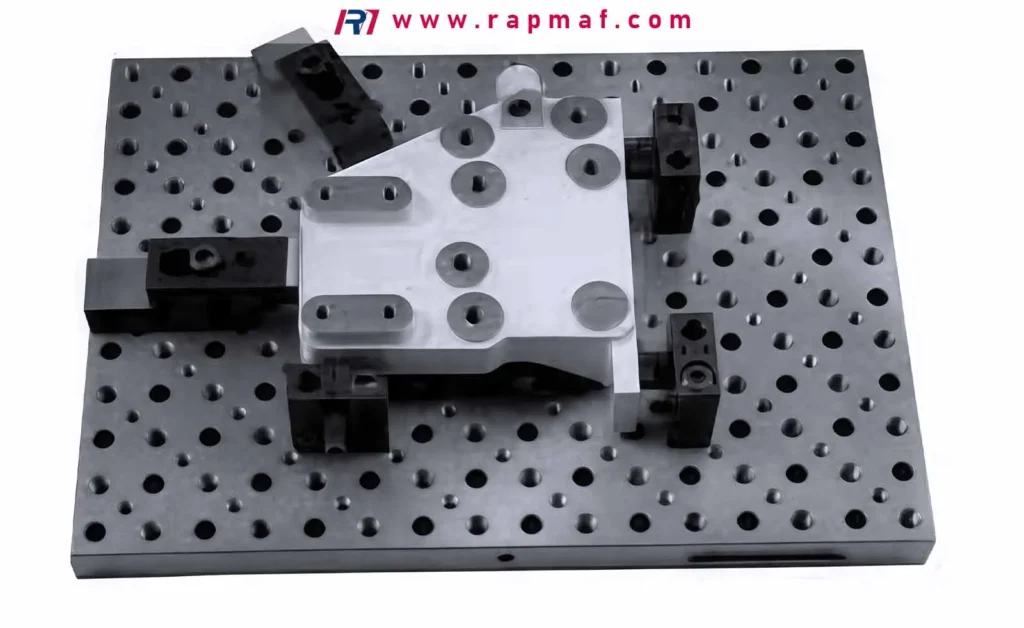
Background
A factory was making a 20 mm thick steel fixture plate with hardened dowel pins for repeatable part locating. The drawing specified:
- Hole diameter: Ø10 H7
- True position: moderate, but enough to matter for repeatability
- Quantity: medium batch
The team initially tried: drill 9.8 mm → ream to 10 mm using a straight-flute HSS machine reamer.
Problem
Production reported:
- Holes measured slightly oversize and sometimes out of tolerance.
- Insertion force for dowel pins varied from part to part.
- Some pins could be pushed in by hand, others needed significant force.
Investigation
Process review found:
- Pre-drilling was done with a worn drill, and the hole was not consistently round.
- The drilled hole wandered slightly, producing out-of-round and slightly tapered holes.
- No boring step was used before reaming.
- The reaming allowance was larger than the tooling guide recommended.
Because the reamer followed each irregular pre-hole, any out-of-roundness and taper were only partially improved, and the extra allowance increased tool deflection.
Corrective Actions
The team changed the process to:
- Drill undersize with a fresh drill.
- Single-point bore each hole to a controlled pre-size and better straightness.
- Add a small chamfer at the entry.
- Ream with a carbide spiral-flute machine reamer following the supplier’s allowance and cutting data.
They also:
- Tightened tool life management: drills and reamers were replaced or re-sharpened at defined intervals.
- Introduced plug gages for intermediate checks.
Results
- The hole size distribution narrowed significantly and stayed within the H7 tolerance.
- Dowel pins pressed in with consistent force across the fixture.
- Fixture repeatability improved; less rework and fewer assembly issues.
This case illustrates that reaming works best when pre-holes are controlled and allowances match the tool design. Trying to use reaming to “repair” poor drilling and shape errors produced unstable results; once the drilling and boring steps were brought under control, reaming delivered the intended precision.
Case Study 2 – Aluminum Valve Body with a Press-Fit Bushing
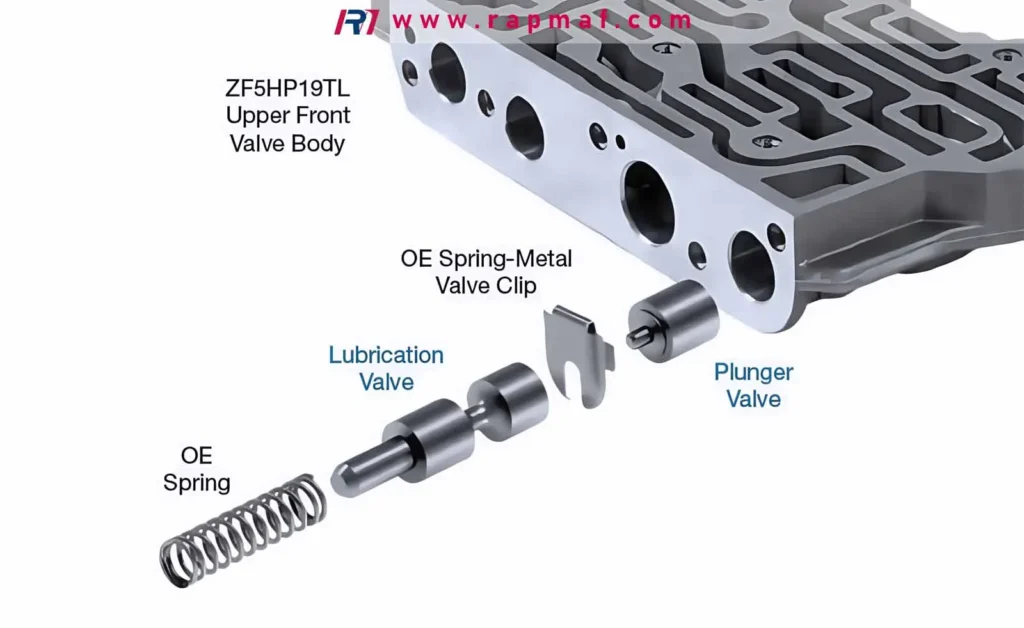
Background
A shop produced an aluminum valve body with a press-fit bronze bushing. The key hole was:
- Nominal diameter: Ø20 mm
- Fit: light press fit for the bushing OD
- Material: aluminum alloy body, relatively soft and prone to burrs
Initial process:
- Drill 19.5 mm.
- Ream to 20 mm with a straight-flute HSS reamer at high speed.
- Press in bushing and inspect.
Problem
Issues observed:
- After pressing in the bushing, some parts showed distortion in the aluminum around the hole.
- A fraction of bushings pressed in too easily – near slip fit.
- Surface finish of the reamed hole varied; some holes showed visible chatter marks.
Analysis
The process review highlighted:
- The drilled hole exhibited taper and burrs at the exit.
- The reaming allowance was relatively large, which loaded the reamer heavily.
- Cutting speed was high, and coolant flow was inconsistent.
- Straight-flute reamer struggled with chip evacuation in this material.
The combination led to:
- Tool deflection and slightly oversize hole diameters.
- Surface finish variation caused by intermittent cutting conditions.
- Local stress concentrations in the aluminum when pressing in the bushing.
Process Improvement
The revised process:
- Drill with a sharp drill, leaving a controlled allowance within toolmaker recommendations.
- Apply a correct chamfer to the hole entry.
- Use a spiral-flute carbide reamer designed for aluminum (polished flutes, appropriate rake).
- Reduce cutting speed to the suggested range, maintain reliable coolant supply.
- Check hole size with plug gages before pressing the bushing.
Results
- The reamed hole size became more consistent, staying within the target band for the desired press fit.
- Surface finish improved, reducing localized stress peaks in the aluminum.
- Bushing press-in force became predictable, and the rate of distorted parts dropped significantly.
This case shows that in soft, ductile materials, chip evacuation and allowance are critical. A well-chosen spiral-flute reamer and tuned cutting conditions can convert a problematic operation into a stable, repeatable step in the process.
Common Reaming Defects and Troubleshooting
Oversize hole
Possible causes:
- Spindle or holder runout.
- Too much reaming allowance and resulting tool deflection.
- Worn or chipped reamer cutting larger than intended.
- Chatter due to lack of rigidity.
Mitigation:
- Measure and correct runout at the tool holder.
- Adjust pre-hole size to optimize allowance.
- Replace or regrind worn reamers on a schedule.
- Improve fixturing and shorten tool overhang.
Undersize hole
Possible causes:
- Too little allowance; reamer is rubbing, not cutting.
- Dull tool with negative effect on cutting action.
- Thermal effects or springback in some materials.
Mitigation:
- Increase allowance slightly, within the toolmaker’s guidance.
- Replace reamer or use a sharper geometry.
- Verify that coolant and temperature conditions are stable.
Bell-mouthed hole (larger at entry)
Possible causes:
- No or inadequate chamfer at entry.
- Misalignment between tool and hole axis at the start.
- Excessive feed at entry.
Mitigation:
- Add a proper lead-in chamfer.
- Improve alignment and fixturing.
- Enter at controlled feed, then ramp to the normal feed rate.
Poor surface finish / chatter
Possible causes:
- Cutting speed too high.
- Inconsistent feed or very low feed causing rubbing.
- Inadequate coolant or chip evacuation.
- Wrong flute style for material and hole type.
Mitigation:
- Adjust speed and feed to the recommended range.
- Ensure continuous chip formation rather than rubbing.
- Improve coolant flow and chip removal.
- Consider spiral-flute reamers in blind holes or stringy materials.
Table 2 – Symptom → Likely Cause → Practical Fix
| Symptom | Likely cause | Practical fix |
|---|---|---|
| Hole oversize | Runout, deflection, worn reamer, chatter | Check runout, adjust allowance, improve rigidity, replace tool |
| Hole undersize | Rubbing, dull tool, too little allowance | Increase allowance slightly, use sharper reamer, stabilize coolant |
| Bell-mouthed entry | No chamfer, misalignment | Add chamfer, align tool and hole axis, control entry feed |
| Tapered hole | Tool deflection, chip packing in blind hole | Adjust allowance, use spiral flute for blind holes, improve chip evacuation |
| Poor finish / chatter | Excessive speed, low feed, poor rigidity | Reduce speed, tune feed, improve fixturing, use more suitable tool geometry |
FAQ
What is the process of reaming?
Reaming is a finishing process applied to an existing hole. You drill or bore first, then use a multi-flute tool (reamer) to remove a small amount of material and improve size, finish, and roundness.
What does a reamer do in machining?
A reamer brings a hole to a controlled final diameter and smooth finish, often for dowel pins, bushings, or bearing fits. It fine-tunes a hole rather than creating it from solid.
What is the purpose of reaming a hole?
The purpose is to achieve a more accurate, consistent hole size and better surface quality than drilling alone, so assemblies fit reliably with predictable clearance or interference.
Can reaming fix a misaligned hole?
Typically not. Reamers tend to follow the existing hole path. If location or axis is off, you usually need boring or interpolation before any reaming.
Is reaming better than drilling?
They serve different roles. Drilling is for creating the hole quickly; reaming is for finishing it to a tighter tolerance and better finish.
When should I use boring instead of reaming?
Use boring when you need to correct position, straightness, or axis of the hole, or when you need very tight geometric control. Reaming is more for finishing size and surface when the hole axis is already acceptable.
References
Sandvik Coromant – Reaming knowledge (overview of reaming, cutting data, troubleshooting):
https://www.sandvik.coromant.com/en-gb/knowledge/machining-formulas-definitions/reaming
Kennametal – Holemaking and reaming applications (hole finishing strategies in production machining):
https://www.kennametal.com/us/en/resources.html