

We stand at the precipice of a new industrial revolution. With the explosion of Foundation Models (LLMs) and Visual-Language Models (VLMs), the “Brain” of the robot has matured faster than the “Body.”
Companies like Tesla (Optimus), Boston Dynamics (Atlas), Figure, and Agility Robotics are racing to deploy General Purpose Humanoid Robots (GPHR).
Elon Musk predicts humanoids will outnumber humans. But there is a massive bottleneck that code cannot solve: Physics.
The Mass Spiral:
Every gram of structural mass acts as a parasite.
- Heavier arm = Bigger motor.
- Bigger motor = Bigger battery.
- Bigger battery = Heavier leg structure.
To break this spiral, robot bodies are moving from “Industrial Blocky” to “Biomimetic Organic.” The parts now resemble human bones—topology-optimized, skeletonized, and incredibly complex.
At Rapid Manufacturing, we have positioned ourselves to solve this “Body Problem.” This guide explores how 5-Axis CNC turns Generative Design into reality.
The Physics of Agility: Why Lightweighting is Non-Negotiable
In automotive, lightweighting is about MPG. In robotics, it’s about Control Authority.
1. The Moment of Inertia Challenge
A humanoid is an inverted pendulum.
- Physics: I=mr2. Mass (m) far from the joint (r) has a squared effect on torque.
- The Implication: Saving 10g at the fingertip is mechanically equivalent to saving 100g at the shoulder.
- The Demand: We are machining distal limbs (forearms) with wall thicknesses down to 0.6mm.
2. Stiffness-to-Weight Ratio
If an arm flexes under load, the Proprioception Sensors (Encoders) get confused. The robot “hallucinates” its position and crashes.
- The Solution: We machine Aluminum 7075-T6 and Titanium 6Al-4V. They offer the highest specific stiffness, replacing cheap 6061 alloy.
Material Matrix: The Skeleton of the Machine
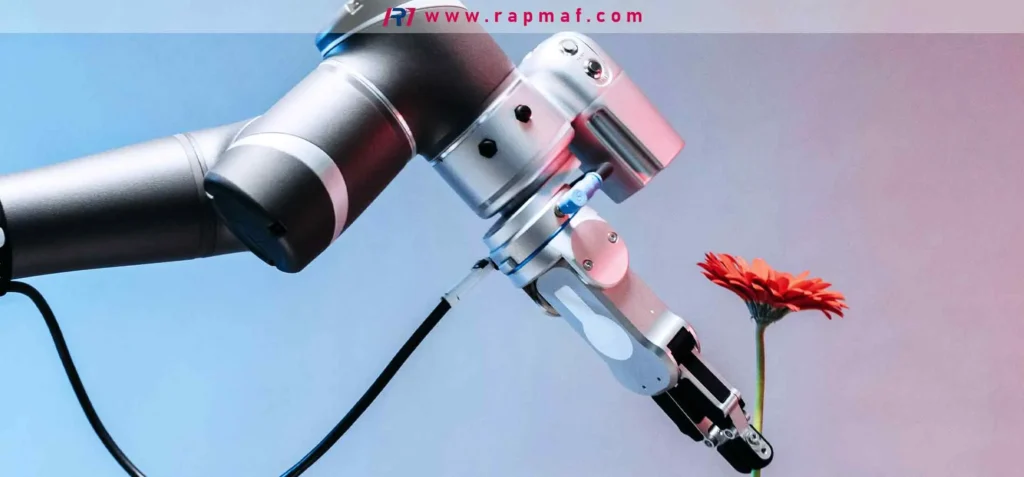
We analyzed the BOMs from dozens of robotic prototypes. A clear hierarchy has emerged.
| Material | Application Area | Why it’s Used | The Machining Challenge |
|---|---|---|---|
| Alu 7075-T6 | Main Skeleton (Thighs, Torso) | Yield Strength: 570 MPa. Allows super-thin walls. | Warping: “Memory” in the metal causes it to curl after cutting. |
| Titanium Gr 5 | High-Impact Joints (Ankles) | Fatigue Resistance: Withstands millions of steps. | Heat: Poor conductivity burns tools and work-hardens surfaces. |
| SS 17-4 PH | Sensor Mounts | Hysteresis: Magnetic properties ideal for force sensors. | Toughness: Breaking tiny M2 taps is a constant risk. |
| PEEK | Cable Guides / Insulation | Insulation: Prevents electrical shorts. | Deformation: Clamping too hard crushes the part. |
Clive’s Note: “7075 is the ‘Goldilocks’ material. But be warned: If you machine it aggressively on one side, it acts like a potato chip. We use a proprietary ‘Rough-Flip-Rough-Finish’ strategy to balance internal stress.”
Generative Design & The 5-Axis Advantage
Modern robot parts are designed by AI. The software is told: “Connect Point A to B, hold 50kg, use minimum metal.”
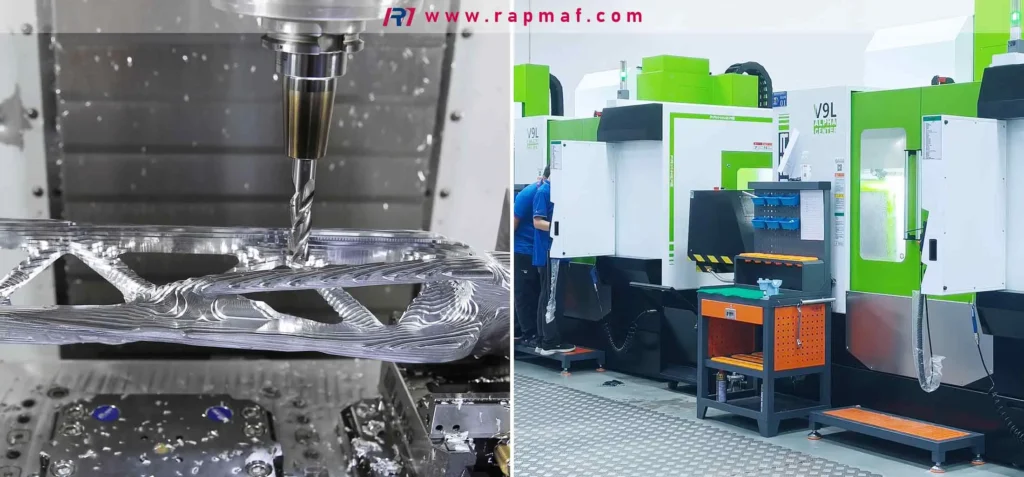
The result looks like a bird bone—curved, hollow, and full of void spaces.
Why 3-Axis Machines Fail:
- Undercuts: 3-Axis cannot reach under the “ribs” of a topology-optimized frame.
- Scalloping: Ball-end mills leave rough textures on curved surfaces.
The 5-Axis Solution:
We use Hermle & DMG MORI Simultaneous 5-Axis Centers.
- Access: We tilt the table to reach inside the “rib cage” of a torso frame.
- Rigidity: We use shorter, stiffer tools because the head gets closer to the part.
- Single Setup: We machine bearing bores on both sides of a knee joint in one clamping. This guarantees perfect alignment.
Precision for Actuators: The “Heart” of the Robot
The “muscle” of a humanoid is the Rotary Actuator (BLDC Motor + Harmonic Drive). These gearboxes are divas.
Concentricity is King
A Harmonic Drive uses a flexible metal cup. The gap is near zero.
- Requirement: The housing bearing bore must hold concentricity < 0.01mm.
- The Risk: If the housing is oval (even by 0.02mm), it squeezes the gear -> Friction -> Heat -> Actuator Failure.
Thermal Management
The aluminum skeleton is the heatsink.
- Surface Flatness: We use diamond fly-cutters to achieve Ra 0.4 flatness on motor mounting faces. This eliminates air gaps, transferring heat away from the sensitive coils.
Machining the Impossible: Thin Walls & Chatter
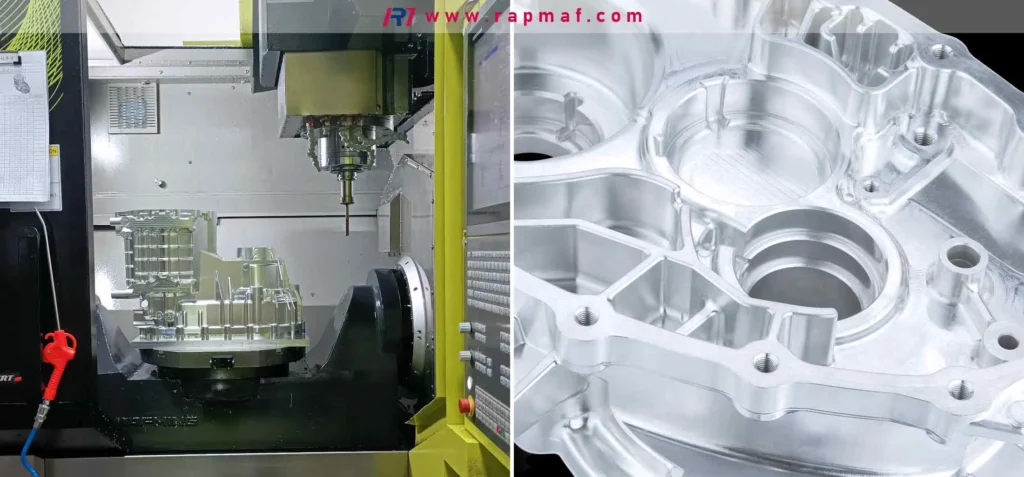
The Request: “Machine this 400mm thigh shell. Wall thickness 1.5mm.”
Thin walls vibrate like a drum skin (Chatter).
The Rapid Protocol:
- The “Waterline” Approach: We finish the top 10mm while the bottom is still a solid block. Then step down. Support is always there.
- HSM (High-Speed Machining): 20,000 RPM, low cutting force. Millions of microscopic bites instead of heavy cuts.
- Custom Soft Jaws: We machine negative molds that cradle the organic shape, dampening vibration.
From Prototype to Fleet: The “Hybrid” Bridge
Phase 1 (Alpha): 5 Robots. CNC is perfect.
Phase 2 (Beta): 100 Robots. CNC is expensive.
Phase 3 (Scale): 10,000 Robots. Need casting.
Our Solution: Hybrid Manufacturing
For Phase 2, we use High-Pressure Die Casting (HPDC) or Extrusion for the rough shape ($20/part), then put it into our 5-Axis CNC to machine only the critical bearing bores (H7 tolerance).
- Result: Cost of Casting + Precision of CNC.
Case Study: The “Un-Machinable” Shin Bone
Part: Tibial Linkage (Shin) for Logistics Robot.
Problem: Generative Design saved 30% weight, but local shops refused to quote. Deep pockets + Undercuts.
The Rapid Solution:
- DFM: We worked with the client’s AI team to add 2mm radii to internal corners (reachable by tools).
- 5-Axis Undercut: Used a “Lollipop Cutter” to reach inside the hollow shin.
- Verification: 3D Scanned the organic profile with our CMM.
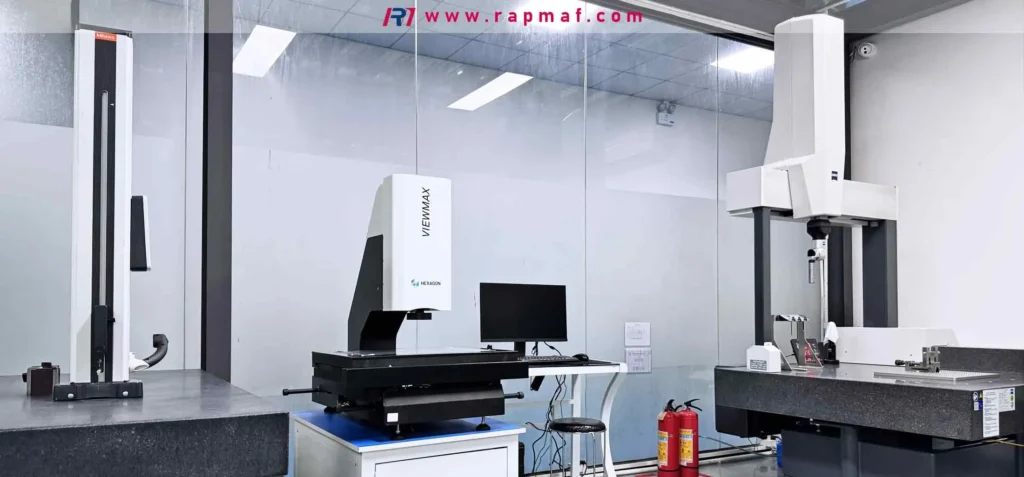
Outcome: Weight reduction allowed downsizing the knee motor, saving $400 per robot in BOM costs.
FAQs
Q: “We use Harmonic Drives (CSG series). Can you hold the tolerance?”
Clive: Yes. We routinely hold ISO IT6 tolerances on bearing bores. We verify with Air Gauges (pneumatic gauging), which are more accurate than CMMs for roundness.
Q: “How do you handle Grounding?”
Clive: Robots generate EMI. We use Selective Masking. We Anodize the whole part for looks, but mask the contact patches where the motor touches the chassis. This creates a clean conductive path.
Q: “Can you do Assembly?”
Clive: Yes. We press-fit bearings, install Heli-Coil inserts (crucial for aluminum threads), and bond thermal pads. We deliver a “ready-to-integrate” module.
Conclusion: We Are the “Bone Builders”
The robots are coming. They will carry boxes, assemble cars, and care for the elderly.
But they cannot be built with 1990s techniques.
They require a supply chain that understands Generative Design, 7075 Aluminum, and 5-Axis Complexity.
At Rapid Manufacturing, we don’t just see a STEP file; we see the kinematic chain. A heavy part is a failed part.
Let’s lighten the load. Send us your “impossible” organic part today.