



This guide is written from my personal perspective as a professional engineer and a partner at RM (Rapid Manufacturing). It’s a question that gets to the very soul of working with metal. In a world dominated by CNC machines that carve away material with sterile precision, forging is something different. It’s elemental. It’s about heat, force, and a deep, intuitive understanding of how metal wants to move. It’s not about removing material; it’s about forcing it into a stronger, more perfect version of itself.
| Simple Answer | Technical Answer | |
|---|---|---|
| What is Forging? | Forging is the art and science of shaping metal by hitting it or squeezing it, usually when the metal is hot. Think of a blacksmith with a hammer and anvil. | Forging is a manufacturing process that shapes metal using localized, compressive forces. This plastic deformation refines the metal’s internal grain structure, aligning it to the part’s geometry, which dramatically increases its strength, toughness, and fatigue resistance. |
To truly grasp forging, you have to understand its secret weapon, the one thing that makes a forged component fundamentally superior to its machined or cast counterparts for strength-critical applications: grain flow.
Imagine a block of wood. It has a distinct grain. If you want to make a strong wooden hook, you would carve it so the grain flows along the curve of the hook. If you were to cut that same hook shape out of a piece of plywood (which has jumbled, random grain) or worse, MDF (which has no grain at all), it would be incredibly weak at the curve.
Metal is the same. When it’s made, it has a grain structure. When we machine a part from a solid block of metal, we are like that plywood cutter—we slice right through the grain, leaving severed, weak points at every corner and curve.
Forging is different. By heating the metal and forcing it to move into the shape of a die, we aren’t cutting the grain; we are bending it. We force the grain to follow the contours of the part, just like that strong wooden hook. This continuous, unbroken grain flow is what gives a forged part its legendary toughness. The grain structure becomes a hidden, internal skeleton that carries loads and resists failure.
At RM, this isn’t just a textbook theory; it’s a daily reality. We’ve had clients come to us with parts machined from high-strength aerospace aluminum that were failing in the field. We take their design, convert it to a closed-die forging, and the failures stop. The part is often lighter, and always profoundly stronger. That is the magic of forging.
So how do we practice this “metal alchemy”? The process begins with a choice, one dictated by the laws of physics: do we work with the metal when it’s screaming hot and pliable as clay, or when it’s cold and stubborn as a rock? This is the fundamental divide in the world of forging. In the next section, I’ll take you on a deep dive into this choice, pitting hot forging against cold forging in a head-to-head showdown.
The Fundamental Choice: Hot vs. Cold Forging
In the last section, I left you at a critical crossroads that every forging engineer faces: do we bring the heat, or do we apply brute force at room temperature? This isn’t just a stylistic choice; it fundamentally changes the material’s behavior, the equipment required, and the final properties of the component. On my shop floor at RM, this decision is the first and most important one we make when designing a forging process.

Hot Forging: Shaping Metal Like Clay
When you picture a blacksmith, you picture hot forging. It is the oldest and most intuitive form of the process. The core principle is to heat the metal workpiece to a temperature above its recrystallization point but below its melting point. For steel, this is typically a glowing orange-to-yellow heat, anywhere from 950°C to 1250°C (1750°F to 2280°F).
What does “recrystallization temperature” mean? In simple terms, it’s a magical point where the metal’s internal grain structure is effectively hitting a reset button. When you deform the metal at this temperature, the distorted and stressed grains don’t just stay broken; they instantly reform into new, fine, and stress-free grains. This has two profound consequences:
- Massive Ductility: The metal becomes incredibly soft and malleable. It requires far less force to shape, allowing us to create incredibly complex geometries that would be impossible to achieve cold.
- No Work Hardening: Because the grains are constantly resetting, the material doesn’t become harder or more brittle as we work it. We can subject it to massive amounts of deformation in a single operation.
At RM, we use hot forging for our most demanding structural parts. Think large automotive crankshafts, aerospace landing gear components, or massive gear blanks for industrial machinery. In these applications, the ability to create complex shapes with an ideal grain flow for maximum toughness is paramount.
However, hot forging has its trade-offs, which are immediately visible to the naked eye.
- Oxidation and Scale: At these extreme temperatures, the surface of the metal reacts with the oxygen in the air, forming a rough, flaky layer of oxide called “scale.” This scale must be removed, and its formation means the final part won’t have a perfectly smooth surface.
- Lower Precision: The metal shrinks as it cools, and this cooling isn’t always perfectly uniform. This, combined with the scale, means that hot-forged parts have looser dimensional tolerances. They often require a final machining step to achieve their precise, finished dimensions.
Cold Forging: The Art of Precision Pressure
Cold forging is the polar opposite. As the name implies, it’s done at or near room temperature. Instead of making the metal pliable with heat, we simply use immense, almost unbelievable, amounts of force to make it move.
This process relies on a property I’ve mentioned before: work hardening (or strain hardening). As you deform the metal at room temperature, its internal crystal structure gets tangled up, making it progressively harder and stronger. Cold forging is not just a shaping process; it’s a strengthening process at the same time.
The advantages are the mirror image of hot forging’s disadvantages:
- Exceptional Precision: With no heat and no scale, we can produce parts with incredibly tight tolerances and a smooth, clean surface finish. Many cold-forged parts are “net-shape” or “near-net-shape,” meaning they require little to no final machining.
- Enhanced Strength: The work-hardening effect can significantly increase the tensile strength and hardness of the material, which can be a huge design advantage.
- Material Savings: The precision of the process means less material is wasted.
We use cold forging at RM for high-volume production of smaller, simpler parts where dimensional accuracy and surface finish are critical. Think of bolts, screws, rivets, and small gear blanks. The process is incredibly fast, often churning out hundreds of parts per minute.
The limitations, however, are significant. The immense forces required mean that only very ductile metals can be cold-forged. Furthermore, you can’t create the same level of complex geometry as you can with hot forging, as the material will fracture if you try to deform it too much.
| Feature | Hot Forging | Cold Forging |
|---|---|---|
| Temperature | Above Recrystallization | Room Temperature |
| Force Required | Low | Extremely High |
| Dimensional Accuracy | Low | High |
| Surface Finish | Poor (due to scale) | Excellent |
| Part Complexity | High | Low to Medium |
| Effect on Strength | Refines grain but doesn’t add strength | Increases strength via work hardening |
| Typical Application | Large structural parts (crankshafts) | Small, precise parts (fasteners) |
The Process Spectrum: How the Force Is Applied
Now that we understand the temperature variable, we need to look at the how. How is that compressive force actually delivered to the workpiece? This is where we get into the different types of forging equipment and methodologies.
Open-Die Forging: Industrial Blacksmithing
Open-die forging is the most basic and flexible type. If hot forging is like working with clay, open-die forging is like shaping that clay with your hands and a few simple tools. The workpiece is placed between two simple, often flat dies that don’t fully enclose it. The force is applied as the dies press into the metal, and the operator (or a robotic manipulator) turns and moves the workpiece between blows.
It’s blacksmithing on an industrial scale. Instead of a 2-pound hammer, we’re using a 50-ton hydraulic press or a massive steam hammer that shakes the entire building.
We use open-die forging at RM for several key situations:
- Huge Components: When a client needs a single massive component, like a 30-foot ship propeller shaft or a huge turbine rotor, it’s too big to be contained in a set of closed dies. Open-die is the only way.
- Prototyping and One-Offs: Creating a set of closed dies can cost hundreds of thousands of dollars. If a client only needs one or two custom parts, we’ll use open-die forging to get them their component without the massive tooling investment.
- Pre-Forming: We often use open-die forging as the first step for a later process. We might take a raw ingot and use an open-die press to “pre-form” it into a rough shape with some basic grain flow before it goes into the final, more precise closed-die operation.
The main disadvantage is that the process is heavily reliant on operator skill, and the dimensional accuracy is the lowest of all forging methods.
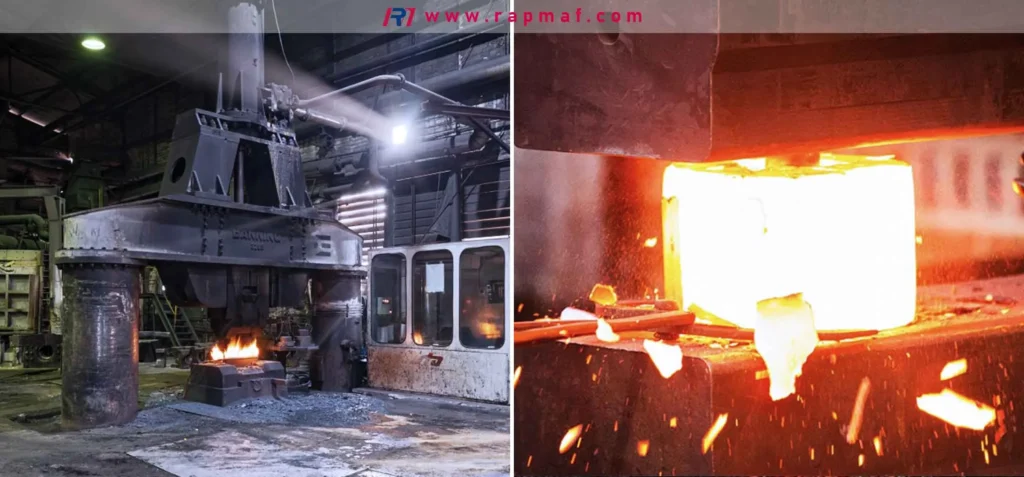
Closed-Die Forging: The Power of the Impression
This is the workhorse of the forging industry and what most people think of when they hear “industrial forging.” In closed-die forging (also called impression-die forging), the workpiece is completely or partially enclosed by two dies that have a precision-machined impression of the final part shape.
The process is methodical and precise:
- A carefully sized metal billet is heated to hot forging temperature.
- It’s placed in the lower die impression.
- The upper die comes down with incredible force, squeezing the metal and forcing it to flow and fill every cavity of the die impressions.
- A small amount of excess material squeezes out the sides into a small channel. This is called flash. The flash is critical; as it cools quickly and becomes hard to move, it acts as a plug, building up immense pressure inside the die to ensure every tiny detail of the impression is filled.
- The part is removed, the flash is trimmed off in a secondary operation, and you’re left with a high-precision, high-strength component.
This is the process we used for the automotive client I mentioned in the first section. Their failing machined part was redesigned as a closed-die forging. We created a die that mirrored the final part shape, ensuring that when the hot aluminum was forced into that shape, the grain structure flowed perfectly along the part’s most critical, high-stress curves. The result was a lighter, immensely stronger part that never failed again.
Closed-die forging is the king for producing high-strength, reliable parts in high volumes—from the connecting rods in your car’s engine to the wrenches in your toolbox. Its primary disadvantage is the high cost and long lead time required to design and manufacture the hardened steel dies.
We’ve seen the ideal process, but the reality on the shop floor is a battle against physics. What materials can withstand this brutal process? And more importantly, what happens when it goes wrong? The world of forging has its own dark side—a rogue’s gallery of potential defects that can turn a masterpiece of engineering into a piece of scrap. In the final section, we will explore the materials of forging and confront the defects that every forging engineer works to defeat.
The Materials of Forging: Choosing the Right Contender
You can’t forge glass. You can’t forge wood. And as it turns out, you can’t forge every type of metal, either. The ability of a material to undergo plastic deformation without rupturing is called forgeability. It’s a property I think about every single day. A material with good forgeability can be squeezed, hammered, and contorted into complex shapes and will respond by refining its grain structure and becoming stronger. A material with poor forgeability will simply crack and crumble under the immense pressure.
At RM, selecting the right alloy is a three-way negotiation between the client’s performance requirements, the material’s forgeability, and the final cost. Let’s walk through the main contenders.
Carbon and Alloy Steels: The Workhorses
When you think of forging, you are most likely thinking of steel. Carbon and alloy steels are, by a massive margin, the most commonly forged materials on the planet. Their combination of strength, toughness, low cost, and excellent forgeability makes them the undisputed champions of the industry.
- Low-Carbon Steels (e.g., 1020): These are incredibly ductile and easy to forge. They are the go-to for less demanding applications where toughness and formability are more important than outright strength.
- Medium-Carbon Steels (e.g., 1045): This is the sweet spot for a huge range of applications. They have a great balance of strength, ductility, and wear resistance. Most of the hand tools in your garage—hammers, wrenches, pliers—are forged from medium-carbon steel.
- Alloy Steels (e.g., 4140, 4340): When the going gets tough, we turn to alloy steels. By adding elements like chromium, molybdenum, and nickel, we create materials with incredible strength, toughness, and hardenability. The high-performance crankshafts, axles, and gears we produce at RM for the automotive and industrial sectors are almost always forged from these high-grade alloys. They forge beautifully, responding to the process by creating a grain structure that is second to none for fatigue resistance.
Stainless Steels: The Tough Contenders
Stainless steels are the divas of the forging world. Their high chromium content gives them their famous corrosion resistance, but it also makes them significantly stronger and less ductile at forging temperatures compared to carbon steels. Forging stainless steel is like trying to convince a very stubborn mule to move—it requires a lot more force and a lot more persuasion.
The presses and hammers we use have to be more powerful. The dies wear out faster. The temperature window for forging is often narrower and requires stricter control. But for applications in the medical, food processing, or marine industries, where corrosion resistance is non-negotiable, there is no other choice. One of our long-term clients manufactures high-pressure valves for desalination plants. The parts are constantly exposed to hot, high-pressure saltwater—a death sentence for carbon steel. We forge these components from a specialized duplex stainless steel. The process is challenging and the die life is short, but the resulting part is a fortress of strength and corrosion immunity.
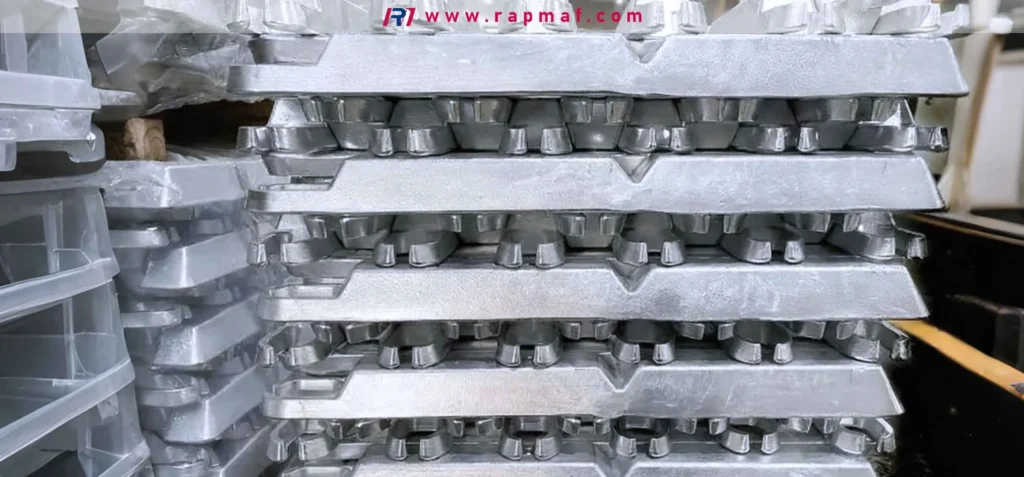
Aluminum Alloys: The Lightweight Champions
If stainless steel is a stubborn mule, aluminum is an eager stallion. Aluminum alloys have fantastic forgeability. They are lightweight, have an excellent strength-to-weight ratio, and are forged at much lower temperatures than steel (typically around 370-480°C or 700-900°F).
This is the material that allowed the aerospace industry to take flight. High-strength aluminum alloys (like 6061 and 7075) are used for everything from structural ribs and spars in aircraft wings to landing gear components. The automotive client I mentioned in the first section, whose part was failing? We switched them from a machined component to a forging made from 6061 aluminum. The combination of aluminum’s low density and the strength imparted by the forging process gave them a part that was not only stronger but also lighter, improving the vehicle’s overall performance.
Titanium Alloys: The Aerospace Superstars
Titanium is the final boss of forging. It is, without a doubt, the most difficult common engineering material to forge. Why?
- Narrow Temperature Window: Titanium has an extremely narrow window of temperature where it can be safely forged. Too hot, and the grain structure grows, making it brittle. Too cold, and it becomes incredibly resistant to deformation, risking cracks. We’re talking about a window that can be as tight as 25°C (50°F).
- High Reactivity: At forging temperatures, titanium reacts aggressively with oxygen, nitrogen, and hydrogen in the atmosphere, which can embrittle the material. For critical parts, it must be forged in a vacuum or an inert argon atmosphere, adding immense complexity and cost.
- Immense Strength: Even at its optimal forging temperature, titanium is incredibly strong, requiring the most powerful presses and the most robust dies.
So why on earth do we bother? Because forged titanium has the highest strength-to-weight ratio of any common metal. It’s strong as steel at a fraction of the weight and maintains that strength at high temperatures. For jet engine fan blades, critical airframe structures in fighter jets, and high-performance medical implants, there is simply no substitute. Forging titanium is the pinnacle of the craft, a place where engineering and materials science meet in the most extreme way.
Unforgeable Metals: Why Some Can’t Take the Pressure
So, what can’t be forged? The primary culprits are materials with very poor ductility, especially cast irons. Their high carbon content exists as flakes of graphite within the metal matrix. When you put cast iron under the immense compressive and tensile forces of forging, it doesn’t flow; it shatters along those graphite flakes. It’s like trying to forge a piece of concrete. Some specific types of “ductile iron” can undergo some forging, but traditional grey and white cast irons are definitively off-limits.
The Rogue’s Gallery: Common Forging Defects and How We Defeat Them
Even with the perfect material and the perfect process on paper, the shop floor is a warzone against physics. A successful forging operation isn’t one that never produces a bad part; it’s one that has robust systems to prevent, detect, and eliminate defects before they ever reach a customer. At RM, our quality control lab is the heart of the operation. Here are the villains we hunt every day.
Unfilled Sections (Underfill)
This is the most straightforward defect. An unfilled section, or “underfill,” is when the metal fails to completely fill the die cavity. The resulting part will have a rounded edge where it should be sharp or will be missing a feature entirely.
- Causes: The cause is usually one of three things: not enough material in the initial billet, insufficient forging pressure, or a die design that makes it too difficult for the metal to flow into tight corners.
- The Fix: This is often a process of trial and error. We might increase the billet size, increase the hammer or press force, or, in more complex cases, redesign the die with more generous radii to encourage material flow.

Cold Shuts or Folds
This is one of the most dangerous defects. A cold shut occurs when two streams of flowing metal meet but are too cold to properly fuse together. They simply fold over on top of each other, creating a hairline crack that runs deep into the part.
- Causes: This often happens in parts with complex geometries, like a web or a rib. If the metal flows around a feature and meets on the other side, it needs to be hot enough to weld itself back into a single piece. Poor die design or an incorrect forging temperature are the usual suspects.
- Consequences: A cold shut is a massive stress concentration point. Under load, a crack will almost certainly start at that fold, leading to catastrophic failure. At RM, we use non-destructive testing methods like dye penetrant testing or magnetic particle inspection to hunt for these invisible but deadly flaws on all critical components.
Scale Pits
Remember how hot forging creates a layer of oxide scale? If that scale isn’t completely removed before forging, it can be hammered directly into the surface of the part. When the part is later cleaned, the scale flakes off, leaving behind ugly pits and depressions.
- Causes: Inadequate descaling of the billet before it enters the die.
- The Fix: This is all about preparation. We use high-pressure water jets, shot blasting, or wire brushing to ensure our billets are perfectly clean before they feel the first hammer blow.
Mismatched Dies
This is a mechanical alignment error. A mismatch occurs when the top and bottom dies are not perfectly aligned. When the dies close, the impressions are offset, creating a horizontal step or shear line on the part.
- Causes: Improper setup of the forging press or hammer. Wear and tear on the die locating pins.
- The Fix: This is a pure process control issue. Rigorous setup procedures, regular equipment maintenance, and first-off part inspections are the only way to prevent mismatch.
Cracking: The Ultimate Failure
This is the defect that signals a fundamental breakdown in the process. Cracks can occur on the surface or deep within the component.
- Causes: The list is long. Forging at a temperature that is too low for the material, causing it to lose its ductility. Cooling the part too quickly after forging, which can induce massive internal stresses. Or, the problem could be with the raw material itself, containing impurities or internal flaws.
- The Fix: This requires a full-scale investigation. We analyze the process parameters, check our furnace temperatures, and send a sample of the material to the metallurgical lab to analyze its chemistry and microstructure. Finding the root cause of cracking is paramount.
The Final Verdict: Why We Go Through All This Trouble
When you look at the immense forces, the extreme temperatures, and the long list of things that can go wrong, you have to ask: why forge? Why not just melt the metal and pour it into a mold (casting) or cut the shape from a solid block (machining)? The answer, as I’ve hinted at all along, comes down to one thing: the grain.
Forging vs. Casting vs. Machining
| Feature | Forging | Casting | Machining |
|---|---|---|---|
| Grain Structure | Aligned, directional grain flow | Random, isotropic grain structure | Severed, discontinuous grain flow |
| Strength | Highest | Good | Dependent on raw stock |
| Toughness & Fatigue Life | Exceptional | Poor to Good | Good |
| Part Complexity | Medium | Highest | High |
| Tooling Cost | High | Medium to High | Low |
| Material Waste | Low (near-net-shape) | Medium | High (creates chips) |
| Best For | High-stress structural parts | Complex, intricate shapes | Prototypes, high-precision features |
Casting can create more complex shapes, and machining can achieve tighter tolerances, but neither can create the internal strength and reliability of a well-designed forging. It is the only process that takes the inherent grain of the metal and intentionally shapes it to be strongest where the part needs it most. It is the process we choose when failure is not an option.
Frequently Asked Questions about Forging
What are the 4 types of forging processes?
The main types are categorized by die design and temperature. The two primary die types are Open-Die Forging and Closed-Die Forging. These can both be performed either hot or cold, with the main process temperatures being Hot Forging and Cold Forging.
What is an example of forging?
Common examples are all around you. Hand tools like wrenches, hammers, and pliers are forged for strength. In your car, critical components like the crankshaft, connecting rods, and axles are forged for fatigue resistance. In aerospace, landing gear and turbine disks are forged for their incredible strength-to-weight ratio.
Which metal cannot be forged?
Metals with low ductility, most notably grey cast iron, cannot be forged. Their internal structure is brittle and will crack under the compressive forces of forging rather than flowing into the desired shape.
What are forged items?
Forged items are components manufactured through the forging process. They are universally recognized for their superior mechanical properties, particularly their high tensile strength, toughness, and resistance to impact and fatigue, which is a direct result of the refined and aligned grain structure created during the forging process.
References and Further Reading
- Forging Industry Association (FIA): The leading trade association for the forging industry in North America, with a wealth of resources on processes and materials.
- ASM International – Forging and Forming Community: A professional organization for materials scientists and engineers, providing deep technical knowledge on all aspects of forging.
- Scot Forge – The Forging Process: A commercial forging company with an excellent educational section on their website explaining the different types of forging with clear diagrams and videos.
From the blacksmith’s anvil to the 50,000-ton hydraulic press, the soul of forging has remained the same. It is a process of controlled violence, of heat and pressure applied with intent and intelligence. It is how we take a simple, uniform block of metal and give it a hidden architecture, a backbone of aligned grains, transforming it from a mere material into a component capable of withstanding the most extreme forces imaginable. It is, and always will be, the ultimate expression of metal’s strength.
Disclaimer
The information on this page is for informational purposes only. RM makes no representations or warranties, express or implied, as to the accuracy or completeness of this information. For any third-party services procured through the RM network, it is the buyer’s responsibility to specify and confirm performance parameters, tolerances, materials, and workmanship during the quotation process. For more detailed information, please do not hesitate to contact us.
RM: Your Precision Manufacturing Partner
RM is an industry leader in custom manufacturing solutions. With over 20 years of profound experience, we have become the trusted partner for more than 5,000 clients worldwide. We specialize in a comprehensive range of manufacturing services—including high-precision CNC machining, sheet metal fabrication, 3D printing, injection molding, and metal stamping—to provide you with a true one-stop-shop experience.
Our world-class facility is equipped with over 100 state-of-the-art 5-axis machining centers and operates in strict compliance with the ISO 9001:2015 quality management system. We are dedicated to providing solutions that blend speed, efficiency, and exceptional quality to customers in over 150 countries. From rapid prototyping to large-scale production, we promise delivery in as fast as 24 hours, helping you gain a competitive edge in the market. Choosing RM means selecting an efficient, reliable, and professional manufacturing ally.
Explore our capabilities today by visiting our website: www.rapmaf.com







2 Responses