



You’re looking for a simple number, a fact you can plug into a calculation or use to settle a debate: What is the melting point of steel?
Here is the quick answer engineers use as a rule of thumb:
Most common steels and stainless steels melt at a temperature range between 1370-1540°C (2500-2800°F).
But the honest, expert answer is more complex and far more useful: There is no single melting point for steel. Asking for the melting point of steel is like asking for the price of “a car.” The immediate, necessary follow-up question is: Which one? A basic carbon steel used for construction beams behaves very differently in a furnace than a high-chromium stainless steel designed for jet engine components.
The exact temperature at which steel turns from a solid to a liquid depends entirely on its alloys—the specific ingredients intentionally mixed into the iron base.
In this definitive guide, we will move beyond the simple numbers. We’ll explore the fundamental science that governs why different steels melt at different temperatures, put carbon steel and stainless steel in a head-to-head showdown, and give you the knowledge to understand which material is right for your high-temperature application.
It All Starts with Iron
To understand steel, you must first understand its parent element: Iron (Fe). Pure iron is a metal with a fixed, known melting point of 1538°C (2800°F). This is our baseline, the starting point for all steel.

But pure iron, while strong, is relatively soft and rusts easily. To enhance its properties—to make it harder, stronger, and more versatile—we add other elements. The moment we intentionally add another element to iron, we create an alloy. And the most important, fundamental alloying element is carbon.
The Power of Carbon: Creating “Plain” Steel
The simplest definition of steel is an alloy of iron and carbon. Think of it like making coffee. Pure iron is a cup of hot water—useful, but basic. Carbon is the coffee grounds. By adding just a small amount of carbon (typically less than 2%), we transform the water into a completely new beverage with different properties, a different taste, and a different color.
In metallurgy, this transformation is even more profound. Adding carbon to iron does two critical things:
- It dramatically increases the material’s hardness and strength.
- It lowers the melting point below that of pure iron.
This might seem counterintuitive. How does adding something make the melting point go down? This phenomenon, known as melting-point depression, occurs because the smaller carbon atoms disrupt the neat, orderly crystal structure of the iron atoms. It becomes easier for the atomic bonds to break apart when heated, requiring less energy (and therefore a lower temperature) to transition into a liquid state.
This iron-carbon alloy is what we refer to as Carbon Steel—the most common and widely produced type of steel in the world. Its properties are almost entirely defined by the percentage of carbon it contains.
Low-Carbon Steel (Mild Steel)
- Carbon Content: Typically 0.05% to 0.25%
- Properties: Relatively soft, highly formable, and easy to weld. It’s the workhorse of the construction and automotive industries.
- Melting Point Range: Approximately 1430-1540°C (2610-2800°F). Notice the upper end of the range is very close to pure iron, as there is very little carbon to disrupt the crystal structure.
- Examples: Structural beams, car body panels, and common fasteners.
Medium-Carbon Steel
- Carbon Content: Typically 0.25% to 0.60%
- Properties: A balance of strength, hardness, and ductility. Can be heat-treated to further enhance its mechanical properties.
- Melting Point Range: Approximately 1425-1540°C (2600-2800°F).
- Examples: Railway tracks, gears, and crankshafts.
High-Carbon Steel
- Carbon Content: Typically 0.60% to 1.5%
- Properties: Very hard and strong, but less ductile (more brittle). It can hold a sharp edge, making it ideal for cutting tools.
- Melting Point Range: Approximately 1370-1520°C (2500-2770°F). Here we see the most significant drop in melting point due to the higher concentration of carbon atoms.
- Examples: Springs, high-strength wires, and tools like drill bits and knives.
So, we have established our first key family: Carbon Steel. Its melting point is not a single number but a range that generally sits just below that of pure iron, influenced primarily by its carbon content. At RM, we work with all of these grades, understanding that the choice between them involves a precise trade-off between cost, machineability, and final strength.
But what happens when we want to protect steel from its greatest enemy—rust? For that, we need to introduce a new, powerful ingredient that creates an entirely different class of material: Stainless Steel. In the next part, we will explore the role of chromium and put these two steel families in a direct head-to-head comparison.
The Magic of Chromium: Creating Stainless Steel
While carbon steel is the workhorse of the world, it has a fatal flaw: it rusts. When exposed to oxygen and moisture, the iron atoms react to form iron oxide, a flaky, reddish-brown substance that compromises the material’s structural integrity. For centuries, the only solutions were coatings like paint, oil, or galvanization.
The breakthrough came in the early 20th century with the discovery that adding a significant amount of chromium (Cr) to steel created a material that could magically resist corrosion.
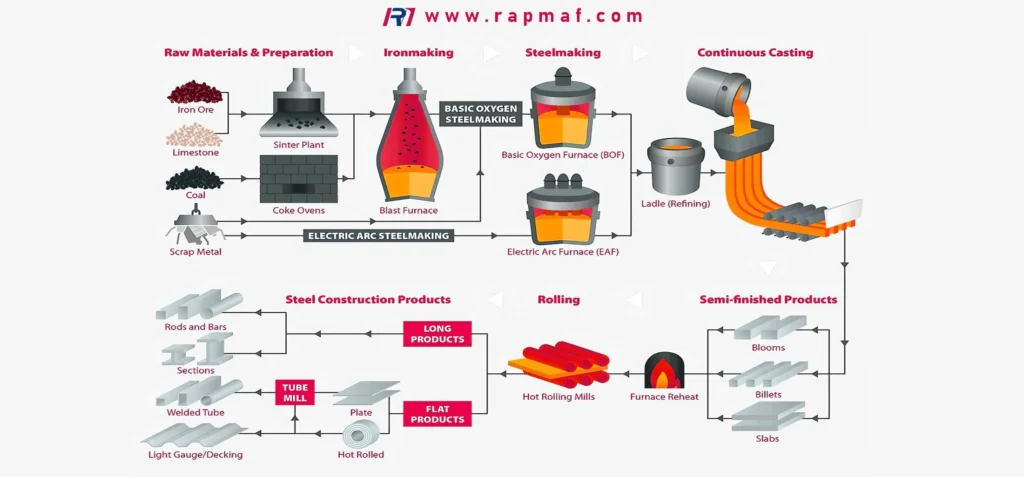
This isn’t magic, but brilliant chemistry. When at least 10.5% chromium is present in the steel alloy, it reacts with oxygen in the air to form a microscopic, invisible, and incredibly durable layer of chromium oxide on the surface of the steel. This is known as the passive layer.
This layer is the key to everything.
- It’s Self-Healing: If the surface is scratched or cut, the exposed chromium immediately reacts with oxygen to reform the protective layer.
- It’s Impermeable: It prevents oxygen and water from reaching the iron underneath, effectively stopping rust before it can even start.
- It’s Stable: It remains effective across a wide range of temperatures and environments.
By adding chromium, and often other elements like nickel and molybdenum, we create Stainless Steel.
How Do Alloying Elements Affect the Melting Point of Stainless Steel?
Just like carbon, these additional, larger alloying atoms (chromium, nickel, etc.) disrupt the iron crystal lattice. This generally lowers the melting point range below that of pure iron. However, the complex interplay of multiple elements makes the melting range of stainless steel highly dependent on its specific grade.
To demonstrate this, let’s look at the three main families of stainless steel:
- Austenitic Stainless Steels (e.g., 304, 316): These are the most common types, known for their excellent corrosion resistance and formability. They contain high levels of chromium and nickel. The addition of nickel is crucial for their specific crystal structure.
- Melting Point Range: Approximately 1400-1450°C (2550-2650°F).
- Ferritic Stainless Steels (e.g., 430): These have a lower carbon content and no nickel, making them magnetic. They are less expensive than austenitic grades but still offer good corrosion resistance.
- Melting Point Range: Approximately 1425-1510°C (2600-2750°F).
- Martensitic Stainless Steels (e.g., 410, 420): These have a higher carbon content and can be heat-treated to achieve very high hardness, similar to high-carbon steel, but with the added benefit of being stainless.
- Melting Point Range: Approximately 1480-1530°C (2700-2790°F).
As you can see, even within the “stainless steel” family, the melting point varies significantly based on the recipe.
Head-to-Head: Carbon Steel vs. Stainless Steel
Now that we understand both families, we can put them in a direct comparison to see how their composition affects not just their melting point, but all their key properties.
| Feature | Carbon Steel | Stainless Steel |
|---|---|---|
| Primary Alloying Element | Carbon (C) | Chromium (Cr) (minimum 10.5%), often with Nickel (Ni) and Molybdenum (Mo) |
| Defining Property | Hardness and Strength (determined by carbon content) | Corrosion Resistance (due to the chromium oxide passive layer) |
| Melting Point Range | ~1370-1540°C (2500-2800°F) Higher carbon generally means lower melting point. |
~1400-1530°C (2550-2790°F) Varies widely by grade and specific alloys. |
| Corrosion Resistance | Poor. Will rust readily without a protective coating. | Excellent. Self-healing passive layer prevents rust. |
| Cost | Low. Iron and carbon are inexpensive and abundant. | High. Chromium and especially nickel are expensive alloying elements. |
| Strength & Hardness | Can be extremely high (especially high-carbon grades), but often at the cost of ductility. | Can range from soft and ductile (304) to extremely hard (heat-treated 420). |
| Common Applications | Structural beams, machinery, tools, car bodies, pipelines. | Cookware, medical instruments, food processing, chemical tanks, architectural trim. |
Real-World Expertise: More Than Just a Melting Point
At RM, we frequently consult with clients on material selection for high-temperature applications, and this is where the textbook numbers for melting points can be dangerously misleading.
A client recently came to us with a design for a custom fixture that would hold parts inside an industrial furnace operating at 800°C (1472°F). They initially specified a high-carbon tool steel for the design, citing its high strength and the fact that 800°C is well below its melting point of ~1400°C.
This is a classic engineering mistake. While the carbon steel wouldn’t melt, it would be a catastrophic failure. Here’s why:
- Oxidation: At 800°C, the carbon steel would rapidly oxidize, forming a thick, flaky scale. It would literally be eaten away over a very short time, losing its structural integrity.
- Loss of Strength: The heat-treated strength of the tool steel would be destroyed by a process called tempering. It would become soft and deform under the weight of the parts it was meant to hold.
Our recommendation was to switch to a specific grade of stainless steel: Type 310. This grade is specifically designed for high-temperature service.
- Why 310 Stainless Steel? It has a very high chromium (
25%) and nickel (20%) content. This creates an extremely stable passive layer that resists high-temperature oxidation. While its melting point (~1450°C) is similar to the carbon steel’s, its effective operating temperature is far superior. It retains a significant portion of its strength at 800°C and will not scale or degrade.
This case study proves a critical point: Melting point is not the same as maximum service temperature. For high-temperature applications, resistance to oxidation and strength retention are often far more important than the ultimate liquefaction temperature.
We’ve now established a clear understanding of the two major steel families and their behavior under heat. But how do they stack up against other common metals? In the final part, we will broaden our perspective, comparing the melting points of steel to aluminum, copper, and titanium to give you a complete picture of the metallic landscape.
A Broader Perspective: Steel vs. Other Common Metals
Melting point is a direct indicator of the strength of the metallic bonds holding the atoms together. A higher melting point generally suggests a material that is more difficult to process but can potentially perform in more extreme environments.
Aluminum: The Lightweight Contender
Approximate Melting Point: 660°C (1220°F)
Aluminum’s melting point is dramatically lower than any steel. This is due to its different atomic structure and weaker metallic bonds compared to iron. This isn’t a weakness; it’s a defining feature that engineers leverage.
- Engineering Implications: The low melting point makes aluminum incredibly easy and energy-efficient to melt, cast, and extrude. This is why it’s the material of choice for complex cast parts like engine blocks and mass-produced items like beverage cans. However, this same property means it loses its strength very quickly at even moderately elevated temperatures, making it unsuitable for high-heat applications where steel excels.
Copper: The Conductive Workhorse
Approximate Melting Point: 1084°C (1983°F)
Copper sits in an interesting middle ground. Its melting point is significantly higher than aluminum’s but still well below the range for most steels. This reflects its stronger metallic bonds, which are also responsible for its excellent electrical and thermal conductivity.
- Engineering Implications: Copper’s melting point is high enough for it to be used in applications like high-quality cookware and plumbing pipes that need to handle heat without deforming. In manufacturing, its melting point is key to joining processes like brazing, where a filler metal with a lower melting point is used to join two stronger components (often steel) without melting them.
Titanium: The Aerospace Champion
Approximate Melting Point: 1668°C (3034°F)
Titanium has a melting point that surpasses even that of pure iron. This is a testament to the incredibly strong bonds between its atoms, which also give it its legendary strength-to-weight ratio.
- Engineering Implications: The extremely high melting point makes titanium very difficult and expensive to work with. It requires specialized vacuum furnaces for melting and casting, and welding must be done in an inert gas environment to prevent contamination. This is why titanium is reserved for “no-compromise” applications where performance is paramount: aerospace components, high-performance engine valves, and biomedical implants.
The Full Picture: A Comparative Chart
To summarize, let’s place these materials on a single spectrum.
| Material | Approx. Melting Point (°C) | Approx. Melting Point (°F) | Key Engineering Implication |
|---|---|---|---|
| Aluminum | 660°C | 1220°F | Easy to cast & recycle; poor high-temp strength. |
| Copper | 1084°C | 1983°F | Good for thermal/electrical uses; moderate temp range. |
| Carbon Steel | 1370-1540°C | 2500-2800°F | Versatile & strong; high-energy processing required. |
| Stainless Steel | 1400-1530°C | 2550-2790°F | Excellent corrosion & heat resistance. |
| Titanium | 1668°C | 3034°F | Elite strength at high temps; difficult to process. |
Final Verdict: Why Melting Point is Just the Beginning
If you’ve followed this guide, you now understand a critical engineering principle: a material’s melting point is a vital statistic, but it’s rarely the whole story.
As our case study demonstrated, the maximum service temperature—the temperature at which a material can perform its job without degrading—is often a far more important metric. Carbon steel will oxidize and lose its strength long before it melts. Stainless steel thrives at temperatures that would destroy aluminum.
The choice is never about finding the highest number. It’s about understanding the complete profile of a material:
- How does it behave at its operating temperature?
- How does it resist its chemical environment?
- What is the cost of manufacturing it into a final part?
At RM, these are the questions we help our clients answer every day. By moving beyond simple data points and embracing a holistic view of material science, we ensure that the right material is chosen for the job, guaranteeing performance, safety, and value.
Frequently Asked Questions (FAQ)
What is the melting point of steel compared to stainless steel?
They have very similar melting point ranges. Carbon steel melts between 1370-1540°C (2500-2800°F), while stainless steel melts between 1400-1530°C (2550-2790°F). The specific melting point for both depends heavily on the exact alloy composition.
What metal has the highest melting point?
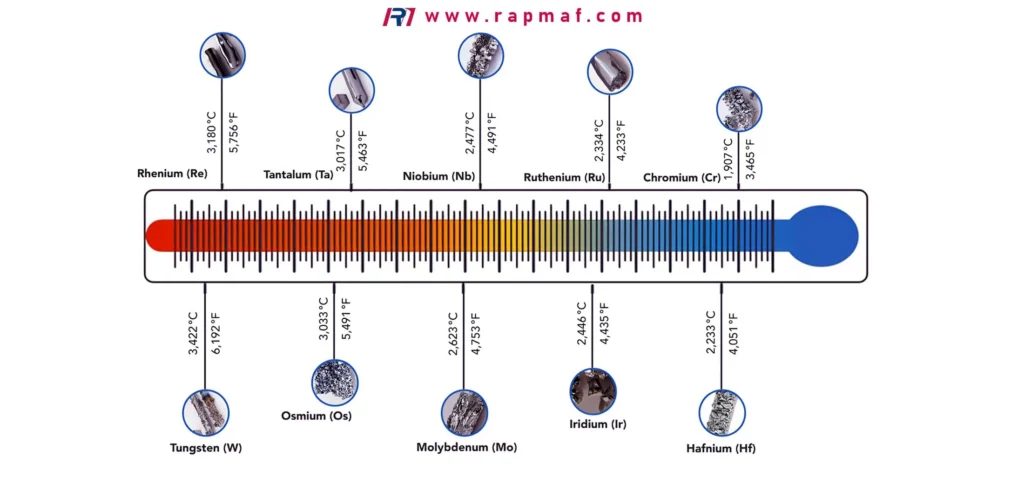
The metal with the highest melting point of all is Tungsten (W), at an incredible 3422°C (6192°F), which is why it’s used for filament in incandescent light bulbs and high-temperature welding electrodes. Among common structural metals, Titanium is one of the highest.
What metal has the lowest melting point?
Mercury (Hg) is a metal that is liquid at room temperature, with a melting point of -38.8°C (-37.9°F). For common solid metals, alloys like solder (tin/lead) have very low melting points, while Aluminum is the lowest among common structural metals.
Which is stronger, steel or stainless steel?
This is a complex question with no single answer. A heat-treated high-carbon tool steel can be much harder and stronger than a common 304 stainless steel. However, certain advanced grades of stainless steel can be treated to achieve incredible strength while retaining corrosion resistance. The “better” material depends entirely on the application’s demands for strength, toughness, corrosion resistance, and temperature stability.
References
- ASM International. (2018). ASM Handbook, Volume 1: Properties and Selection: Irons, Steels, and High-Performance Alloys.
- Callister, W. D., & Rethwisch, D. G. (2018). Materials Science and Engineering: An Introduction (10th ed.). Wiley.
- Davis, J. R. (Ed.). (1998). Metals Handbook Desk Edition (2nd ed.). ASM International.
Disclaimer
The information on this page is for informational purposes only. RM makes no representations or warranties, express or implied, as to the accuracy or completeness of this information. For any third-party services procured through the RM network, it is the buyer’s responsibility to specify and confirm performance parameters, tolerances, materials, and workmanship during the quotation process. For more detailed information, please do not hesitate to contact us.
RM: Your Precision Manufacturing Partner
RM is an industry leader in custom manufacturing solutions. With over 20 years of profound experience, we have become the trusted partner for more than 5,000 clients worldwide. We specialize in a comprehensive range of manufacturing services—including high-precision CNC machining, sheet metal fabrication, 3D printing, injection molding, and metal stamping—to provide you with a true one-stop-shop experience.
Our world-class facility is equipped with over 100 state-of-the-art 5-axis machining centers and operates in strict compliance with the ISO 9001:2015 quality management system. We are dedicated to providing solutions that blend speed, efficiency, and exceptional quality to customers in over 150 countries. From rapid prototyping to large-scale production, we promise delivery in as fast as 24 hours, helping you gain a competitive edge in the market. Choosing RM means selecting an efficient, reliable, and professional manufacturing ally.
Explore our capabilities today by visiting our website: www.rapmaf.com







11 Responses