


You’ve asked a foundational question in material science: What is a material ceramic? The short answer is that a ceramic is a solid material comprising an inorganic compound of metal, non-metal or metalloid atoms primarily held in ionic and covalent bonds. Typically, they are hardened by a high-temperature firing process.
But this definition, while accurate, hides the incredible story of this material class. Most people hear “ceramic” and picture a clay pot, a dinner plate, or a bathroom tile. While those are certainly ceramics, they represent just one branch of a massive family tree. In modern engineering, technical ceramics are high-performance materials essential for everything from jet engines and medical implants to the phone in your pocket.
At RM (Rapid Manufacturing), we work with these advanced technical ceramics to solve problems that are impossible for metals or plastics to handle. This guide will take you beyond the pottery studio and into the world of material science to give you a true engineer’s understanding of what a ceramic is, what it can do, and why it is one of the most important material classes in the world.
Beyond the Clay Pot: The Modern Engineering Definition
To truly understand ceramics, we need to break down that initial definition. Unlike a simple material like pure iron, ceramics are defined by a set of characteristics. A material must meet three key criteria to be considered a ceramic:
- It Must Be Inorganic: This is the first and most important dividing line. Organic materials, like wood, cotton, and all plastics (polymers), are based on carbon chemistry—long chains of carbon atoms. Ceramics are not. Their chemistry is based on compounds that do not have this carbon backbone, such as oxides, nitrides, and carbides. This is why a diamond (pure carbon, but in a crystal lattice) is often studied alongside ceramics, while plastic is in a completely different category.
- It Must Be Non-Metallic: This refers to the way the atoms are bonded together. In metals, the atoms share a “sea” of free-floating electrons. This metallic bond is what allows metals to be bent, stretched, and to conduct electricity and heat so well. Ceramic atoms are joined by much more rigid and localized covalent and ionic bonds. This is the secret to their properties: these strong, inflexible bonds are what make ceramics incredibly hard, but also what makes them brittle. We will explore this in detail shortly.
- It is Solidified by Heat and Pressure (Sintering): You can’t melt down ceramic powders and cast them into a mold like you can with aluminum or plastic. Instead, most ceramics are formed by taking a fine powder, pressing it into the desired shape (a “green body”), and then firing it at an extremely high temperature, but below its melting point. This process, called sintering, causes the individual powder particles to fuse together, eliminating the gaps between them and forming a dense, hard, solid object.
A material that fits all three of these criteria—inorganic, non-metallic bonding, and processed via sintering—is a ceramic.
The Atomic Glue: What Gives Ceramics Their Superpowers?
The difference between a high-performance ceramic and a lump of steel comes down to the invisible forces holding their atoms together. Understanding this is the key to understanding why ceramics behave the way they do.
Covalent and Ionic Bonds: A Double-Edged Sword
As mentioned, ceramics are dominated by two types of chemical bonds:
- Ionic Bonds: Formed when one atom gives an electron to another. This creates a powerful electrostatic attraction between the resulting positive and negative ions (think of a tiny magnet). The bond is very strong, but it’s directionally rigid.
- Covalent Bonds: Formed when atoms share electrons. This creates an incredibly strong and stable link in a very specific orientation.
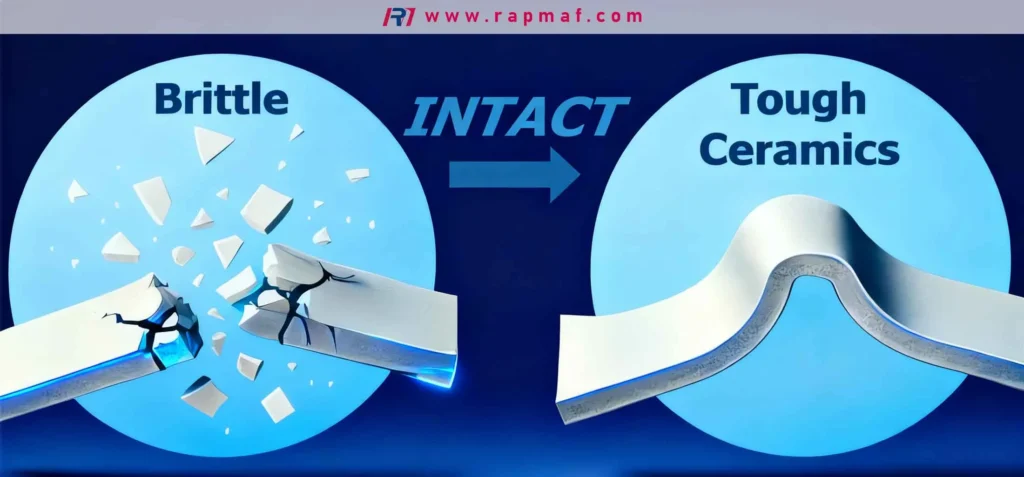
Imagine building a wall. You could build it with perfectly shaped, interlocking bricks and super-strong mortar. This wall would be immensely strong in compression (you could stack a huge weight on it) and very hard to scratch. This is a ceramic. But if you hit that wall with a sledgehammer, it won’t bend—it will shatter. The energy has nowhere to go but into breaking those rigid bonds.
Now, imagine a chain-link fence. The metal atoms are held by metallic bonds—that “sea” of shared electrons. This structure is flexible. If you hit it with a sledgehammer, the fence will deform and dent, but it won’t shatter. The atoms can slide past one another without breaking their connection. This is why metals are ductile and malleable.
This fundamental difference in atomic bonding is the source of nearly every property that defines ceramics:
- High Hardness & Compressive Strength: The strong, rigid bonds are extremely difficult to scratch or crush.
- Brittleness: The bonds cannot deform, so they break catastrophically when their limit is reached.
- High-Temperature Resistance: It takes an enormous amount of energy to break these bonds, giving ceramics very high melting points.
- Chemical Inertness: The stable bonds make ceramics highly resistant to chemical attack and corrosion.
- Electrical & Thermal Insulation: The electrons are locked tightly in the bonds and cannot move freely, making most ceramics excellent insulators.
The Two Great Families of Ceramics
Now that we have a solid definition, we can divide the vast world of ceramics into two main families, which primarily differ in their composition and purity.
Traditional Ceramics: The Earth’s Legacy
These are the ceramics that humanity has known for millennia. They are based on three main natural ingredients:
- Clay (e.g., Kaolinite): Provides plasticity, allowing the material to be shaped when wet.
- Silica (Flint): The primary glass-former, providing the structural backbone.
- Feldspar: Acts as a flux, lowering the melting temperature and helping to fuse the components together.
Products made from traditional ceramics include pottery, bricks, porcelain insulators, and tiles. While essential to our civilization, they are made from natural, minimally processed raw materials, which means they contain impurities. These impurities create inconsistencies in the final material, limiting their performance in extreme engineering applications.
Advanced Ceramics (Technical or Engineering Ceramics): The Engineered Future
This is the family of ceramics we specialize in at RM. Unlike traditional ceramics, advanced ceramics are made from highly purified and precisely controlled synthetic powders. They are not made from a scoop of clay from a riverbed; they are synthesized in a lab to achieve a purity of 99.9% or higher.
This purity and control allow us to engineer materials with extraordinary and reliable properties. The main types include:
- Oxides: Aluminum Oxide (Alumina), Zirconium Oxide (Zirconia). Known for extreme hardness and wear resistance.
- Nitrides: Silicon Nitride, Boron Nitride. Excel in high-temperature applications where they maintain strength.
- Carbides: Silicon Carbide, Tungsten Carbide. Among the hardest materials known, used for cutting tools and armor.
These are the materials that enable modern technology—from the ceramic capacitors in your phone to the Zirconia ball bearings in a jet engine’s fuel pump.
We have now established a solid, scientific foundation for what a material ceramic is. We’ve defined it by its chemical nature, its atomic bonding, and its manufacturing process. We’ve also divided its vast world into two main families.
In the next part, we will perform a deep dive into the extraordinary properties of ceramics, quantifying their incredible strength and temperature resistance, and present a real-world case study from RM where a technical ceramic solved an engineering problem that no metal could.
A Profile of Extremes: The 6 Key Properties of Technical Ceramics
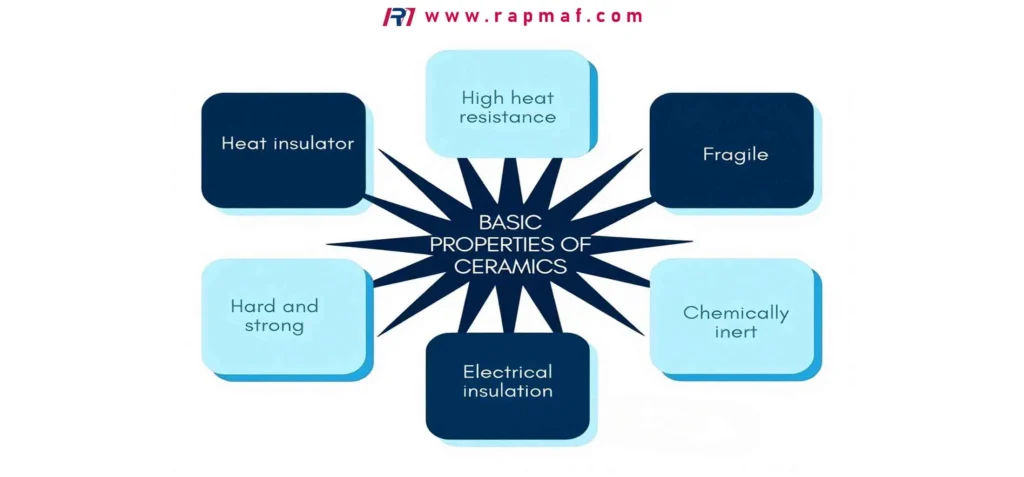
The properties of technical ceramics are not a story of balance; they are a story of extremes. They excel in certain areas to a degree that metals and plastics cannot approach, while having distinct limitations that must be respected in any design.
1. Extreme Hardness and Wear Resistance
This is the most famous characteristic of ceramics. Hardness is a material’s ability to resist localized surface deformation, such as scratching or indentation. On the Mohs scale of mineral hardness, which runs from 1 (Talc) to 10 (Diamond), many technical ceramics score a 9 or higher.
- The Science Behind It: The strong, tightly packed covalent and ionic bonds are incredibly difficult to displace. A foreign object attempting to scratch the surface simply cannot generate enough localized force to break these bonds and plow a groove.
- Real-World Impact: This is why ceramics are used for cutting tools (Tungsten Carbide), abrasive media (sandpaper often uses Aluminum Oxide or Silicon Carbide), armor plating (Boron Carbide), and wear-resistant linings in industrial equipment. A ceramic component can operate in a highly abrasive environment for months or years while a hardened steel part would be destroyed in weeks.
2. Immense Compressive Strength
While brittle in tension (when pulled apart), ceramics are phenomenally strong when squeezed. Compressive strength is the ability to withstand a crushing force. It’s not uncommon for a technical ceramic like Silicon Carbide to have a compressive strength ten times greater than that of common structural steel.
- The Science Behind It: Imagine trying to crush that wall of perfectly interlocked bricks we discussed in Part 1. The compressive force pushes the atoms even closer together, and the strong, rigid bonds resist this force with incredible power. Any microscopic cracks are forced closed, preventing failure.
- Real-World Impact: This property makes ceramics ideal for support structures, high-pressure seals, and applications where immense static loads are present. It’s the same principle that allows a concrete (a type of ceramic composite) pillar to support a bridge.
3. High-Temperature Stability (Refractoriness)
Metals melt. Plastics melt and burn. Technical ceramics, however, can operate at temperatures that would turn steel into a puddle. The ability of a material to retain its strength and chemical integrity at high temperatures is known as refractoriness.
- The Science Behind It: A material’s melting point is directly related to the energy required to break its atomic bonds. The immense energy locked in the covalent and ionic bonds of ceramics means they have exceptionally high melting points. Alumina melts at over 2,000°C (3,600°F), while most steels are liquid by 1,400°C (2,500°F).
- Real-World Impact: This makes ceramics the only choice for applications like furnace linings, the heat shield tiles on a space shuttle, jet engine turbine blades (in the form of ceramic matrix composites), and crucibles for melting other metals.
4. Brittleness (Low Fracture Toughness)
This is the critical trade-off for all of the properties listed above. Brittleness is the tendency of a material to fracture without significant plastic deformation. Fracture toughness is the engineering measurement of a material’s resistance to crack propagation. Ceramics have very low fracture toughness.
- The Science Behind It: When a small crack forms in a ceramic and a tensile (pulling) force is applied, the stress becomes highly concentrated at the tip of that crack. In a metal, the atoms at the crack tip could flow and deform, blunting the crack and dissipating the energy. In a ceramic, the rigid bonds cannot deform. All of that concentrated energy goes into breaking the next atomic bond, and the next, causing the crack to propagate almost instantaneously through the material, resulting in catastrophic failure. This is why dropping a ceramic plate causes it to shatter, while a dropped steel plate just dents.
- Real-World Impact: Designing with ceramics requires a completely different mindset. Engineers must design components to avoid sharp corners and tensile stress, keeping the ceramic in compression wherever possible. This property is the single biggest challenge in working with these materials.
5. Electrical Insulation
While some specialized ceramics can be engineered to be semiconductors or even superconductors, the vast majority are excellent electrical insulators. They do not conduct electricity.
- The Science Behind It: Electrical conductivity relies on the free movement of electrons. In metals, the “sea” of electrons is free to move and carry a current. In ceramics, the electrons are locked tightly within the ionic and covalent bonds. They are not free to move, so no current can flow.
- Real-World Impact: This property is the foundation of the entire electronics industry. Ceramic insulators are used to support high-voltage power lines (porcelain), as substrates for circuit boards (Alumina), and as the dielectric material in billions of tiny capacitors.
6. Chemical Inertness and Corrosion Resistance
Ceramics are extremely stable and unreactive in most chemical environments, including strong acids and bases. They do not rust or corrode like metals.
- The Science Behind It: Corrosion is a chemical reaction. The atoms in ceramics are already in a highly stable, low-energy oxidized state (e.g., Aluminum Oxide). They have very little chemical incentive to react further with their environment.
- Real-World Impact: This makes ceramics ideal for use in chemical processing plants, as medical implants (Zirconia, Bioglass) that must survive in the body without reacting, and for laboratory equipment.
At a Glance: Ceramics vs. Metals
To put these properties into perspective, here is a direct comparison of a typical technical ceramic (Aluminum Oxide) against two common engineering metals.
| Property | Aluminum Oxide (Al₂O₃) | Carbon Steel (AISI 1045) | Aluminum Alloy (6061) |
|---|---|---|---|
| Hardness (Mohs) | ~9 | ~4-5 | ~3 |
| Compressive Strength (MPa) | > 2,000 | ~600 | ~240 |
| Fracture Toughness (MPa√m) | 2-4 (Low) | 50-65 (High) | 24-35 (Medium) |
| Max. Use Temperature (°C) | ~1,650 | ~400 | ~150 |
| Electrical Resistivity (Ω·m) | > 10¹² (Insulator) | ~10⁻⁷ (Conductor) | ~10⁻⁸ (Conductor) |
| Density (g/cm³) | ~3.9 | ~7.8 | ~2.7 |
As the table clearly shows, the ceramic vastly outperforms the metals in hardness, compressive strength, and temperature resistance, but pays a significant price in fracture toughness.
RM Case Study: Solving a Wear Problem Metals Couldn’t
The Client: A major chemical processing company.
The Problem: The client was using a large pump to move a highly abrasive and corrosive chemical slurry—a liquid mixed with fine, hard particles. The critical component was the mechanical seal, which prevents the slurry from leaking out around the rotating pump shaft. They were using seals made from a high-grade, hardened stainless steel, but the abrasive particles were wearing them down, causing catastrophic failure every 3-4 months. Each failure meant shutting down the entire production line for a day, costing tens of thousands of dollars in lost production and maintenance.
Our Analysis (The RM Way): The problem was twofold. The stainless steel was chosen for its corrosion resistance, which was adequate. However, it was failing due to mechanical wear (abrasion), not chemical corrosion. The client was fighting the wrong battle. They needed a material that was both chemically inert and exceptionally hard.
The Ceramic Solution: After analyzing the slurry composition and operating pressures, we recommended replacing the steel seal faces with a matched pair made of Sintered Silicon Carbide (SiC). Silicon Carbide is one of the hardest and most wear-resistant technical ceramics available, second only to diamond on the Mohs scale. It is also completely inert to the client’s chemical slurry. We machined the raw SiC blanks using specialized diamond grinding tools to achieve the required mirror finish and tight tolerances for a perfect seal.
The Result: The new Silicon Carbide seals were installed. The first one ran for over two years before scheduled maintenance, an 8x increase in lifespan. The client has since replaced the seals in all of their slurry pumps with our SiC components. The project eliminated unplanned downtime, drastically cut maintenance costs, and improved plant safety by preventing corrosive leaks. This is a perfect example of leveraging a ceramic’s extreme properties to solve a problem where metal had reached its absolute limit.
We have now quantified the incredible performance profile of technical ceramics and seen a real-world example of how these properties are leveraged in an industrial setting.
In the final part, we will explore the fascinating process of how these advanced materials are made, from powder to finished part, and provide a more detailed look at the different types of advanced ceramics and their specific applications.
From Powder to Power: The 4 Steps of Ceramic Manufacturing
You cannot cast, forge, or conventionally machine a technical ceramic into its final shape. Instead, it is built up from powder in a process that is part chemistry, part heat, and part artistry.
Step 1: Raw Material Preparation
Everything starts with an extremely pure, fine powder. The raw materials, such as aluminum oxide or silicon carbide, are mined and then refined to remove impurities. These are then milled down into particles that can be just a few micrometers in diameter—finer than dust. The consistency and purity of this initial powder are critical; any inconsistencies at this stage will be magnified in the final product. Often, organic binders or plasticizers are added to the powder to help it stick together during the next stage.

Step 2: Forming the “Green” Part
The powder mixture is then formed into the desired shape. At this stage, the part is held together only by the weak forces of the binder and particle compaction. It is chalky, fragile, and known as a “green” part. There are several common forming methods:
- Pressing: The powder is compacted in a rigid die at high pressure. This is a fast and economical method for producing simple shapes like tiles, seals, or substrates.
- Casting: A liquid slurry of the ceramic powder (called a “slip”) is poured into a porous mold. The mold absorbs the liquid, leaving a solid layer of ceramic on the mold’s inner surface. This is excellent for complex, hollow shapes.
- Extrusion: A paste-like ceramic mixture is forced through a shaped die to create long parts with a uniform cross-section, such as tubes, rods, and insulators.
- Injection Molding (CIM): For high-volume production of small, highly complex parts, the ceramic powder is mixed with a polymer to create a feedstock that can be heated and injected into a mold, just like plastic injection molding. The polymer is then burned away in a later step.
Step 3: Sintering (Firing)
This is the heart of the ceramic manufacturing process. The fragile “green” part is placed in a high-temperature furnace and fired at a precisely controlled temperature, often exceeding 1,600°C (3,000°F). The part is heated to a point below its melting point.
At this extreme temperature, the individual ceramic particles don’t melt, but their atoms become highly energized. They begin to diffuse across the boundaries of the grains, fusing the particles together into a dense, solid mass. The voids between the particles are eliminated, and the entire part shrinks significantly—often by as much as 20% in every dimension. This densification is what gives the ceramic its final strength and hardness.
Step 4: Finishing (Diamond Grinding)
After sintering, the ceramic part is near its final dimensions but is now incredibly hard. While sintering is a precise process, the shrinkage can introduce minor dimensional variations. To achieve the tight tolerances required for high-tech applications, the part must be finished.
Because it is too hard for conventional steel tools, this finishing is done through grinding with tools made from an even harder material: diamond. Diamond grinding is a slow, expensive process that uses diamond-impregnated wheels to carefully remove tiny amounts of material until the exact dimensions and a smooth surface finish are achieved.
A Tour of the Advanced Ceramic Families
While “ceramic” is a broad category, engineers typically work with a few key families of advanced or technical ceramics, each with its own unique set of properties.
Oxide Ceramics
This is the most widely used and cost-effective family of technical ceramics. They are based on metallic oxides.
- Key Materials: Aluminum Oxide (Alumina), Zirconium Dioxide (Zirconia).
- Defining Properties: Excellent electrical insulation, high hardness, and good corrosion resistance. Zirconia is notable for its unusually high fracture toughness for a ceramic, earning it the nickname “ceramic steel.”
- Applications: Alumina is used for spark plug insulators, electronic substrates, and wear-resistant liners. Zirconia is used for dental implants, luxury watch casings, and industrial cutting blades.
Carbide Ceramics
Carbide ceramics are known for their extreme hardness, which in some cases approaches that of diamond.
- Key Materials: Silicon Carbide (SiC), Tungsten Carbide (WC), Boron Carbide (B₄C).
- Defining Properties: Extreme hardness, high-temperature strength, and excellent wear resistance. Many also have good thermal conductivity.
- Applications: Silicon Carbide is used for the mechanical seals in our case study, as well as for bulletproof armor. Tungsten Carbide is the dominant material for metal cutting tools and mining equipment. Boron Carbide is used in sandblasting nozzles and as a nuclear control rod material.
Nitride Ceramics
This family of ceramics is prized for its exceptional performance at high temperatures, retaining its strength and toughness where other materials fail.
- Key Materials: Silicon Nitride (Si₃N₄), Aluminum Nitride (AlN), Boron Nitride (BN).
- Defining Properties: Superb thermal shock resistance (they don’t crack when heated and cooled rapidly), high strength, and good fracture toughness. Aluminum Nitride is unique for its high thermal conductivity combined with electrical insulation.
- Applications: Silicon Nitride is used for high-performance ball bearings, automotive engine components, and handling molten metals. Aluminum Nitride is a critical material for heat sinks in high-power electronics.
The Final Verdict: An Essential Material with Demanding Rules
So, is ceramic a “good” material? The answer is an unequivocal yes, if you respect its rules. It is not a forgiving material like steel or aluminum. It is a material of extremes that demands a deep understanding of its properties to be used effectively.
The core trade-off is simple: you gain almost supernatural performance in hardness, temperature, and chemical resistance, but you must design your component to accommodate its brittleness. You must keep it in compression, avoid sharp impacts, and engineer the system around its strengths.
For the right application, a ceramic is not just a better material—it is often the only material that can do the job. From the chip in your phone to the engines on a jet, technical ceramics are the invisible, enabling materials that make our most advanced technology possible.
Ready to Solve Your Toughest Engineering Challenge?
If you have a problem with wear, temperature, or corrosion that metals can’t solve, you might need a ceramic solution. The experts at RM have the material science knowledge and precision manufacturing capabilities to design and produce the ceramic component that will elevate your product’s performance.
Contact us today to discuss your project.
Frequently Asked Questions
What material is ceramic?
Ceramic is an inorganic, non-metallic solid material. Its atoms are linked by strong ionic and covalent bonds. While the raw materials (like clays, alumina, or silica sand) are natural, the final ceramic product is a synthetic, engineered material created through a high-temperature firing process (sintering).
Is ceramic a natural or synthetic material?
It’s both. The raw ingredients are often naturally occurring minerals. However, these are highly processed, refined, and then transformed through an artificial manufacturing process (forming and sintering) into a final product with properties not found in nature. Therefore, a technical ceramic is best described as a synthetic material derived from natural resources.
Is ceramic plastic or metal?
Neither. Ceramics represent a distinct third category of engineering materials, alongside metals and polymers (plastics). Their atomic structure, properties, and manufacturing methods are fundamentally different from the other two.
Is ceramic material good?
Ceramic is not inherently “good” or “bad”; it is a high-performance material with a unique set of trade-offs. It is exceptionally good in applications requiring hardness, heat resistance, and chemical inertness. It is a poor choice for applications requiring toughness, impact resistance, and the ability to bend without breaking. Its quality depends entirely on using it in the right application.
What are the 4 main types of ceramic materials?
The four major categories are:
- Traditional Ceramics: Based on natural clays (e.g., pottery, brick).
- Oxide Ceramics: Based on metallic oxides (e.g., Alumina, Zirconia) used for electronics and wear parts.
- Carbide Ceramics: Based on carbon compounds (e.g., Silicon Carbide, Tungsten Carbide) used for cutting and armor.
- Nitride Ceramics: Based on nitrogen compounds (e.g., Silicon Nitride) used for high-temperature applications like engine parts.
References
- Callister, W. D., & Rethwisch, D. G. (2018). Materials Science and Engineering: An Introduction (10th ed.). Wiley. (A foundational textbook covering the atomic structures and properties of ceramics, metals, and polymers).
- ASM International. (2012). ASM Handbook, Volume 5B: Protective Organic Coatings. (While the link is to the general handbook page, this series contains exhaustive detail on the processing and application of all engineering materials, including specific volumes on ceramics).
- Shackelford, J. F. (2015). Introduction to Materials Science for Engineers (8th ed.). Pearson. (Provides a comprehensive overview of material properties and processing, with dedicated chapters on ceramics).
Disclaimer
The information on this page is for informational purposes only. RM makes no representations or warranties, express or implied, as to the accuracy or completeness of this information. For any third-party services procured through the RM network, it is the buyer’s responsibility to specify and confirm performance parameters, tolerances, materials, and workmanship during the quotation process. For more detailed information, please do not hesitate to contact us.
RM: Your Precision Manufacturing Partner
RM is an industry leader in custom manufacturing solutions. With over 20 years of profound experience, we have become the trusted partner for more than 5,000 clients worldwide. We specialize in a comprehensive range of manufacturing services—including high-precision CNC machining, sheet metal fabrication, 3D printing, injection molding, and metal stamping—to provide you with a true one-stop-shop experience.
Our world-class facility is equipped with over 100 state-of-the-art 5-axis machining centers and operates in strict compliance with the ISO 9001:2015 quality management system. We are dedicated to providing solutions that blend speed, efficiency, and exceptional quality to customers in over 150 countries. From rapid prototyping to large-scale production, we promise delivery in as fast as 24 hours, helping you gain a competitive edge in the market. Choosing RM means selecting an efficient, reliable, and professional manufacturing ally.
Explore our capabilities today by visiting our website: www.rapmaf.com