



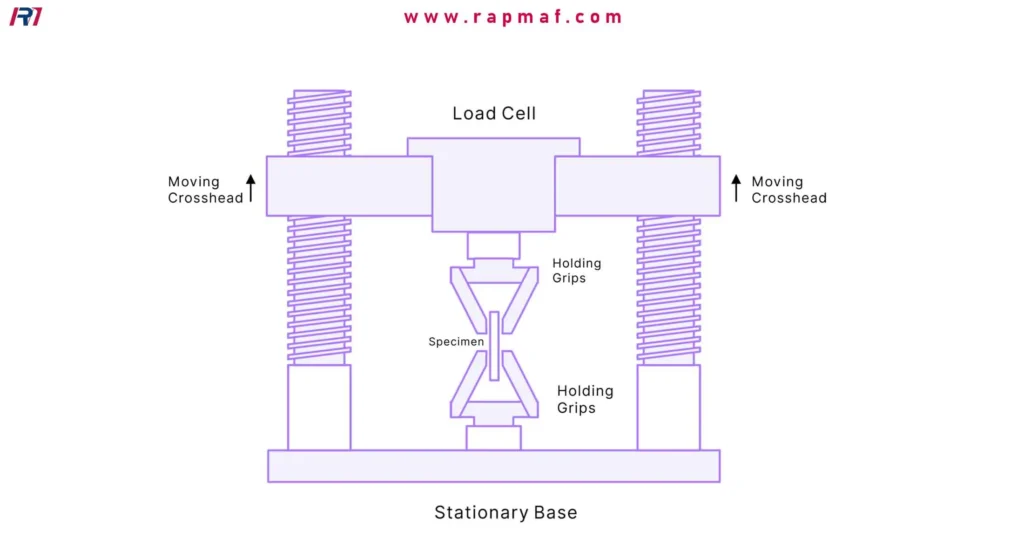
In a perfect world, we would perform a destructive Tensile Test (ASTM E8) on every single batch of metal that enters the shop. We would pull a sample until it snaps and get precise data.
In the real world? We don’t have time (or money) to destroy perfectly good parts.
Instead, we use Hardness Testing. It’s non-destructive, fast, and cheap.
But here is the problem: Your drawing specifies “Min. Tensile Strength 900 MPa,” but your Quality Control report says “30 HRC.”
Do they match?
How do you translate “Dent Resistance” (Hardness) into “Pulling Strength” (Tensile)?
This guide breaks down the math, the limitations, and the practical formulas we use on the shop floor to bridge the gap.
The Golden Rule (For Carbon Steel Only)
If you are working with Carbon Steel or Low Alloy Steel (like 1018, 4140, 4340), you are in luck. There is a surprisingly accurate linear relationship between Brinell Hardness (HB) and Ultimate Tensile Strength (UTS).
The Formula
For non-austenitic steels, the magic number is 3.45 (for metric) or 500 (for imperial).
UTS (MPa) ≈ 3.45 × HB
UTS (psi) ≈ 500 × HB
- Note: HB = Brinell Hardness Number
Example Calculation
You measure a 4140 steel shaft and get a hardness of 300 HB.
- Metric: 300×3.45=1035 MPa
- Imperial: 300×500=150,000 psi
Clive’s Warning: This relationship starts to fall apart at very high hardness levels (> 550 HB) because the material becomes brittle. It also does not work well for Stainless Steel or Aluminum (more on that later).
Rockwell C (HRC) – The Hard Stuff
Brinell (HB) is great for raw bars, but for hardened, heat-treated parts (like gears or mold inserts), we use Rockwell C (HRC).
There is no simple “multiply by X” formula for HRC because the scale is not linear. However, we rely on established conversion tables (ASTM E140).
Here is a simplified “Rule of Thumb” table for heat-treated steel:
| Rockwell C (HRC) | Brinell (HB) | Approx. Tensile Strength (MPa) | Approx. Tensile Strength (psi) | Typical Application |
|---|---|---|---|---|
| 20 HRC | ~225 HB | 770 MPa | 112,000 psi | High-strength shafting |
| 30 HRC | ~285 HB | 960 MPa | 140,000 psi | Pre-hardened Mold Steel (P20) |
| 40 HRC | ~370 HB | 1260 MPa | 182,000 psi | High-stress bolts |
| 50 HRC | ~480 HB | 1680 MPa | 244,000 psi | Springs, cutting tools |
| 60 HRC | ~650 HB | > 2000 MPa | > 300,000 psi | Bearing races, knife edges |
Pro Tip: If you see “60 HRC” on a print, stop thinking about Tensile Strength. At that hardness, the material is basically glass. It won’t yield; it will snap. Focus on Fracture Toughness instead.
The “Aluminum Problem”
This is where 50% of engineers get it wrong.
You cannot use the 3.45×HB formula for Aluminum.
Aluminum behaves differently. Its relationship between hardness and strength is less consistent because it depends heavily on the specific alloy and temper (Heat Treatment).
However, for common alloys like 6061 and 7075, we can use rough estimations:
- For 6000 Series (e.g., 6061-T6):
UTS (MPa) ≈ 4.0 × HB (Very rough approx.)
Real world: 95 HB ≈ 310 MPa - For 7000 Series (e.g., 7075-T6):
UTS (MPa) ≈ 3.75 × HB
Real world: 150 HB ≈ 570 MPa
Clive’s Advice: Never rely on hardness conversions for Aluminum critical structures (like aerospace parts). The margin of error is too high (+/- 15%). Always order a mill cert (Tensile Test Report) with the material.

Why Your Readings Might Be Wrong (Measurement Errors)
I’ve seen a Quality Inspector reject a good batch of parts because his hardness reading was low. It turned out, he was testing it wrong.
1. The “Decarb” Layer
When steel is heat-treated in a furnace, the outer surface (0.1mm – 0.5mm) can lose carbon (“Decarburization”). This skin is soft.
- The Fix: You must grind off at least 0.5mm from the surface before testing. If you test the skin, you will get a false low reading.
2. The Edge Effect
If you poke the indenter too close to the edge of the part, the metal bulges out sideways instead of resisting the force.
- The Rule: Keep indentations at least 3x the diameter of the indent away from the edge.
3. Thickness Limit
If the part is too thin, the indenter anvil (the table underneath) influences the reading.
- The Rule: The material must be at least 10x thicker than the depth of the indentation. Don’t try to Rockwell test a sheet of foil.
Which Test Should I Use? (Vickers vs. Brinell vs. Rockwell)
| Method | The Tool | Best For… | Limitations |
|---|---|---|---|
| Brinell (HB) | 10mm Tungsten ball | Raw Material / Castings. The large ball averages out inconsistencies in the grain structure. | Leave a huge dent. Not for finished parts. |
| Rockwell C (HRC) | Diamond Cone | Hardened Steel. Fast, leaves a small dent. | Not for soft materials or thin sheets. |
| Rockwell B (HRB) | 1/16″ Steel Ball | Soft Steel / Aluminum / Brass. | “Caps out” at 100 HRB. |
| Vickers (HV) | Diamond Pyramid | Micro-hardness. Thin foils, surface coatings, individual grains. | Slow, requires microscope to read. |
Conclusion: Use the Data, Don’t Worship It
Hardness conversion is an estimation tool, not a law of physics.
It is fantastic for quick Quality Control checks (“Did the heat treater actually quench this?”).
But it is not a substitute for a proper Tensile Test (ASTM E8) when safety is on the line.
If your project requires certified strength data, tell us. At Rapid Manufacturing, we can provide full Material Test Reports (MTRs) with every shipment, ensuring the physics matches the paperwork.
References & Conversion Standards
- Standard Conversion Tables:
- ASTM E140. Standard Hardness Conversion Tables for Metals Relationship Among Brinell Hardness, Vickers Hardness, Rockwell Hardness, Superficial Hardness, Knoop Hardness, Scleroscope Hardness, and Leeb Hardness.
- Note: This is the “Bible” for conversion. If you are in doubt, refer to Table 1 in ASTM E140.
- Hardness Testing Methods:







19 Responses