



Look at the device you’re reading this on. Think about the engine in your car, the intricate metal components inside a modern aircraft, or the medical implants that save lives. At the heart of their creation lies a technology that is both brutally powerful and microscopically precise: the milling machine. While the term is common in workshops and engineering schools, its true purpose and incredible versatility are often misunderstood.
A milling machine is not just a tool; it is a foundational pillar of modern manufacturing. It is the sculptor’s chisel and the artist’s brush for the world of metal, plastic, and wood. But what is it actually used for?
This guide will provide the definitive answer. We will move beyond simple definitions to explore the core principles, the practical applications, and the strategic role of milling in production. We will demystify the technology for beginners, provide deeper insights for hobbyists, and offer a clear framework for engineers and business owners.
- Part 1: The Foundation. We will establish the fundamental definition of a milling machine, explain its core principle of operation, and introduce the two primary orientations: vertical and horizontal mills.
- Part 2: The Applications. We will put the milling machine head-to-head with its primary counterpart, the lathe, and break down the specific operations it excels at, from creating flat surfaces to cutting complex 3D contours.
- Part 3: The Advanced Capabilities. We will explore the world of multi-axis CNC milling, delve into the materials that can be machined, and provide a final verdict on the indispensable role of this technology.
By the end of this guide, you will not only understand what a milling machine is used for—you will understand how it shapes the physical world around us.
The Fundamental Definition: A Sculptor for Metal
At its most basic level, a milling machine is a tool used for subtractive manufacturing. This is a critical concept. While a 3D printer practices additive manufacturing (building a part layer by layer from nothing), a milling machine does the opposite. It starts with a solid block of material (called a workpiece or stock) and systematically carves away unwanted material to reveal the final desired shape.
Think of a sculptor who starts with a block of marble and chips away everything that isn’t the statue. A milling machine does the same, but with engineering-grade precision, powerful motors, and ultra-hard cutting tools.

The Core Principle: Rotating Cutter, Moving Workpiece
The magic of milling happens through the precise, coordinated movement of two key components:
- The Cutter: A multi-toothed cutting tool (often called an end mill or face mill) is held in a rotating spindle. It spins at very high speeds, with each tooth acting like a tiny, sharp knife that slices away a small chip of material with every revolution.
- The Workpiece: The block of material is securely clamped to a table that can move in multiple directions (left-right, forward-backward, and up-down).
The machine precisely controls the movement of the table, feeding the workpiece into the rotating cutter. By moving the workpiece along different paths (or axes), the cutter can create a virtually limitless variety of features, such as slots, holes, pockets, and complex contoured surfaces.
Subtractive vs. Additive Manufacturing: The Two Worlds of Creation
Understanding milling’s place in the world requires understanding its counterpart.
- Subtractive (Milling): This process is defined by material removal. It is renowned for its incredible precision, ability to create excellent surface finishes, and its strength in working with metals like steel, aluminum, and titanium. The final part is a monolithic piece of the original material, giving it superior structural integrity. Its main limitation is waste; the material cut away becomes scrap chips.
- Additive (3D Printing): This process is defined by material addition. It excels at creating highly complex, lightweight, and intricate geometries that would be impossible to mill. It is ideal for rapid prototyping and low-volume production. Its limitations often lie in material properties, surface finish, and the internal stresses that can be created between layers.
A professional manufacturing environment doesn’t choose one over the other; it uses both. A part might be 3D printed for a prototype, then milled from a solid block of aluminum for final production when strength and precision are paramount.
The Golden Rule and the Two Primary Orientations
While the core principle is simple, the technique is sophisticated. A key concept taught to every machinist is the “golden rule” of milling, which relates to the direction the cutter is rotating relative to the direction the workpiece is moving. This choice dramatically affects cut quality, tool life, and machine stability.
Understanding the “Golden Rule” of Milling
The two methods are Conventional Milling and Climb Milling.
- Conventional Milling (or “Up” Milling): Here, the cutting tool rotates against the direction of the workpiece feed. The chip starts out infinitely thin and gets thicker as the tooth moves through the material. This process can “smear” or burnish the surface before it starts cutting, leading to more tool wear and a poorer finish. It was the standard for older, manual machines because the forces involved helped prevent backlash in the machine’s lead screws.
- Climb Milling (or “Down” Milling): This is the modern standard and the “golden rule” for today’s rigid CNC machines. The cutting tool rotates with the direction of the workpiece feed. The cutter’s tooth engages the material at its thickest point and exits at its thinnest. This results in a cleaner shear, a better surface finish, more efficient chip evacuation, and significantly longer tool life. The forces tend to pull the workpiece into the cutter, which requires a rigid machine without any “slop” or backlash to handle it safely.
For this reason, whenever possible on a modern machine, machinists are trained to use climb milling.
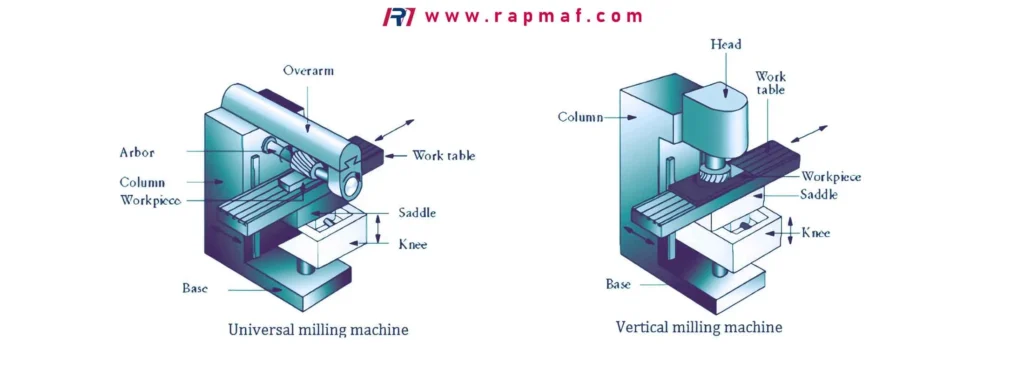
Vertical Mills: The Workshop Workhorse
The most common type of milling machine, found in workshops and tool rooms everywhere, is the vertical mill. The name refers to the orientation of the spindle, which is vertical (perpendicular to the table).
- How it Works: The cutting tool points straight down at the workpiece. The machine’s table moves in the X (left-right) and Y (forward-backward) axes, while the spindle assembly (called the quill) moves up and down along the Z-axis to control the depth of the cut.
- Primary Uses: Vertical mills are incredibly versatile. They are perfect for operations on the top surface of a part. This includes:
- Face Milling: Creating a perfectly flat, smooth surface on the top of the block.
- Drilling and Boring: Creating precise, straight holes.
- Cutting Pockets and Cavities: Machining out internal features, like the inside of a mold.
- Slotting: Cutting keyways or grooves.
- Advantages: The primary advantage of a vertical mill is visibility and ease of use. The operator can easily see what is being cut, making setup and monitoring straightforward.
Horizontal Mills: The Industrial Powerhouse
In high-production and heavy-duty manufacturing environments, the horizontal mill is king. Here, the spindle is oriented horizontally (parallel to the table).
- How it Works: The cutting tool is mounted on a horizontal arbor that extends across the workpiece. The table moves in the same X, Y, and Z directions, but the cutting action happens on the sides of the part.
- Primary Uses: Horizontal mills excel at tasks that are difficult for vertical mills.
- Heavy Slotting and Grooving: Because the cutters can be wider and are better supported by the arbor, they can take much heavier cuts.
- Gang Milling: Multiple cutters can be mounted on the arbor at once, allowing several features to be machined in a single pass, drastically increasing production speed.
- Straddle Milling: Two cutters can be set up to machine two parallel sides of a workpiece simultaneously.
- Advantages: The main advantage is rigidity and chip evacuation. The horizontal setup allows chips to fall away from the cut naturally, preventing them from being re-cut and improving the surface finish and tool life. They are generally more robust and designed for higher metal removal rates.
Mill vs. Lathe: The Two Foundational Machining Philosophies
If a mill is a sculptor, a lathe is a potter. This is the simplest and most powerful analogy. A potter’s wheel spins the clay (the workpiece), and the potter’s stationary hands (the cutting tool) shape it into a round object. A lathe does exactly the same with metal.
- The Lathe’s Principle: The workpiece (typically a round bar) is spun at high speed. A stationary, single-point cutting tool is advanced into the spinning material to remove chips, creating cylindrical features.
- The Mill’s Principle: The workpiece is held stationary. A rotating, multi-point cutting tool is advanced into the material to remove chips, creating prismatic (squarish) and complex features.
This single difference in “who spins”—the part or the tool—dictates everything that follows.
Head-to-Head Comparison: Milling Machine vs. Lathe
| Feature | Milling Machine | Lathe (Turning Center) |
|---|---|---|
| Core Principle | The cutting tool rotates; the workpiece is stationary. | The workpiece rotates; the cutting tool is stationary. |
| Primary Workpiece Shape | Prismatic (square, rectangular) blocks and plates. | Cylindrical (round, conical, spherical) bars and tubes. |
| Cutting Tool | Multi-point cutters (end mills, face mills) with multiple cutting edges. | Single-point cutting tools (inserts) with one cutting edge. |
| Primary Operations | Facing, pocketing, slotting, drilling, contouring, 3D surfacing. | Turning, facing, grooving, threading, drilling (on-center). |
| Axis Terminology | X (left-right), Y (forward-back), Z (up-down). | X (diameter), Z (length). |
| Typical Parts Made | Engine blocks, mold cavities, machine brackets, electronic enclosures. | Shafts, pins, axles, pistons, screws, pipe fittings. |
While a basic mill creates square parts and a basic lathe creates round parts, modern manufacturing often requires parts that are a combination of both. This leads to complex production challenges and innovative machine solutions.
Case Study: The Hydraulic Manifold Conundrum
The Challenge: Our team at RM was tasked with producing a high-pressure hydraulic manifold for a piece of aerospace ground equipment. The part was a complex, single block of 7075 aluminum designed to minimize failure points. It featured a prismatic, rectangular body with multiple flat mounting faces, precisely located threaded ports on three different sides, and a perfectly concentric, mirror-finished central bore that a high-tolerance piston would travel through.
The Problem: This part presented a classic mill vs. lathe problem.
- The rectangular body, flat faces, and off-center threaded ports were classic milling work.
- The central, high-precision bore with a critical surface finish was classic lathe work.
The Options:
- Mill-Only Approach: We could machine the entire part on a high-end 5-axis mill. The bore could be created using a technique called “circular interpolation” with a boring tool. However, achieving the required concentricity and surface finish with a spinning tool would be extremely challenging and time-consuming.
- Two-Machine Approach: We could first mill the block square and drill the mounting holes on a milling machine. Then, we would create a special fixture to hold the rectangular block in a lathe, indicate it to be perfectly on center, and then turn the internal bore. This would produce a superior bore but introduce the risk of tolerance error during the second setup. Every time a part is moved and re-clamped, a tiny amount of precision is lost.
- The RM Solution: Mill-Turn Machining. We opted to use one of our integrated mill-turn centers. This hybrid machine combines the capabilities of both a mill and a lathe in a single platform. We clamped the block once. The machine acted as a mill, using its rotating spindle and a face mill to create the flat surfaces. It then used a drill and tap to create the threaded ports. Finally, the machine stopped the tool from spinning, locked the spindle, and then rotated the entire workpiece while a stationary, single-point boring bar advanced to cut the central bore.
The Result: By using a mill-turn center, we leveraged the strengths of both processes without ever moving the part. This eliminated the risk of a second setup error, guaranteeing the perfect concentricity between the bore and the external mounting features. The cycle time was reduced by over 40%, and the part’s quality and reliability were massively increased. This project perfectly illustrates that the choice isn’t just “mill or lathe,” but how to best apply the principles of milling and turning to a specific engineering problem.
A Deep Dive into Milling Machine Operations
With a clear understanding of how milling differs from turning, we can now explore the specific vocabulary of operations that a milling machine is used for. Each of these techniques uses a different type of cutting tool and machine movement to achieve a specific geometric outcome.
1. Facing
This is often the very first operation performed on a raw block of material.
- Purpose: To create a perfectly flat, smooth, and clean surface. This first machined surface often becomes the “datum” or reference plane from which all other measurements are taken.
- Tool Used: A face mill. This is a large-diameter cutter with multiple carbide inserts around its circumference.
- Process: The face mill is positioned above the workpiece and lowered to the desired depth. The machine then moves the table in the X or Y direction so the large cutter sweeps across the entire surface in a single pass, ensuring it is perfectly flat and perpendicular to the spindle.
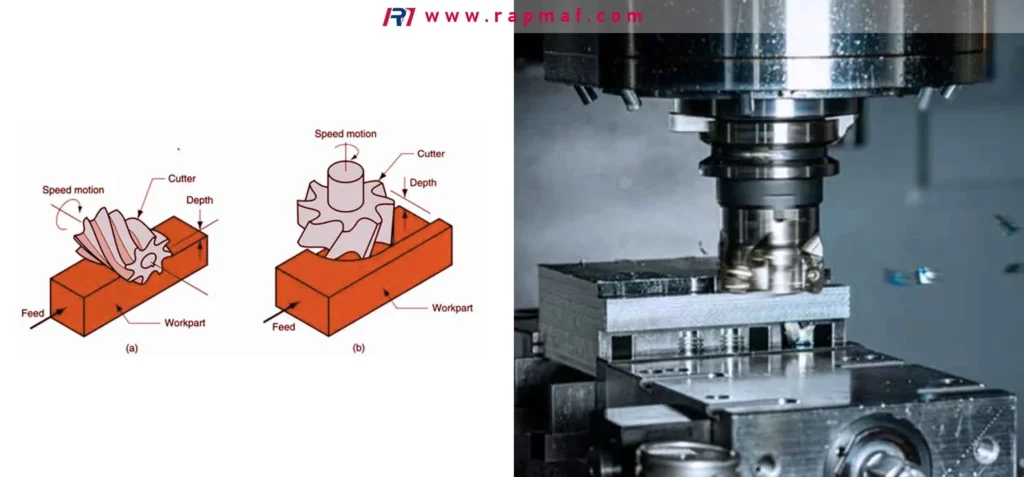
2. Pocketing
This is the process of hollowing out a part, removing material from the inside of a boundary.
- Purpose: To create cavities, recesses, or hollow sections in a workpiece. This is essential for making things like enclosures, molds, and lightweight components.
- Tool Used: An end mill. This is a cylindrical cutter with teeth on its sides and end, resembling a drill bit but designed to cut sideways.
- Process: The end mill plunges into the material and then moves in a path (often a spiral or zig-zag pattern) to clear out the material within a pre-defined boundary. This involves a “roughing” stage to remove material quickly, followed by a “finishing” stage to create a precise final size and a smooth surface.
3. Slotting
This is the process of cutting narrow channels or grooves into a workpiece.
- Purpose: To create keyways for shafts, channels for O-rings, T-slots for machine tables, or simple clearance grooves.
- Tool Used: An end mill (for simple slots) or a specialized slitting saw or T-slot cutter.
- Process: The cutter is fed along a linear path to create the channel. The width and depth of the slot are precisely controlled by the cutter’s diameter and the Z-axis position.
4. Contouring (or Profiling)
This is the operation that cuts the outside shape of a part.
- Purpose: To machine the perimeter of a 2D or 3D part, creating the final external profile.
- Tool Used: An end mill.
- Process: The end mill traces the path defined by the part’s CAD drawing, cutting away the excess material around the outside. On a CNC mill, this allows for the creation of incredibly complex curves and shapes that would be impossible to make manually.
5. Drilling, Boring, and Reaming
While a drill press can make a hole, a milling machine makes a hole in the exact right spot with unparalleled precision. It offers a suite of hole-making operations.
- Drilling: Using a standard drill bit held in the spindle to create a hole.
- Boring: Using a specialized, adjustable boring head to enlarge an existing hole and make it perfectly round and concentric. A drill might “wander” slightly, but a boring head will true the hole to perfection.
- Tapping / Threading: Using a tap tool to cut internal threads into a hole for screws. A more advanced method is thread milling, where a special end mill spirals inside the hole to cut the threads, offering much greater control and versatility.
6. 3D Surfacing
This is where the true power of multi-axis CNC milling becomes apparent.
- Purpose: To create complex, three-dimensional, and organic surfaces that are not flat or cylindrical. This is critical for making molds for injection molding, turbine blades, orthopedic implants, and artistic sculptures.
- Tool Used: A ball-nose end mill, which has a hemispherical tip.
- Process: The machine moves in all three axes (X, Y, and Z) simultaneously. The ball-nose cutter acts like a digital chisel, making thousands of tiny, overlapping passes to smoothly sculpt the contoured surface.
Unlocking Geometric Freedom: The 4th and 5th Axes
The leap from 3-axis to multi-axis milling is the difference between carving a simple relief on a tablet and sculpting a fully three-dimensional statue. By adding one or two axes of rotation, we grant the machine the ability to approach the workpiece from nearly any angle, unlocking a new universe of geometric possibility and manufacturing efficiency.
The 4th Axis: Indexing and Wrapping
The most common fourth axis is a rotary table (an A-axis or B-axis) that clamps the workpiece and rotates it around the X- or Y-axis. This seemingly simple addition has two game-changing applications.
1. Indexing: Imagine you need to drill a precise pattern of holes on all four sides of a rectangular block. On a 3-axis machine, this is a tedious and error-prone process. You would machine the first side, then unclamp the part, manually rotate it 90 degrees, re-clamp it, carefully re-establish your zero point, and then machine the second side. You would repeat this four times. Each new setup introduces a small but measurable amount of error.
With a 4th-axis rotary table, the process is transformed. The part is clamped once. The machine drills the holes on the first face, then the rotary table automatically and precisely rotates the part exactly 90.000 degrees, and the machine immediately begins work on the second face. This is called indexing. It doesn’t just save an enormous amount of labor and time; it dramatically increases the accuracy of the final part by ensuring all features are perfectly located relative to one another.
2. Continuous Machining (Wrapping): In this mode, the 4th axis rotates continuously in sync with the linear axes. This allows the mill to “wrap” a 2D profile around a cylindrical part. This is used for:
- Cutting cam lobes: Creating the complex, non-circular shapes on a camshaft that actuate engine valves.
- Engraving: Carving text or logos around a cylindrical part.
- Helical Machining: Cutting spiral grooves, like the flutes on a drill bit or a complex helical gear.
The 5th Axis: True “Done-in-One” Manufacturing
A 5-axis CNC milling machine adds a second rotary axis (typically a C-axis rotation in addition to the A- or B-axis tilt). This combination of a trunnion-style table that can tilt and rotate the workpiece, or an articulating head that can pivot the cutting tool, allows the machine to approach the part from virtually any compound angle. This is the pinnacle of milling technology and is used for three primary reasons:
1. Machining Geometrically Complex Parts: This is the most obvious benefit. 5-axis machining is the only way to efficiently produce parts with complex, continuously curving surfaces. This includes:
- Aerospace: Turbine blades (blisks), impellers, and complex structural components.
- Medical: Orthopedic implants like artificial knees and hips, which must match organic human geometry.
- Molding: Creating the intricate cavities and cores for injection molds that will be used to produce millions of plastic parts.
2. Better Tool Access and Performance: By tilting the workpiece or the tool, a 5-axis machine can get into tight corners and machine steep walls using shorter, more rigid cutting tools. A shorter tool deflects less under cutting pressure, resulting in higher accuracy, a better surface finish, and longer tool life. This is often called “3+2 machining,” where the machine orients the part to a fixed compound angle and then executes a 3-axis program.
3. Single-Setup Machining: This is the ultimate goal of 5-axis machining: to produce a complete part in a single clamping, often referred to as “Done-in-One.” By eliminating the need to move the part to different machines or re-fixture it multiple times, single-setup machining offers the highest possible accuracy and drastically reduces lead times, transforming the economics of complex part production.
The Material Palette: What Can a Milling Machine Cut?
A milling machine’s versatility is defined not just by the shapes it can create, but by the incredible range of materials it can shape. The “golden rule of milling” is to match the right cutting tool, cutting speed, and feed rate to the specific material being machined. Here is a survey of the mill’s vast material palette.
| Material Category | Examples | Machining Characteristics & Applications |
|---|---|---|
| Soft Metals | Aluminum (6061, 7075), Brass, Copper, Magnesium | High machinability. Allows for very high spindle speeds and feed rates, leading to rapid material removal. Prone to creating long, stringy chips. Used for: Aerospace components, electronic enclosures, decorative parts, heat sinks. |
| Steels | Mild Steel (1018), Alloy Steel (4140), Tool Steel (A2, D2) | Lower machinability than aluminum. Requires slower speeds, more rigid setups, and robust tooling to handle higher cutting forces. Generates significant heat. Used for: Machine frames, shafts, gears, molds, dies, fixtures. |
| Stainless Steels | 304, 316, 17-4 PH | Difficult to machine. These alloys are “gummy” and prone to work-hardening, where the material becomes harder as it’s being cut. Requires sharp, coated tools and a constant, aggressive feed rate to stay “under” the hardened layer. Used for: Medical devices, food processing equipment, marine hardware. |
| Superalloys & Exotics | Titanium, Inconel, Monel, Hastelloy | Extremely difficult to machine. These materials have incredible strength and heat resistance, which they retain during cutting. This generates extreme temperatures at the tool tip, requiring very low cutting speeds, high-pressure coolant, and specialized carbide or ceramic tools. Used for: Jet engine components, gas turbines, surgical implants, oil & gas equipment. |
| Plastics | Delrin (Acetal), Nylon, Polycarbonate, PEEK, ABS | The main challenge is managing heat to prevent melting. Requires extremely sharp tools (often specific “plastic-cutting” geometry), high feed rates, and often an air blast instead of liquid coolant to clear chips and cool the part. Used for: Prototypes, insulators, bushings, medical prototypes, low-friction components. |
| Composites | Carbon Fiber Reinforced Polymer (CFRP), G-10, FR-4 | Highly abrasive. These materials act like fine-grained sandpaper, rapidly wearing out standard tools. Machining requires polycrystalline diamond (PCD) coated tools and a powerful vacuum/dust collection system, as the dust is a hazardous irritant. Used for: High-performance automotive parts, aerospace structures, PCB circuit boards. |
| Wood & Foam | Hardwoods, MDF, High-Density Urethane Foam | This is the primary domain of the CNC Router, which is a type of milling machine optimized for high-speed cutting of large sheets of softer materials. The principles are identical to metal milling, but the machine construction is lighter and the spindles are much faster. Used for: Cabinetry, sign making, furniture, mold patterns. |
Conclusion: The Indispensable Heart of Modern Manufacturing
So, what is a milling machine used for? After this comprehensive journey, the answer is clear: a milling machine is used to transform a digital design into a precise physical object by controllably carving away material.

It is not merely a tool; it is a foundational platform technology. It is the master machine that creates the parts for other machines. It carves the intricate molds that give shape to nearly every plastic object in your home. It sculpts the mission-critical aerospace and medical components that define the limits of modern technology. From the simplest bracket holding an engine together to the most complex impeller powering a jet, the milling machine’s work is the invisible, indispensable backbone of our physical world.
In an age increasingly dominated by additive manufacturing (3D printing), the milling machine’s role has not diminished—it has become more refined. While 3D printing excels at creating complex initial forms, it is the milling machine that is called upon to deliver the final precision, the critical flat surfaces, and the mirror-smooth finishes that functional parts demand. They are not competitors, but powerful partners.
Ultimately, a milling machine is used for the act of creation through controlled, precise subtraction. It is a device that brings order from chaos, carving a world of function and precision from a solid block of raw material.
Frequently Asked Questions (FAQ)
Q1: What is the difference between a CNC mill and a CNC router?
A CNC mill and a CNC router operate on the exact same principle, but they are optimized for different tasks. A CNC mill is built for rigidity and power, designed to make precise cuts in hard materials like steel and titanium. It has a smaller work area and slower, higher-torque spindles. A CNC router is built for speed and a large work area, designed for high-speed cutting of softer materials like wood, plastic, and aluminum sheets. It has a lighter gantry-style construction and a very high-RPM spindle.
Q2: Is milling an expensive process?
Milling can range from highly affordable to very expensive, depending on the part’s complexity, material, and required tolerances. Simple parts made from aluminum can be relatively inexpensive. Complex 5-axis parts made from Inconel require millions of dollars in machinery and highly skilled labor, making them very expensive. The cost is directly related to the machine time, programming time, and labor required, but for creating high-precision, reliable parts, its value is often unmatched.
Q3: How hard is it to learn to operate a milling machine?
Learning the basics of a manual milling machine—turning the handwheels, changing tools, and making simple square cuts—can be learned in a few weeks of dedicated practice. Learning to program and operate a CNC milling machine is more complex, involving CAD (design), CAM (toolpath generation), and G-code. A basic proficiency can be achieved in a few months, but becoming a true expert machinist—one who understands metallurgy, advanced workholding, and can optimize programs for maximum efficiency—is a lifelong pursuit that requires thousands of hours of experience.
Expert-Level References
- Smid, P. (2008). CNC Programming Handbook. Industrial Press Inc. (The definitive, industry-standard reference for G-code programming and CNC machining concepts).
- Oberg, E., et al. (2020). Machinery’s Handbook, 31st Edition. Industrial Press Inc. (Often called “The Bible of the Mechanical Industries,” this handbook provides the essential, peer-vetted data on material properties, cutting speeds, feeds, and machining standards referenced by professionals daily).
Disclaimer
The information on this page is for informational purposes only. RM makes no representations or warranties, express or implied, as to the accuracy or completeness of this information. For any third-party services procured through the RM network, it is the buyer’s responsibility to specify and confirm performance parameters, tolerances, materials, and workmanship during the quotation process. For more detailed information, please do not hesitate to contact us.
RM: Your Precision Manufacturing Partner
RM is an industry leader in custom manufacturing solutions. With over 20 years of profound experience, we have become the trusted partner for more than 5,000 clients worldwide. We specialize in a comprehensive range of manufacturing services—including high-precision CNC machining, sheet metal fabrication, 3D printing, injection molding, and metal stamping—to provide you with a true one-stop-shop experience.
Our world-class facility is equipped with over 100 state-of-the-art 5-axis machining centers and operates in strict compliance with the ISO 9001:2015 quality management system. We are dedicated to providing solutions that blend speed, efficiency, and exceptional quality to customers in over 150 countries. From rapid prototyping to large-scale production, we promise delivery in as fast as 24 hours, helping you gain a competitive edge in the market. Choosing RM means selecting an efficient, reliable, and professional manufacturing ally.
Explore our capabilities today by visiting our website: www.rapmaf.com







2 Responses