



In everyday language, “strain” is a feeling of pressure or stress. We talk about being “under strain” when we’re overworked. But in the world of engineering, physics, and material science, Strain has a precise, critical, and measurable meaning. It is the language we use to describe how an object or material deforms—how it stretches, compresses, or warps—when subjected to a force.
Imagine stretching a rubber band. You can see it get longer. Now imagine a massive steel beam in a skyscraper supporting thousands of tons. It is also “stretching” or compressing, but by an amount so small it’s invisible to the naked eye. Strain is the concept that allows us to quantify both of these changes in the exact same way.
Understanding strain is not an academic exercise; it’s the bedrock of safe and reliable engineering.
- It tells us if a bridge will buckle under the weight of traffic.
- It predicts when a bolt will stretch too far and fail.
- It allows us to design aircraft wings that can flex safely without breaking.
In this definitive guide, we will move beyond the dictionary definition. We will explore what strain truly means, the different ways a material can deform (the types of strain), and most importantly, how to calculate it. This is the knowledge that separates guessing from engineering.
The Core Definition: Strain vs. Stress
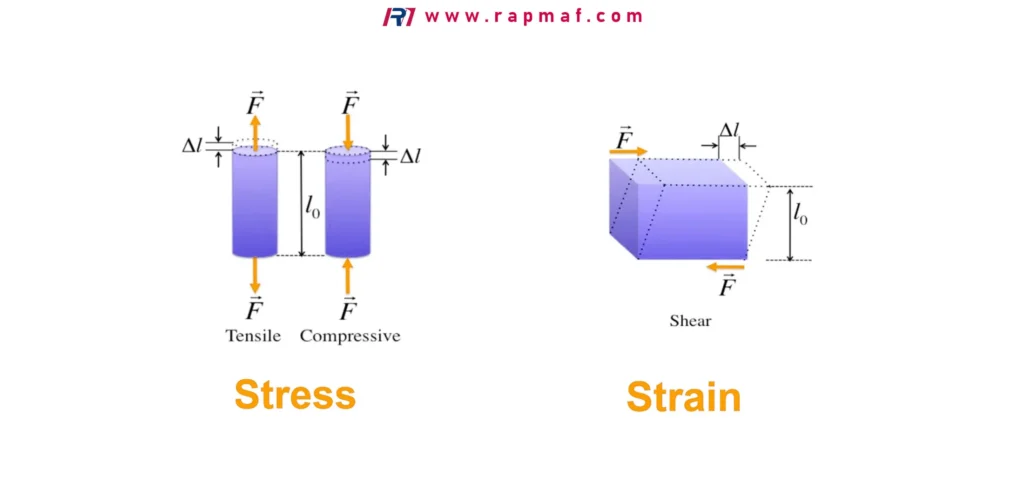
Before we can define strain, we must distinguish it from its inseparable partner: Stress. This is the single most common point of confusion.
- Stress (σ): This is the internal force per unit of area inside a material. It’s the cause. Think of it as the intensity of the force inside the object, resisting being pulled apart or pushed together. It’s measured in Pascals (Pa) or pounds per square inch (PSI).
- Strain (ε): This is the measure of the deformation that results from the stress. It’s the effect. Strain is the geometric expression of how much the object’s shape has changed.
The simplest analogy: If you pull on a rope (applying a force), the Stress is the tension you create inside the rope’s fibers. The Strain is how much the rope physically stretches in response to that tension.
With that distinction clear, we can provide the formal definition:
Engineering Strain (ε) is the measure of the deformation of a material, expressed as the ratio of the change in a dimension to the original dimension.
It’s a ratio. A comparison. That’s it. How much did it change compared to how big it was to begin with? This simple ratio is one of the most powerful tools in all of engineering.
Strain Units: The Dimensionless Wonder
A common question is, “What are the units of strain?” Because strain is a ratio of a length to a length, it is technically dimensionless.
Let’s say a 100-millimeter-long rod stretches by 1 millimeter. The calculation would be:
- Change in Length (δ) = 1 mm
- Original Length (L₀) = 100 mm
- Strain (ε) = 1 mm / 100 mm = 0.01
The units (mm/mm) cancel out. The same would be true for inches (in/in).
However, in practice, you will see strain expressed in a few common ways:
- As a decimal: ε = 0.01
- As a percentage: 0.01 * 100 = 1% Strain
- In “microstrain” (με): For many engineering materials like metals, the strain values are very small. A strain of 0.000001 is common. To make this easier to write, engineers use the term microstrain. 1 με = 1 x 10⁻⁶. So, 0.000001 strain is simply 1 microstrain.
At RM (Rapid Manufacturing), our Finite Element Analysis (FEA) software reports strain as a dimensionless decimal, which our engineers then interpret to predict whether a part will deform beyond its design limits.
An Introduction to the Main Types of Strain
Deformation isn’t just about simple stretching. A material can be compressed, twisted, or bent. Therefore, engineers classify strain into two primary categories, which we will explore in detail in the next section.

- Normal Strain (ε): This is the most intuitive type. It measures the change in length of a line segment per unit of original length. It happens when a force is applied perpendicular (or “normal”) to a surface. Normal strain itself is broken down into two types:
- Tensile Strain: The strain produced by a pulling or stretching force (tension). The object gets longer.
- Compressive Strain: The strain produced by a pushing or squeezing force (compression). The object gets shorter.
- Shear Strain (γ): This is the measure of the change in the angle between two line segments that were originally perpendicular. It happens when a force is applied parallel to a surface. Imagine pushing the top cover of a book sideways—the book’s cross-section changes from a rectangle to a parallelogram. That change in angle is shear strain. It’s about a change in shape, not just length.
How to Calculate Normal Strain (Tensile & Compressive)
Normal strain is the most common type of strain calculation. It’s the measure of how much an object stretches or shortens along the axis of an applied force. The formula is beautifully simple and directly follows from its definition.
The Formula:
ε = δ / L₀
Where:
- ε (epsilon) is the normal strain (dimensionless).
- δ (delta) is the change in length (elongation or contraction). This is
L_final - L_original. - L₀ (L-naught) is the original, undeformed length of the object.
It’s crucial that δ and L₀ are in the same units (e.g., meters, millimeters, inches) so that the units cancel out, leaving strain as a pure dimensionless number.
Sign Convention:
- Positive (+) Strain: Indicates tensile strain. The object has gotten longer (elongated).
- Negative (-) Strain: Indicates compressive strain. The object has gotten shorter (contracted).
Step-by-Step Calculation Example: A Steel Tie Rod
Let’s imagine we’re designing a support structure that uses a solid steel rod.
- The original length of the steel rod (L₀) is 2 meters (or 2000 mm).
- Under the full design load, we measure its new length (L_final) to be 2003 mm.
- Goal: Calculate the tensile strain in the rod.
Step 1: Calculate the Change in Length (δ)
δ = L_final - L₀
δ = 2003 mm - 2000 mm = 3 mm
Step 2: Apply the Strain Formula
ε = δ / L₀
ε = 3 mm / 2000 mm
ε = 0.0015
Step 3: Interpret the Result
The normal strain is 0.0015. Because it’s a positive number, we know it’s tensile strain. We can also express this as 0.15% strain or as 1500 microstrain. This value is critical. An engineer can now take this strain value, look at a stress-strain curve for that specific steel alloy, and determine the exact amount of stress inside the material, ensuring it’s well below the failure point.
How to Calculate Shear Strain
Shear strain is a measure of a change in shape—an angular distortion. Imagine a force acting parallel to a surface, like the wind pushing on the side of a tall building or a pair of scissors cutting paper. The formula for shear strain quantifies this angular change.
The Concept:
Imagine a small square element within a material. When a shear force is applied, this square deforms into a parallelogram. The shear strain is the change in the angle at the corner of that square.
The Formula:
γ = tan(θ)
Where:
- γ (gamma) is the shear strain (in radians).
- θ (theta) is the angle of deformation in degrees.
An Important Engineering Shortcut: For almost all solid materials in their elastic range, the angle of deformation (θ) is extremely small. In mathematics, for very small angles, tan(θ) is approximately equal to θ itself (when θ is measured in radians). Therefore, engineers often use the simplified formula:
γ ≈ θ (where θ is in radians)
Step-by-Step Calculation Example: A Rivet in Shear
At RM (Rapid Manufacturing), we often assemble parts using high-strength rivets. Let’s analyze a rivet holding two plates together.
- The plates are being pulled apart, creating a shearing force across the rivet’s cross-section.
- This force causes the top of the rivet to displace sideways relative to the bottom by 0.05 mm.
- The height of the rivet being sheared (its diameter in this case) is 10 mm.
- Goal: Calculate the shear strain in the rivet.
Step 1: Visualize the Deformation
The displacement and height form a right-angled triangle. We need to find the angle of deformation, θ.
Step 2: Use Trigonometry to find tan(θ)
tan(θ) = Opposite / Adjacent
tan(θ) = 0.05 mm / 10 mm = 0.005
Step 3: Apply the Shear Strain Formula
γ = tan(θ)
γ = 0.005
The shear strain is 0.005 radians. This value tells an engineer how much the rivet is distorting and is critical for preventing the rivet from shearing in half.
Real-World Application: The Strain-Based FEA at RM
Theory is important, but at RM (Rapid Manufacturing), these calculations are the core of our daily engineering validation process.
The Scenario: A client in the aerospace industry contracted us to manufacture a critical landing gear bracket from a high-strength titanium alloy. The design was complex, with many thin sections and mounting holes.
The Challenge: The client provided the load cases—the forces the bracket would experience during landing. They needed 100% confidence that the bracket would not bend permanently (plastically deform) or, worse, fracture. A simple “it looks strong enough” was not an option.
Our Process at RM:
- FEA Simulation: We didn’t cut a single piece of metal. First, our engineering team created a digital model of the bracket and loaded it into our Finite Element Analysis (FEA) software. We applied the client’s exact load cases to the digital model.
- Strain Mapping: The FEA software performs millions of calculations and produces a detailed “strain map” of the entire part. This is a color-coded visual representation showing the precise strain values at every point on the bracket.
- Identify High-Strain Zones: We immediately saw a small region near a mounting hole where the strain was concentrated. The maximum calculated normal strain in this area was ε = 0.0072.
- Material Data Comparison: This number means nothing on its own. The next step is to compare it to the known properties of the titanium alloy. We consulted the material’s official stress-strain curve and found its yield strain—the point at which it begins to deform permanently—is ε_yield = 0.0088.
- The Engineering Verdict: Our calculated maximum strain (0.0072) was dangerously close to the material’s yield strain (0.0088). While it technically “passed,” the safety factor was too low for a critical aerospace component.
- Design for Manufacturing (DFM) Feedback: We went back to the client with this data. We recommended adding a small fillet with a larger radius to that specific hole. This change would help distribute the stress more evenly. We re-ran the simulation with the modified design, and the new maximum strain dropped to ε = 0.0045, well within the safe elastic limit.
The Result: By calculating and analyzing strain before manufacturing, we identified a potential failure point, improved the design’s reliability, and saved the client the immense cost and danger of a component failure. This is the power of moving from theory to practical application.
Other Key Strain Concepts You Need to Know
While normal and shear strain are the workhorses of mechanical engineering, two other concepts are essential for a complete picture of how materials behave under real-world conditions.
Thermal Strain: Deformation Without Force
So far, we have only discussed strain caused by mechanical forces. However, materials also change size in response to temperature changes. This phenomenon is known as thermal expansion and contraction, and the resulting deformation is called thermal strain.
Imagine a long steel beam sitting in the sun. As the temperature rises, the atoms within the steel vibrate more energetically, pushing their neighbors further apart. The cumulative effect of this atomic-level movement is that the entire beam gets slightly longer. This happens without any external pulling force.
The Formula:
ε_thermal = α * ΔT
Where:
- ε_thermal is the thermal strain (dimensionless).
- α (alpha) is the Coefficient of Thermal Expansion (CTE). This is an intrinsic property of a material that describes how much it expands or contracts per degree of temperature change. Materials like aluminum and plastics have a high CTE, while ceramics and specialized alloys like Invar have a very low CTE.
- ΔT (Delta-T) is the change in temperature (in Celsius or Fahrenheit).
Why It’s Critical: At RM (Rapid Manufacturing), we work with tolerances measured in microns. Our entire machine shop is climate-controlled for this very reason. A 10°C temperature swing can cause a large aluminum part to change dimensions enough to push it out of specification.
A dramatic real-world example is the expansion joint in bridges. Engineers intentionally leave a gap between sections of the bridge. This gap allows the bridge to expand on a hot day (experiencing thermal strain) without buckling under the immense internal forces that would otherwise build up. The same principle applies to railway tracks. Without small gaps left between rail sections, the tracks would expand on a hot day, press against each other, and potentially buckle, leading to a derailment.
The Key Takeaway: Strain can occur without any external force. Temperature change is a powerful driver of deformation, and failing to account for it can lead to catastrophic failures.
Poisson’s Ratio: The “Squeeze-in” Effect
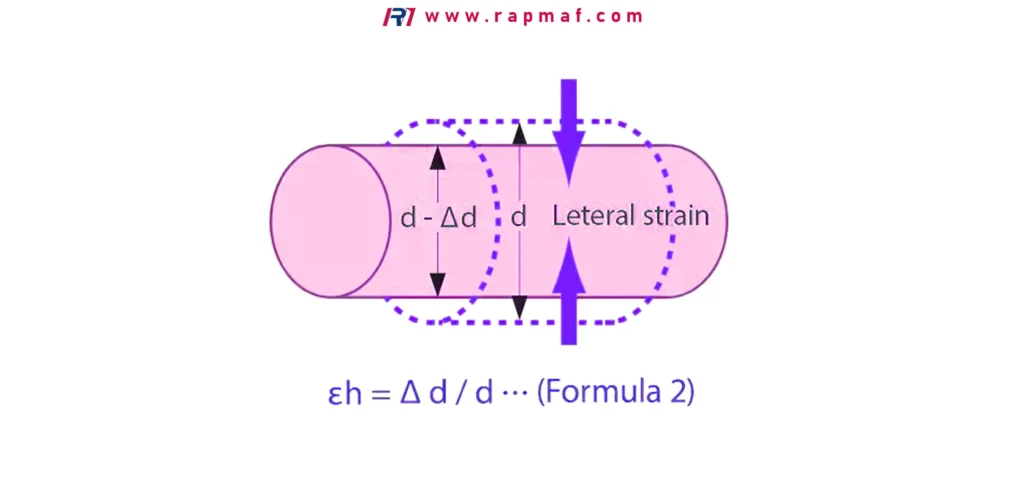
When you stretch a rubber band, you intuitively know that as it gets longer, it also gets thinner. This phenomenon—where a material under tension in one direction contracts in the perpendicular directions—is quantified by Poisson’s Ratio.
It’s a fundamental property of materials that links axial strain and lateral strain.
- Axial Strain (ε_axial): The strain in the direction of the applied force (the stretching direction).
- Lateral Strain (ε_lateral): The strain in the directions perpendicular to the applied force (the thinning direction).
The Formula:
ν = - (ε_lateral / ε_axial)
Where:
- ν (nu) is Poisson’s Ratio (dimensionless).
- The negative sign is included as a convention because for tensile forces, axial strain is positive (elongation) while lateral strain is negative (contraction). The negative sign makes the resulting Poisson’s Ratio a positive number for most materials.
What the Value Means:
- A Poisson’s Ratio of 0.5 (like for rubber) means the material is incompressible. Its volume doesn’t change as it’s stretched.
- Most metals have a Poisson’s Ratio between 0.25 and 0.35. For steel, it’s around 0.3. This means for every 10 units of stretch in length, it will contract by 3 units in width and thickness.
- A material like cork has a Poisson’s Ratio near 0.0, which is why it’s great for wine bottles. When you push it in (compressive axial strain), it doesn’t bulge out sideways (low lateral strain), making it easy to insert and remove.
Engineers use Poisson’s Ratio to predict the full dimensional changes of a part under load, ensuring that it will still fit and function correctly within a larger assembly.
Conclusion: Strain is the Language of Deformation
Throughout this guide, we’ve moved from a simple definition to complex, real-world applications. The core takeaway is this: Strain is the single most important metric for understanding how a part is deforming under load.
It is the starting point for all mechanical analysis.
- Strain tells you how much a part has changed shape.
- Knowing the strain and the material’s properties allows you to calculate the stress, which tells you the internal forces tearing the material apart.
- Comparing the stress and strain to the material’s Stress-Strain Curve tells you if the part is safe, if it’s about to fail, or if it has already been permanently damaged.
Understanding strain is not an academic exercise; it is a non-negotiable requirement for safe, reliable, and efficient engineering. It’s the difference between a product that lasts a lifetime and one that fails unexpectedly. At RM (Rapid Manufacturing), this deep understanding of material behavior is embedded in every project we undertake, from the initial design review to the final quality inspection.
If you have a project where performance and reliability are critical, you need a partner who speaks the language of strain. Contact the RM engineering team today to discuss your project.
Frequently Asked Questions (FAQ)
Q1: What is the main difference between stress and strain?
A: The simplest way to think about it is that stress is the cause and strain is the effect. Stress is the internal force per unit area within a material resisting an external load. Strain is the measure of the physical deformation or displacement that occurs as a result of that stress. Stress is about force; strain is about shape change.
Q2: What are the units of strain?
A: Strain is a ratio of two lengths (e.g., mm/mm or in/in), which means it is a dimensionless quantity. However, it is often expressed in several ways for convenience: as a decimal (0.002), a percentage (0.2%), or for very small values, in “microstrain” (με), where 1 με = 0.000001 strain.
Q3: What are the 4 main types of strain?
A: The four fundamental types of strain are:
- Tensile Strain: Caused by a stretching or pulling force, resulting in elongation.
- Compressive Strain: Caused by a squashing or pushing force, resulting in shortening.
- Shear Strain: Caused by parallel forces acting in opposite directions, resulting in an angular distortion or “twist.”
- Volumetric Strain: The change in an object’s total volume, which is a combination of strains in all three dimensions.
Q4: Can an object have strain without stress?
A: Yes. The most common example is unconstrained thermal expansion. A piece of metal that is free to expand and contract as it’s heated and cooled will experience thermal strain. However, because it is not being restricted, no internal stress will build up. Stress only occurs when this free movement is prevented (constrained).
Q5: How is strain measured on a real-world object?
A: Strain is typically measured using a device called a strain gauge. This is a small, foil-like grid that is bonded directly to the surface of the part being tested. As the part stretches or compresses, the fine wires in the gauge also stretch or compress, changing their electrical resistance. This change in resistance is precisely measured and converted into a highly accurate strain value.
References
- Hibbeler, R. C. (2017). Mechanics of Materials. Pearson. (A foundational textbook in mechanical engineering education).
- ASTM International. (2018). ASTM E8/E8M – 16a: Standard Test Methods for Tension Testing of Metallic Materials. https://www.astm.org/e0008_e0008m-16a.html
- MIT OpenCourseWare. (2006). 3.11 Mechanics of Materials – Strain. https://ocw.mit.edu/courses/3-11-mechanics-of-materials-fall-1999/pages/modules/strain/
Disclaimer
The information on this page is for informational purposes only. RM makes no representations or warranties, express or implied, as to the accuracy or completeness of this information. For any third-party services procured through the RM network, it is the buyer’s responsibility to specify and confirm performance parameters, tolerances, materials, and workmanship during the quotation process. For more detailed information, please do not hesitate to contact us.
RM: Your Precision Manufacturing Partner
RM is an industry leader in custom manufacturing solutions. With over 20 years of profound experience, we have become the trusted partner for more than 5,000 clients worldwide. We specialize in a comprehensive range of manufacturing services—including high-precision CNC machining, sheet metal fabrication, 3D printing, injection molding, and metal stamping—to provide you with a true one-stop-shop experience.
Our world-class facility is equipped with over 100 state-of-the-art 5-axis machining centers and operates in strict compliance with the ISO 9001:2015 quality management system. We are dedicated to providing solutions that blend speed, efficiency, and exceptional quality to customers in over 150 countries. From rapid prototyping to large-scale production, we promise delivery in as fast as 24 hours, helping you gain a competitive edge in the market. Choosing RM means selecting an efficient, reliable, and professional manufacturing ally.
Explore our capabilities today by visiting our website: www.rapmaf.com







2 Responses