


When the majority of engineering students listen to “Young’s Modulus” for the very first time, they panic. They visualize a blackboard covered in difficult calculus, Greek letters (Sigma and Epsilon), and a teacher rambling on regarding atomic bonds.
Yet when I listen to “Young’s Modulus,” I do not think about math. I think about a diving board.
In the engineering globe, Young’s Modulus is simply a fancy word for Stiffness.
It is not Strength. It is not Hardness. It is Stiffness. It is a number that tells you exactly how much a material will stretch when you pull on it.
If you are building a bridge, you require a high Young’s Modulus (so it does not droop). If you are building a bungee cord, you require a low Young’s Modulus (so it stretches).
As somebody who has actually spent thirty years checking materials till they snap, I am going to damage down this concept. I will explain the “dish” we utilize to calculate it, the difference between being solid and being stiff, and why this one number dictates safety and security in everything from skyscrapers to dental implants.
What Actually Is Young’s Modulus? (The Workshop Definition)
Forget the textbook for a minute. Let us go to the workshop.
Imagine you have two rods of the exact same size. One is made of Steel. The various other is made of Rubber.
You grab both ends of the Rubber rod and pull. It stretches easily. You can make it double in length with your bare hands.
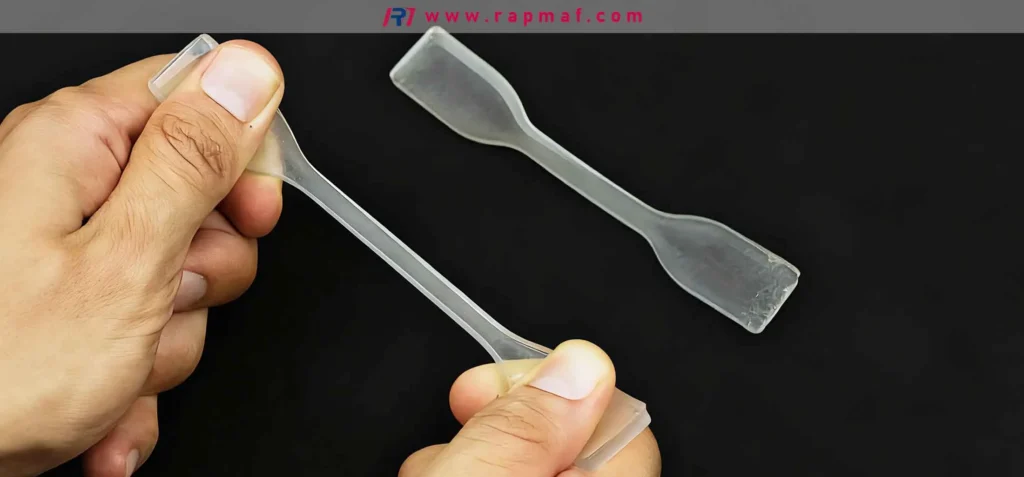
Verdict: Rubber has a very Low Young’s Modulus. It is floppy. It is elastic.
Now, grab the Steel rod and pull. You can pull until your face turns purple, and that bar will not move a millimeter.
Verdict: Steel has a very High Young’s Modulus. It is stiff. It withstands deformation.
The Official Definition:
Young’s Modulus (symbolized as E) is a mechanical property that measures the stiffness of a strong material. It specifies the relationship between Stress (Force) and Strain (Deformation) in a material in the linear elasticity regime of a uniaxial deformation.
The Clive Definition:
It is the “Spring Constant” for a material. It tells you how hard the springs between the atoms are.
The Great Confusion: Stiffness vs. Strength
This is the single biggest blunder I see new engineers make. They utilize the words “Strong” and “Stiff” reciprocally. This is dangerous.
Let us clear this up.
1. Strength (Yield Strength)
Strength is exactly how much force a material can take before it permanently bends or breaks.
- If I hang a truck from a cable and the cable snaps, that is a Strength failure.
2. Stiffness (Young’s Modulus)
Stiffness is exactly how much a material stretches while it is holding that weight.
- If I hang a truck from a cable and the cable stretches 10 feet (but does not break), that is a Stiffness issue.
The Classic Example: Titanium vs. Steel
Everyone thinks Titanium is “stronger” than Steel.
In reality, high-strength Steel and Titanium frequently have comparable Strength (they break at the same load).
However, Steel is twice as Stiff as Titanium.
If you make a bicycle frame out of Titanium, it will be lighter, but it will feel “springy” or “noodly” when you pedal hard. The Steel frame will feel rigid.
- Steel Young’s Modulus: ~ 200 GPa (Gigapascals).
- Titanium Young’s Modulus: ~ 110 GPa.
Titanium stretches twice as much as steel for the same load.
The Math: How Do We Calculate It? (The Dish)
We do not presume this number. We measure it. The “dish” for Young’s Modulus is remarkably simple. It is named after Thomas Young, a 19th-century British researcher, however the logic goes back to Hooke’s Law (F = kx).
The Formula:
E = Stress / Strain
Let us damage down the active ingredients in this dish.
Ingredient 1: Stress (The Force)
Stress is not just force; it is Force divided by Area.
Imagine a woman stepping on your foot.
- If she is wearing sneakers (large area), it hurts a little.
- If she is wearing high heels (tiny area), it pierces your foot.
The force is the very same (her weight), but the Stress is greater with the heel. - Units: Pascals (Pa) or Pounds per Square Inch (psi).
Ingredient 2: Strain (The Stretch)
Strain is a portion. It is the change in length divided by the original length.
If a 100-inch bar stretches 1 inch, the strain is 0.01 (or 1%).
- Units: None (it is dimensionless).
The Calculation
If you apply a great deal of Stress (Force), and you get extremely little Strain (Stretch), the resulting number (E) is huge. That means the material is Stiff.
If you apply a little Stress, and get a great deal of Strain, the number (E) is tiny. That means the material is Flexible.
Real World Examples: Who Is The King of Stiffness?
To truly comprehend this, we need to compare materials we see in the globe every day. Here is the leaderboard of Stiffness, measured in GPa (Gigapascals).
- Rubber: 0.01 – 0.1 GPa. (Super floppy).
- Nylon Plastic: 2 – 4 GPa. (You can flex it with your hands).
- Oak Wood: 11 GPa. (Stiff, but bends under body weight).
- Concrete: 30 GPa. (Stiff, but brittle).
- Aluminum: 69 GPa. (The requirement for light-weight metal).
- Copper: 117 GPa.
- Steel: 200 GPa. (The industrial standard for “Stiff”).
- Tungsten: 400 GPa. (Incredibly inflexible).
- Diamond: 1,200 GPa. (The King).
Why does this issue?
If you switch an aluminum beam for a steel beam of the exact same dimension, the steel beam will deflect (sag) 3 times less.
If you are building a machine tool (like a lathe) that needs to cut metal with accuracy, you utilize Cast Iron or Steel. You never utilize Aluminum, since it would flex too much and destroy the part.
The Physics: What Happens inside the Material?
Why is diamond 1,200 GPa while rubber is 0.01 GPa? It comes down to atomic bonding.
Visualize the atoms in a material are tiny balls connected by springs.
- In Rubber: The springs are long, tangled, and weak. When you pull, the tangle corrects the alignment of, and the springs stretch easily.

- In Steel: The springs (Metallic Bonds) are tight and stiff.
- In Diamond: The springs (Covalent Bonds) are extremely short and unbelievably rigid. The carbon atoms are locked in a crystal grid that refuses to budge.
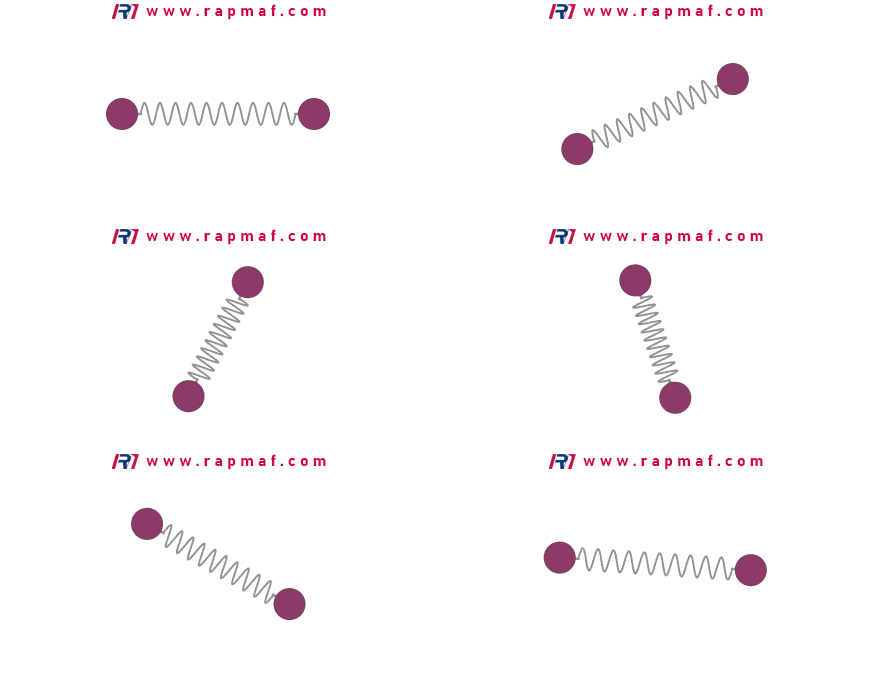
When we determine Young’s Modulus, we are basically measuring the stiffness of those atomic springs. This is why you can not really change the Young’s Modulus of a material conveniently.
You can heat treat steel to make it stronger (harder to break), but you cannot heat treat it to make it stiffer. The atomic springs are the atomic springs. A soft steel nail has the exact same Young’s Modulus as a solidified steel knife blade.
How We Measure It: The Tensile Test
So, how do we obtain these numbers? We do not utilize a calculator; we utilize a torture rack called a Universal Testing Machine.
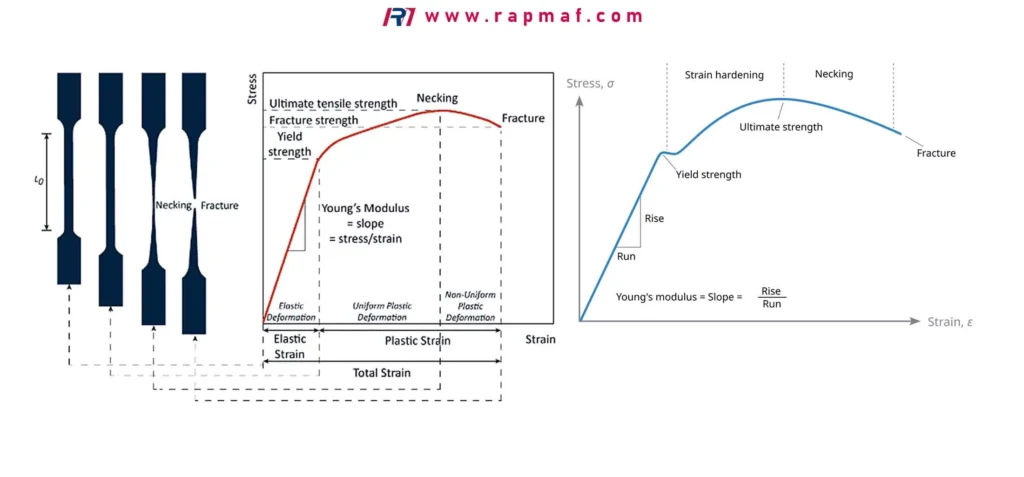
- The Setup: We machine a sample of the material into a “dog bone” shape (thick ends, slim middle).
- The Grip: We clamp the ends into the machine.
- The Pull: The machine slowly draws the sample apart. Huge hydraulic cylinders apply tons of pressure.
- The Data: An Extensometer (a really delicate leader) clips onto the slim part of the sample. It gauges the stretch to the millionth of a meter.
- The Graph: The computer plots Stress (Y-axis) vs. Strain (X-axis).
The Linear Region (The Elastic Zone)
At the start of the test, the line goes straight up. This is the Elastic Region.
If you stop the machine here and let go, the sample snaps back to its original size (like a rubber band).
The Slope of this straight line IS Young’s Modulus.
Steep slope = High Modulus (Stiff).
Shallow slope = Low Modulus (Flexible).
Once the line starts to curve, you have passed the Yield Point. You are permanently deforming the metal. Young’s Modulus no more applies.
Why Do Engineers Care? (The Deflection Problem)
You might be thinking, “Clive, I am not building a rocket ship. Why do I care?”
You care because of Deflection.
In the structure and building globe, failure isn’t usually things blowing up. Failure is things moving excessive.
- Floors: If you build a floor with wood beams that are too bouncy, the china in your cupboard rattles every time you walk by. The beams are “strong” sufficient (they won’t break), but their Young’s Modulus is also low for the period.

- Airplane Wings: Airplane wings bend upwards when flying. If they bend too much, they change the aerodynamics. Engineers have to utilize composites with high stiffness to maintain the wing shape.
- Drive Shafts: In a car, the long tube that spins to turn the rear wheels acts like a tight spring. If it isn’t stiff enough, it starts to whip around at high speeds (vibration).
Temperature: The Enemy of Stiffness
Here is a truth they do not always tell you in institution. Young’s Modulus changes with temperature.
As things get hotter, atoms shake more strongly. The “springs” between them get looser.
- At room temperature, Steel is 200 GPa.
- At 600 ° C (red hot), Steel drops to ~ 150 GPa.
This is catastrophic for things like jet engines or steam pipes. A pipe that is completely inflexible when cold might begin to droop like a wet noodle when it is carrying superheated heavy steam. We have to factor this “Modulus Drop” into our safety calculations.
Comparison: Is Higher Always Better?
No. This is a common misconception.
When you want High Modulus:
- Beams in a building (you don’t want the ceiling to sag).
- Bicycle frames (you desire your energy going into the wheels, not flexing the frame).
- Chassis of a racing car.
When you want Low Modulus:
- Tires: They need to deform to grasp the road.
- Springs: A spring needs to be able to compress.
- Car Bumpers: You want the bumper to flex and take in the energy of a crash, rather than transferring the shock to your neck.
- Biomedical Implants: If you put a metal bone screw into a human body, you desire it to have a stiffness similar to bone. If the metal is too stiff, it takes all the load and the surrounding bone starts to wither away (an effect called “Stress Shielding”). Titanium is commonly better than Steel here because its lower modulus matches bone better.
FAQ: Common Myths & Quick Solutions
Q: What is the symbol for Young’s Modulus?
A: Capital E.
Why E? It represents “Elasticity.”
Q: What are the units?
A: In the metric system (SI), we utilize Pascals (Pa) or Gigapascals (GPa).
1 GPa = 1,000,000,000 Pascals.
In the Imperial system (USA), we utilize psi (Pounds per Square Inch) or Mpsi (Million psi).
Steel is 30 Mpsi.
Q: Is Young’s Modulus the same as Tensile Strength?
A: No. Never confuse these.
Young’s Modulus = Resistance to Stretching (Stiffness).
Tensile Strength = Resistance to Breaking.
A glass window has a high Young’s Modulus (very stiff), but low Tensile Strength (it cracks easily).
Q: Can I change the Young’s Modulus of a metal?
A: Generally, no. Alloying (adding tiny amounts of other metals) modifications strength, yet it barely affects stiffness. Heat treating does absolutely nothing to stiffness. The only way to obtain a different modulus is to change the base material (e.g., switch from Aluminum to Steel).
Final Verdict
So, what is Young’s Modulus in simple terms?
It is the Stiffness Number.
- Big Number = Hard to Stretch (Steel, Diamond).
- Small Number = Easy to Stretch (Rubber, Plastic).
It is the number that engineers utilize to make sure your floor doesn’t bounce, your bridge doesn’t sag, and your car doesn’t shake itself to pieces. It is the undetectable pressure of rigidity that holds our constructed globe in shape.
Deep Dive & Authority Links
For those who wish to dig deeper into the math and data:
- MatWeb: Material Property Data
- The ultimate database. Search “Steel” to see the Modulus numbers.
- The Engineering Toolbox: Young’s Modulus List
- Huge list of modulus values for thousands of materials.
- ASTM International: Standard Test Methods for Tension Testing
- The official rulebook (ASTM E8) on how to measure this in the lab.