


When the majority of engineers listen to the word “rubber,” they think of a single material. They visualize a rubber band or a car tire.
Yet when I listen to “rubber,” I do not think about the material. I think about the Hardness.
In the industrial sealing and manufacturing globe, asking for “an O-ring” without specifying the Durometer is like walking into a bar and asking for “a drink.” You might get water, or you might get pure ethanol.
The difference between a 70 Durometer and a 90 Durometer material is the difference between a machine that runs for ten years and a machine that explodes on day one.
As somebody who has actually spent decades digging extruded rubber bits out of failed hydraulic cylinders, I am going to damage down the Shore Hardness scale. I will explain the “dish” we utilize to measure it, why higher numbers aren’t always better, and solve the eternal dispute of 70 vs 90.
The Short Answer: Which is Harder?
Let us get the simple facts out of the way first.
90 Durometer is harder than 70 Durometer.
In the Shore A scale (which is what we generally utilize for rubbers and elastomers):
- 70 Durometer (Shore A): This is the industry requirement. It feels like a Car Tire or the sole of a running shoe. It is firm, but if you dig your thumbnail into it, it will leave a mark and bounce back.
- 90 Durometer (Shore A): This is the hard stuff. It feels like a Hockey Puck or a shopping cart wheel. It feels almost like plastic. You cannot indent it with your thumbnail.
The Rule of Thumb: Higher Number = Harder Material.
But why do we have two standards so close together? Why not just make everything hard? That is where the physics of sealing comes in.
What Is a “Durometer” Actually? (The Tool vs. The Scale)
The word “Durometer” is confusing because we utilize it to mean two different things.
- The Tool: The actual gauge (looks like a round stopwatch with a pin sticking out) utilized to measure hardness.
- The Scale: The unit of measurement itself (i.e., “This part is 70 durometer”).
It was created by a man named Albert Shore in the 1920s. He needed a way to measure materials that were softer than metal (where they utilize Rockwell or Brinell scales).
The “Dish” for Measurement
How does the tool work? It is surprisingly low-tech.
It is basically a needle attached to a spring.
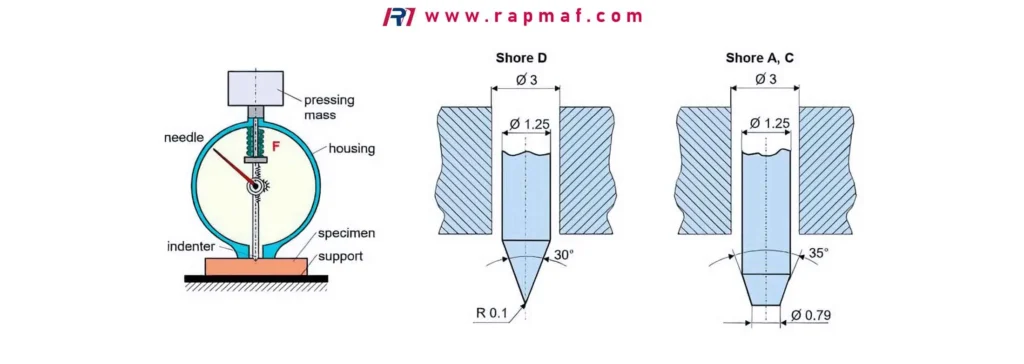
- The Indenter: A hardened steel pin sticks out of the bottom of the gauge.
- The Spring: A calibrated spring pushes the pin down.
- The Test: You press the gauge flat against the rubber.
- If the needle penetrates deep into the rubber, the needle moves far. The gauge reads a Low Number (Soft).
- If the rubber resists the needle, the needle stays pushed up. The gauge reads a High Number (Hard).
It measures Resistance to Indentation. That is it. It does not measure scratch resistance or tensile strength. It measures how much the material fights back against a poker.
The Alphabet Soup: Shore A vs. Shore D
Before we dive deeper into 70 vs 90, you need to understand the letter after the number.
The Shore scale is not one scale. It is a series of overlapping scales.
Shore A (The General Purpose Scale)
This is the one we care about for O-rings, gaskets, and tires.
- Range: Soft rubber to hard rubber.
- Indenter: A truncated cone (a flat-tipped pin).
- Common Values: 70A, 90A, 60A.
Shore D (The Hard Plastic Scale)
This is for things that are practically rock hard. Hard hats, PVC pipe, bowling balls.
- Indenter: A sharp point (like a needle).
- The Overlap: A very hard Shore A (like 95A) is roughly the same as a soft Shore D (like 45D).
Shore 00 (The Soft Stuff)
This is for sponge, foam, and gels.
- Indenter: A round sphere.
- Examples: Bicycle gel seats, gummy bears, shoe insoles.
Crucial Warning: If somebody sends you a print asking for “70 Durometer” and doesn’t specify the scale, you have a problem.
- 70 Shore 00 = A Gummy Bear.
- 70 Shore A = A Tire.
- 70 Shore D = A Construction Helmet.
Always ask for the scale.
The Great Debate: O-Rings (NBR 70 vs 90)
This is the number one area where this topic appears in the engineering globe.
You are ordering nitrile (Buna-N) O-rings for a flange or a piston. The catalog lists “N70” and “N90.” Which one do you pick?
The Case for 70 Durometer (The Standard)
If you walk right into a hardware store and buy an O-ring, it is 70 Duro.
- Pros: It is squishy. Because it is softer, it conforms better to rough surface areas. If your metal parts aren’t perfectly machined (which they never are), the 70 Duro rubber flows into the microscopic valleys and creates a seal.
- Pros: It installs easily. You can stretch it over a piston without breaking your fingers.
- Cons: It extrudes under high pressure.
The Case for 90 Durometer (The High Pressure Shield)
We utilize 90 Duro when the pressure gets terrifying.
- Pros: Extrusion Resistance. This is the key.
- Cons: It is unforgiving. If your metal surface area is rough, 90 Duro won’t fill the gaps. It leaks. It is also a headache to install (literally, you might snap a tool trying to stretch it).
The Nightmare Scenario: Gap Extrusion
Imagine a hydraulic piston inside a cylinder. There is a tiny gap between the metal piston and the metal cylinder wall (the clearance gap).
You put an O-ring there to seal the oil.
When you pump the pressure up to 3,000 psi, the oil pushes hard against the O-ring.
- If you utilize 70 Duro: The rubber is too soft. The pressure pushes the rubber into the tiny metal gap. The O-ring looks like it is being put through a pasta maker. It gets “nibbled” away. Eventually, it blows out.
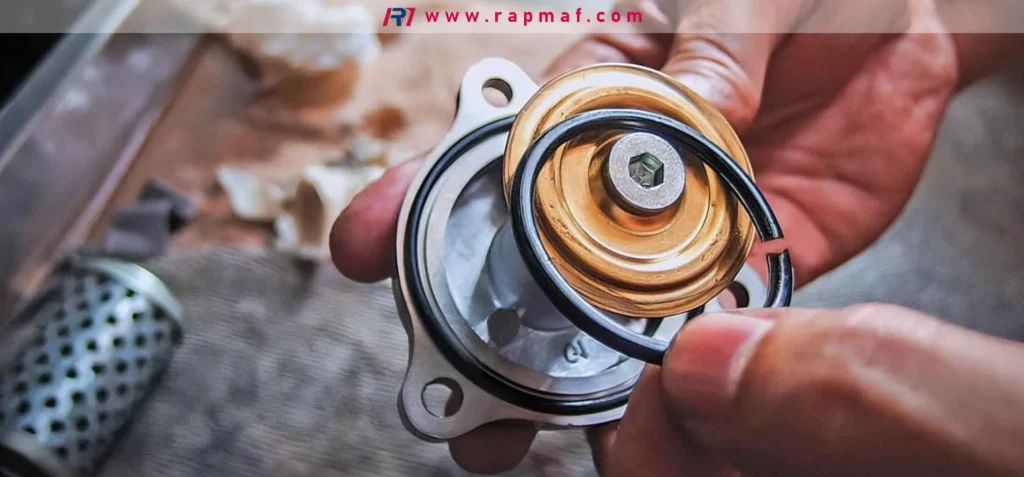
- If you utilize 90 Duro: The rubber is stiff enough to bridge the gap without flowing into it. It holds its shape.
The Rule:
- Below 1,500 psi: Utilize 70 Duro.
- Above 1,500 psi: Utilize 90 Duro (or utilize 70 with backup rings).
The Physics: Why is 90 Harder?
What is happening chemically to make one piece of black rubber harder than the other?
They are frequently the exact same base polymer (like Nitrile or Viton).
The difference is Cross-linking Density and Fillers.
1. Sulfur Bridges (Vulcanization)
Rubber is made of long spaghetti-like chains of molecules. By themselves, they slip past each other (liquid/goo).
To make it solid, we “cure” it with sulfur. The sulfur atoms construct bridges between the spaghetti chains, tying them together.
- 70 Duro: Fewer bridges. The chains can stretch and move a bit.
- 90 Duro: Lots of bridges. The chains are locked down tight. They cannot move.
2. Carbon Black (The Filler)
We also dump filler into the mix, typically Carbon Black (soot).
Think of it like adding rocks to concrete.
- More Carbon Black = Harder Rubber.
This is why 90 Durometer O-rings are often slightly more brittle and have less “stretch” (Elongation at Break) than 70 Duro.
Applications Beyond O-Rings
It is not just about hydraulics. Durometer dictates how the globe interacts with friction.
Skateboard & Rollerblade Wheels

If you skate, you know this well.
- 78A – 80A (Soft): These are “Cruiser” wheels. They are soft. They grip the road. They absorb bumps (vibration damping). But they are slow because they squash down as you roll (rolling resistance).
- 99A – 101A (Hard): These are “Park” wheels. They are hard as rocks. They are fast. They allow you to “slide” the board sideways. But if you hit a pebble, you will feel it in your teeth.
Industrial Rollers
In a printing press or a conveyor belt system:
- We utilize softer rubber (60-70A) to grab the paper or box.
- We utilize harder rubber (90A) for drive wheels that need to carry heavy loads without deforming.
How to Measure Accurately (The Pitfalls)
I have seen countless arguments in the workshop because two individuals got different numbers on the same part.
Measuring Durometer is notoriously finicky. Here is how to do it right.
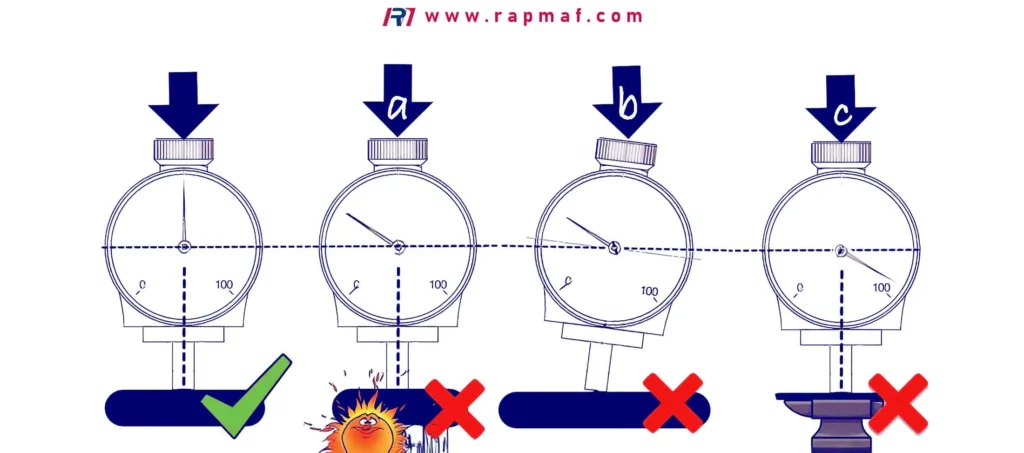
1. The Thickness Rule
You cannot measure a thin sheet of rubber.
If the sample is thinner than 6mm (0.25 inches), the needle will push through the rubber and “feel” the hard metal table underneath. You will get a fake high reading.
Solution: Stack layers of the material until it is thick enough.
2. The Edge Rule
Don’t measure near the edge. The rubber will bulge out the side, giving a fake low reading. Measure in the center.
3. The Time Rule (Creep)
Rubber moves. When you press the gauge down, the needle jumps to a number (say, 75). But if you hold it there, the needle slowly drifts down (to 72… 71…). This is called Creep.
The standard is to take the reading immediately (within 1 second) unless specified otherwise.
4. The Temperature Rule
Rubber gets softer when hot and harder when cold.
Measuring a seal right after it comes out of a hot molding press will give you the wrong number. Wait for it to cool to space temperature.
FAQ: Common Myths & Quick Solutions
The Conversion Myth: Shore A to D
The Question: Can I just convert Shore A numbers to Shore D?
The Truth: Technically, you can utilize a chart, however it is a guess. Since the indenter shapes are totally different (flat cone vs. sharp point), the math rarely lines up completely. Generally, 90 Shore A is roughly 40 Shore D, but I would never wager my job on it.
The Material Name Trap
The Question: Is “Buna-N” always 70 Durometer?
The Truth: Absolutely not.
“Buna-N” (Nitrile) is just the chemical dish. It is the ingredients. You can cook those ingredients into a 40, 50, or 90 Durometer final product. Never assume the hardness just because you recognize the material name.
The Durability Battle: 70 vs 90
The Question: Which one lasts longer?
The Truth: It relies entirely on the abuse.
- For Scraping (Abrasion): The 90 Duro wins. It acts like a shield.
- For Shaking (Vibration): The 70 Duro wins. If you put rigid 90 Duro in a vibrating engine mount, it will fracture instantly. It needs to bend to survive.
Real World Check: Car Tires
The Question: How hard is the tire on my truck?
The Truth: Go out to the driveway. That tread is typically 60 to 70 Shore A.
If you check a Formula 1 track, those tires (slicks) are vastly softer (40-50A). That is why they stick to the asphalt like glue but dissolve in 50 miles.
Deep Dive & Authority Links
For those who wish to dig deeper into the charts and standards:
- Parker Hannifin: O-Ring Handbook
- The absolute bible of sealing. Chapter 2 covers hardness in deep detail.
- ASTM International: ASTM D2240 Standard
- The official procedure for testing rubber property with a Durometer.
- MatWeb: Material Property Data
- Look up “Nitrile 70” vs “Nitrile 90” to see the tensile strength differences.
- Smooth-On: Durometer Scale Guide
- Excellent visual guides comparing rubber hardness to everyday objects.