


If you read English news and engineering documents at the same time, you may notice something strange:
- One article talks about galvanized steel and hot‑dip galvanizing.
- Another headline says a tragic event galvanized the public or a leader galvanized support.
Same word, completely different topics.
This is where many English learners – and even some engineers – get confused. Does “galvanize” always mean “to put zinc on steel”? Or does it mean “to motivate people”? How are these ideas connected?
As an engineer of Rapid Manufacturing, in order to better assist you in differentiating, we will:
- Explain the two main meanings of “galvanize” and “galvanizing”
- Show how the technical meaning (zinc coating) and the figurative meaning (strongly motivate) developed
- Give clear examples for both senses
- Compare “galvanize” with related technical and everyday words
- Answer common questions English learners ask about this word
Meaning 1: “Galvanize” in Engineering – Coating Steel with Zinc
What Is Galvanize ?
In engineering and manufacturing, to galvanize a metal – usually steel – means:
To apply a protective coating of zinc, usually to prevent rust and corrosion.
The result is called galvanized steel, and the process is called galvanizing. You will often see terms like:
- galvanized steel sheet
- galvanized pipe
- hot‑dip galvanizing
- electro‑galvanizing (zinc electroplating)
So if you read a sentence like:
“All exterior steel components are galvanized for long‑term corrosion protection.”
this is definitely the metal‑coating meaning, not the “motivate people” meaning.
Why Zinc?
Steel is strong and relatively cheap, but it rusts easily when exposed to water and oxygen. Zinc is chosen for galvanizing for two key reasons:
- Zinc is more active (more anodic) than iron/steel
In the electrochemical series, zinc has a more negative potential. That means it will corrode (oxidize) before the steel does. - Zinc offers sacrificial protection
Even if the zinc coating is scratched and bare steel is exposed, the nearby zinc can still protect the steel by corroding first. This is called sacrificial anodic protection.
So galvanizing is not just “paint” on the surface. It is a combination of:
- a barrier that keeps moisture and oxygen away from steel
- a sacrificial layer that continues to protect even when damaged in small areas
This is why galvanized parts often last much longer outdoors than painted steel.
Main Industrial Galvanizing Processes
There are several ways to galvanize steel. The most common industrial methods are:
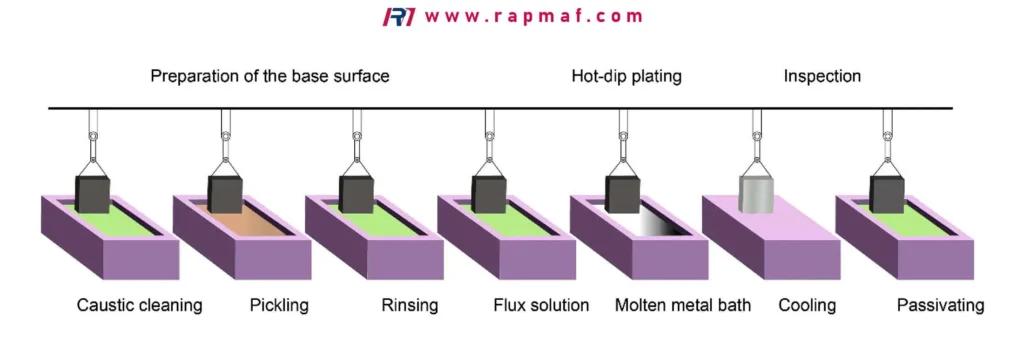
(1) Hot‑dip galvanizing
This is the process most people think of when they hear “galvanized steel”.
Basic steps:
- Surface preparation – Remove oil, dirt and rust by degreasing and pickling (acid cleaning).
- Fluxing – Apply a flux (usually zinc ammonium chloride) to prevent oxidation before dipping.
- Galvanizing – Immerse the steel in a bath of molten zinc (typically around 450 °C).
- Cooling & inspection – Take the parts out, let the zinc solidify, then inspect coating thickness and appearance.
Characteristics:
- Produces a thick, robust zinc coating
- Coating is metallurgically bonded to the steel, very durable
- Surface can look slightly rough or spangled
- Ideal for outdoor structures and harsh environments
Typical applications:
- Building structures (beams, columns, brackets)
- Guard rails and roadside barriers
- Power transmission towers and poles
- Fencing, handrails, ladders, platforms
- Large fabricated steel parts
You will also see search terms like “hot dip galvanizing near me” because these parts are often large and heavy. Transporting them over long distances can be expensive, so many projects prefer local galvanizing plants.
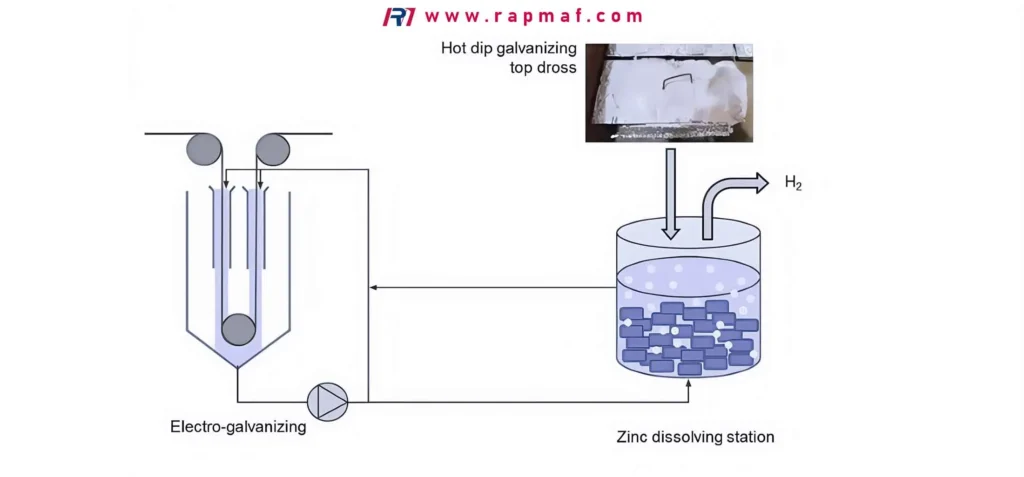
(2) Electro‑galvanizing (zinc electroplating)
Electro‑galvanizing uses electric current to deposit zinc from a solution onto the surface of steel.
Basic idea:
- Steel parts are placed in a bath containing zinc ions
- They are connected as the cathode in an electrical circuit
- Zinc ions are reduced and deposited as a thin, even coating
Characteristics:
- Thinner coating than hot‑dip, often a few micrometers
- Very smooth and uniform surface
- Good for parts where appearance and tight tolerances matter
- Common in automotive and consumer goods
Typical applications:
- Automotive body panels
- Small mechanical components
- Fasteners and fittings that need a clean finish
- Electrical and electronic parts
(3) Other zinc‑based coatings
Besides these, there are related zinc protection methods, such as:
- Mechanical plating – zinc is cold‑welded onto parts by tumbling with zinc powder and glass beads
- Zinc‑rich paints and sprays – coatings loaded with zinc dust, used when hot‑dip is not possible or for on‑site repair
These are not always called “galvanizing” in a strict sense, but they serve a similar purpose: zinc‑based corrosion protection.

Where you see galvanized steel in daily life
Even if you’re not an engineer, you’ve almost certainly seen galvanized products:
- corrugated galvanized steel roofing sheets
- street sign posts and light poles
- wire mesh fences and gates
- buckets, watering cans, outdoor furniture frames
- cable trays and ladder racks in factories
Whenever you see dull gray metal that seems to resist rust in outdoor environments, there is a good chance it is galvanized.
Technical terms for Galvanizing processing
Because “galvanizing” is used across many industries, several related terms often appear in technical documents.
“Galvanizing process”
When you see “galvanizing process” in a spec sheet or quotation, it usually includes:
- Surface cleaning (degreasing, pickling)
- Fluxing
- Zinc coating (hot‑dip or electroplating)
- Cooling and inspection
- Sometimes, passivation or sealing after coating to improve durability
For buyers and engineers, it is important to remember: the quality of surface preparation strongly affects coating performance. Poor cleaning can lead to peeling or uneven zinc layers.
“Hot‑dip galvanizing” vs “zinc plating”
Many people treat these words as synonyms, but engineers distinguish them:
- Hot‑dip galvanizing
- Thicker coating, often 50–100 µm or more
- Rougher surface and visible zinc patterns
- Excellent for long‑term outdoor and marine environments
- Zinc plating / electro‑galvanizing
- Thinner coating, often <20 µm
- Smoother, more decorative finish
- Suitable for indoor use or parts that later receive paint
When writing technical standards or purchase specifications, define which process is required, not just the word “galvanized”.
How to define “galvanize” in a technical document
In a formal specification, you might define it like this:
“Galvanize: To apply a protective zinc coating to steel or iron, typically by hot‑dip immersion or electroplating, to provide corrosion resistance.”
This makes it clear that zinc is essential to the meaning, and it is not just any type of coating.
Meaning 2: “Galvanize” in Everyday English – To Shock or Motivate
Outside engineering, especially in newspapers and speeches, “galvanize” has a very different meaning.
Simple dictionary‑style definition
In general English, to galvanize people or groups means:
To shock, excite, or strongly motivate them so that they take action quickly.
It is usually used with:
- public / voters / citizens
- team / workforce / employees
- international community / organizations
- supporters / volunteers
For example:
- “The video of the accident galvanized the community into demanding safer roads.”
- “The CEO’s speech galvanized employees to support the new strategy.”
Here, nobody is coating people with zinc. The idea is that something acts like an electric shock or a strong wake‑up call, pushing people to act.
How this meaning came from science
The figurative sense of “galvanize” comes from early experiments with electricity.
In the late 18th century, Italian scientist Luigi Galvani studied how electric currents made muscles contract in frogs and other animals. The term “galvanism” was used for electricity’s effects on muscles.

Originally, to galvanize meant “to stimulate by electric current”. Over time, people started using the word more metaphorically:
- to stimulate people strongly
- to cause them to react and move
- to bring them from a passive state into action
So the modern meaning “to galvanize people into action” is directly connected to this scientific history.
Common phrases with “galvanize”
You will often see combinations like:
- galvanize the public – A shocking event or message makes the public take collective action.
- galvanize support – A leader or crisis causes people to support a cause more actively.
- galvanize the team / workforce – Management or a coach strongly motivates a group to improve performance.
- galvanize the international community – A global crisis pushes countries and organizations to respond.
These phrases usually describe a change from inaction or low energy to strong, urgent action.
“Galvanizing personality” – what does it mean?
When someone is described as having a galvanizing personality, it is usually a compliment.
It means:
- Their energy, passion, or words have a powerful effect on others.
- They can mobilize people and make them care about an issue.
- They often appear during crises or big changes, when strong leadership is needed.
For example:
“During the company’s restructuring, her galvanizing leadership kept the team focused and motivated.”
In some contexts, it can also imply that the person is intense or demanding. But usually, it is positive.
Compare: galvanize vs. inspire vs. motivate
These words are similar but not identical:
- Inspire
- Softer, more emotional.
- You feel uplifted, encouraged, or full of ideas.
- No strong sense of urgency.
- Motivate
- Provide reasons, incentives, or goals to act.
- Can be logical (salary, promotion) or emotional (mission, values).
- Galvanize
- Stronger and more urgent.
- Suggests a shock, crisis, or powerful appeal that wakes people up.
- Often used when fast, collective action is needed.
So you might say:
- “The teacher inspired her students to love physics.”
- “The manager motivated the team with clear targets and bonuses.”
- “The disaster galvanized local residents to start a rescue effort.”
One Word, Two Meanings: How to Tell Which Is Which
Because both meanings of “galvanize” are quite common, it helps to have a simple way to distinguish them.
Comparison table
| Aspect | “Galvanize Steel” (technical) | “Galvanize People” (figurative) |
|---|---|---|
| Field / context | Engineering, manufacturing, materials | News, politics, business, social issues |
| Object | Metal: steel, iron | People, groups, public, voters, teams |
| Basic action | Coat with zinc | Shock, excite, strongly motivate |
| Main purpose | Protect from rust / corrosion | Make people take action quickly |
| Typical collocations | galvanized steel, hot‑dip galvanizing, zinc coating | galvanize support, galvanize the public, galvanizing leader |
| Related technical terms | coating, corrosion, process, bath, plating | inspire, motivate, mobilize, spark, trigger |
How to guess meaning from context
A simple rule:
- If the sentence includes steel, pipes, beams, coating, zinc, rust, corrosion → it is almost certainly the engineering meaning.
- If it includes public, voters, team, community, support, movement, campaign → it is the motivation meaning.
For example:
“The company galvanized public support for the new law.”
→ This is about people and support, not metal.
“The company galvanized all outdoor steel structures to avoid rust.”
→ This is about metal protection.
Common mistakes by English learners
Some typical misunderstandings:
- Thinking “galvanize” always refers to people and motivation, and not recognizing the technical meaning in engineering texts.
- Thinking it always means zinc coating, and being confused when they see headlines like “Tragedy galvanizes protesters”.
- Overusing “galvanize” in everyday conversations where simpler words like “motivate” or “encourage” might sound more natural.
As a general guide:
- Use “galvanize” in writing and formal speech, especially about large groups.
- In casual conversations, “motivate” and “inspire” may feel more natural.
Example Sentences for Practice
Here are some example sentences that show both meanings clearly.
Technical (engineering) meaning
- “All structural steelwork exposed to the weather shall be hot‑dip galvanized.”
- “These brackets are first fabricated, then sent to a local galvanizing plant.”
- “Electro‑galvanized parts have a thinner zinc layer but a smoother surface.”
- “Without proper surface preparation, the galvanizing may not adhere well.”
Figurative (motivation) meaning
- “The shocking images on social media galvanized thousands of people to donate.”
- “The coach’s speech galvanized the team to play with new energy.”
- “The crisis galvanized the government into taking stronger measures.”
- “She has a galvanizing effect on everyone who works with her.”
You can test yourself when you see “galvanize” in the news or a technical document: which meaning is used here?
FAQ: Common Questions About “Galvanize” and “Galvanizing”
Q1. What exactly does “galvanizing” mean in engineering?
In engineering, galvanizing means coating steel or iron with a layer of zinc to protect it from rust and corrosion. The two main processes are hot‑dip galvanizing (dipping parts in molten zinc) and electro‑galvanizing (zinc electroplating).
Q2. What does it mean for people to be “galvanized”?
When people or groups are galvanized, it means they are strongly motivated or shocked into taking action. Often, something dramatic happens that makes them move from being passive to being active.
Example:
“The climate report galvanized young people into organizing protests.”
Q3. What is an example of something galvanizing people?
Typical examples include:
- A natural disaster that galvanizes a community to organize relief efforts
- A powerful speech that galvanizes employees to support a difficult change
- A viral video that galvanizes public opinion on a social issue
In all these cases, there is a strong trigger followed by rapid, collective action.
Q4. What is a “galvanizing personality”?
A galvanizing personality is someone whose presence, energy, or words strongly motivate others. They often:
- Bring people together around a goal
- Wake others up to the importance of an issue
- Inspire quick, decisive action during a crisis
It is usually a positive description, especially in leadership contexts.
Q5. Is “galvanize” a formal word?
“Galvanize” is more common in written English (news, articles, reports, speeches) than in casual conversation. It is not slang; it is a standard, relatively formal verb.
In everyday speech, people might more often say:
- “We need to motivate the team.”
- “Her story really inspired me.”
In writing, especially about politics or social change, you will often read:
- “The event galvanized public opinion.”
Q6. Are the two meanings of “galvanize” related?
Yes. The figurative meaning (to shock or motivate) comes from the original scientific use referring to electric stimulation of muscles. Just as an electric shock makes muscles move suddenly, a powerful event or speech can make people “move” (take action) suddenly.
The zinc‑coating meaning is also named after Luigi Galvani, because early corrosion‑protection experiments used zinc and electricity. So both meanings share a common historical root in electricity and galvanism.
Summary
To recap:
- In engineering and manufacturing, “galvanize” means to coat steel with zinc to protect it from rust. The main processes are hot‑dip galvanizing and electro‑galvanizing.
- In general English, “galvanize” means to shock or strongly motivate people into taking action, especially groups like the public, voters, or teams.
You can usually tell which meaning is intended by looking at the context:
- If you see words like steel, zinc, rust, coating, hot‑dip → it’s about metal protection.
- If you see words like public, team, support, campaign, voters → it’s about motivation and action.
Understanding both meanings will help you read technical texts more accurately and also follow news and discussions in English more easily.
References
Below are some reliable sources you can visit for more detail. All links were valid and accessible at the time of writing:
- Encyclopaedia Britannica – Luigi Galvani
https://www.britannica.com/biography/Luigi-Galvani - Merriam‑Webster Dictionary – Definition of “galvanize”
https://www.merriam-webster.com/dictionary/galvanize - Cambridge Dictionary – “galvanize”
https://dictionary.cambridge.org/dictionary/english/galvanize