


You’ve got a design for a bracket, an enclosure, a chassis. It looks perfect in your CAD software. Now comes the hard part: getting it made without blowing your budget. You send out a request for quote (RFQ) to three different sheet metal fabrication shops and get back three wildly different numbers. One is bafflingly cheap, one seems astronomically high, and one is somewhere in the middle.
Why? Is there no standard? Is it all just guesswork?
I’ve been on the receiving end of these RFQs for over 25 years. My name is Clive, and I run a precision manufacturing facility. I’ve seen brilliant, cost-effective designs and I’ve seen designs that were doomed from the start to be needlessly expensive. The difference between the two almost always comes down to a fundamental misunderstanding of what actually drives cost on the shop floor.
The good news is that it’s not magic. The price you are quoted is the direct result of a simple, predictable formula. Understanding this formula is the single most powerful tool you have for controlling your project’s budget.
The Master Formula: Cost = Material + Time + Finishing
That’s it. Every quote you will ever receive is a variation of this equation. It’s like a recipe. The material is your ingredients, the time is your prep and cooking, and the finishing is the final plating. Some manufacturing might obscure the details, but these three pillars are always there. Your job, as a designer or engineer, is to understand how your decisions impact each one of these variables.
Pillar 1: Material Cost – The Price of Your Ingredients
This seems like the most straightforward part, but there are hidden complexities that can dramatically inflate your costs if you aren’t careful.
Base Material Price (Cost per Sheet)
This is the obvious starting point. The market price of the raw sheet metal. A 4×8 foot sheet of 16-gauge (0.06″) mild steel might cost 100.Thesamesizesheetof5052aluminumcouldbe
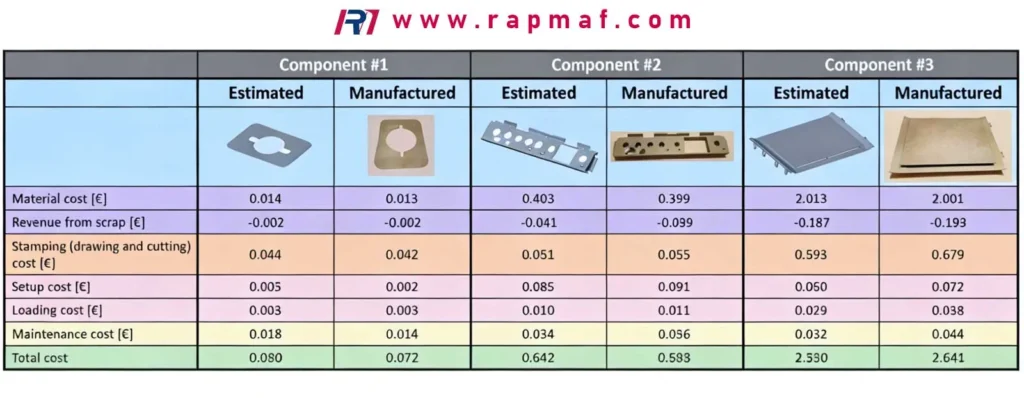
Your choice of material is the foundation of your cost. If you don’t need the corrosion resistance of stainless steel, don’t specify it. If the strength-to-weight ratio of aluminum isn’t critical, stick with steel. This initial choice sets the baseline for the entire project.
Waste and Yield (The Unused Dough)
This is the single most overlooked aspect of material cost. We buy metal in standard rectangular sheets. If your parts are oddly shaped, the leftover material—the “skeleton”—is waste. We try to “nest” as many parts as possible onto a sheet to maximize the yield, but there is always some waste. A design that nests efficiently can have a yield of 90%, meaning only 10% of the material is waste. A poorly designed part that nests awkwardly might have a yield of only 50%.
Think about it: at 50% yield, you are paying for twice the raw material you actually use. I’ve seen clients reduce their material cost by 30% simply by adjusting a part’s dimensions by half an inch to allow for a more efficient nest on a standard sheet size.
Thickness: The Exponential Cost Multiplier
A sheet of 1/4″ steel isn’t just twice as expensive as a sheet of 1/8″ steel; it can be three or four times the price per pound. But the material cost is only half the story. Thicker material is exponentially slower and harder to work with. It takes longer to cut, requires more powerful (and expensive) machines to bend, and is harder to handle.
Clive’s Rule of Thumb: Every step up in material thickness should be aggressively challenged. If you can add a reinforcing bend or a gusset to achieve the required strength with a thinner material, you will almost always save a significant amount of money.
Pillar 2: Time Cost – The Price of the Recipe
This is the most complex and most variable part of any sheet metal fabrication quote. It’s where your design decisions have the most dramatic impact. Time is money, and on a manufacturing floor, we measure it in seconds.
To understand time cost, you first need to understand the difference between setup and run time.
- Setup Time: The time it takes a skilled operator to load the material, pull up the program, load the correct tools (like press brake dies), and run a first article for inspection. This can take anywhere from 15 minutes to over an hour.
- Run Time: The actual time the machine spends cutting, bending, and processing each individual part.
For a one-off prototype, the setup cost is huge because it’s applied to a single piece. For a run of 10,000 parts, the setup cost per piece becomes negligible. This is why per-piece prices drop so dramatically with quantity.
To quantify this, let’s look at some real-world numbers. Here is a simplified version of the internal cost index we use at my facility. These are blended rates that include the machine’s operating cost, maintenance, and the skilled operator’s wage.
Exclusive Insight: Clive Manufacturing 2024 Q3 Cost Index
| Process | Blended Hourly Rate | Notes |
|---|---|---|
| CAD/CAM Programming | $75/hr | Converting your drawing into machine code. |
| Fiber Laser Cutting | 150−225/hr | Rate varies based on material thickness and machine power. |
| Press Brake Bending | 120−180/hr | Rate depends on setup complexity and operator skill. |
| Hardware Insertion (PEM) | $90/hr | Installing threaded inserts, standoffs, etc. |
| Welding & Grinding | $110/hr | Highly skilled manual labor. The most variable cost. |
| Manual Assembly | $85/hr | Bolting, riveting, and other final assembly steps. |
Now, let’s connect this to your design. Every feature on your drawing translates directly to time on one of these machines. A simple design might require 30 seconds on the laser and 60 seconds on the press brake. A complex design could require 5 minutes on the laser and 10 minutes on the press brake. Using the rates above, you can see how the cost can balloon.
This is where Design for Manufacturability (DFM) comes in. DFM is the practice of designing parts in a way that makes them as easy and fast to produce as possible. A designer who ignores DFM can easily make a part 10 times more expensive than it needs to be. This isn’t an exaggeration; I see it happen every single week.
The core principle is simple: Your job as a designer is to remove time from the manufacturing process. Every bend you eliminate, every weld you design out, every standard tool you accommodate, directly translates into a lower quote. We’ve established the formula and the raw numbers. In the next part, we will dive deep into a practical case study, comparing a “bad” DFM design to a “good” one to show you the staggering difference in the final quoted price.
How Your Design Choices Impact Manufacturing Time
Let’s follow a part’s journey through the shop and see where the costs are hiding.
Cutting (Laser/Plasma)
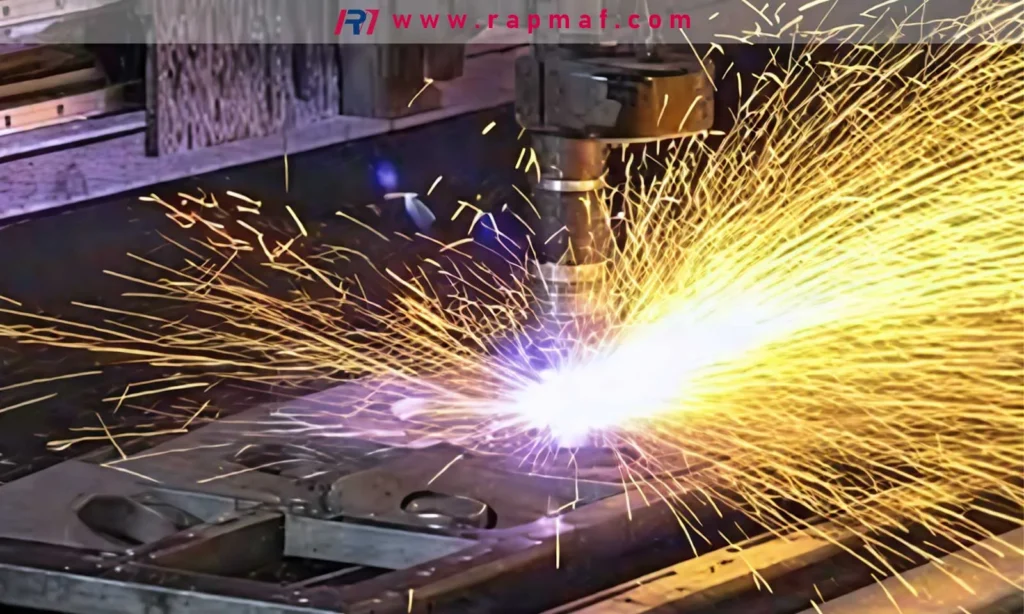
A fiber laser is incredibly fast, but its time is still a factor.
- Complexity: A simple rectangle cuts faster than a part with hundreds of small, intricate features. Every time the laser has to slow down for a sharp corner or pierce the material for an internal cutout, it adds seconds.
- Common Line Cutting: If you have multiple rectangular parts, a smart programmer can arrange them to share a cut line, effectively cutting two parts at once. Designing parts to standard dimensions that allow for this can reduce cut time and material waste.
Bending (Press Brake) – The #1 Source of Hidden Costs
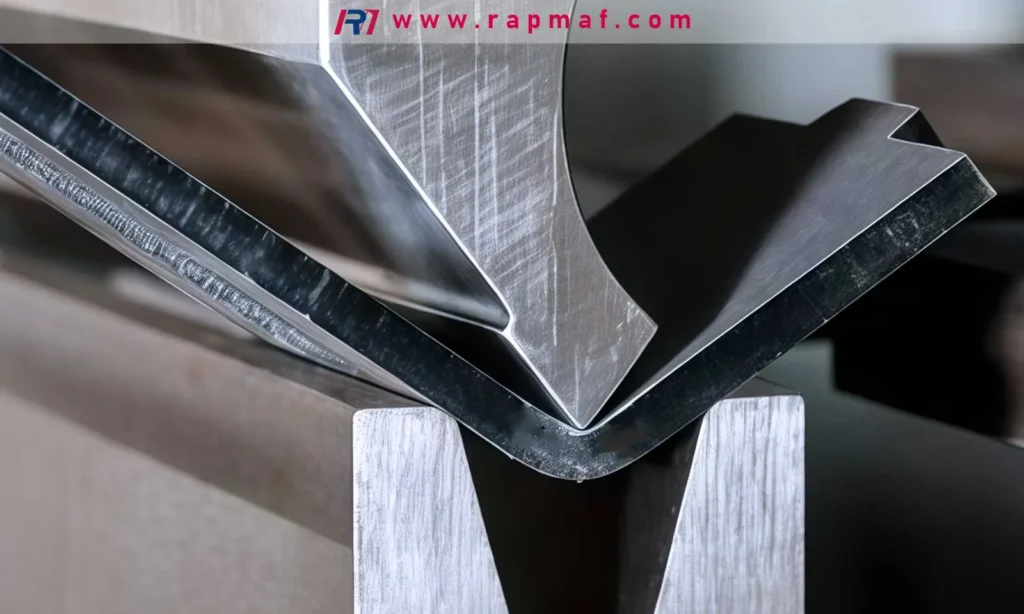
If cutting is a science, bending is an art, and it’s where inexperienced designers cost themselves a fortune.
- Standard Tooling: Every fabrication shop has a library of standard press brake dies (e.g., V-openings for specific material thicknesses and punches with common radii). If your design uses a standard bend radius (a good rule of thumb is to use a radius equal to the material thickness), we can use our existing tools. If you specify a unique, tight, or large radius, we may have to order custom tooling, which can cost thousands of dollars and add weeks to your lead time. That cost will be passed directly on to you.
- Bend Reliefs: When you bend a flange, the material at the corner needs somewhere to go. Without a small cutout (a bend relief), the material will tear and deform. If a designer forgets this, we have to stop and manually add it with a grinder, which is slow, expensive, and ugly.
- Complex Bend Sequences: Imagine bending a five-sided box. The final bend might be impossible to make because the rest of the part collides with the press brake machine itself. A good design considers the bending order. A bad one forces the operator into slow, awkward setups or requires multiple, complex tool changes.
- Bending Near Holes: Placing a hole too close to a bend line will cause the hole to stretch and deform into an oval during bending. The standard rule is to keep holes at least 3-4 times the material thickness away from the bend line.
Hardware & Assembly
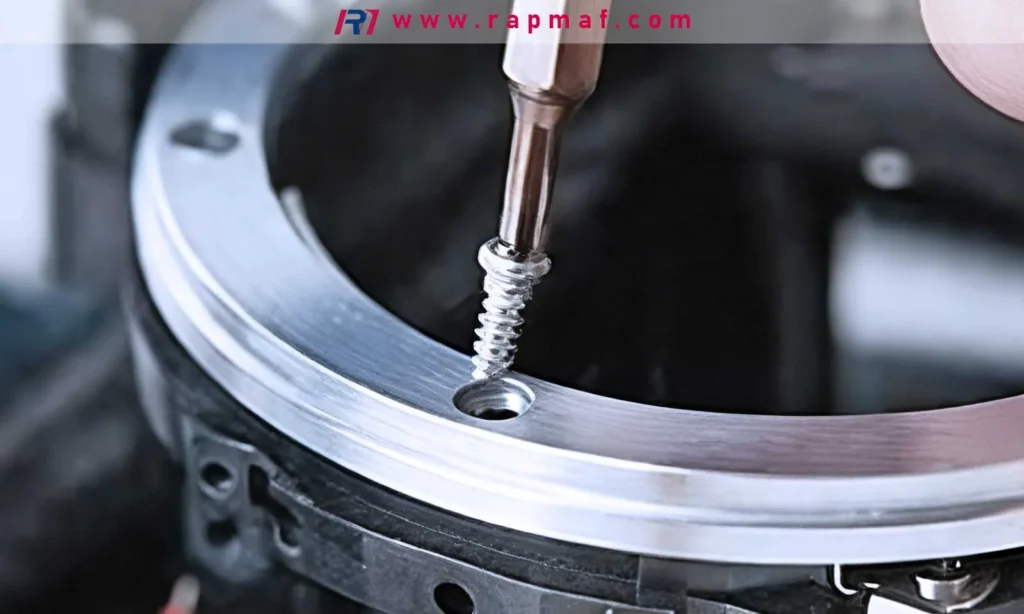
- Self-Clinching Hardware (PEMs): These are the fastest and cheapest way to add strong threads to sheet metal. We press them in using a dedicated machine. It’s a fast, repeatable process.
- Tapping: Tapping threads directly into sheet metal is slow, prone to breaking taps (which have to be manually removed), and generally weaker, especially in thin material. Unless absolutely necessary, always opt for a PEM nut over a tapped hole.
- Welding: Welding is pure skilled labor time. A design that minimizes welding is a cost-effective design. Use slot-and-tab features that allow parts to self-locate before welding. This drastically reduces the need for expensive, custom fixtures and cuts down on welder setup time. A continuous seam weld is far more expensive than a few simple tack welds.
Pillar 3: Finishing – The “Plating” That Adds Cost and Value
Once the part is fabricated, it almost always needs some form of finishing. This is the final pillar of cost.
- Deburring: The edges left by a laser are sharp. For most parts, we run them through a large tumbling machine to knock off the sharp edges. This is a cheap, bulk process. If you specify a perfectly smooth, hand-finished edge, the cost skyrockets.
- Powder Coating: This is the most common and durable finish. The cost is driven by the size of the part, the complexity of masking (taping off areas that shouldn’t be coated), and the color. Standard colors are cheaper than custom matches.
- Anodizing (for Aluminum): An electrochemical process that creates a hard, durable surface.
- Plating (Zinc, Chrome, etc.): Adds a metallic coating for corrosion resistance or cosmetic appearance.
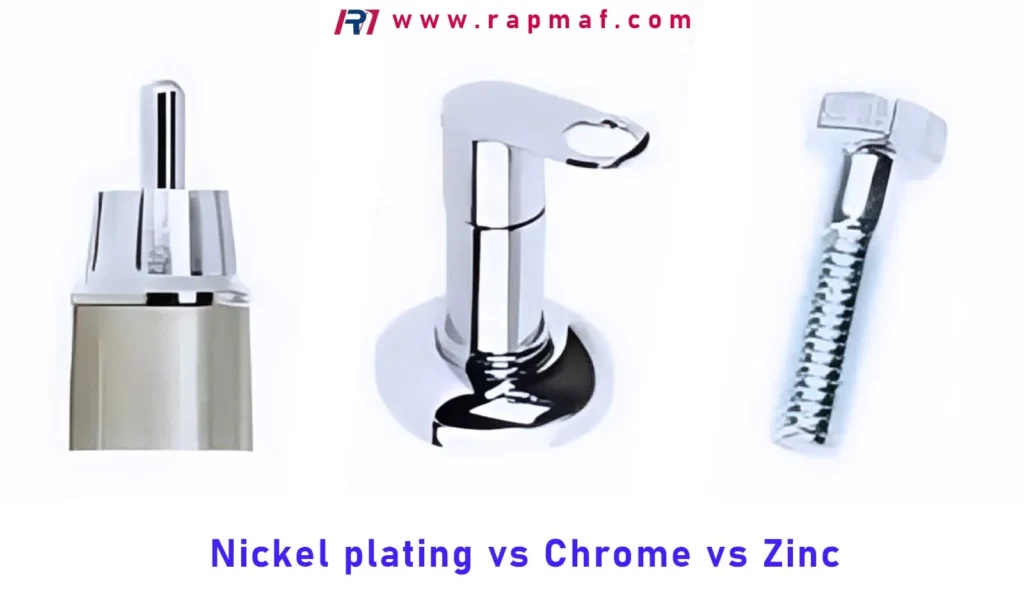
Finishing is often outsourced to a specialist, which adds logistics and handling costs to your project. Always ask yourself if the finish is truly necessary and specify the most cost-effective option that meets your requirements.
Case Study: The Tale of Two Brackets (DFM in Action)
A client came to us needing 1,000 units of a simple mounting bracket. Let’s look at their initial design and the optimized version we proposed. The material for both is 1/8″ (0.125″) P&O Steel.
Design A: “The Over-Engineered Bracket”
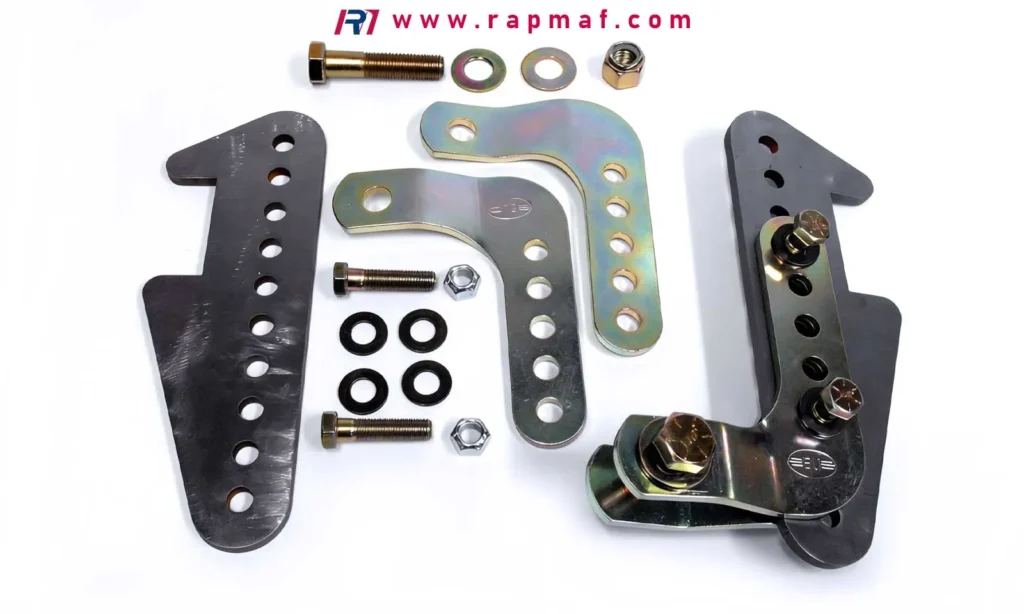
- Features: Tight, 0.03″ bend radii. No bend reliefs. Four tapped #10-32 holes. Required a full seam weld along a joining edge.
- The Problems: The tight radii required custom tooling. The lack of reliefs meant a secondary manual operation. Tapping is slow. The seam weld required a complex fixture and significant welding/grinding time.
Cost Breakdown for Design A (Per Piece, at 1000 qty):
| Process | Time / Notes | Cost |
|---|---|---|
| Material | 85% Yield | $2.10 |
| Laser Cutting | 45 seconds | $1.88 |
| Press Brake Bending | 3 setups, 120 seconds | $4.00 |
| Tapping | 4 holes, 60 seconds | $2.00 |
| Welding & Grinding | Fixturing + 90 seconds | $3.67 |
| Custom Tooling Amortization | ($2,500 / 1000 pcs) | $2.50 |
| Total Per Piece Cost | $16.15 |
Design B: “The DFM-Optimized Bracket”
- Features: We changed the bend radii to 0.125″ (our standard tooling). Added 0.06″ bend reliefs. Replaced tapped holes with PEM nuts. Re-designed the seam weld into a slot-and-tab feature requiring only two small tack welds.
- The Improvements: Used standard, off-the-shelf tooling. Bending was faster and cleaner. PEM insertion is 5x faster than tapping. The part self-fixtured, and weld time was cut by 80%.
Cost Breakdown for Design B (Per Piece, at 1000 qty):
| Process | Time / Notes | Cost |
|---|---|---|
| Material | 85% Yield | $2.10 |
| Laser Cutting | 45 seconds | $1.88 |
| Press Brake Bending | 1 setup, 75 seconds | $2.50 |
| Hardware Insertion (PEM) | 4 inserts, 12 seconds | $0.40 |
| Welding & Grinding | No fixture + 18 seconds | $0.73 |
| Custom Tooling Amortization | ($0 / 1000 pcs) | $0.00 |
| Total Per Piece Cost | $7.61 |
The Result: By applying basic DFM principles, we cut the per-piece cost from $16.15 to $7.61—a saving of 53%. For the total run of 1,000 pieces, this represents a saving of $8,540.
Frequently Asked Questions (FAQ)
What’s a typical hourly rate for fabrication?
As you saw in my index, it varies wildly by process. A simple manual operation might be 85/hr,whileahigh−endfiberlasercanbeover200/hr. Expect a blended average rate for a full-service shop to be in the 100−150/hr range. Be wary of shops advertising extremely low rates; they often make up for it with inflated material costs or poor quality.
Is laser cutting or plasma cutting cheaper?
For thin gauge material (under 1/4″), laser cutting is almost always superior, offering a cleaner edge and higher precision. For thick plate steel (1/2″ and up), plasma is much faster and therefore cheaper, but the edge quality is lower and requires more cleanup.
How can I get a quick, accurate estimate?
The best way is to provide a 3D CAD model (a .STEP or .IGES file is universal) and a simple 2D drawing (.PDF) that specifies the material, thickness, quantity, and any required finishing. This gives the estimator everything they need to provide an accurate quote quickly.
What is the absolute biggest and most common mistake you see?
Ignoring DFM for bending. Hands down. Designers specifying non-standard, razor-sharp bend radii and forgetting bend reliefs probably accounts for 50% of all needlessly expensive parts I quote.
Conclusion: You Have More Control Than You Think
The cost of sheet metal fabrication is not an arbitrary number. It is a direct and predictable consequence of your design choices, calculated with a simple formula: Material + Time + Finishing.
You, the designer, have the most leverage over the “Time” component. By embracing Design for Manufacturability—using standard tools, simplifying operations, and designing parts that are easy to handle and assemble—you can dramatically reduce the cost of your projects without sacrificing quality or function.
The next time you send out an RFQ, don’t just be a price-taker. Be a cost-driver. Design with the manufacturing process in mind, communicate with your fabricator early, and you’ll be able to get your parts made on time, on budget, and exactly to spec.
References
- Ryerson (or any major metal supplier): The websites of large metal suppliers like Ryerson are a great resource for checking the relative costs and availability of different alloys and thicknesses.
- Practical Machinist (Online Forum): An invaluable resource where you can read discussions between professional machinists and fabricators. You will learn more about real-world manufacturing challenges and solutions on the Practical Machinist Forum than in any textbook.