



If you hold a magnet up to a copper pipe, nothing happens. It doesn’t stick.
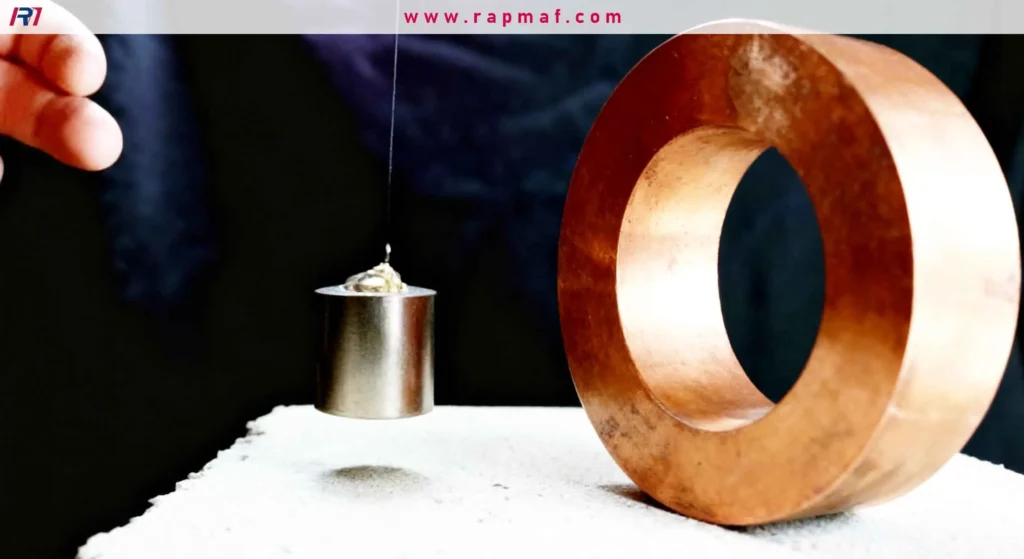
If you drop that same magnet through the copper pipe, something magical happens: It floats down in slow motion.
So, is copper magnetic?
The short answer is: No.
The engineering answer is: It’s Diamagnetic, and that’s even more useful.
Understanding this distinction is critical if you are designing EV motors, magnetic braking systems, or RF shielding enclosures. Let’s break down the physics and the manufacturing applications.
The Three Types of Magnetism
To understand Copper, you have to look at the electron shells.
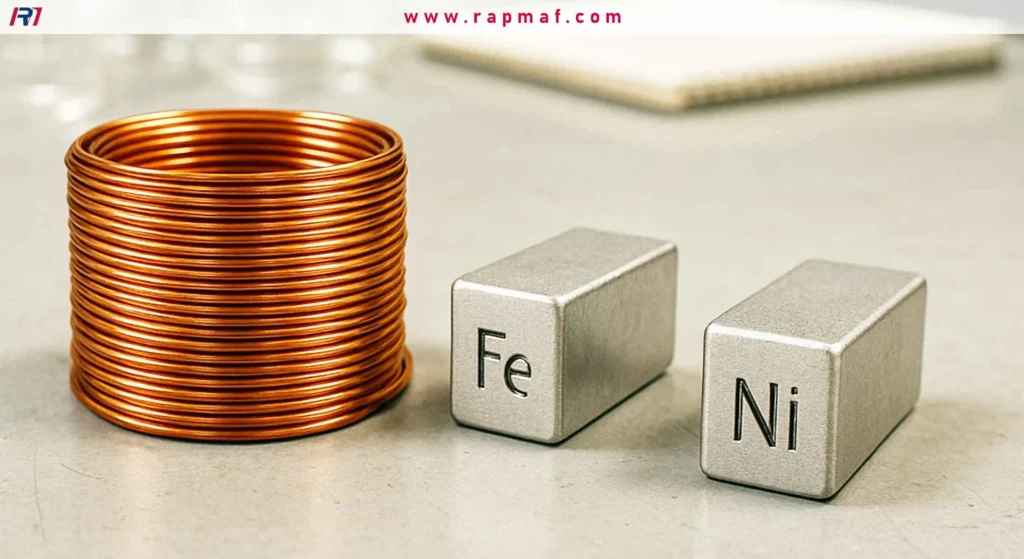
1. Ferromagnetic (Iron, Nickel, Cobalt)
- Behavior: Strongly attracted to magnets. They can become permanent magnets themselves.
- Why: Their unpaired electrons line up nicely with an external field.
2. Paramagnetic (Aluminum, Platinum)
- Behavior: Very weakly attracted. You usually need sensitive lab equipment to see it.
- Why: They have some unpaired electrons, but thermal energy scrambles them.
3. Diamagnetic (Copper, Gold, Silver, Lead)
- Behavior: Repelled by magnetic fields.
- Why: Copper has a full outer electron shell. It hates magnetic fields. When you push a magnet near it, it creates a tiny, opposing field to push back.
- The Reality: The repulsion is so weak you can’t feel it with your hand, but it’s there.
The Magic Trick – Lenz’s Law (Eddy Currents)
This is where things get profitable for engineers.
Copper isn’t magnetic statically, but it is highly reactive kinetically.
The Experiment: Drop a neodymium magnet down a copper tube.
The Result: Gravity says it should fall in 0.5 seconds. Instead, it takes 4 seconds.
Why? (Lenz’s Law)
- Motion: A moving magnetic field passes the conductor (Copper).
- Induction: This changing field induces an electrical current inside the copper. These are called Eddy Currents.
- Opposing Field: These swirling currents create their own magnetic field.
- The Brake: According to Lenz’s Law, this new field is perfectly opposite to the magnet’s field. It fights the magnet’s motion.
Application: Magnetic Braking
We machine massive Copper Discs for roller coasters and high-speed trains. When they need to stop without touching (frictionless braking), they push magnets near the spinning copper disc. The Eddy Currents create drag, stopping the train smoothly with zero wear.
Copper for RF Shielding (Faraday Cages)
Because Copper is so conductive, it is the King of RFI / EMI Shielding.
If you have sensitive electronics (like a medical MRI or a spy satellite component), you need to block external radio waves.
Radio waves are just oscillating electromagnetic fields.
When a radio wave hits a Copper enclosure:
- The wave tries to pass through.
- The copper absorbs the energy and turns it into electron flow (current) on the surface.
- The wave is grounded out or reflected.
Clive’s Design Tip:
For shielding, Continuity is Key.
If you send me a design for a shielding box, ensure the lid and the box have a conductive gasket path. If there is a gap, the radio waves will leak in like water. We often use Chromate Conversion Coating (Alodine) on aluminum/copper parts to keep them conductive while preventing corrosion. Do not Anodize shielding surfaces! (Anodizing is an insulator).
Sorting Scrap – The “Magnet Test”
On the shop floor, the “Magnet Test” is our quickest quality check.
Scenario: We have a bin of mixed “Yellow Metal” chips—some are Brass, some are Bronze, some are Copper-Nickel.
- Brass/Bronze: Generally non-magnetic (unless they have high iron content).
- Monel (Nickel-Copper): Some grades are slightly magnetic.
- Plating: Sometimes a “Copper” part is actually Steel plated with Copper.
The Test:
If the magnet sticks hard: It’s Steel (Plated). Junk it.
If the magnet pulls slightly: It might be Nickel or a specific Stainless Steel (work-hardened 304).
If there is zero pull: It’s pure Copper, Brass, or 316 Stainless.
Impurities Matter (Beryllium Copper)
There is one exception where Copper alloys get weird properties.
Beryllium Copper (BeCu).
It is non-magnetic, but it is as strong as steel.
- Use Case: Tools for Oil Rigs and Coal Mines.
- Why? If you drop a steel wrench, it sparks. Boom. If you drop a BeCu wrench, it doesn’t spark (Non-Sparking), and it’s non-magnetic (won’t trigger magnetic sensors).
Machining Warning: Beryllium dust is toxic. We machine this wet, with full HEPA filtration. Do not try this in a garage.
Conclusion: Use the “Anti-Magnet”
So, Copper isn’t magnetic. And that is exactly why we love it.
We use it to:
- Stop trains (Eddy Current Brakes).
- Block radio waves (EMI Shielding).
- Prevent explosions (Non-Sparking Tools).
If you are designing a magnetic assembly, a shielding enclosure, or a high-conductivity busbar, you need precision machined Copper.
We handle C11000 (ETP), C10100 (Oxygen-Free), and C17200 (BeCu).
References & Physics Sources
- Electromagnetism Basics:
- HyperPhysics (Georgia State University). Lenz’s Law and Faraday’s Law.
- Note: The definitive physics explanation for the “Magnet in Tube” effect.
- Shielding Standards:
- Leader Tech Inc. Shielding Effectiveness of Materials.
- ASTM B193. Standard Test Method for Resistivity of Electrical Conductor Materials.
- Material Safety:
- CDC / NIOSH. Beryllium Sensitization and Toxicity.
- Note: Essential reading if you are requesting Beryllium Copper parts.







5 Responses