



You have two pieces of plastic that need to become one. Your first instinct might be to reach for a tube of super glue or a two-part epoxy. While adhesives have their place, in the world of professional manufacturing and high-performance repairs, there is a far superior method for creating a permanent, monolithic bond: plastic welding.
So, what is it?
At its core, plastic welding is a process that uses heat, pressure, and time to melt the surfaces of two compatible plastic parts, allowing their polymer chains to mix and fuse together. As the area cools, it solidifies into a single, continuous piece of plastic.
This is the single most important distinction between welding and gluing:
- Gluing is an adhesive bond. It’s a separate substance acting as a middleman, sticking the two surfaces together.
- Welding is a cohesive bond. You are melting and fusing the parent material itself. A properly executed plastic weld is not a joint held together by something; it is the material.
This fundamental difference is why a good weld can achieve 80-95% of the original material’s strength, while a glue joint’s strength is limited by the adhesive itself and is far more susceptible to failure from chemicals, UV exposure, or peeling forces.
To understand how this fusion is achieved, it’s helpful to categorize the dozens of specific techniques into two main families, based on how they generate the necessary heat.
The Two Families of Plastic Welding
Every plastic welding method is simply a different strategy for delivering a controlled amount of thermal energy to a precise location. These strategies fall into two camps.
1. Thermal Welding (External Heat Source)
This is the most intuitive category. Just like welding metal with a torch, these methods use an external tool to apply heat directly to the joint area. The heat is transferred through conduction or convection, melting the surfaces of the parts and often a plastic filler rod simultaneously.

Imagine you’re repairing a large crack in a plastic water tank. You would likely use a Hot Gas Welder. This tool looks like a specialized hair dryer with a narrow nozzle. It blows a superheated stream of air (or an inert gas like nitrogen) directly onto the crack and a plastic welding rod. As both the tank surface and the rod melt, you press the molten rod material into the crack, creating a seamless, waterproof repair as it cools. This is thermal welding in its most common form.
2. Frictional / Mechanical Welding (Internal Heat Generation)
This family of techniques is more advanced and often used in high-volume industrial manufacturing. Instead of applying heat from the outside, these methods use mechanical movement—vibration, spinning, or ultrasonic waves—to generate intense friction directly at the interface between the two parts. This friction creates localized heat, melting the plastic from the inside out.
Imagine an automotive factory assembling thousands of plastic sensor housings per day. Each housing consists of two halves that must be sealed perfectly. Using glue would be slow, messy, and require curing time. Instead, they use Ultrasonic Welding. The parts are placed in a fixture, and a high-frequency (20,000+ Hz) vibrating tool called a “horn” is pressed against them. The ultrasonic vibrations are channeled to the joint, creating intense friction that melts and fuses the two halves in less than a second. No glues, no fumes, no waiting.
These two families—applying heat from the outside versus generating it from the inside—cover every professional plastic welding technique.
In the next part, we will perform a deep dive into the most important methods within each family, from Hot Gas and Extrusion welding to the high-tech power of Ultrasonic and Laser welding. We will compare their strengths and weaknesses and present a real-world case study from RM showing how we selected the perfect welding process for a demanding medical device application.
A Deep Dive into the Methods: From Hand Tools to High-Tech Robotics
The “best” plastic welding method doesn’t exist. The right choice is a function of part size, material, joint geometry, required strength, cosmetic appearance, and production volume.
Family 1: Thermal Welding (Applying Heat from the Outside)
These methods are conceptually the simplest and are often used for repairs, prototyping, and large-scale fabrication.
Hot Gas Welding
This is the quintessential manual plastic welding technique. An operator uses a handheld tool that blows a jet of hot air or inert gas (typically nitrogen for sensitive plastics) onto the joint area and a separate plastic filler rod. The operator must use a steady hand to simultaneously melt the base material and the rod, pressing the molten rod material into the joint to create the weld.
- Common Uses: Repairing cracks in car bumpers, fabricating large chemical tanks and water pipes, welding single-ply roofing membranes.
- Pros:
- Highly portable and relatively low equipment cost.
- Extremely versatile for large, awkwardly shaped parts and field repairs.
- Can create very strong structural welds when done correctly.
- Cons:
- Highly dependent on operator skill; consistency can be a major challenge.
- A very slow process, unsuitable for mass production.
- Weld appearance is often rough and requires post-processing for a smooth finish.
Extrusion Welding
Think of extrusion welding as “hot gas welding on steroids.” It uses a large, handheld welding gun that contains a built-in extruder (like a miniature 3D printer). The tool still uses a jet of hot air to pre-heat the base materials, but instead of feeding a thin rod by hand, it lays down a thick, continuous bead of molten plastic that has been plasticized inside the gun’s barrel.
- Common Uses: Lining large ponds and landfills with geomembranes, fabricating massive plastic tanks, joining thick plastic sheets where maximum strength and a high deposition rate are critical.
- Pros:
- Creates exceptionally strong welds due to the large volume of material deposited under pressure.
- Much faster than manual hot gas welding for large-scale jobs.
- Cons:
- Equipment is bulky, heavy, and expensive.
- Only suitable for large, easily accessible joints; cannot be used for intricate or small parts.
Hot Plate Welding
In this highly reliable process, the two plastic parts to be joined are fixtured and brought into contact with a precisely heated platen. After the surfaces have melted to a specific depth, the platen is quickly retracted, and the two molten parts are pressed together with a controlled force. They are held in place until the joint cools and solidifies.
- Common Uses: Sealing automotive intake manifolds and fluid reservoirs, joining pipe fittings, assembling battery casings.
- Pros:
- Creates incredibly strong, reliable, and often hermetically sealed welds.
- Highly repeatable and controllable process, ideal for automation and high-volume production.
- Less dependent on operator skill than hot gas methods.
- Cons:
- Generally limited to parts with flat or linear joint geometries.
- Cycle times can be longer than frictional methods due to the heating and cooling phases.
- Produces “flash” (excess material squeezed out of the joint) that may need to be removed.
Family 2: Frictional Welding (Generating Heat from the Inside)
These advanced methods are the workhorses of modern, high-volume manufacturing. They are prized for their speed, precision, and cleanliness.
Ultrasonic Welding
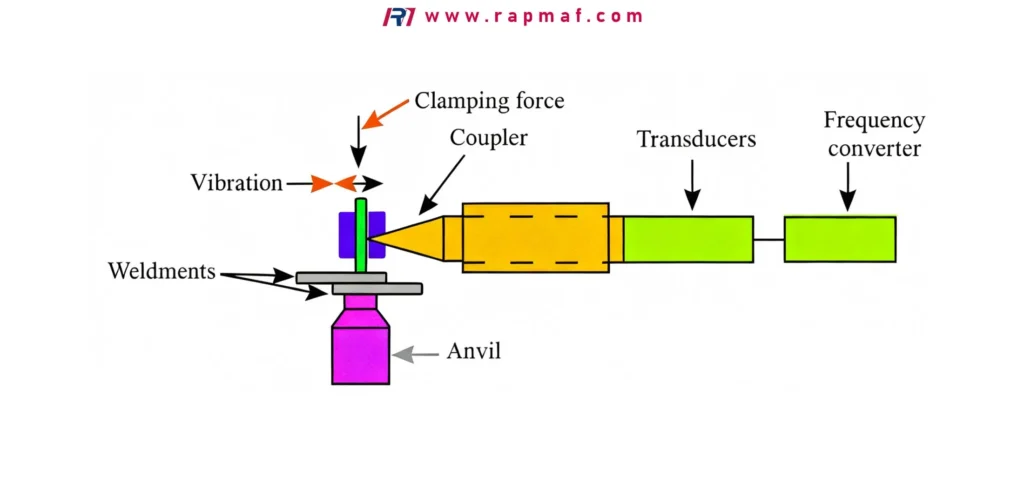
This is one of the most sophisticated and widely used industrial techniques. Parts are held together under pressure in a fixture. A titanium or aluminum tool called a “horn” is brought into contact with one of the parts and vibrates at a high frequency (typically 20 to 40 kHz). These ultrasonic waves are channeled to the joint interface, where they create intense, localized intermolecular friction. This friction generates rapid heat, melting and fusing the plastic in a fraction of a second.
For this to work effectively, the parts must be designed with an “energy director”—typically a small, sharp triangular ridge on one of the surfaces—that concentrates the vibrational energy to initiate the melt.
- Common Uses: Sealing electronic enclosures, assembling medical devices and filters, manufacturing automotive components and consumer products.
- Pros:
- Extremely fast cycle times (often less than one second).
- Creates clean, precise welds with minimal to no flash.
- Perfect for automation and robotic assembly.
- Does not introduce external heat or contaminants.
- Cons:
- High initial capital investment for equipment.
- Requires careful part and joint design (the energy director is crucial).
- Generally limited to smaller, rigid parts.
Spin Welding
The concept of spin welding is brilliantly simple. One part with a circular joint is held stationary while the other part is rotated against it at high speed. The friction and pressure generate heat, melting the interface. At the precise moment, the rotation is stopped, and the parts are held together under pressure to cool, forming a strong, permanent bond.
- Common Uses: Joining pipes and fittings, sealing fluid filters and floats, manufacturing aerosol bottles and containers.
- Pros:
- Fast, reliable, and highly repeatable process.
- Creates strong, hermetically sealed circular welds.
- The equipment is often simpler and less expensive than ultrasonic welders.
- Cons:
- Strictly limited to parts with a circular joint axis.
- Produces significant flash that usually needs to be managed or removed.
Comparison of Plastic Welding Methods
| Method | Heat Source | Key Advantage | Key Disadvantage | Typical Application |
|---|---|---|---|---|
| Hot Gas Welding | External (Hot Air/Gas) | Portability & Versatility | Operator Skill & Slow Speed | Field Repair, Large Tanks |
| Extrusion Welding | External (Hot Air + Extrusion) | High Strength & Deposition | Bulky Equipment | Geomembranes, Thick Sheets |
| Hot Plate Welding | External (Heated Platen) | Hermetic Seals & Reliability | Limited Joint Geometry | Automotive Reservoirs |
| Ultrasonic Welding | Internal (High-Frequency Vibration) | Extreme Speed & Precision | High Cost & Design Constraints | Medical Devices, Electronics |
| Spin Welding | Internal (Rotational Friction) | Simplicity & Strong Circular Welds | Only for Circular Joints | Pipes, Filters, Floats |
Case Study: Selecting the Right Weld for a Medical Device Enclosure
The Challenge: A medical technology client approached RM with a new handheld diagnostic device. The enclosure, made of a medical-grade Polycarbonate (PC), consisted of two clamshell halves. The requirements were non-negotiable:
- Hermetic Seal: The joint had to be perfectly sealed to protect sensitive internal electronics from cleaning fluids and contamination.
- Material Integrity: The welding process could not degrade the biocompatible PC material.
- Cosmetic Perfection: The final product needed a clean, seamless appearance with no visible flash or witness marks.
- High Volume: The process had to be scalable for production runs of 100,000+ units per year.
Analyzing the Options:
- Hot Plate Welding was considered. It could create the required hermetic seal. However, the process would produce external flash that would need a secondary removal step, adding cost and risk of particulate contamination. The cycle time was also a concern for the target volume.
- Gluing with Adhesives was rejected early. The validation process for biocompatible adhesives is extensive, and the risk of bond-line failure over the device’s lifespan was too high.
- Laser Welding was an attractive option for its cleanliness and precision. However, the high capital cost of the equipment and the need for one half of the enclosure to be laser-transparent added significant cost and complexity to the material supply chain.
The Solution: Ultrasonic Welding
Our engineering team identified ultrasonic welding as the ideal solution.
- Joint Design: We worked with the client to modify the part design, incorporating a specialized “shear joint” with a precisely engineered energy director. This design contains the molten material entirely within the joint, preventing any external flash.
- Speed & Scalability: With a weld time of under 700 milliseconds, the process easily met the high-volume production requirements.
- Seal & Strength: Through rigorous testing and validation, we dialed in the exact amplitude, pressure, and weld time to create a bond that was both structurally sound and verifiably hermetic.
- Cleanliness: As the heat is generated internally and the process is instantaneous, there is minimal thermal stress on the material and zero risk of external contamination.
The Outcome: By selecting and optimizing the ultrasonic welding process, RM was able to deliver a perfectly sealed, cosmetically flawless medical device enclosure that met all regulatory, performance, and commercial requirements for the client. This is a perfect example of how choosing the right manufacturing process is just as critical as designing the part itself.
We have now seen how different welding techniques work. But which plastics can actually be welded in the first place? And what makes a good joint design? In the final part, we will explore the crucial topic of plastic weldability and the fundamental design principles for creating strong, reliable welded joints.
Which Plastics Can Be Welded? The Golden Rule of Compatibility
The first and most important rule of plastic welding is that only thermoplastics can be welded.
Thermoplastics are polymers that become soft and moldable when heated and return to a solid state when cooled. This process is reversible, like melting and freezing wax. It is this ability to be re-melted that makes welding possible.
In contrast, thermosets (like epoxy, silicone, or polyurethane) undergo an irreversible chemical reaction (curing) when heated. Once they are set, they cannot be re-melted. Trying to weld a thermoset is like trying to un-bake a cake—applying more heat will only cause it to char and degrade.
The Great Divide: Amorphous vs. Semi-Crystalline Thermoplastics
Even within the weldable thermoplastic family, there is a crucial distinction that determines how easily a material will weld. It all comes down to their molecular structure.
- Amorphous Thermoplastics: These plastics have a random, tangled, spaghetti-like molecular structure. This chaos means they don’t have a sharp, defined melting point. Instead, they soften gradually over a wide temperature range, transitioning from a rigid solid to a soft, rubbery state, and finally to a viscous liquid.
- Examples: ABS (Acrylonitrile Butadiene Styrene), PC (Polycarbonate), PVC (Polyvinyl Chloride), PMMA (Acrylic).
- Weldability: Excellent. Their wide processing window makes them forgiving. They absorb the frictional energy from methods like ultrasonic welding very effectively. This is why they are so common in complex consumer electronics and medical devices.
- Semi-Crystalline Thermoplastics: These plastics have a highly ordered, structured molecular arrangement. Think of neatly folded chains forming crystalline regions, interspersed with some random amorphous regions. This structure gives them a very sharp and defined melting point. They stay solid until they reach that exact temperature, at which point they rapidly transition to a low-viscosity liquid.
- Examples: PE (Polyethylene), PP (Polypropylene), PA (Nylon), POM (Acetal).
- Weldability: Good, but challenging. Their sharp melting point requires much more precise temperature control. Their ordered structure is also poor at absorbing vibrational energy, making them notoriously difficult to weld with ultrasonic methods without very careful joint design. Hot plate and hot gas welding are often more reliable for these materials.
The Second Golden Rule: Like Welds Like
You cannot reliably weld two chemically different plastics together. You can’t weld an ABS part to a Polypropylene part. Their long-chain polymer molecules are fundamentally incompatible and will not form a durable intermolecular bond, much like oil and water refuse to mix. For a strong, permanent weld, the base materials and the filler rod (if used) must be made of the same plastic.
| Material | Type | General Weldability | Common Welding Methods |
|---|---|---|---|
| ABS | Amorphous | Excellent | Ultrasonic, Hot Plate, Hot Gas |
| Polycarbonate (PC) | Amorphous | Excellent | Ultrasonic, Laser, Hot Plate |
| Polypropylene (PP) | Semi-Crystalline | Good | Hot Plate, Spin, Hot Gas, Extrusion |
| Polyethylene (PE) | Semi-Crystalline | Good | Hot Plate, Hot Gas, Extrusion |
| PVC | Amorphous | Excellent | Hot Gas, Hot Plate, Solvents |
| Nylon (PA) | Semi-Crystalline | Challenging (Hygroscopic) | Hot Plate, Spin, Vibration |
| Epoxy/Silicone | Thermoset | Unweldable | Must use adhesives |
Designing for Success: Principles of Strong Plastic Joints
A weld is only as good as the joint it’s created in. At RM, we treat joint design as a critical step in the manufacturing process. A well-designed joint makes the welding process easier, stronger, and more repeatable.
1. Maximize Surface Area
A simple “butt joint,” where two flat ends are pressed together, is the weakest possible design. It relies on a very small surface area and is prone to peeling and cracking under stress. A far better approach is to design joints that increase the contact area and create mechanical interlocks.
- Good: Tongue and Groove Joint
- Better: V-Groove (for hot gas welding)
- Excellent: Step Joint or Shear Joint (for ultrasonic welding)

2. Ensure Proper Alignment
Parts must be held in precise alignment during the entire welding and cooling cycle. Any shifting will result in a weak or failed bond. Good part design incorporates self-aligning features.
- Pins and Sockets: These features ensure the two halves lock into the correct position before the weld begins.
- Fixturing Nests: The fixture (or “nest”) that holds the part during welding should be custom-machined to the part’s exact geometry, providing robust support and preventing any movement.
3. Manage Molten Material Flow (Flash)
When two molten surfaces are pressed together, some material will inevitably be squeezed out of the joint. This excess material is called “flash.” In many applications, visible flash is cosmetically unacceptable.
- Flash Traps: A smart design includes small internal channels or recesses next to the joint line. These “traps” give the excess molten plastic a place to flow and hide, keeping the exterior surface clean.
- Energy Director/Shear Joint Design: As discussed in our case study, specific joint geometries for ultrasonic welding are designed to contain the melting process entirely within the joint, resulting in a flash-free weld.
Final Verdict: The Three Pillars of Plastic Welding
Successfully joining plastic is not about finding the “best” welding machine. It’s about a holistic engineering approach that respects the three pillars of the process:
- The Right Process: You must select a welding method that matches your part’s size, geometry, material, and production volume. A hot gas welder is perfect for a one-off tank repair but completely wrong for 100,000 electronic enclosures.
- The Right Material: The material must be a weldable thermoplastic, and both parts must be made of the same material. Understanding the difference between amorphous and semi-crystalline plastics is critical for predicting process success.
- The Right Design: The joint must be intelligently designed to maximize strength, ensure alignment, and manage material flow. The part design and the welding process must be developed in harmony.
When these three pillars are aligned, plastic welding transforms from a simple repair technique into a sophisticated, reliable, and powerful manufacturing process capable of creating the most demanding products in the world.
Frequently Asked Questions (FAQs)
Q1: What is the strongest plastic welding method?
There is no single “strongest” method. The strength of a weld depends on the process, material, and joint design. However, for a properly designed joint, both hot plate welding and extrusion welding are known for creating exceptionally strong, often hermetically sealed bonds that can approach the strength of the parent material itself.
Q2: Can you weld any two pieces of plastic together?
No. You can only weld “like” plastics together (e.g., Polypropylene to Polypropylene). Different types of plastic, like ABS and Polyethylene, are molecularly incompatible and will not form a strong bond. Furthermore, you can only weld thermoplastics; thermosets like epoxy or silicone cannot be welded.
Q3: Can you weld plastic without a special welder?
For simple, non-structural repairs on some thermoplastics, it is sometimes possible to use a soldering iron with a flat tip to carefully melt the joint. However, this method offers very poor temperature control and is not recommended for anything requiring strength or a good cosmetic finish. It is very easy to overheat and burn the plastic, releasing harmful fumes and creating a brittle joint.
Q4: What’s the difference between plastic welding and gluing?
Plastic welding uses heat and/or friction to melt the base plastics themselves, fusing them into a single, monolithic part upon cooling. The bond is made of the original material. Gluing (or adhesive bonding) involves introducing a third substance (the adhesive) that bonds to the surfaces of the two parts to hold them together. Welding creates a homogenous bond, while gluing creates a heterogeneous one.
References
- Troughton, M. J. (2008). Handbook of Plastics Joining: A Practical Guide (2nd ed.). William Andrew Publishing. (A comprehensive industry reference covering all major plastic joining techniques).
- ASTM International. (2020). ASTM D638 – 14: Standard Test Method for Tensile Properties of Plastics. (The industry standard for testing the strength of plastic materials, which is also used to validate the strength of a welded joint).
- Grewell, D., Benatar, A., & Park, J. (Eds.). (2003). Plastics and Composites Welding Handbook. Hanser Publications. (An in-depth technical handbook covering the science and application of various welding processes).
Disclaimer
The information on this page is for informational purposes only. RM makes no representations or warranties, express or implied, as to the accuracy or completeness of this information. For any third-party services procured through the RM network, it is the buyer’s responsibility to specify and confirm performance parameters, tolerances, materials, and workmanship during the quotation process. For more detailed information, please do not hesitate to contact us.
RM: Your Precision Manufacturing Partner
RM is an industry leader in custom manufacturing solutions. With over 20 years of profound experience, we have become the trusted partner for more than 5,000 clients worldwide. We specialize in a comprehensive range of manufacturing services—including high-precision CNC machining, sheet metal fabrication, 3D printing, injection molding, and metal stamping—to provide you with a true one-stop-shop experience.
Our world-class facility is equipped with over 100 state-of-the-art 5-axis machining centers and operates in strict compliance with the ISO 9001:2015 quality management system. We are dedicated to providing solutions that blend speed, efficiency, and exceptional quality to customers in over 150 countries. From rapid prototyping to large-scale production, we promise delivery in as fast as 24 hours, helping you gain a competitive edge in the market. Choosing RM means selecting an efficient, reliable, and professional manufacturing ally.
Explore our capabilities today by visiting our website: www.rapmaf.com







6 Responses