

Hello, I’m Clive Chen, an engineer at Rapmaf. In our world of high-precision CNC machining and advanced polymer molding, it’s easy to think of engineering as a purely modern discipline. But the principles we rely on today were forged—often quite literally—by the engineers who built the industrial world. And nothing embodies that legacy of raw, powerful, and incredibly clever engineering quite like riveted steel.
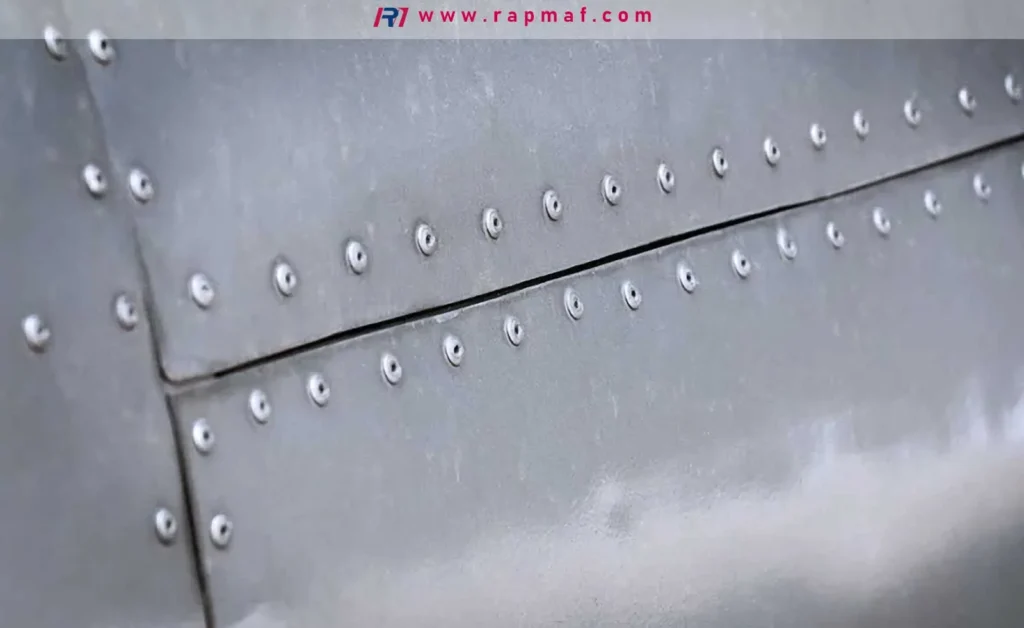
When you stand before a structure like the Eiffel Tower, an old railway bridge, or even the hull of a ship like the RMS Titanic, you are looking at a monument to this technology. The repeating pattern of rivet heads is the signature of an entire era of construction. But it would be a huge mistake to dismiss riveting as a historical relic. The fundamental physics that make a riveted joint so robust are the very same reasons it remains the non-negotiable joining method for critical structures today, most notably in the aerospace industry.
So, what exactly is riveted steel? Why was it the undisputed king of heavy construction for nearly a century? This guide is the first of a two-part deep dive into the art and science of this foundational technology. We’ll break down the physics behind its incredible strength, walk through the forgotten industrial craft of the hot riveting process, and dissect the anatomy of the rivet itself. Let’s begin.
The Core Principle: It’s Not the Pin, It’s the Pinch
At first glance, a rivet seems simple: it’s a metal pin with a head on one end, used to fasten two plates of steel together. This leads to the most common misconception—that a rivet works like a nail or a simple pin, resisting loads only by preventing the plates from shearing apart. While it does do that, it’s not its primary function. The true genius of a structural riveted joint lies in a single, powerful phenomenon: clamping force derived from thermal contraction.
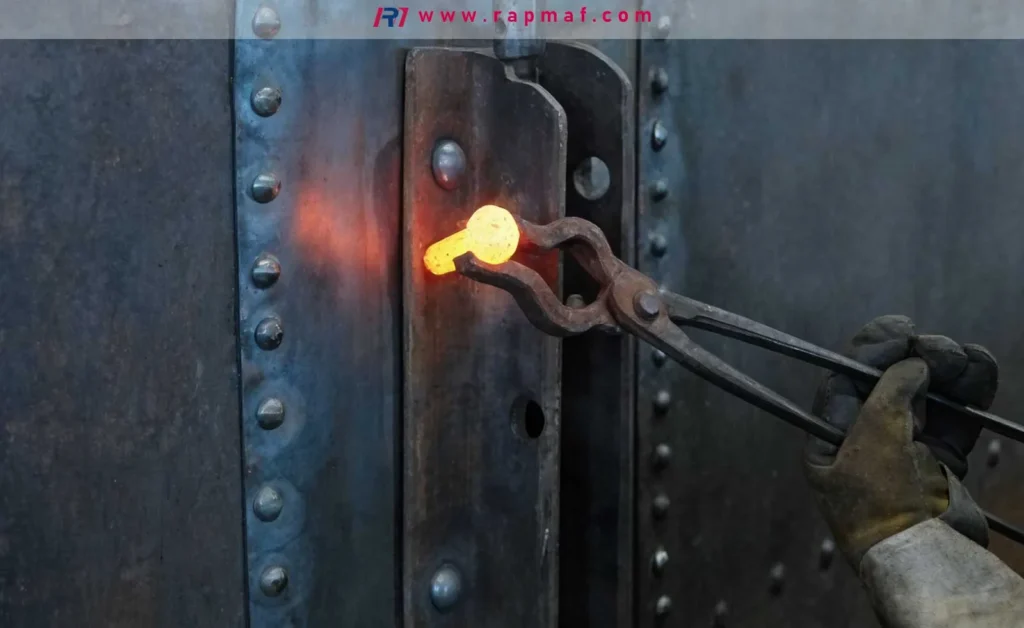
To understand this, we need to look at the classic method of hot riveting. A steel rivet is heated in a forge to a light cherry-red, approximately 1000-1100°C (1800-2000°F). At this temperature, the steel is soft, malleable, and expanded. This glowing-hot rivet is then placed through precisely aligned holes in the steel plates to be joined. A second head is immediately formed on the tail end using a pneumatic hammer.
Now, the physics begins. As the rivet cools from 1000°C down to ambient temperature, it attempts to contract along its length, governed by the formula for thermal contraction: ΔL = αL₀ΔT.
- ΔL is the change in length.
- α is the coefficient of thermal expansion for steel (about 12 x 10⁻⁶ / °C).
- L₀ is the original length (the grip length between the heads).
- ΔT is the massive change in temperature (around 1000°C).
Because the rivet’s two heads are now locked against the steel plates, it cannot shrink freely. Instead, this contraction translates into an enormous tensile force within the rivet, which in turn creates a massive compressive or clamping force on the plates. Think of each rivet as a permanent, high-strength clamp, squeezing the steel plates together with a force of several tons.
This clamping force creates immense friction between the mating surfaces of the steel plates. It is this frictional resistance that carries the vast majority of the load in the joint, preventing the plates from sliding past one another. This is what engineers call a friction-type connection. The solid body of the rivet, filling the hole, acts as a secondary safety mechanism. Only if an extreme overload manages to overcome this friction will the rivet itself bear the load in shear. This two-stage system is what made riveted joints so incredibly reliable and damage-tolerant.
The Hot Riveting Process: A Lost Industrial Symphony
The process of installing these rivets was a noisy, dangerous, and highly skilled craft. It was less like a modern assembly line and more like a coordinated industrial ballet, typically performed by a four-person team who had to work in perfect unison.
- The Heater (or “Cooker”): This was the starting point. The Heater operated a small, often coke-fired, portable forge. His job was to heat batches of rivets to the exact temperature needed. There were no digital thermometers; this was done entirely by eye, judging the color of the glowing steel. Too cold, and the rivet couldn’t be formed properly. Too hot, and the rivet could be damaged or burn. He had to anticipate the team’s rhythm, ensuring a perfectly heated rivet was ready the moment they needed it.
- The Catcher/Inserter: Once the rivet was ready, the Heater would use long tongs to pull it from the forge and, with a skilled throw, send it arcing through the air to the Catcher. On a bridge or skyscraper, this throw could be 50 feet or more. The Catcher would snag the white-hot rivet out of the air in a leather or metal cone. He would then quickly bang the rivet against a beam to knock off any slag or scale and then immediately drive it into the aligned hole. Speed was essential.
- The Bucker-Up: Positioned on the opposite side of the steel—often in a precarious or cramped space—was the Bucker-Up. He wielded a heavy tool called a “dolly” or a “buck,” which was essentially a massive, counter-weighted steel bar or a pneumatic brace. His job was to press this dolly firmly against the manufactured head of the rivet, absorbing the immense force of the riveting hammer from the other side. A good Bucker-Up was critical; if he failed to hold the rivet steady, the head could be formed improperly, and the entire rivet would have to be drilled out and replaced.
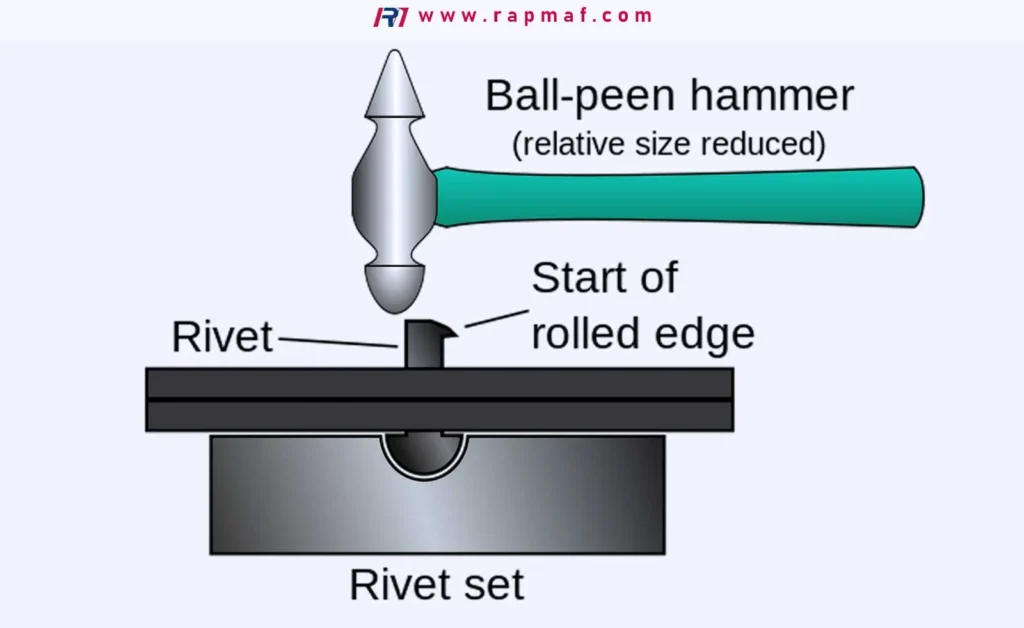
- The Riveter (or “Gun Man”): This was the final and most visible member. Using a heavy pneumatic riveting hammer (the “gun”), which could weigh up to 90 pounds, he would brace himself against the structure and unleash a deafening torrent of blows onto the rivet’s tail. In a matter of seconds, he would skillfully form the tail into a second, identical head (the “shop head”), ensuring it was perfectly shaped and fully seated against the steel plate before the rivet cooled too much.
The entire sequence was a high-speed, high-stakes operation defined by the rhythmic rat-a-tat-tat of the pneumatic hammer. After the noise subsided, a properly installed rivet would cool and contract, often emitting a distinct, high-pitched “ping” as it tightened, a sound that signaled to the foreman and inspectors that the joint was secure. The quality of the joint was then verified by tapping the rivet head with a hammer; a solid ring meant a tight rivet, while a dull thud indicated a loose one that needed to be replaced.
Anatomy of a Rivet: Designing for the Load
While the installation process is fascinating, the design of the rivet itself is a matter of pure engineering. The material and the head shape are chosen specifically for the demands of the application.
Rivet Material: The Importance of Ductility
Structural rivets were not made from high-strength, hardened steel. They were typically forged from a ductile, low-to-medium carbon steel, as specified by standards like ASTM A502, Grade 1. This choice was deliberate:
- Formability: The material had to be soft enough at high temperatures to be easily formed into a new head in seconds.
- Toughness: It needed to withstand the rapid hammering and the immense stresses of thermal contraction without becoming brittle or cracking.
- Hole-Filling Capacity: A ductile material would flow under the force of the hammer, ensuring it completely filled every irregularity in the drilled hole. This complete bearing is critical for the joint’s fatigue resistance, as it prevents any micro-movements.
Rivet Head Types and Their Functions
The shape of the rivet head was not arbitrary. It was designed to optimize the transfer of load from the rivet to the steel plate.
Table 1: Common Types of Solid Rivet Heads
| Head Type | Diagram / Description | Engineering Application & Rationale |
|---|---|---|
| Button / Round Head | A classic dome-shaped head. The most common type for general structural steel. | This is the workhorse of structural riveting. The domed shape is easy to form with a pneumatic hammer and provides a good bearing surface to distribute the clamping force onto the plate. Its protruding profile makes it unsuitable for flush surfaces. Used extensively on bridges, girders, and building frames. |
| Pan Head | A flat top with steeply tapered sides, resembling an inverted pan. | The Pan Head provides a larger bearing surface and is structurally stronger than a Button Head. It was often specified for high-stress applications requiring maximum shear and bearing strength, such as in the construction of high-pressure steam boilers, tanks, and in the primary structural members of ships. |
| Countersunk Head | A flat-topped head with a conical bearing surface that sits flush with the surface of the steel plate. | This head is used when a smooth, unobstructed surface is an absolute requirement. The steel plate must be prepared with a conical recess (a countersink) for the head to sit in. This is essential for aerodynamics on aircraft skins and for creating a smooth hull on ships to reduce drag. The trade-off is that countersinking removes material from the plate, which must be accounted for in design calculations. |
| Truss / Wagon Box Head | A very wide, low-profile, almost flat head. | This head style has a very large diameter, spreading the clamping force over a wider area. It was often used for joining thinner sheets of metal or softer materials where a more concentrated head like a Button Head might risk deforming or pulling through the material. |
By mastering the physics of thermal contraction and developing a highly skilled installation process, engineers of the 19th and early 20th centuries were able to build structures of a scale and durability never before seen. This foundational knowledge of how rivets work—relying on clamping force, friction, and shear resistance—is the essential first step to understanding their place in engineering history.
Rivets vs. High-Strength Bolts vs. Welding
The transition away from riveting in mainstream construction began in the mid-20th century. The two technologies that replaced it were high-strength bolting and structural welding. To understand why, we need to conduct a fair, head-to-head comparison.
Rivets vs. High-Strength Bolts
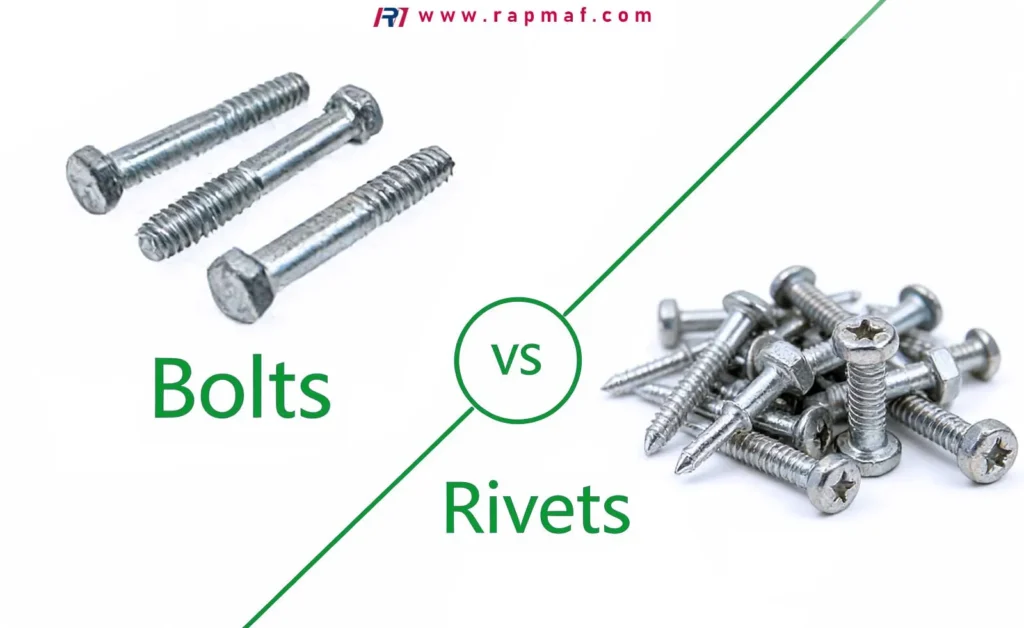
This is the most direct comparison, as a high-strength bolted joint often works on the very same principle as a riveted joint: clamping force. When a high-strength bolt (specified under standards like ASTM A325 or A490) is properly tensioned, it stretches elastically like a very stiff spring. This tension creates the same powerful clamping force on the steel plates, generating the friction needed to resist loads.
So how do they differ?
- Clamping Force & Predictability: A hot rivet’s clamping force is powerful but also somewhat variable, depending on its initial temperature and cooling rate. A high-strength bolt’s clamping force, however, is precisely controllable. Using a calibrated torque wrench or tension-control (TC) bolts (where a spline shears off at the correct tension), an engineer can be certain that a specific, calculated clamping force has been achieved. This level of predictability is a major advantage for modern structural analysis.
- Material Strength: This is a clear win for bolts. The steel alloys used for modern high-strength bolts are far more advanced than the soft, ductile steel used for rivets. A modern A490 bolt has a tensile strength more than double that of a traditional rivet of the same diameter. This means fewer or smaller bolts can be used to achieve the same joint strength, saving material and weight.
- Installation Speed & Cost: This was the knockout blow for riveting in construction. A four-person riveting team was skilled, expensive, and relatively slow. A two-person bolting team could install high-strength bolts much faster, with less training, using simpler tools, and with far less noise. This dramatic reduction in labor cost and construction time made bolting the clear economic choice.
- Repair & Disassembly: A riveted structure is essentially permanent. To replace a damaged member, the rivets must be laboriously drilled or cut out. A bolted structure, on the other hand, can be disassembled. Members can be unbolted and replaced with relative ease, a massive advantage for maintenance and retrofitting.
- Fatigue Resistance: Here, the old technology has a subtle but important edge. When a hot rivet is driven, its soft metal swells to completely fill every microscopic void in the hole. This creates a perfect, tight fit with no room for movement. A bolt, even in a snug-fit hole, has a small manufacturing tolerance and cannot achieve this perfect fill. In applications with high-vibration or many load reversals, the potential for micro-slips in a bolted joint makes it slightly more susceptible to fatigue than a perfectly installed rivet.
Rivets vs. Welding
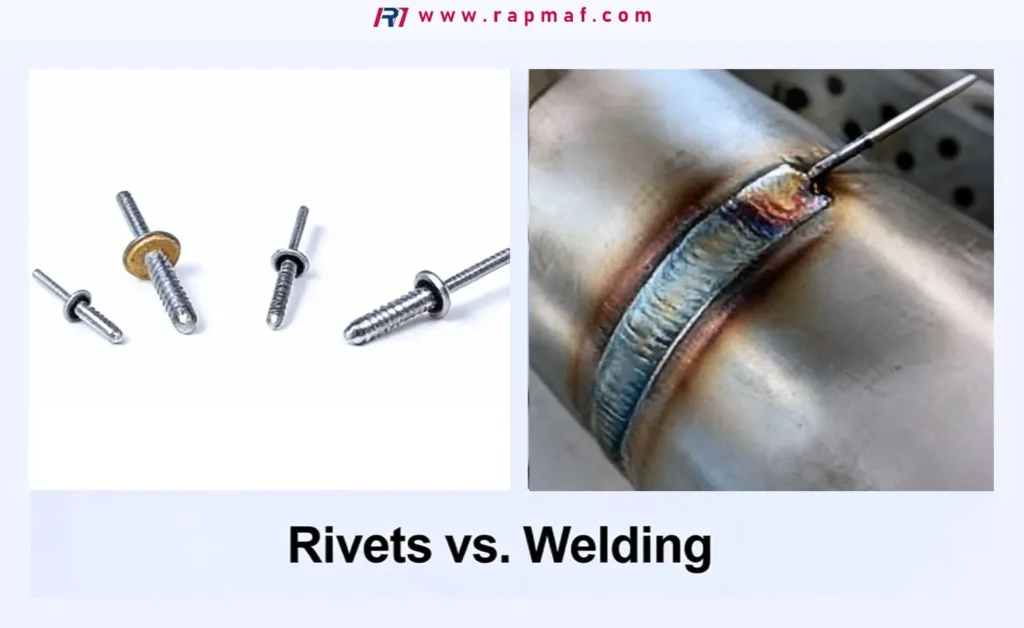
Welding represents a completely different philosophy of joining. Instead of clamping two separate pieces together, welding aims to fuse them into a single, continuous piece of metal.
- Joint Efficiency & Aesthetics: A properly executed full-penetration butt weld can make the joint 100% as strong as the parent metal itself. This creates a seamless, monolithic structure that is lighter (no need for overlapping plates or gussets) and often seen as more aesthetically pleasing. For pure static strength, welding is often the superior method.
- The Heat Affected Zone (HAZ): This is welding’s inherent drawback. The intense, localized heat of the welding arc melts the metal at the joint, but it also alters the crystal structure of the metal in the area immediately surrounding the weld. This “Heat Affected Zone” is no longer the same as the parent material. It can be more brittle, have different hardness, and contain residual stresses from the heating and cooling cycle. The HAZ is often the weakest point in a welded assembly and a prime location for failures to originate. Riveting, while a hot process, involves much lower temperatures distributed over a larger area and does not fundamentally alter the grain structure of the parent steel plates.
- Fatigue Resistance: This is the most critical difference. The residual stresses and sharp geometric transitions at the toe of a weld create significant stress concentrations. These areas are extremely vulnerable to the initiation and propagation of fatigue cracks under cyclical loading. A riveted joint, by contrast, is excellent at resisting fatigue. The high clamping force prevents movement, and the separate plates and multiple rivet holes act as natural “crack arresters.” A fatigue crack that might start at one rivet hole will have a very difficult time propagating across the high-friction interface to the next hole.
- Inspection: A riveted joint can be inspected visually and audibly. An inspector can see a failed head and can hear a loose rivet with the tap of a hammer. A welded joint can have dangerous internal defects—like lack of fusion, porosity, or internal cracks—that are completely invisible from the surface. Finding these defects requires complex and expensive Non-Destructive Testing (NDT) methods like ultrasonic testing, magnetic particle inspection, or X-rays.
Table 3: Engineering Comparison of Joining Methods
| Feature | Riveting | High-Strength Bolting | Welding |
|---|---|---|---|
| Primary Load Mechanism | Friction from clamping force | Friction from controlled tension | Fusion of parent material |
| Static Strength | Good | Excellent | Excellent (potentially monolithic) |
| Fatigue Resistance | Excellent | Good | Poor to Fair |
| Installation Cost/Speed | High / Slow | Low / Fast | Moderate / Moderate |
| Inspection | Simple (Visual/Audible) | Reliable (Torque/Visual) | Complex (NDT Required) |
| Repairability | Difficult | Easy | Very Difficult |
| Key Weakness | High labor cost | Potential for loosening under vibration | Heat Affected Zone (HAZ) |
The Critical Application: Why Are Airplanes Still Riveted?
This brings us to the ultimate modern case study for riveting. If you look at the skin of any commercial airliner, you will see thousands upon thousands of rivet heads. Given the advanced technologies available, why does the entire aerospace industry rely on this century-old joining method? The answer is a masterclass in materials science and fatigue management.
- Material Science Trumps All: The primary reason is that airplanes are not made of steel. They are built from high-strength aluminum alloys. These alloys derive their incredible strength-to-weight ratio from very specific heat-treating and age-hardening processes. The intense heat of welding (over 660°C for aluminum) would completely destroy this finely-tuned microstructure, creating a wide, weak, and brittle Heat Affected Zone. A welded aluminum joint would be dangerously weak right where it needs to be strongest. Riveting, especially the cold riveting process used for aluminum, involves no damaging heat and preserves the material’s properties.
- Unmatched Fatigue Resistance: An airplane is a textbook example of a fatigue-critical structure. Every single flight involves a pressurization cycle where the fuselage skin is stretched like a balloon. The wings flex up and down constantly due to turbulence and aerodynamic lift. The engines create continuous vibration. This cyclical loading is the perfect environment for fatigue cracks to form. Rivets are the perfect defense against them. A riveted fuselage is a “crack-arresting” structure. If a tiny fatigue crack does start to form at the edge of a rivet hole, its path is blocked. It cannot easily jump across the seam to the next panel. In a welded fuselage, a single crack could potentially propagate unimpeded across the structure, leading to catastrophic failure.
- Inspectability and Repairability: The safety of air travel depends on rigorous inspection. A failing rivet often gives a tell-tale sign: it works itself loose, allowing a microscopic amount of black aluminum oxide to seep out, creating a “smoking rivet” that is easily spotted by an inspector. It’s a simple, built-in warning system. Furthermore, if a panel is damaged, maintenance crews can carefully drill out the rivets, replace the single damaged panel, and install new rivets. Repairing a welded skin would be an immensely complex, if not impossible, undertaking.
For these reasons—preserving material properties, preventing catastrophic fatigue failure, and enabling reliable inspection and repair—riveting remains the undisputed, non-negotiable standard for assembling the primary structure of almost every commercial and military aircraft in the sky.
FAQs
What does riveted steel mean?
It refers to a structural system where steel plates are joined by rivets. Critically, it’s a friction-type connection that relies on the immense clamping force generated by the cooling rivets to carry the load, with the rivet body providing a secondary shear resistance.
Are rivets or bolts stronger?
In a direct material-to-material comparison, a modern high-strength bolt is significantly stronger than a traditional rivet of the same size in both static tension and shear. However, a properly installed riveted joint offers superior performance in fatigue-critical applications due to the way the rivet swells to completely fill the hole.
What is rivet steel?
The rivets used for hot riveting of steel structures are typically made from a soft, ductile, low-carbon steel designed to be easily formed and to withstand thermal stresses without cracking. A common standard is ASTM A502, Grade 1.
What are rivets used for?
Historically, they were the primary fastener for all heavy steel construction, including bridges, buildings, boilers, ships, and trains. Today, their main structural application is in the aerospace industry for assembling aircraft. Lighter-duty rivets are also used in many other applications, from brake linings and sheet metal work to the copper rivets on denim jeans.
Final Thoughts
The story of riveted steel is a powerful lesson for any engineer. It demonstrates that the “best” technology is always relative to the application’s specific demands. While bolts and welding surpassed riveting in cost and speed for static construction, the fundamental principles of a riveted joint—its incredible fatigue resistance and damage tolerance—have ensured its enduring legacy in applications where failure is not an option.
References
1.American Institute of Steel Construction (AISC), Specification for Structural Steel Buildings (Historical). AISC’s historical documents provide the original design standards for riveted connections. Link to AISC
2.Federal Aviation Administration (FAA), Advisory Circular 43.13-1B, Chapter 4: Metal Structure, Welding, and Brazing. Provides detailed information on aircraft riveting standards and practices. Link to FAA.gov