



The acronym “CNC” has exploded in use, but it has two completely different, unrelated meanings depending on the context. This guide will provide a clear, definitive answer for both, before diving deep into the engineering definition that powers modern manufacturing.
The Quick Answer: The Two Worlds of CNC
If you’re looking for a fast answer, here it is:
- In Engineering & Manufacturing: CNC stands for Computer Numerical Control. It is the automated control system that uses a computer to direct high-precision machine tools—like mills, lathes, and routers—to create physical parts from digital designs. This is the world of factories, machine shops, and engineering.
- In Slang, Dating, & Social Media (TikTok, Books): CNC stands for Consensual Non-Consent. It is a term used in relationship dynamics and fiction (particularly dark romance) to describe a role-playing scenario where one person gives prior, enthusiastic consent to engage in an activity where they will play along with “resisting.” It is a specific type of negotiated role-play between trusting partners.
This expert guide is the definitive resource for the engineering and manufacturing definition: Computer Numerical Control. We will now explore what those three words truly mean and how they launched a global industrial revolution.
Breaking Down the Acronym: Computer Numerical Control
To understand what CNC does, we first need to understand what each word in its name represents. It’s not just a name; it’s a literal description of a revolutionary process that replaced manual labor with digital precision.
The “C”: Computer
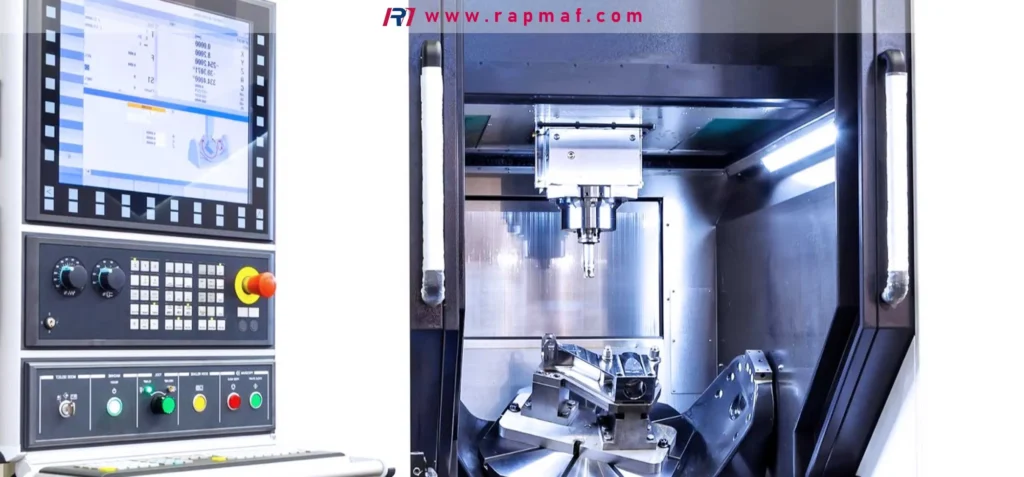
This is the modern brain of the operation. In the early days of automation, machines were controlled by pre-programmed tapes or cards. There was no “intelligence” at the machine itself. The “Computer” in CNC signifies the introduction of a dedicated, onboard processor. This was a monumental leap forward.
- Memory & Processing: The computer can store programs, tool information, and coordinate system data. It can process complex instructions on the fly.
- User Interface: It provides a screen and controls that allow a human operator to load programs, make adjustments (offsets), monitor the process, and intervene if necessary.
- Flexibility: A program can be easily edited right at the machine, a task that was impossible with old tape-driven systems.
The computer acts as the translator and the conductor, converting a digital program into the precise electrical signals that command the machine’s motors and systems.
The “N”: Numerical
This refers to the language the computer speaks and understands: the language of numbers. At its core, every physical object can be described by a series of numerical coordinates on a Cartesian plane (X, Y, and Z axes). CNC machining is the process of using numbers to guide a cutting tool to these exact coordinates.
This numerical language is called G-code. It’s a set of instructions that tells the machine:
- Where to go:
G01 X50.0 Y25.0 Z-2.0(Move in a straight line to these X, Y, and Z coordinates). - How fast to go:
F200(Move at a feed rate of 200 mm per minute). - How fast to spin the tool:
S10000(Set the spindle speed to 10,000 RPM). - What tool to use:
T01 M06(Select tool #1 and perform a tool change).
Every curve, every hole, and every flat surface on a finished part is the result of the machine flawlessly executing thousands of these numerical commands.
The “C”: Control
This is the final, physical action. The “Control” is the part of the system that takes the numerical instructions from the computer and converts them into precise, controlled motion. This involves a sophisticated system of high-tech components:
- Servo Motors: These are not simple motors. They have feedback sensors (encoders) that constantly report the exact position of the machine’s axes back to the computer.
- Ball Screws: These convert the rotary motion of the motors into extremely precise linear motion, moving the machine table or the cutting head.
- Controllers: The electronic hardware that sends power to the motors and reads the feedback, ensuring the machine is exactly where the numbers tell it to be, often with a precision of less than 0.001 inches (about 25 microns).
Put it all together, and Computer Numerical Control is a process where a computer uses a language of numbers to precisely control the physical movement of a machine tool, removing material to create a part with incredible accuracy and repeatability. It is the real-world bridge between a digital design and a physical object.
In the next part, we will explore the evolution from older systems like NC (Numerical Control), compare it to the modern CNC workflow, and present a real-world case study from RM showing how this technology is used to create mission-critical components.
The Dawn of Automation: NC (Numerical Control)
Before there was CNC, there was its revolutionary ancestor: NC, or Numerical Control. Developed in the late 1940s and 1950s, NC was the first major step in automating machine tools. It was a brilliant solution that, for the first time, allowed a machine to follow a pre-programmed path without constant human guidance.
The core concept was the same: use numbers to define a toolpath. However, the “computer” was missing. Instead of a processor and memory, NC machines relied on a physical, tangible medium to store and read the program: punched tape.
Imagine a long strip of paper or Mylar film. The program was encoded onto this tape by punching patterns of holes into it. Each set of holes across the tape represented a single character or command, forming the lines of code. To run the job, the operator would load this tape into a tape reader on the machine. The reader would shine a light through the holes or use mechanical pins to interpret the code, one line at a time, and send electrical signals to the machine’s motors.
The Limitations of NC were immense:
- No Memory: The machine had zero memory. It read one command, executed it, and then moved to the next. The entire tape had to be read from start to finish for every single part produced.
- Zero Editability: If a programmer made a single mistake in the code—a misplaced decimal point, a wrong coordinate—the entire tape was useless. They had to go back to the punching machine and create a completely new tape from scratch. Fine-tuning a program was a tedious and expensive process.
- Physical Degradation: The tapes were fragile. They could tear, get dirty, or the holes could become worn, leading to read errors and scrapped parts. The tape reader itself was a complex mechanical device prone to failure.
- Limited Complexity: Due to the difficulty of creating and verifying long tapes, NC programs were typically much simpler than modern CNC programs.
NC was a groundbreaking first step, but it was rigid, unforgiving, and cumbersome. It proved that automation was possible, but the industry needed a more intelligent and flexible solution.
The Revolution: From NC to CNC
The arrival of the microprocessor in the 1970s changed everything. By integrating a dedicated computer directly into the machine tool, NC evolved into CNC (Computer Numerical Control), and the limitations of punched tape were shattered overnight.
The onboard computer was the game-changer, introducing several revolutionary capabilities:
- Program Storage and Onboard Editing: The computer could store entire programs in its memory. A program could be loaded from a tape once (or later, from a floppy disk or network) and then run repeatedly from memory. More importantly, if an adjustment was needed, the operator could edit the G-code directly on the machine’s screen using a keyboard. This single feature increased productivity exponentially.
- Increased Complexity and Power: A computer could process complex mathematical functions that were impossible for a simple tape reader. This enabled advanced toolpaths like circular interpolation (cutting perfect arcs) and canned cycles (pre-programmed routines for common tasks like drilling holes).
- User-Friendly Interface: The operator now had a screen (a Cathode Ray Tube or CRT at the time) that displayed the program code, the machine’s position, tool information, and diagnostic messages. This interactive interface made setup and operation far easier and more intuitive.
- Digital Reliability: Replacing a fragile physical tape with a robust digital file eliminated a major source of errors and machine downtime.

NC vs. CNC: A Head-to-Head Comparison
The difference between NC and CNC represents one of the most significant leaps in manufacturing technology. Here’s a direct comparison of their core features:
| Feature | NC (Numerical Control) | CNC (Computer Numerical Control) |
|---|---|---|
| Control Unit | Mechanical/Electronic Tape Reader | Onboard Microprocessor/Computer |
| Program Storage | Physical Punched Tape | Digital Memory (Hard Drive, RAM, USB) |
| Editing Capability | None. A new tape must be punched. | On-the-fly editing directly at the machine’s control panel. |
| Operator Interface | Basic buttons, dials, and indicator lights. | Screen (CRT/LCD), keyboard, and graphical user interface. |
| Program Complexity | Low. Limited to simple point-to-point and linear paths. | High. Can handle complex curves, 3D surfaces, and subroutines. |
| Reliability | Low. Prone to tape wear, read errors, and mechanical failure. | High. Based on robust and reliable digital data transfer. |
In short, while NC provided the automation, CNC provided the intelligence and flexibility that truly unlocked its potential.
What About DNC? (Distributed Numerical Control)
Another term you might encounter is DNC (Distributed or Direct Numerical Control). It’s important to understand that DNC is not a type of machine control like NC or CNC. Instead, DNC is a networking solution.
A DNC system is a central computer connected to multiple CNC machines on a shop floor. Its purpose is to manage and distribute (“distribute”) CNC programs. Instead of an operator walking a USB stick from their computer to the machine, they can pull the required program directly from the central server via the network.

Think of it this way:
- CNC is the smart computer running a single machine.
- DNC is the local network that connects all the smart computers in the factory, allowing for centralized file management, version control, and production monitoring.
Real-World Case Study: CNC Machining an Aerospace Bracket at RM
To see why the leap from NC to CNC was so critical, let’s look at a common job on our shop floor at RM: machining a complex structural bracket for an aircraft from a solid block of titanium.
The Challenge: The bracket has a complex 3D shape with curved surfaces, multiple pockets, and dozens of precisely located holes. The tolerances are incredibly tight (often within ±0.0005 inches), and the material, titanium, is notoriously difficult to machine. A single mistake could scrap a part worth thousands of dollars.
Why NC Would Fail:
An NC machine would be completely impractical for this job. The punched tape required to define the complex 3D toolpaths would be hundreds or even thousands of feet long. Creating this tape without a single error would be nearly impossible. Furthermore, if a cutting tool wore slightly and the operator needed to make a tiny compensation adjustment (an “offset”), they would have to create a whole new tape. The process would be slow, unreliable, and prohibitively expensive.
The CNC Solution:
- CAM Programming: An engineer uses specialized CAM (Computer-Aided Manufacturing) software to design the toolpaths. The software simulates the entire process, generating tens of thousands of lines of optimized G-code.
- Program Transfer: This large digital file is transferred to the 5-axis CNC milling machine’s control in seconds, often over our internal DNC network.
- Interactive Setup: The machine operator uses the CNC’s interface and a digital probe to precisely locate the block of titanium. They input tool wear offsets directly into the control, compensating for tiny variations with a few keystrokes.
- Controlled Execution: The CNC’s powerful computer reads the complex program and executes it flawlessly. Its feedback-loop servo motors constantly adjust to maintain exact positioning, ensuring every curve and feature is machined to the required aerospace tolerance.
- Quality & Repeatability: The result is a perfect part. Because the program is a digital file, we can produce a hundred more brackets that are all physically identical to the first.
This bracket simply could not be manufactured economically or reliably without the intelligence, memory, and flexibility of CNC.
We have now defined CNC and placed it in its historical context. But what kinds of machines are actually controlled by this powerful system? In the final part, we will explore the main types of CNC machines—from mills and lathes to laser cutters and 3D printers—and answer common questions about this foundational manufacturing technology.
The CNC Family: A Tour of the Technology
While CNC is most famously associated with metal cutting, its principles of precise, automated motion are used to control a vast range of equipment. Here are the primary types you will encounter in a modern manufacturing environment.
CNC Milling Machines
This is the quintessential CNC machine and the one most people picture first.
- Core Function: A CNC mill uses a rotating cutting tool to selectively remove material from a stationary workpiece.
- Process: The workpiece is clamped to a table that can move in the X and Y axes, while the spindle (which holds the cutting tool) moves in the Z-axis. On more advanced 5-axis machines, the table and spindle can also tilt and rotate, allowing for the creation of incredibly complex 3D shapes without needing to re-clamp the part.
- Applications: Creating engine blocks, molds for injection molding, complex aerospace components, custom enclosures, and high-precision prototypes.
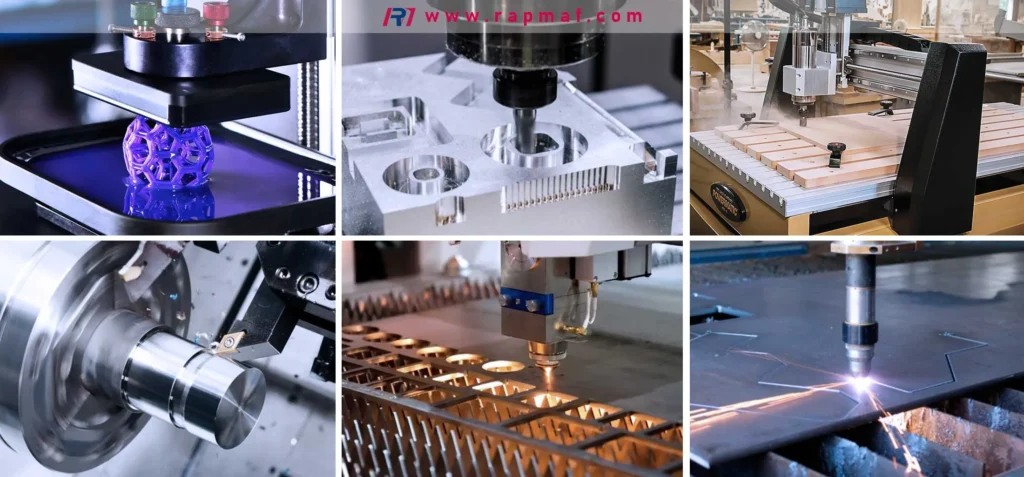
CNC Lathes (Turning Centers)
Where a mill moves the tool around a stationary part, a lathe does the opposite.
- Core Function: A CNC lathe rotates a workpiece at high speed while a stationary cutting tool removes material to create cylindrical, conical, and threaded features.
- Process: A cylindrical bar of material is held in a rotating chuck. The cutting tool, mounted on a turret, is programmed to move along the length (Z-axis) and across the diameter (X-axis) of the rotating part. Modern turning centers often have “live tooling,” where a tool in the turret can also spin, allowing for milling and drilling operations on the same machine.
- Applications: Producing shafts, axles, bolts, threaded fittings, nozzles, and any other part with rotational symmetry.
CNC Routers
A CNC router is conceptually similar to a mill but is typically built for a different class of materials.
- Core Function: A CNC router uses a rotating cutting tool to cut softer materials like wood, plastics, foam, and aluminum.
- Process: The setup is often a gantry-style system, where the spindle moves over a large, flat table. They are optimized for high-speed cutting over large surface areas rather than the high-force, high-precision cutting of hardened steel that a mill is designed for.
- Applications: Sign making, cabinet making, woodworking, cutting large sheets of plastic, and creating architectural models.
CNC Laser Cutters
Here, we move from physical contact to a high-energy beam.
- Core Function: A CNC laser cutter uses a highly focused beam of light to melt, burn, or vaporize material with extreme precision.
- Process: The CNC system controls the movement of the laser head over the material. The computer precisely modulates the laser’s power and travel speed to achieve a clean cut through a specific material thickness. There is no physical force exerted on the material, which is ideal for delicate work.
- Applications: Cutting intricate patterns in sheet metal, acrylic, and wood; engraving logos and serial numbers; cutting fabric in the textile industry.
CNC Plasma Cutters
Plasma cutters are the heavy-duty thermal cutting solution, ideal for thick metals.
- Core Function: A CNC plasma cutter uses a jet of superheated, electrically ionized gas (plasma) to slice through electrically conductive metals.
- Process: Similar to a laser cutter, a CNC gantry moves a plasma torch over a sheet of metal. The system creates an electrical arc that turns a gas (like compressed air or nitrogen) into plasma, which is hot enough to sever thick steel or aluminum plate with ease. While not as precise as a laser, it is much faster and more cost-effective for thick materials.
- Applications: Cutting large steel plates for ship building and structural fabrication, creating metal art, and profiling parts for heavy machinery.
3D Printers (Additive Manufacturing)
It may be surprising, but most 3D printers are fundamentally CNC machines.
- Core Function: Instead of removing material (subtractive), a 3D printer builds a part layer-by-layer from a digital file (additive).
- Process: The CNC system controls the precise movement of an extrusion head (for plastic), a laser (for sintering metal powder), or a print head (for jetting resin). The head follows a programmed path for each cross-section of the part, depositing or solidifying material until the final 3D object is complete.
- Applications: Rapid prototyping, creating complex and lightweight structures, custom medical implants, and low-volume production parts.
Beyond the Acronym: The Impact of CNC
Understanding that CNC stands for Computer Numerical Control is just the first step. The true meaning of CNC lies in its impact. It is the technology that took manufacturing from a manual art form, reliant on the skill of individual craftspeople, to a precise, repeatable, and accessible science.
CNC democratized precision. It allows a small design firm in one country to send a digital file to a machine shop like RM in another, and receive a physical part that is identical down to the thousandth of an inch. It is the backbone of the modern supply chain and the engine that enables the creation of everything from your smartphone to the satellites that provide its signal.
Frequently Asked Questions
What does CNC stand for in slang or relationships?
In a completely separate context, primarily on social media platforms like TikTok, in fan fiction, and in dark romance book communities, CNC stands for “Consensual Non-Consent.” This is a niche term used to describe a specific role-playing scenario in a relationship or story where one partner gives prior, enthusiastic consent to engage in a scene where they will “play” at not consenting. It is a form of fantasy play between trusting partners and is fundamentally built on a foundation of explicit, real-world consent and communication. This meaning has absolutely no connection to the manufacturing term.
What type of CNC is best for beginners?
For hobbyists looking to learn the principles of CNC, a CNC Router is often the most accessible starting point. They are less expensive, safer to operate, and work with more forgiving materials like wood and plastic. For those looking to enter the industrial trades, learning the basics of a CNC Lathe can be a great introduction to the core concepts of G-code, tool offsets, and metal cutting.
What’s the difference between CNC Machining and 3D Printing?
They are two sides of the CNC coin. CNC Machining is a subtractive process; it starts with a solid block of material and removes it to reveal the final part. 3D Printing is an additive process; it starts with nothing and builds the part from the ground up, layer by layer.
Is CNC hard to learn?
Learning CNC has two different paths. Learning to be a CNC Operator—loading parts, setting up tools, and running pre-written programs—can be learned in a matter of months with on-the-job training. Learning to be a CNC Programmer or Machinist—who creates the programs from scratch using CAM software and G-code, and understands the complex science of cutting speeds and feeds—is a highly skilled trade that takes years to master.
References
- Haas Automation, Inc. (2023). What is CNC Machining? (A comprehensive overview from one of the world’s leading manufacturers of CNC machine tools).
- National Institute of Standards and Technology (NIST). A Brief History of CNC Technology (An authoritative historical perspective from a primary US government standards agency).
Disclaimer
The information on this page is for informational purposes only. RM makes no representations or warranties, express or implied, as to the accuracy or completeness of this information. For any third-party services procured through the RM network, it is the buyer’s responsibility to specify and confirm performance parameters, tolerances, materials, and workmanship during the quotation process. For more detailed information, please do not hesitate to contact us.
RM: Your Precision Manufacturing Partner
RM is an industry leader in custom manufacturing solutions. With over 20 years of profound experience, we have become the trusted partner for more than 5,000 clients worldwide. We specialize in a comprehensive range of manufacturing services—including high-precision CNC machining, sheet metal fabrication, 3D printing, injection molding, and metal stamping—to provide you with a true one-stop-shop experience.
Our world-class facility is equipped with over 100 state-of-the-art 5-axis machining centers and operates in strict compliance with the ISO 9001:2015 quality management system. We are dedicated to providing solutions that blend speed, efficiency, and exceptional quality to customers in over 150 countries. From rapid prototyping to large-scale production, we promise delivery in as fast as 24 hours, helping you gain a competitive edge in the market. Choosing RM means selecting an efficient, reliable, and professional manufacturing ally.
Explore our capabilities today by visiting our website: www.rapmaf.com







3 Responses