



About the Author
My name is Clive, and I’m a lead manufacturing engineer here at RM. For over 15 years, I’ve been on the front lines of taking designs from a computer screen to a physical reality. I’ve seen technologies come and go, but nothing has revolutionized our work more than Additive Manufacturing (AM). The problem is, “AM” or “3D Printing” isn’t one single thing. It’s a family of seven distinct, official technologies, each with its own language, materials, and superpowers. Choosing the wrong one is like trying to build a skyscraper with wood screws—it’s a recipe for disaster. This guide will make you fluent in the language of AM, so you can make the right call, every time.
Our Expertise at RM
At RM, we aren’t just a vendor; we are a full-stack manufacturing partner. Our facility houses not only traditional CNC mills and lathes but also a state-of-the-art additive manufacturing lab featuring multiple AM technologies. We don’t just print parts; we consult with our clients to select the optimal process for their specific application, whether it’s a rapid prototype, a complex aerospace component, or a custom medical implant. This guide is built from thousands of hours of hands-on experience, successes, and hard-won lessons.
First, What is Additive Manufacturing? (The Official Definition)
Before we can talk about the seven types, we need a rock-solid definition.
Additive Manufacturing (AM) is the official industry-standard term for any process that builds a three-dimensional object by adding material layer-upon-layer from a digital file.
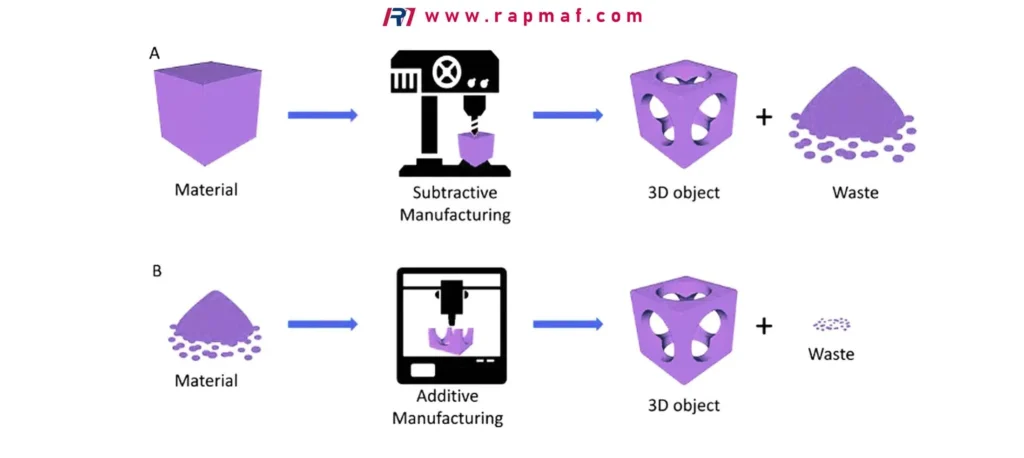
Think of it like this:
- Subtractive Manufacturing (Traditional): You start with a solid block of metal or plastic and carve away everything you don’t want, like a sculptor carving a statue from marble. This is how a CNC mill works.
- Additive Manufacturing (3D Printing): You start with nothing and build up only what you need, layer by layer, like building a complex structure with Lego bricks.
This fundamental difference is why AM can create incredibly complex geometries, hollow parts, and internal lattice structures that are physically impossible to make with traditional methods.
The “Official” 7 Types: The ASTM/ISO 52900 Standard
So, where do these seven types come from? They aren’t just arbitrary categories. They are defined by the ASTM F42 / ISO 52900 standard, which is the global gold standard for classifying AM processes. Any serious manufacturer or engineer operates by this standard.
Knowing these seven categories is like knowing the difference between a screwdriver, a wrench, and a hammer. They are all tools, but you can’t use them interchangeably. Let’s break them down, starting with the most common.
Type 1: Material Extrusion (The Workhorse of Prototyping)
What it is: This is the process most people picture when they hear “3D printing.” A thermoplastic filament (a spool of plastic wire) is heated until it’s molten and then extruded through a small nozzle, drawing the shape of an object one layer at a time. The layers cool and fuse together to form a solid part.
Clive’s Analogy: Imagine a highly precise, computer-controlled hot glue gun building an object from the ground up.
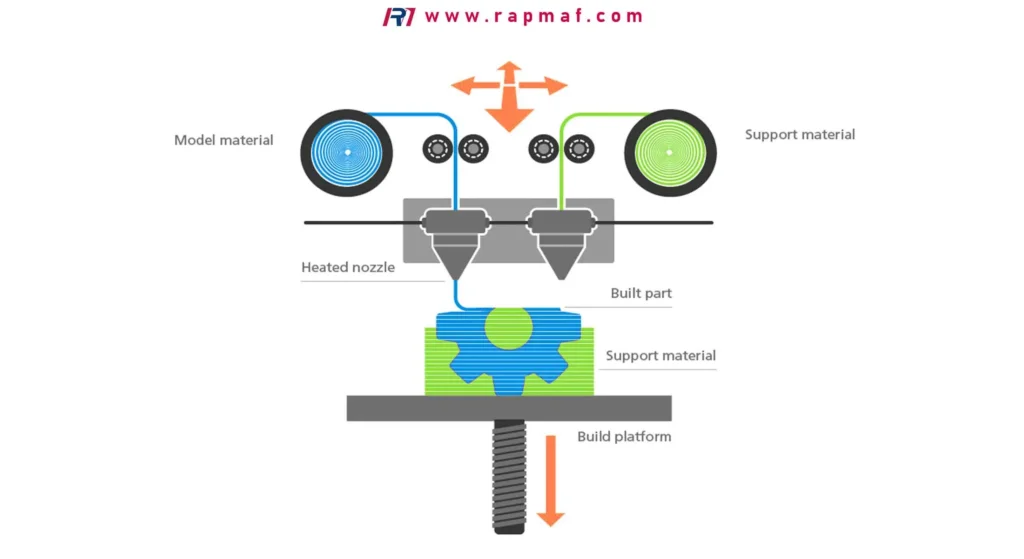
Common Acronyms:
- FDM (Fused Deposition Modeling): This is the trademarked term by Stratasys, the company that invented it.
- FFF (Fused Filament Fabrication): The open-source term for the same process.
Typical Materials:
- PLA (Polylactic Acid): Easy to print, brittle, good for visual models.
- ABS (Acrylonitrile Butadiene Styrene): Stronger, more durable (Lego is made from ABS).
- PETG (Polyethylene Terephthalate Glycol): A good middle ground, food-safe, durable.
- High-Performance Polymers: PEEK, Ultem (for aerospace and medical).
Key Strengths:
- Low Cost: The cheapest and most accessible form of AM.
- Speed: Excellent for producing early-stage prototypes quickly.
- Material Variety: A massive range of plastics with different properties is available.
Key Weaknesses:
- Visible Layer Lines: The surface finish is not smooth.
- Anisotropic Strength: The parts are weaker between the layers (on the Z-axis) than they are along the layers (X-Y plane).
Primary Use Case: Rapid prototyping, manufacturing jigs and fixtures, hobbyist models.
Type 2: Vat Photopolymerization (The Master of Detail)
What it is: This process uses a vat (or tank) of liquid photopolymer resin. A UV light source (either a laser or a digital projector) selectively hardens the resin layer-by-layer. After a layer is cured, the build platform moves slightly to allow a new layer of liquid resin to flow in, and the process repeats.
Clive’s Analogy: It’s like an object is being magically pulled out of a pool of liquid, solidifying as it emerges.
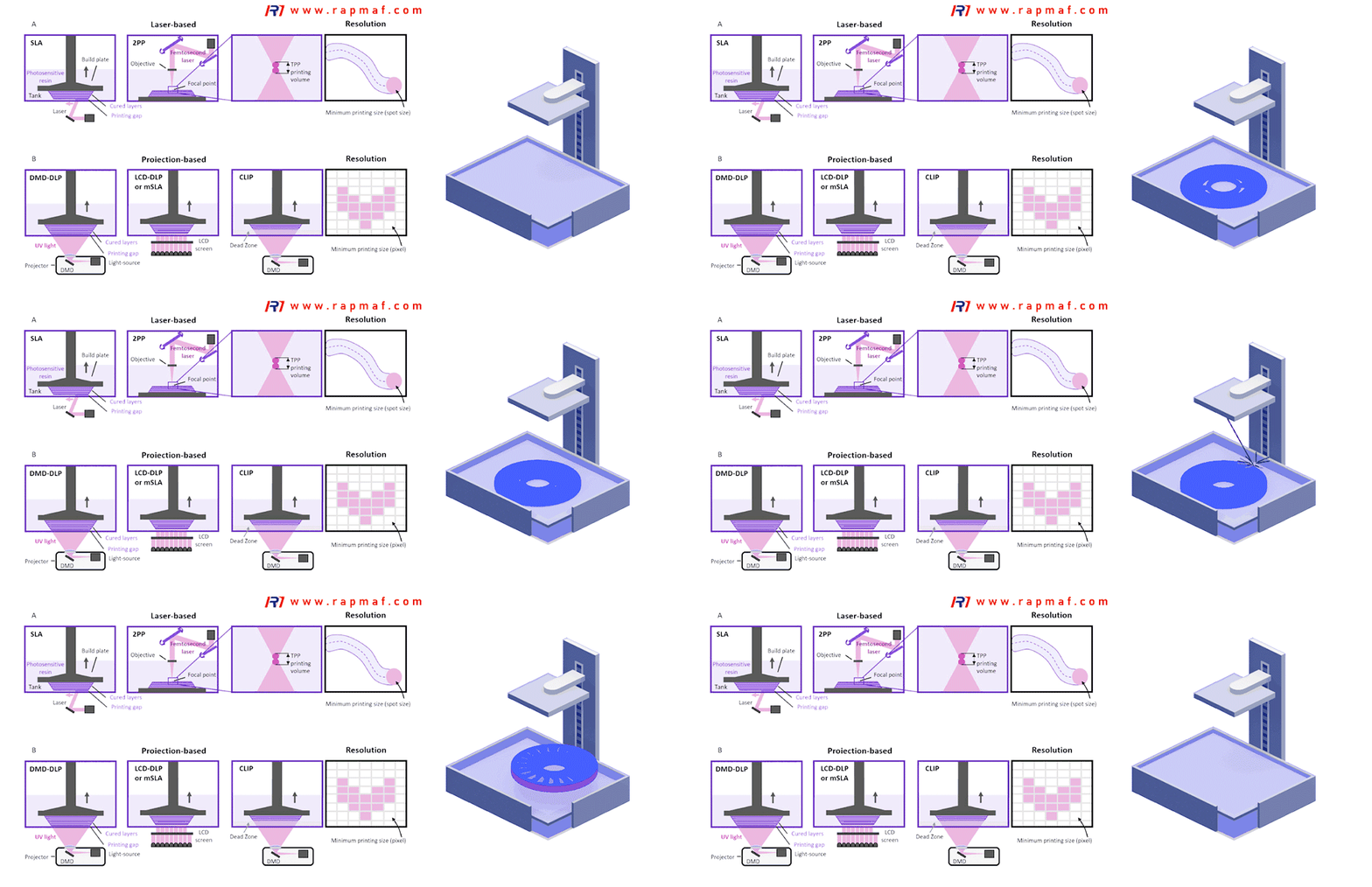
Common Acronyms:
- SLA (Stereolithography): Uses a UV laser to trace the shape of the layer.
- DLP (Digital Light Processing): Uses a digital projector to flash an image of the entire layer at once, making it faster than SLA.
Typical Materials:
- Standard Resins: For general-purpose prototyping.
- Tough/Durable Resins: Mimic the properties of ABS or Polypropylene.
- Castable Resins: Used to create molds for jewelry and dental applications (they burn out cleanly).
- Biocompatible Resins: For medical and dental devices.
Key Strengths:
- Incredible Detail: Can produce parts with extremely fine features and a very smooth surface finish, right out of the printer.
- Isotropic Properties: Parts are generally strong in all directions.
Key Weaknesses:
- Material Properties: The resins can be brittle and degrade with prolonged UV exposure.
- Messy Post-Processing: Parts need to be washed in a solvent and then post-cured in a UV chamber.
Primary Use Case: High-fidelity prototypes, dental and jewelry molds, miniature figures, and any application where fine detail is paramount.
Type 3: Powder Bed Fusion (The Industrial Powerhouse)
What it is: This is where Additive Manufacturing gets really serious. Powder Bed Fusion (PBF) works by spreading a very thin layer of fine powder (either polymer or metal) across a build platform. A high-powered energy source—typically a laser or an electron beam—then selectively melts or sinters the powder particles together, tracing the shape of the part’s cross-section. The platform then lowers, a new layer of powder is spread, and the process repeats until the entire part is encased in a solid block of unsintered powder.
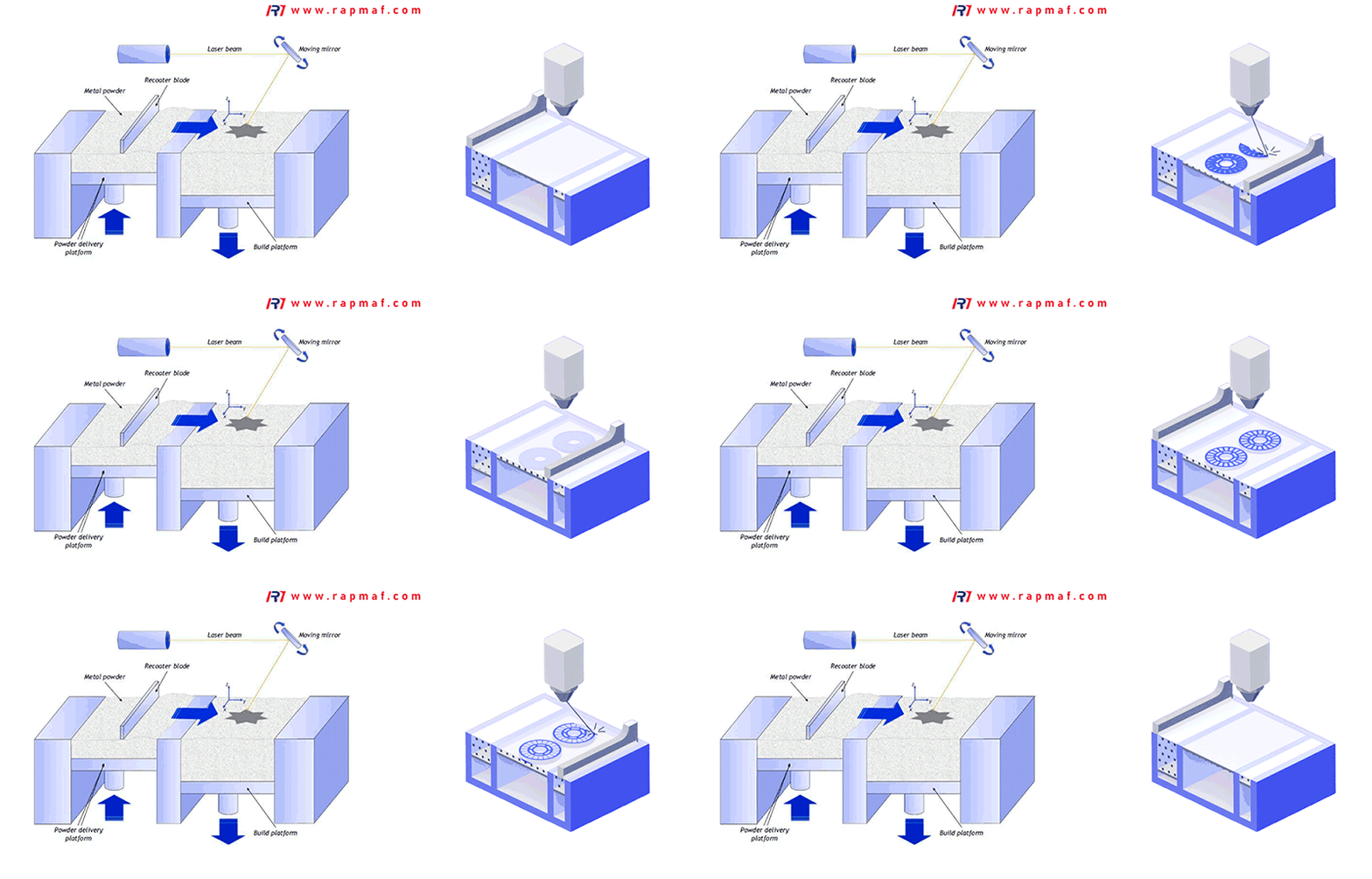
Clive’s Analogy: It’s like drawing a shape on a bed of sand with a magnifying glass and the sun, fusing the sand grains together. Then you add another thin layer of sand and repeat, building your object up inside the sandbox.
PBF is a broad category with several critical sub-types you MUST know:
- SLS (Selective Laser Sintering): This is for polymers. A CO2 laser heats thermoplastic powder (like Nylon) to the point where the particles fuse together. A huge advantage of SLS is that the surrounding unsintered powder acts as a natural support structure, allowing for incredibly complex, free-floating geometries without the need for dedicated support structures.
- DMLS (Direct Metal Laser Sintering) & SLM (Selective Laser Melting): These are for metals. A high-powered fiber laser is used to completely melt fine metal powder (like stainless steel, aluminum, or titanium). While often used interchangeably, SLM fully melts the powder into a liquid, while DMLS sinters it at a molecular level. The end result is a fully dense, solid metal part. Unlike SLS, metal PBF processes require extensive support structures to anchor the part to the build plate and manage thermal stresses.
- EBM (Electron Beam Melting): Also for metals, but instead of a laser, it uses a powerful electron beam in a vacuum. It operates at higher temperatures, which helps to relieve internal stresses, making it ideal for high-performance materials like titanium alloys used in aerospace and medical implants.
Typical Materials:
- Polymers (SLS): Nylon (PA11, PA12), TPU (a flexible, rubber-like material).
- Metals (DMLS/SLM/EBM): Aluminum, Stainless Steel, Titanium, Inconel (a superalloy), Cobalt Chrome.
Key Strengths:
- Excellent Mechanical Properties: Produces strong, functional parts suitable for end-use applications. Metal parts can rival or even exceed the strength of cast parts.
- Design Freedom: The ability to create complex internal channels, lattice structures, and consolidated assemblies is unmatched.
- Material Variety: A wide range of robust engineering polymers and metals are available.
Key Weaknesses:
- Extremely High Cost: The machines, materials, and required post-processing make this one of the most expensive AM processes.
- Extensive Post-Processing: Parts must be excavated from the powder cake, de-powdered (often with bead blasting), and for metals, heat-treated (stress relief) and removed from the build plate. Surface finishing is often required.
- Slower Build Speeds: The layer-by-layer process can be time-consuming.
Primary Use Case: Functional prototypes, complex end-use parts, medical implants, aerospace components, conformal cooling channels in injection molds.
Type 4: Binder Jetting (The Master of Speed and Scale)
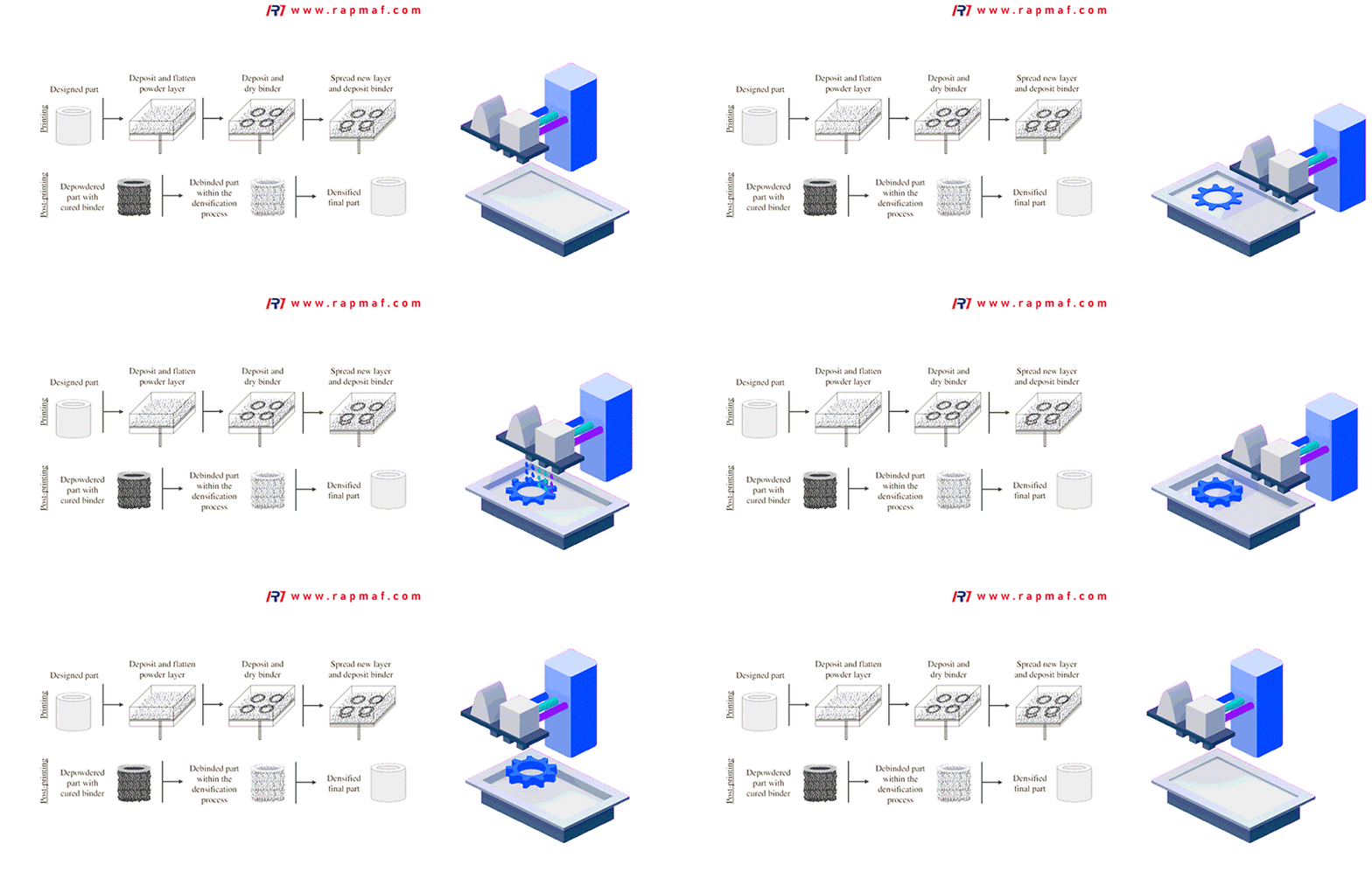
What it is: Binder Jetting operates similarly to PBF in that it uses a bed of powder. However, instead of using a laser or electron beam to fuse the powder, it uses an industrial printhead (much like a standard 2D inkjet printer) to selectively deposit a liquid binding agent (a “glue”) onto the powder, sticking the particles together. Layer by layer, the object is formed from powder held together by this binder.
Clive’s Analogy: Imagine a 2D inkjet printer, but instead of printing with ink on paper, it’s printing with glue onto a bed of fine dust, one layer at a time.
Typical Materials:
- Sand: Used to create large, complex molds and cores for the metal casting industry.
- Metals: Stainless Steel, Inconel. The parts produced are in a fragile “green state” and must be put through a secondary process.
- Gypsum: Used to produce full-color, photorealistic models and architectural mockups.
Key Strengths:
- Speed & Scalability: Binder Jetting is one of the fastest AM technologies, as the printhead can deposit binder much faster than a laser can trace a path. This makes it ideal for mass production.
- No Support Structures: Like SLS, the surrounding powder supports the part.
- Low Cost (for the “green part”): The initial printing process is relatively inexpensive compared to PBF.
Key Weaknesses:
- Required Post-Processing for Metals: This is the critical tradeoff. Metal parts come out of the printer in a fragile “green state.” They must then be cured and placed in a high-temperature furnace to sinter the metal particles together, which shrinks the part. Often, they are then infiltrated with another metal (like bronze) to achieve full density. This multi-step process adds time, cost, and complexity.
- Lower Mechanical Properties: Even after post-processing, binder-jetted metal parts typically don’t have the same density or strength as PBF parts.
Primary Use Case: Sand casting molds for foundries, low-cost metal parts for mass production, full-color architectural and product models.
Real-World Case Study: Choosing the Right AM Process
To make this tangible, let me walk you through a recent project here at RM.
The Client: An aerospace startup designing a next-generation drone.
The Challenge: They needed a custom mounting bracket for a specialized sensor. The bracket had to be incredibly lightweight but also strong and stiff enough to withstand high-vibration flight conditions. Their initial design, meant for CNC machining, was too heavy and bulky.
Our Analysis & Process Selection: This was a perfect application for an “AM-first” mindset. Here’s how we evaluated the options based on the seven types:
- Initial Prototype (Geometry & Fit Check):
- Our Choice: Type 1 – Material Extrusion (FDM).
- Why: We needed to verify the bracket’s fit and mounting points on the actual drone frame. We printed a version in PETG in just a few hours for under $50. The client could physically hold it, test the fit, and make minor design tweaks. The part had no functional strength, but for this stage, it didn’t need it.
- Evaluating for the Final, Flight-Ready Part:
- Option A: Type 2 – Vat Photopolymerization (SLA): Immediately rejected. While the detail would be excellent, the standard resins are too brittle and would likely fail under vibration.
- Option B: Type 3 – Powder Bed Fusion (DMLS): We identified this as the strongest contender. We advised the client to redesign the bracket using topology optimization software—an AI tool that removes material from non-critical areas, creating an organic, skeleton-like structure that is optimized for strength-to-weight. This design would be impossible to machine. We could print it in Titanium (Ti64), which is the gold standard for aerospace applications.
- Option C: Type 4 – Binder Jetting (Metal): We considered this but rejected it for this specific application. The multi-step post-processing and the resulting lower part density did not meet the stringent reliability and certification requirements of the aerospace industry.
The Solution:
The client approved the topology-optimized design. We produced the final bracket using Type 3: DMLS with Titanium powder. The final part was 45% lighter than the original machined design but 20% stiffer. It passed all vibration and load testing, giving the client a competitive advantage through superior engineering that was only possible with the correct application of Additive Manufacturing.
Type 5: Directed Energy Deposition (The Repair & Reinforce Pro)
What it is: Directed Energy Deposition (DED) is a process where a focused thermal energy source (usually a laser or electron beam) is used to melt material as it is being deposited. Think of it less like a printer and more like a highly precise, robotic welding arm. The material, in either wire or powder form, is fed through a nozzle and melted at the point of deposition, fusing it to the underlying surface or previous layer. The process is often performed inside a hermetically sealed chamber but can also be done in open air with shielding gas.
Clive’s Analogy: It’s like using a hot glue gun that shoots out molten metal instead of glue. You can use it to build an object from scratch, but it’s also fantastic for adding material onto an existing part or repairing a crack.
Typical Materials:
- Metals: A wide range, including Titanium alloys, Inconel, stainless steel, and various tool steels. The ability to use wire feedstock makes material handling much cleaner and more efficient than powder.
Key Strengths:
- Large Part Capability: Because it’s not confined to a powder bed, DED can be used to create very large structures, often limited only by the reach of the robotic arm.
- High Deposition Rate: It can lay down material much faster than PBF, making it suitable for large-volume parts.
- Repair & Feature Addition: Its unique strength is the ability to add material to an existing part, making it invaluable for repairing high-value components like turbine blades or aerospace structural elements.
- Hybrid Manufacturing: DED nozzles can be integrated into CNC machines to create “hybrid” systems that can both add material and machine it in the same setup.
Key Weaknesses:
- Low Resolution & Poor Surface Finish: The process produces parts with a very rough, weld-bead-like surface that requires significant post-process machining to achieve final dimensions and a smooth finish.
- High Cost: DED systems are complex and expensive pieces of industrial machinery.
- Thermal Stresses: The high heat input can create significant internal stresses in the part, requiring careful process control and post-process heat treatment.
Primary Use Case: Repairing high-value metal components, adding features to existing parts, creating large but non-complex metal structures.
Type 6: Material Jetting (The Hyper-Realistic Prototyper)
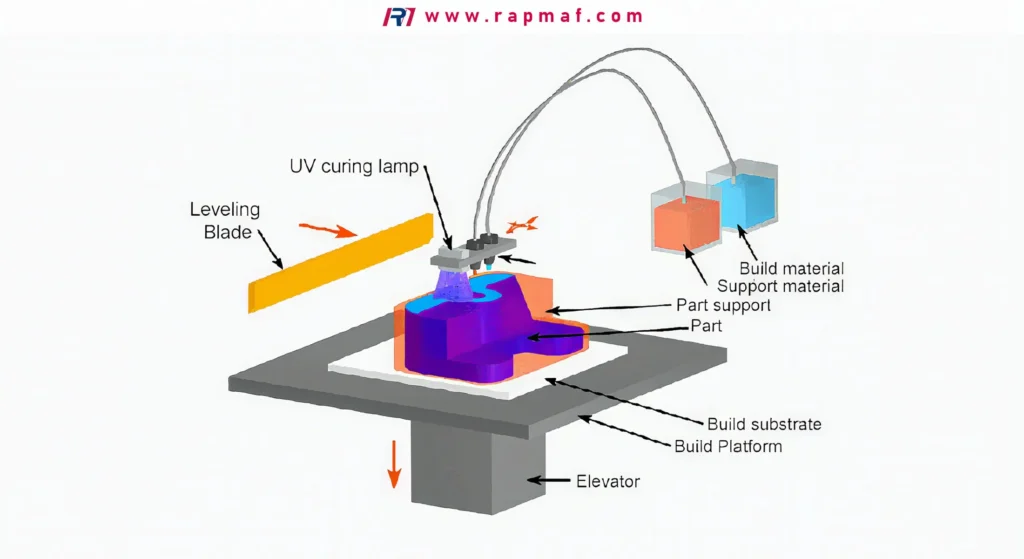
What it is: Material Jetting works by depositing tiny droplets of a photopolymer (a liquid plastic that cures under UV light) from hundreds of tiny nozzles on a printhead. It operates much like a standard 2D inkjet printer, but instead of ink on paper, it builds up an object layer by layer. After each layer of droplets is deposited, a UV light source passes over it, instantly curing and solidifying the material.
Clive’s Analogy: It’s the ultimate 3D inkjet printer. Imagine it printing a full-color photo, but it keeps printing on top of the same sheet of paper, layer after tiny layer, until the photo becomes a solid, 3D object.
Typical Materials:
- Photopolymers: A huge range of acrylic-based resins that can be mixed on the fly to produce a spectrum of colors, durometers (hardness levels), and opacities. This allows for parts that are rigid, rubber-like, transparent, and multi-colored all in one print.
Key Strengths:
- Incredible Realism & Detail: Material Jetting produces the most realistic parts of any AM process, with ultra-smooth surfaces, sharp edges, and the ability to print in millions of colors.
- Multi-Material & Multi-Color: Its standout feature is the ability to combine different materials and colors in a single print, creating complex prototypes that look and feel exactly like the final product.
- High Accuracy: The layer heights are incredibly small, resulting in dimensionally accurate parts straight off the printer.
Key Weaknesses:
- Brittle Parts: The acrylic-based materials are generally not suitable for functional or load-bearing applications. They are for visual and haptic prototyping, not performance testing.
- High Material Cost: The proprietary photopolymer resins are among the most expensive AM materials.
- UV Sensitivity: The parts can become more brittle and change color over time with prolonged exposure to sunlight.
Primary Use Case: Hyper-realistic product prototypes for marketing and design reviews, medical models for surgical planning, visual aids, and tooling for injection mold simulation.
Type 7: Sheet Lamination (The Niche Specialist)
What it is: This is a less common but still important process family. Sheet Lamination builds objects by stacking and bonding thin sheets of material together. There are two main methods:
- Laminated Object Manufacturing (LOM): Layers of adhesive-coated material (like paper, plastic, or composites) are rolled into position, and a laser or knife cuts the outline of the part. The excess material is cross-hatched for easy removal later. The process repeats, with the heat and pressure of the roller bonding the new layer to the one below it.
- Ultrasonic Additive Manufacturing (UAM): This is for metals. Thin sheets or foils of metal are bonded together using ultrasonic sound waves and pressure, without significant heat or melting. A CNC milling head is often integrated into the system to machine fine details into the part as it’s being built.
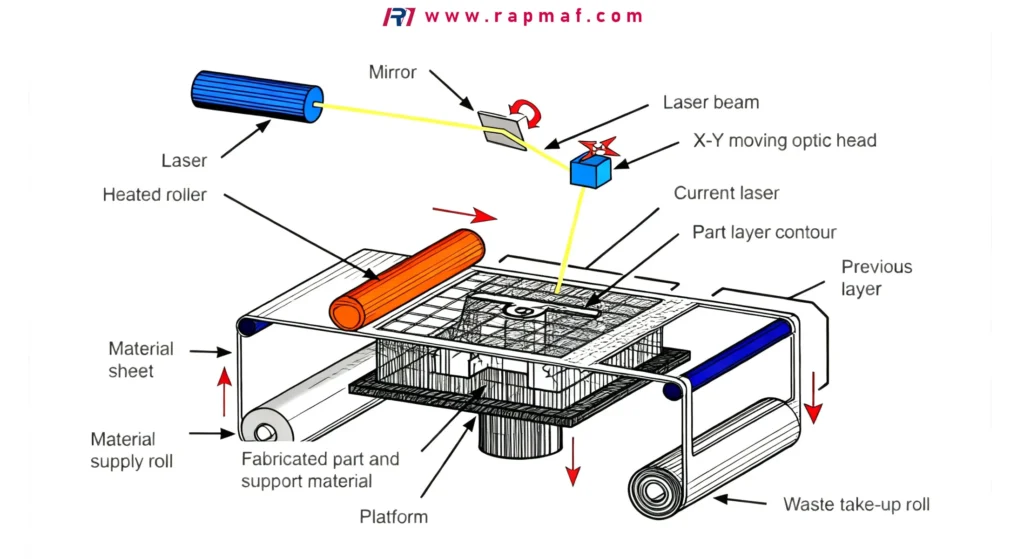
Clive’s Analogy: For LOM, think of it as creating a topographical map. You cut the shape of each elevation line out of a sheet of cardboard, then you stack and glue all the sheets together to form a 3D mountain.
Typical Materials:
- LOM: Paper, composites, plastics.
- UAM: Aluminum, copper, stainless steel, titanium.
Key Strengths:
- Speed & Low Cost (LOM): The process can be very fast and inexpensive, especially for large models.
- Unique Material Combinations (UAM): UAM can bond dissimilar metals, making it possible to embed sensors or create unique material properties within a solid metal part.
- No Melting (UAM): The solid-state bonding process avoids the thermal stresses and material property changes associated with melting.
Key Weaknesses:
- Wasteful: A significant amount of material is left over as a cross-hatched block that must be removed.
- Limited Geometric Complexity: It’s difficult to create complex internal features or hollow parts.
- Delamination Risk: Parts can be weaker along the layer lines and may be prone to splitting.
Primary Use Case: Large-scale concept models, architectural mockups (LOM), and specialized industrial applications requiring embedded electronics or dissimilar metal bonding (UAM).
Conclusion: A Toolbox, Not a Competition
After breaking down all seven official types of Additive Manufacturing, the most important lesson is this: there is no single “best” type.
Thinking of these seven processes as a competition is a rookie mistake. A true manufacturing professional sees them as a toolbox. You wouldn’t use a sledgehammer to hang a picture frame, and you wouldn’t use a finishing nail to break up concrete.
- Need a quick, cheap fit check? FDM (Material Extrusion) is your tool.
- Need a hyper-realistic marketing prototype? Material Jetting is your tool.
- Need a flight-ready, lightweighted titanium bracket? DMLS (Powder Bed Fusion) is your tool.
- Need to produce 10,000 complex sand cores for a foundry? Binder Jetting is your tool.
The future of engineering isn’t about picking one winner. It’s about understanding the specific strengths and weaknesses of each process and applying the right tool to the right job. Navigating this complex landscape requires experience, deep material knowledge, and a realistic understanding of the costs and post-processing involved. That’s where a manufacturing partner becomes invaluable—not just to make the part, but to help you choose the right way to make it in the first place.
Clive, Lead Engineer, RM Manufacturing
With 35 years of hands-on experience, I’ve seen technologies come and go. Additive Manufacturing is here to stay, but its power is only unlocked when you move past the hype and into the practical application. At RM Manufacturing, we combine decades of traditional machining wisdom with cutting-edge AM capabilities to deliver parts that are not just possible, but practical, repeatable, and cost-effective.
Frequently Asked Questions (FAQs)
1. What are the 7 main types of 3D printing?
The seven official types of Additive Manufacturing, as standardized by ISO/ASTM, are: 1. Material Extrusion (FDM), 2. Vat Photopolymerization (SLA, DLP), 3. Powder Bed Fusion (SLS, DMLS, SLM), 4. Binder Jetting, 5. Directed Energy Deposition (DED), 6. Material Jetting, and 7. Sheet Lamination.
2. What is the most common type of additive manufacturing?
For consumers and hobbyists, Material Extrusion (FDM) is by far the most common due to its low cost and simplicity. In industrial settings, Powder Bed Fusion (especially SLS for polymers and DMLS for metals) is one of the most widely used technologies for producing high-strength, functional parts.
3. Is additive manufacturing the same as 3D printing?
Yes, the terms are often used interchangeably. “3D Printing” is the more popular and widely understood term, while “Additive Manufacturing” (AM) is the more formal, industrial term that emphasizes its use as a viable manufacturing process, not just for prototyping.
4. What are the main disadvantages of additive manufacturing?
The main disadvantages generally include high equipment and material costs, often slower production speeds for single parts compared to traditional methods, limitations on part size, and the frequent need for extensive post-processing (like support removal, heat treatment, or surface finishing) to achieve the desired properties and tolerances.
5. Which AM process is best for metal parts?
It depends on the application. For high-detail, high-strength parts, Powder Bed Fusion (DMLS, SLM, EBM) is the top choice. For very large parts or repairs, Directed Energy Deposition (DED) is better. For higher volume, less critical metal parts, Binder Jetting can be the most cost-effective.
6. Which AM process creates the strongest parts?
Generally, metal AM processes produce the strongest parts. Powder Bed Fusion (DMLS, SLM, EBM) and Directed Energy Deposition (DED) can produce fully dense metal parts with mechanical properties that can meet or even exceed those of cast or forged materials, especially with advanced alloys like titanium and nickel superalloys.
7. How do you choose the right additive manufacturing process?
You must first define your project’s key requirements: What are the mechanical needs (strength, flexibility)? What material is required? What level of detail and surface finish is necessary? What is your budget? How many parts do you need? Answering these questions, as shown in our case study, will quickly narrow down the 7 types to the one or two that are the best fit for your job.
8. What are the 8 steps in additive manufacturing?
The general workflow for most AM processes can be broken down into 8 steps: 1. CAD Design: Create a 3D model. 2. STL Export: Convert the model to a standard 3D printing file format. 3. Slicing: Use software to slice the model into thin layers and generate machine code. 4. Machine Setup: Load material and prepare the printer. 5. The Build: The machine builds the part layer by layer. 6. Part Removal: The finished part is removed from the machine. 7. Post-Processing: Support removal, cleaning, curing, or finishing. 8. Inspection: The part is verified for accuracy and quality.
References
- ISO/ASTM 52900:2021, Additive manufacturing — General principles — Fundamentals and vocabulary: The international standard that officially defines the seven process categories and establishes the terminology for the AM industry.
- NASA, “Additive Manufacturing: An Overview”: A resource from the National Aeronautics and Space Administration detailing their use and development of AM technologies for mission-critical space applications.
- Wohlers Report, “3D Printing and Additive Manufacturing State of the Industry”: While a paid report, it is widely considered the most authoritative annual analysis of the AM industry, providing data on growth, trends, and technology adoption.
Disclaimer
The information on this page is for informational purposes only. RM makes no representations or warranties, express or implied, as to the accuracy or completeness of this information. For any third-party services procured through the RM network, it is the buyer’s responsibility to specify and confirm performance parameters, tolerances, materials, and workmanship during the quotation process. For more detailed information, please do not hesitate to contact us.
RM: Your Precision Manufacturing Partner
RM is an industry leader in custom manufacturing solutions. With over 20 years of profound experience, we have become the trusted partner for more than 5,000 clients worldwide. We specialize in a comprehensive range of manufacturing services—including high-precision CNC machining, sheet metal fabrication, 3D printing, injection molding, and metal stamping—to provide you with a true one-stop-shop experience.
Our world-class facility is equipped with over 100 state-of-the-art 5-axis machining centers and operates in strict compliance with the ISO 9001:2015 quality management system. We are dedicated to providing solutions that blend speed, efficiency, and exceptional quality to customers in over 150 countries. From rapid prototyping to large-scale production, we promise delivery in as fast as 24 hours, helping you gain a competitive edge in the market. Choosing RM means selecting an efficient, reliable, and professional manufacturing ally.
Explore our capabilities today by visiting our website: www.rapmaf.com







4 Responses