



The first time I stood in a real machine shop, the smell hit me first—a sharp, clean, metallic scent of cutting fluid and hot steel that sticks with you forever. My mentor, a grizzled old machinist named Frank, handed me a solid, six-inch cube of 6061 aluminum. It was heavy, perfectly square, and utterly useless.
“Your job,” he said, his voice a low rumble over the whine of a distant lathe, “is to turn this block of metal into that.” He pointed to a complex bracket sitting on the workbench, a component for a pneumatic press with interlocking features, precise holes, and a smooth, satin finish. “This block is a block of potential. It’s your job to remove everything that isn’t the part. That’s all machining is. It’s not about adding; it’s about taking away. It’s sculpture, but with tolerances measured in the thousandths of an inch.”
That single idea has been the foundation of my 25-year career. Machining isn’t about creating something from nothing, like 3D printing. It is the art and science of subtractive manufacturing: the controlled removal of material to reveal a desired shape. Every process, from the simplest hole drilled in a piece of wood to the most complex 5-axis milling of a turbine blade, is just a different method of carving away the excess. And at the heart of this entire universe of processes are three fundamental pillars—three core methods that account for the vast majority of all machined parts in the world. They are the father, son, and holy ghost of the machine shop: Turning, Milling, and Drilling.
| Machining Process | Core Principle | Primary Machine | Common Products |
|---|---|---|---|
| Turning | The workpiece rotates while a stationary cutting tool removes material. | Lathe | Shafts, pins, bolts, pulleys, nozzles, anything cylindrical. |
| Milling | The cutting tool rotates while the workpiece is held stationary. | Milling Machine (Mill) | Engine blocks, brackets, molds, flat surfaces, pockets, slots. |
| Drilling | A rotating cutting tool moves axially into a stationary workpiece to create a round hole. | Drill Press, Mill, Lathe | Holes for fasteners, fluid passages, weight reduction. |
| Grinding | An abrasive wheel rotates at high speed to remove microscopic amounts of material. | Grinder | Bearing races, gauge blocks, ultra-precise shafts. |
| Sawing | A toothed blade moves in a linear motion to cut a narrow slit in the workpiece. | Bandsaw, Cold Saw | Cutting raw material to length, creating rough blanks. |
| Broaching | A toothed tool is pushed or pulled through a hole or over a surface to create a specific shape. | Broaching Machine | Internal keyways, splines, gear teeth. |
| EDM (Electrical Discharge Machining) | Material is removed by a series of controlled electrical sparks between an electrode and the workpiece. | EDM Machine | Complex molds, cutting hardened steel, removing broken taps. |
What is the Fundamental Principle of Machining?
Before we can understand the different types of machining, we must grasp the one concept that unites them all. At its core, machining is the process of using a cutting tool to create a chip. That tiny sliver of metal, whether it’s a long, curling blue ribbon coming off a lathe or a fine powder from a grinder, is the fundamental unit of material removal.
The entire science of machining—from tool geometry and material science to speeds and feeds—is dedicated to creating this chip as efficiently and precisely as possible. The process works by forcing a cutting tool, which is harder than the material being cut, into the workpiece. This creates immense localized stress, causing the material to shear away in the form of a chip.
This is the opposite of additive manufacturing (like 3D printing), which builds parts layer by layer, or formative manufacturing (like forging or stamping), which reshapes material without removing it. Machining is uniquely subtractive. You start with more material than you need and methodically cut it away. This process is prized for its ability to produce parts with incredible accuracy, excellent surface finishes, and superior material properties, as it works with a solid, homogenous block of metal rather than a fused collection of powders or filaments. Frank was right: it’s sculpture, governed by the laws of physics.
What is Turning and Why is it Essential?
Imagine a potter at a spinning wheel. Their hands are the stationary tool, and the spinning clay is the workpiece. This is the essence of turning. It is a machining process used to create cylindrical or conical parts by rotating a workpiece against a single-point cutting tool. The machine that performs this operation is the undisputed king of the machine shop: the lathe.
In a lathe, the workpiece is held securely in a rotating chuck and spun at high speed. The cutting tool is mounted on a rigid tool post, which is moved linearly by the machinist (or a computer in a CNC lathe).
- When the tool moves parallel to the axis of rotation, it creates a constant diameter, a process called “turning.”
- When the tool moves perpendicular to the axis of rotation, it creates a flat face on the end of the part, a process called “facing.”
- By moving the tool at an angle, you can create tapers or chamfers. By using specially shaped tools, you can cut grooves, threads, and complex profiles.
What Kinds of Parts Are Made by Turning?
Turning is the go-to process for any part that is fundamentally round. The world is full of them:
- Shafts and Axles: The rotating components that transmit power in everything from a car engine to a wind turbine.
- Pins and Dowels: Used for locating and aligning components with high precision.
- Bolts and Screws: The threads on a fastener are a classic turning operation.
- Pulleys and Flanges: Grooved wheels for belts and flat discs for connecting pipes.
- Nozzles and Fittings: Conical and threaded parts for controlling fluid flow.
The lathe is one of the oldest machine tools, and its principle is simple but incredibly powerful. It is the primary way the world creates parts that spin.
What is Milling and How Does it Differ from Turning?
If turning is the potter’s wheel, milling is the sculptor’s chisel. In milling, the roles are reversed: the cutting tool rotates, while the workpiece is held stationary on a movable table. The machine used is a milling machine, often called a “mill.
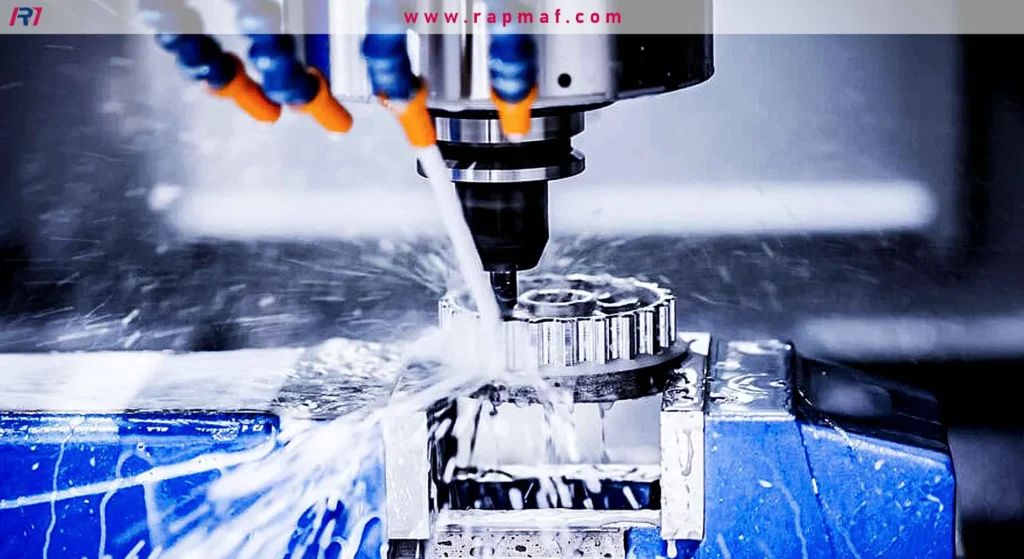
The cutting tool, known as an end mill or face mill, typically has multiple cutting edges (flutes). As it spins at high speed, the workpiece is fed into it. By moving the workpiece table in the X, Y, and Z axes, the machinist can create a vast array of shapes.
- Face Milling: Uses a large diameter cutter to create a perfectly flat surface on the top of a part.
- Peripheral Milling (or End Milling): Uses the side of the rotating cutter to create vertical walls, slots, and shoulders.
- Pocketing: Machining a recess or cavity into the surface of a part.
- Contouring: Using the mill to follow a complex 2D or 3D path, creating curved surfaces and organic shapes.
What Kinds of Parts Are Made by Milling?
Milling is used to create prismatic (non-cylindrical) shapes. It’s the workhorse for creating the building blocks of most machines:
- Engine Blocks: The complex internal and external features are all milled.
- Brackets and Housings: Components that hold other parts in place.
- Molds and Dies: For injection molding and stamping, requiring complex 3D cavities.
- Manifolds: Blocks of metal with intricate, interconnected fluid passages.
The fundamental difference between turning and milling is about what moves. Turning spins the part; Milling spins the tool. This simple distinction creates two completely different universes of possible shapes. Most complex parts, in fact, require both processes—a shaft might be turned on a lathe to get its round shape and then moved to a mill to have a flat or a keyway cut into it.
Why is Drilling Considered a Basic Machining Process?
The third pillar is the simplest and most familiar: drilling. This is the process of creating a round hole in a workpiece. Like milling, it uses a rotating cutting tool, but with one key difference: the tool, called a drill bit, only moves along its own axis (the Z-axis), plunging directly into the material.
While a hand drill is a common household tool, in a machine shop, drilling is done on a drill press for accuracy, or as an operation on a mill or a lathe. The drill press ensures the hole is perfectly perpendicular to the surface and allows the operator to apply controlled, steady pressure.
Drilling is often the first step before other operations. For example, you must drill a hole before you can tap it to create threads, or before you can use a boring tool to make the hole larger and more precise.
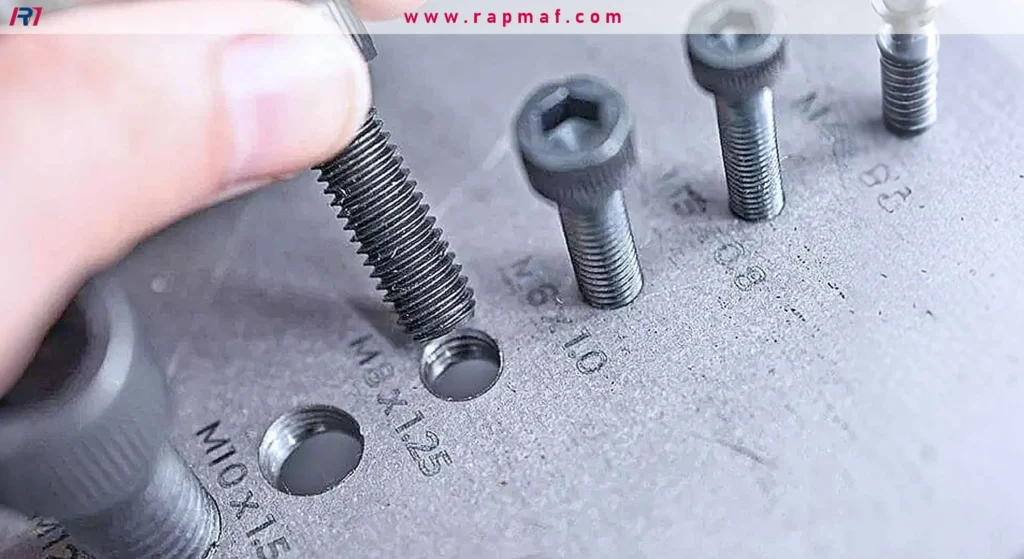
Drilling is ubiquitous. It’s used for:
- Creating clearance holes for bolts and screws.
- Making pilot holes for larger drilling operations.
- Drilling passages for fluids or wiring.
- Reducing the weight of a component.
These three processes—turning, milling, and drilling—form the foundation of the subtractive manufacturing world. They are the primary tools used to shape metal. However, they are not the only ones. What happens when you need a perfectly square hole, a mirror-like finish, or need to cut a material so hard that a normal tool can’t even scratch it? For that, we need to bring in the specialists.
We’ve met the three titans of the machine shop: turning, milling, and drilling. They are the earthmovers, the heavy lifters responsible for roughing out the primary shapes of most components. They take a solid block and give it the general form of a bracket, a shaft, or a housing. But what happens when “general form” isn’t good enough? What about the final thousandth of an inch that makes the difference between a sloppy fit and a precision bearing surface? What about shapes that no rotating tool can create? For these challenges, we have to call in the specialists.
Frank used to call this “the difference between the carpenters and the cabinetmakers.” The carpenters (turning and milling) frame the house—it’s strong, functional, and gets the shape right. But the cabinetmakers come in to create the flawless finish, the perfect joints, and the intricate details that turn a structure into a work of art. In machining, our cabinetmakers are the grinding, sawing, and broaching processes. And when we encounter a problem that even the finest craftsman can’t solve with a conventional tool, we turn to the magicians—the non-traditional processes like EDM.
When is Grinding a Better Choice than Milling or Turning?
Imagine trying to slice a piece of granite with a steel knife. The knife, being softer, would just dull and skate across the surface. This is the exact problem machinists face when working with hardened steel or when they need a surface finish so smooth it’s like a mirror. The solution is grinding.
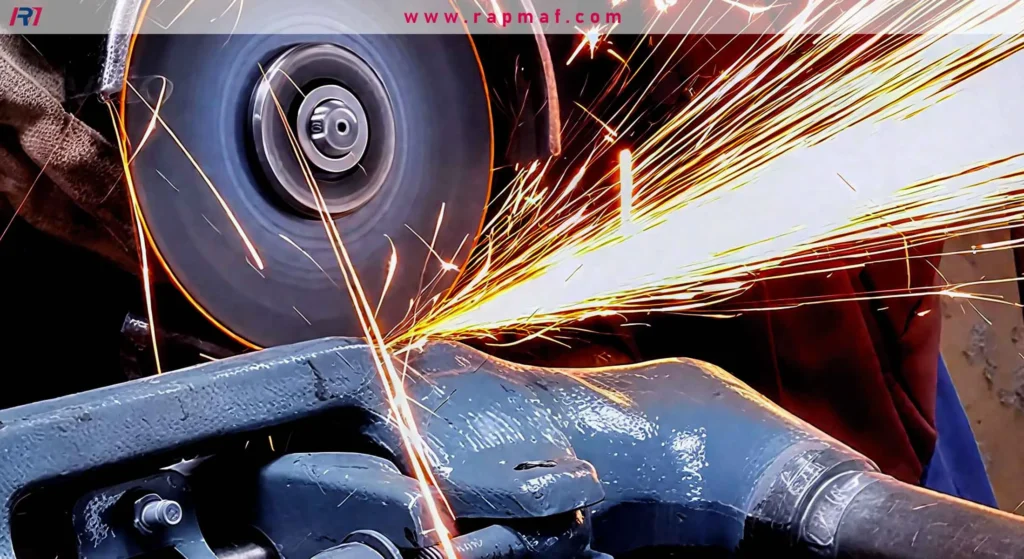
Grinding is a machining process that uses a rotating abrasive wheel to remove very small amounts of material. Think of it as a high-speed, ultra-precise version of sanding. Instead of a single cutting edge, the grinding wheel is made of millions of microscopic, super-hard abrasive grains (like aluminum oxide or cubic boron nitride). Each tiny grain acts as a microscopic cutting tool, shaving off a minuscule chip.
Why Choose Grinding?
You turn to grinding for two primary reasons:
- Working with Hard Materials: After a steel part is heat-treated to make it hard and wear-resistant (like a ball bearing or a cutting tool), it’s often too hard to be cut effectively by a traditional lathe or mill. Grinding is one of the few ways to shape these hardened materials.
- Achieving High Precision and Fine Surface Finishes: Grinding can produce parts with dimensional tolerances and surface finishes that are an order of magnitude better than milling or turning. While a good mill might hold a tolerance of +/- 0.001 inches (one-thousandth of an inch), a grinder can easily achieve +/- 0.0001 inches (one-ten-thousandth of an inch). The resulting surface is incredibly smooth and often reflective.
Grinding machines come in various forms, such as surface grinders (for creating perfectly flat surfaces), cylindrical grinders (for finishing the outside of shafts), and internal grinders (for finishing the inside of holes). It is almost always a finishing operation, performed after the bulk of the material has been removed by turning or milling. It’s the final, precise kiss that brings a part to its final dimension.
Why is Sawing Considered a Machining Process?
It might seem odd to put a simple saw in the same category as a multi-million dollar CNC mill, but sawing is a legitimate and essential machining process. Like all other machining, it uses a cutting tool (a toothed blade) to remove material in the form of chips to create a feature (a cut).
The most common industrial sawing machine is the bandsaw, which uses a long, continuous blade that moves in one direction. This is far more efficient than a reciprocating hacksaw. Industrial saws also use a constant flood of coolant to keep the blade from overheating and to flush away the chips, allowing for surprisingly fast and accurate cuts.
What is the Role of Sawing in a Machine Shop?
Sawing has one primary, indispensable job: cutting raw stock to a manageable size. Before any turning or milling can happen, that 20-foot-long bar of steel or 4-foot by 8-foot plate of aluminum needs to be cut into a blank—a piece of material that is slightly larger than the final part. The saw is the tool for this job.
While not as precise as other machining operations, a modern industrial saw can still hold tolerances of a few hundredths of an inch, which is more than good enough for creating the initial blanks. Without the saw, every machine shop in the world would grind to a halt. It’s the first operation in the life of almost every machined part.
How Do You Machine a Square Hole?
This is a classic machinist’s riddle. A drill bit, by its very nature, creates a round hole. An end mill can create a pocket with a flat bottom, but because it’s a round, rotating tool, it will always leave a radius in the corners. So, how do you get a perfectly sharp, square internal corner? The answer is a clever and powerful process called broaching.
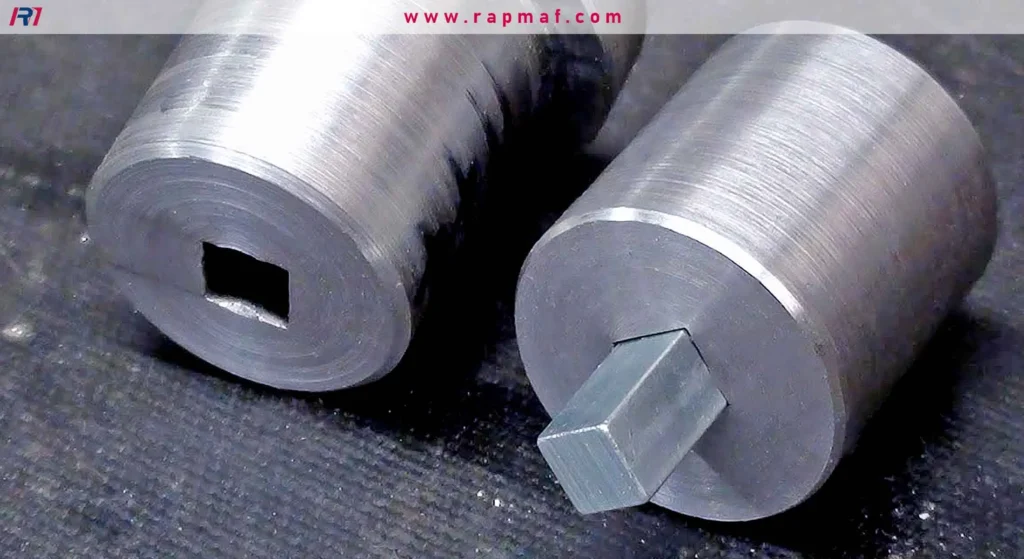
A broach is a long tool with a series of cutting teeth arranged in ascending height. As the broach is pushed or pulled through a pre-drilled round hole, each successive tooth takes a slightly deeper cut. The final teeth on the broach are the exact shape of the desired feature. The process is incredibly fast—a single pass is all it takes—and extremely repeatable.
What is Broaching Used For?
Broaching is the go-to method for creating specific, non-round internal shapes:
- Internal Keyways: A square or rectangular slot inside the bore of a gear or pulley that mates with a key on a shaft, preventing it from slipping. This is the most common use for broaching.
- Splines: A series of keyways arranged around the inside of a hole, used for high-torque applications like in automotive transmissions.
- Square, Hexagonal, or Double-D Holes: For special fasteners or tool interfaces.
The main limitation of broaching is that the tool is specific to one shape and size, making it best suited for high-volume production where the cost of the custom broach can be justified. For a one-off part, a machinist would likely use another method, like EDM.
How Can Electricity Be Used to Machine Metal?
Frank had a broken tap extractor kit that was just a collection of small metal rods and a big power supply. One day a rookie broke a hardened steel tap deep inside a priceless aluminum engine block. No drill could touch the tap, and trying to get it out would ruin the threads. Frank calmly hooked up his kit. He used a brass rod as an electrode, submerged the area in dielectric fluid, and started pulsing a high-frequency electrical current. Over the next hour, with a quiet buzzing sound, the tap simply disintegrated into dust, leaving the aluminum threads completely untouched. It was pure magic.

This magic is Electrical Discharge Machining (EDM). It’s a non-traditional machining process that removes material using a series of rapid, recurring electrical discharges (sparks) between an electrode (the tool) and the workpiece. The workpiece and electrode are submerged in a dielectric fluid, which acts as an insulator until enough voltage is applied to create a spark. Each spark creates a tiny pocket of intense heat (8,000 to 12,000°C), melting and vaporizing a microscopic particle of the workpiece, which is then flushed away by the fluid.
Why is EDM So Powerful?
EDM’s unique mechanism gives it several incredible advantages:
- It can machine any conductive material, regardless of its hardness. This is its superpower. It’s used to work on hardened tool steels, carbide, and exotic superalloys that are impossible to machine conventionally.
- It creates no cutting forces. Since the electrode never physically touches the workpiece, there is no tool pressure, allowing for the creation of extremely fragile, thin-walled features without distortion.
- It can create complex shapes. The electrode can be machined into any shape, allowing for the creation of intricate cavities and features that are impossible with rotating tools, including sharp internal corners.
There are two main types: Die Sinker EDM (which uses a formed electrode to “sink” a shape into the part, like making a mold cavity) and Wire EDM (which uses a thin, continuously spooling brass wire as the electrode to make precise 2D cuts, like a high-tech bandsaw). EDM is slower and more expensive than conventional machining, but for the right jobs, it’s not just the best option—it’s the only option.
| Process | Key Advantage | Disadvantage | Common Application |
|---|---|---|---|
| Grinding | Ultra-high precision; works on hardened materials. | Slow; removes very little material. | Bearing races, gauge blocks, final finish on shafts. |
| Sawing | Fast for cutting raw stock to length. | Low precision; rough surface finish. | Creating blanks for other operations. |
| Broaching | Very fast for creating specific internal shapes. | Tooling is expensive and single-purpose. | Keyways, splines, square holes. |
| EDM | Machines any conductive material regardless of hardness; no cutting forces. | Very slow; only works on conductive materials. | Mold making, removing broken taps, cutting carbide. |
We now have a full toolbox, from the raw power of a lathe to the surgical precision of an EDM machine. But how do you decide which tool to use? In the final section, we will build the ultimate design checklist for manufacturability. I’ll give you the five commandments for designing machined parts and explain how a simple decision on a drawing can mean the difference between a $10 part and a $1,000 part.
We’ve toured the entire workshop, from the heavy-duty lathes that hog off massive chips to the ethereal spark of the EDM machine that vaporizes metal without even touching it. We’ve seen the raw power, the precision, and the specialized magic. But a machinist doesn’t just know how to run these machines; a great machinist knows why and when to use each one. And a great engineer designs parts in a way that makes this choice easy, efficient, and cheap.
This bridge between design and production is called Design for Manufacturability (DFM). Frank had a brutal but effective way of teaching this. If a young engineer brought him a drawing with an “impossible” feature—like a perfectly sharp internal corner on a milled pocket—he wouldn’t just say no. He’d say, “Sure, I can do that. It’ll take me four hours on the EDM machine, and it’s going to cost you $800.” Then he’d pause, take out his red pen, draw a small radius in the corner, and say, “Or, you can let me use a quarter-inch end mill, I’ll be done in five minutes, and it’ll cost you $20. Your choice.” It was a lesson you only needed to learn once. The cost of a part is not determined on the shop floor; it’s determined in the design phase.
How Can You Design a Part That is Easy to Machine?
The most fundamental principle of DFM for machining is to respect the nature of the tools. The vast majority of machining is done with rotating cutters. This simple fact leads to the five commandments of designing cost-effective machined parts. Following them will make you a hero to your machinists and save your company a fortune. Ignoring them is the fastest way to design a part that is needlessly expensive or outright impossible to make.
Commandment 1: Thou Shalt Love Radii in Internal Corners
As Frank’s lesson taught us, a rotating end mill cannot create a sharp internal corner. It will always leave a radius equal to the radius of the tool. Demanding a sharp corner (a “zero radius”) forces a secondary, much more expensive process like EDM.
- Good Design: Generously radius all internal vertical corners. A good rule of thumb is to make the radius at least 1/8″ (3mm) or larger. Even better, specify the radius as “Max R0.125,” which gives the machinist the flexibility to use any tool up to a quarter-inch diameter.
- Bad Design: Calling out a sharp corner with
R0or a very small radius that requires a tiny, fragile, and expensive end mill.
Commandment 2: Thou Shalt Keep Hole Depths Reasonable
Drilling a deep, small-diameter hole is one of the most challenging operations in a machine shop. The deeper the hole, the harder it is for the chips to escape and for coolant to reach the cutting edge. The drill bit can get clogged, overheat, and break off deep inside the part—a catastrophic failure.
- Good Design: Avoid holes with a depth-to-diameter ratio greater than 4:1 whenever possible. If you must have a deep hole, be prepared for the cost to increase significantly as the machinist will need to use special “peck drilling” cycles (drilling a little, retracting to clear chips, and repeating), which takes much more time.
- Bad Design: Specifying a 1/8″ diameter hole that is 2 inches deep in a piece of stainless steel without a very, very good reason.
Command-to-wall thickness ratio. This can lead to vibration (“chatter”) during machining, which results in a poor surface finish and can even break the cutting tool.
- Good Design: Maintain thick, sturdy walls. If you are machining a housing or pocket, ensure the walls are at least 1/16″ (1.5mm) thick for aluminum and 1/32″ (0.8mm) for steel, and much thicker if possible.
- Bad Design: Designing a part with long, unsupported walls that are as thin as paper.
Commandment 4: Thou Shalt Minimize the Number of Setups
Every time the machinist has to unclamp the part, rotate it, and re-clamp it in a new orientation to access different features, it costs time and introduces potential for error. This is called a “setup.” A part that can be machined completely from one side (a single setup) is always cheaper than a part that needs to be flipped over five times.
- Good Design: Try to design features to be on the same plane or accessible from the same direction. If features must be on opposite sides, ensure there are good parallel surfaces for the machinist to clamp onto for the second setup.
- Bad Design: A cube with a complex, precision feature on all six faces, requiring six separate setups and meticulous re-alignment each time.
Commandment 5: Thou Shalt Standardize
Machinists have standard tool sizes (drills, end mills, taps) readily available. Designing a part that requires a non-standard tool is like asking a carpenter to build a house with screws that require a special, custom-made screwdriver. It’s possible, but it’s slow and expensive.
- Good Design: Use standard hole sizes that correspond to common drill bits. Use standard thread sizes like 1/4″-20 or M6. Make your corner radii match common end mill sizes (e.g., a 0.25″ radius for a 0.5″ end mill).
- Bad Design: Specifying a 0.317-inch diameter hole or a 7/16″-18 thread. The machinist will have to order a special tool, adding cost and lead time to the job.
How Do You Choose the Right Machining Process?
Now that we have our DFM commandments, how do we connect a design to the correct process? It’s a logic tree that often comes down to four key questions: Material, Precision, Geometry, and Quantity.
Case Study: The Simple Bracket
Let’s imagine we need to make a simple L-shaped bracket from a block of aluminum. It has two through-holes and one threaded hole.
- Material? Aluminum. It’s soft and easy to cut. All conventional processes (sawing, milling, drilling, tapping) are on the table.
- Precision? Standard tolerances of +/- 0.005″. No problem for a standard CNC mill. No grinding required.
- Geometry? A simple prismatic shape with holes. This is the bread and butter of milling and drilling. No complex curves or internal corners that would require EDM or broaching.
- Quantity? We need 500 pieces.
The Manufacturing Plan:
- Sawing: Cut 500 blanks from a long bar of aluminum stock.
- Milling (Setup 1): Clamp the blank in a vise. Use a large face mill to machine the top surface flat. Use an end mill to machine the outside profile of the “L” shape.
- Drilling: Use a drill bit to create the two through-holes and the pilot hole for the thread.
- Tapping: Use a tap to cut the threads in the third hole.
- Milling (Setup 2): Flip the part over, face the other side to final thickness.
- Deburring: Tumble the parts to remove any sharp edges.
This is a straightforward, cost-effective plan that relies on the “big three” processes.
Case Study: The Hardened Steel Mold Cavity
Now, let’s design a cavity for an injection mold. It will be used to make millions of plastic parts.
- Material? A2 Tool Steel, heat-treated to 60 HRC. This material is incredibly hard and wear-resistant. Conventional milling and drilling are now off the table for the finishing operations.
- Precision? Extremely high. Tolerances of +/- 0.0002″ and a mirror-like surface finish are required to ensure the plastic parts release cleanly.
- Geometry? A complex, organic shape with several small, sharp internal corners.
- Quantity? Just one.
The Manufacturing Plan:
- Sawing: Cut one blank from a block of annealed (soft) A2 tool steel.
- Milling: While the steel is still soft, use a CNC mill to machine the general shape of the cavity, leaving about 0.010″ of extra material on all critical surfaces. This is called “roughing.”
- Heat Treatment: Send the roughed-out block to a heat-treat facility to be hardened to 60 HRC.
- Grinding: Use a surface grinder to bring the outside faces of the block to their final, precise dimensions.
- EDM: This is the key step. Create a graphite or copper electrode that is the exact inverse shape of the final cavity. Use a die-sinker EDM machine to slowly and precisely burn the final shape into the hardened steel block, creating the sharp corners and fine details that milling could not.
- Polishing: Hand-polish the cavity to achieve the required mirror finish.
Here, the process is dictated by the material’s hardness and the geometry’s complexity, forcing us to use the specialist processes of grinding and EDM. The cost of this single part will be thousands of dollars, justified by its role in producing millions of cheap plastic parts.
Conclusion: A Symphony of Subtraction
The world of machining is a symphony of subtraction. Each of the nine processes we’ve explored is an instrument with a unique voice and a specific role to play. The raw power of turning and milling are the percussion and bass, laying down the foundational rhythm of the part. Drilling adds the crisp, precise notes. The finishing processes—grinding, sawing, and broaching—are the woodwinds and strings, adding the refined melodies and harmonies that bring the piece to life. And the non-traditional methods, like EDM, are the soloists, capable of performing breathtaking feats that no other instrument can touch.
A designer who understands these instruments can compose a part that is elegant, efficient, and cost-effective. A designer who doesn’t is like a composer writing a trumpet solo that goes lower than the instrument can play—the result is frustrating, expensive, and ultimately, a failure. By embracing the principles of DFM and respecting the capabilities of each process, you are not just designing a part; you are composing a blueprint for success, ensuring that your vision can be brought to life beautifully and affordably by the skilled musicians of the machine shop.
Frequently Asked Questions (FAQs)
What is the most common type of machining?
By far, the three most common types of machining are turning, milling, and drilling. These three processes form the foundation of modern manufacturing and are responsible for producing the vast majority of features on machined parts.
What’s the difference between machining and manufacturing?
Manufacturing is the broad term for converting raw materials into finished goods. This can include processes like casting, molding, forging, and assembly. Machining is a specific subset of manufacturing. It is a subtractive process that uses cutting tools to remove material and shape a part, typically one made of metal or plastic.
Is 3D printing a type of machining?
No, 3D printing is the opposite of machining. Machining is a subtractive process (you start with a block and remove material), while 3D printing is an additive process (you start with nothing and add material layer by layer). They are two fundamentally different approaches to manufacturing.
Why is it called “CNC” machining?
CNC stands for Computer Numerical Control. Early manual machines required a skilled operator to turn cranks and pull levers to control the tool’s position. In CNC machining, the tool’s movements are controlled by a computer program (typically G-code), allowing for incredible precision, repeatability, and the creation of complex shapes that would be impossible by hand.
Which machining process is the most expensive?
Generally, the non-traditional processes are the most expensive per hour. EDM is often considered one of the most expensive due to its slow material removal rate and the cost of the machines and consumables (electrodes and dielectric fluid). However, for the specific tasks it performs (like machining hardened materials), it is often the most cost-effective solution overall. The true cost of any operation depends on the part’s geometry, material, and quantity.
References
- Degarmo, E. P., Black, J. T., & Kohser, R. A. (2017). DeGarmo’s Materials and Processes in Manufacturing. Wiley.
- Groover, M. P. (2012). Fundamentals of Modern Manufacturing: Materials, Processes, and Systems. John Wiley & Sons.
- Machinery’s Handbook. (2020). 31st Edition. Industrial Press Inc.
- Smid, P. (2008). CNC Programming Handbook. Industrial Press Inc.
Disclaimer
The information on this page is for informational purposes only. RM makes no representations or warranties, express or implied, as to the accuracy or completeness of this information. For any third-party services procured through the RM network, it is the buyer’s responsibility to specify and confirm performance parameters, tolerances, materials, and workmanship during the quotation process. For more detailed information, please do not hesitate to contact us.
RM: Your Precision Manufacturing Partner
RM is an industry leader in custom manufacturing solutions. With over 20 years of profound experience, we have become the trusted partner for more than 5,000 clients worldwide. We specialize in a comprehensive range of manufacturing services—including high-precision CNC machining, sheet metal fabrication, 3D printing, injection molding, and metal stamping—to provide you with a true one-stop-shop experience.
Our world-class facility is equipped with over 100 state-of-the-art 5-axis machining centers and operates in strict compliance with the ISO 9001:2015 quality management system. We are dedicated to providing solutions that blend speed, efficiency, and exceptional quality to customers in over 150 countries. From rapid prototyping to large-scale production, we promise delivery in as fast as 24 hours, helping you gain a competitive edge in the market. Choosing RM means selecting an efficient, reliable, and professional manufacturing ally.
Explore our capabilities today by visiting our website: www.rapmaf.com







2 Responses